
Short answer
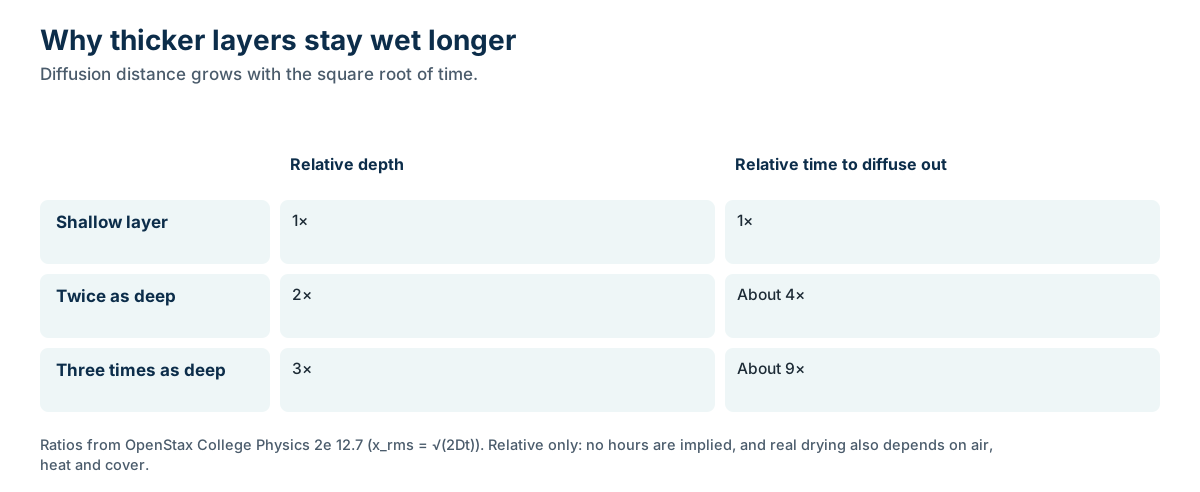
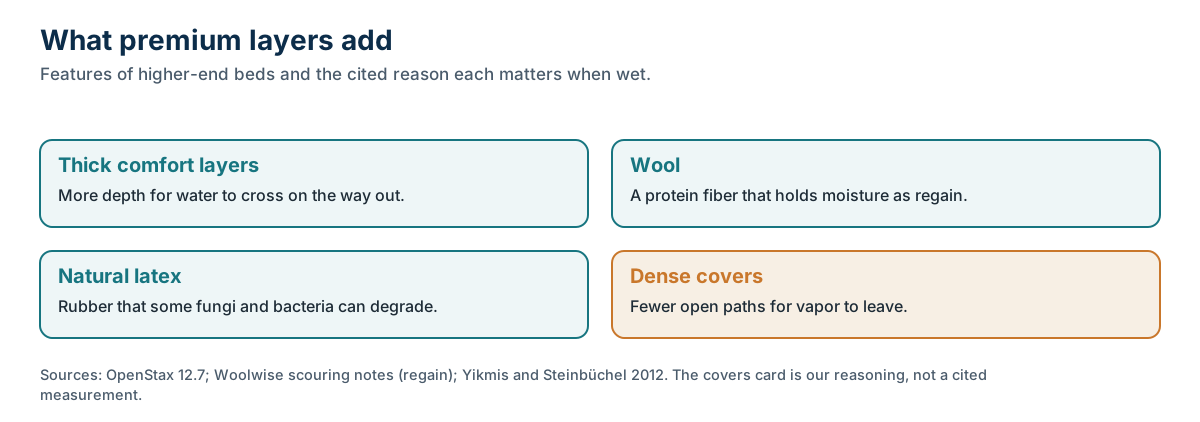
Because the features that make a bed plush also slow drying. Diffusion time grows with the square of distance, so water twice as deep takes roughly four times as long to work its way out. Wool holds moisture in the fiber, natural latex is a material some fungi can grow on, and dense covers leave fewer paths for vapor. WHO says microbes grow indoors when sufficient moisture is available.
Key terms used on this page
- Diffusion distance:
- The average distance a molecule wanders by random motion, x = √(2Dt). Because it grows with the square root of time, covering twice the distance takes about four times as long.
- Wool regain:
- Wool's moisture content, expressed as the weight of moisture divided by the dry weight of the wool, times 100. Woolwise uses it to describe how much liquor a squeeze roller leaves in scoured wool.
- Microbial rubber degradation:
- Breakdown of natural or synthetic rubber by microbes. A 2012 review describes rubber-degrading bacteria and fungi, including strains of Aspergillus reported to degrade vulcanized rubber.
- Natural rubber latex:
- The milky material from the rubber tree Hevea brasiliensis. A 2026 review says fresh latex is about 60% water, 35% polyisoprene and 5% proteins and lipids.
- Dampness indicators:
- The signs WHO uses to recognize problem moisture indoors: condensation on surfaces, visible mold, a perceived moldy odor and a history of water damage, leakage or penetration.
- Comfort layer:
- The foam, latex or fiber layer between the quilting and the support core. Urine that reaches it is harder to treat than urine that stayed in the cover.
Premium mattresses can mold after a soak because the features that make them plush also slow drying. Diffusion time grows with the square of distance, so water twice as deep takes roughly four times as long to work its way out. Wool holds moisture in the fiber, natural latex is a material some fungi can grow on, and dense covers leave fewer paths for vapor. WHO says microbes grow indoors when sufficient moisture is available.
General information about mattress cleaning methods, not medical advice. For health questions, ask a doctor.
Isn't this covered elsewhere?
The basics are. Hub 5 explains whether mattress moisture can lead to mildew or mold and why foam mattresses are slow to dry, and we don't repeat those. This article asks a narrower question: why the thickest, most expensive beds can be the slowest to recover from the wet methods described in this hub, and what about their construction causes that.
What does WHO say about moisture and microbes?
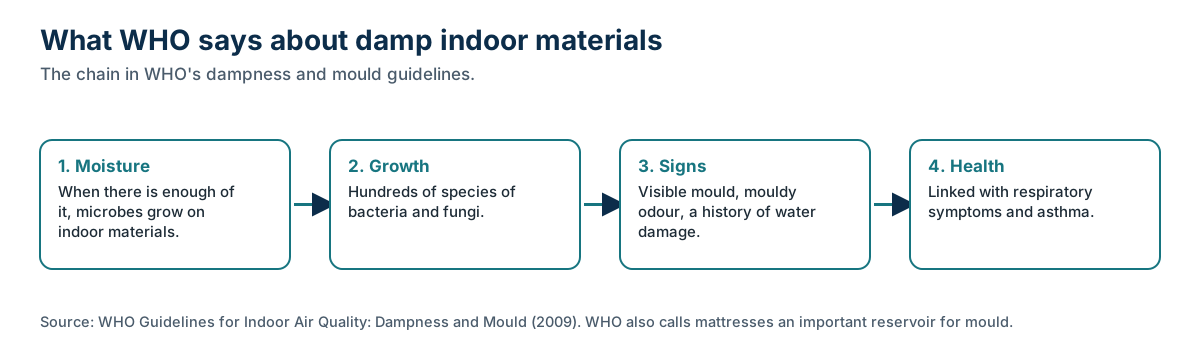
That moisture comes first. WHO's dampness and mould guidelines open with the statement that "When sufficient moisture is available, hundreds of species of bacteria and fungi – particularly mould – pollute indoor air." They conclude that "The most important effects of exposure to these pollutants are the increased prevalence of respiratory symptoms, allergies and asthma, as well as disturbance of the immune system."
WHO also names mattresses specifically: "Mattresses constitute an important reservoir for mould." Its central recommendation is prevention: "Preventing (or minimizing) persistent dampness and microbial growth on interior surfaces and building structures is the most important means of avoiding harmful effects on health." The EPA's mold guide puts it in one line: "The key to mold control is moisture control."
Why does a thick bed hold water longer?
Because of how diffusion scales. Once free water has drained and suction has done what it can, the remaining moisture leaves mostly by evaporating and diffusing out as vapor. OpenStax's section on diffusion explains that the average distance a molecule travels "is proportional to the square root of time."
Turn that around and the time grows with the square of the distance. If water sits twice as deep, it takes roughly four times as long to diffuse out; three times as deep, roughly nine times. Real drying also depends on air movement, temperature and the cover, so these are ratios, not hours. But the ratio explains why depth matters out of proportion to its size, and depth is part of what makes a plush bed plush. A pillow-top or euro-top adds yet another layer above the core, and Hub 2 lists how those constructions respond to cleaning in its compatibility guide. Every added inch is paid for in drying time, squared.
Why do thick comfort layers make it worse?
They put more material between the water and the air. Water pushed into a mattress spreads sideways and sinks, as where water goes explains, and suction can't retrieve all of it, as the suction article explains. In a thin bed, leftover water sits close to a surface. In a bed with several inches of comfort foam over a core, it can sit far below the ticking, where the square law works against it.
What does wool add?
Moisture held inside the fiber. Woolwise course notes on aqueous scouring define the measure: "The regain is the term for the moisture content of wool and it is always shown as a percentage," calculated as the weight of moisture divided by the dry weight of the wool. In the scouring industry, squeeze rollers matter because lowering the regain of wool entering the dryer reduces the dryer's energy use.
That's the point for mattresses, too. Wool that soaked up water carries it in the fiber as well as between fibers, and it gives it up gradually. Hub 8 explains the fiber in wool in mattresses, and Hub 2 covers wool cleaning compatibility. This hub's hot water article explains what heat plus detergent does to wool.
What about natural latex?
It's a natural polymer that some microbes can use. A review by Yikmis and Steinbüchel in Applied and Environmental Microbiology describes bacteria and fungi that degrade natural rubber, and reports early work in which strains of Penicillium and Aspergillus, both common molds, were grown "in liquid medium containing NR," the review's abbreviation for natural rubber. That work found weight losses in the rubber "after incubation periods lasting from 19 months to 5 years."
So latex doesn't rot after one wetting, and we don't claim it does. What the review shows is that natural rubber isn't inert to microbes the way glass is. Combined with moisture that's slow to leave, that's a reason for care. Hub 8 explains the latex types in Dunlop vs Talalay latex.
Do dense covers matter?
We think so, though we found no measurement. Many mattress covers are quilted panels, and many beds add a fire barrier fabric beneath the ticking. Every layer between the wet core and the room is another obstacle for vapor leaving. That's our reasoning from the diffusion physics, not a cited finding, so we list it under what we don't know. Hub 8 describes ticking and cover fabrics.
What about memory foam specifically?
Hub 1 covers it in what happens when water penetrates memory foam, and Hub 5 in what happens when memory foam gets wet. The Polyurethane Foam Association describes memory foam as "a type of open cell, flexible polyurethane foam" in its viscoelastic bulletin, which is why water can move into it at all. We don't repeat the material details here.
What should you watch for?
A smell that returns. WHO's guidelines treat a moldy odor, visible mold and a history of water damage as dampness indicators. In a mattress, odor is often the first sign, as why a wet-cleaned mattress can smell worse later explains, and signs your mattress was overwetted lists the rest. If you see mold or have health symptoms, see a doctor for the symptoms and consider whether the mattress should be replaced.
Sleep Sanitation's view
This section is our view. Thick, plush beds get our most cautious handling, since depth and natural fibers punish any water left behind. We set steam output and pass speed for what the bed contains, wool and latex included, and work only through the cover. That's a practice we arrived at ourselves, not one any manufacturer has exempted, which is why your care label and warranty wording govern; look over your warranty terms before you book. We make no disinfection claim and no mold-removal claim, and our sanitizing language follows the CDC. Expect a moisture check before we leave. Our process page has the sequence; the hub on mattress cleaning done wrong has the background.
What we don't know
- How often mold follows wet cleaning in thick mattresses. We found no study comparing outcomes by mattress type or method.
- How much dense quilted covers slow vapor leaving a mattress. We found no published measurement on mattress covers.
- How quickly mold can establish inside common mattress materials after a soak. The latex studies we cite ran for months to years in liquid culture, not in mattresses.
Changelog
- 6 October 2026: First published. Sources accessed on this date.
Sources
- College Physics 2e, 12.7 Molecular Transport Phenomena: Diffusion, Osmosis, and Related Processes · OpenStax (Rice University)
- Aqueous Scouring and Detergents (Wool 482/582 lecture notes) · Australian Wool Education Trust / University of New England (Woolwise)
- Historical and Recent Achievements in the Field of Microbial Degradation of Natural and Synthetic Rubber (Yikmis and Steinbüchel, Appl Environ Microbiol, 2012) · PubMed Central
- WHO Guidelines for Indoor Air Quality: Dampness and Mould (2009) · World Health Organization
- A brief guide to mold, moisture and your home · US EPA
- IN-TOUCH Vol. 11 No. 1: Viscoelastic (memory) foam (revised 2016) · Polyurethane Foam Association
Last reviewed October 6, 2026. Manufacturer specifications and care instructions change; check the current version for your exact model. This page is general information, not medical advice. How we source and check pages: editorial standards.