
Short answer
It can, if water stays long enough. EPA says no mold will grow without water or moisture and advises drying water-damaged items within 24-48 hours, guidance for leaks and floods, not a mattress test. One bed bug study's small steamed arenas of mattress material showed no mold after 30 days; it didn't test dry vapor or a full mattress.
Key terms used on this page
- Water-damage drying guidance:
- EPA's advice for materials soaked by leaks and floods. EPA says to dry water-damaged areas and items within 24-48 hours to prevent mold growth, and its Table 1 says upholstered furniture may be difficult to completely dry within 48 hours.
- Mattress saturation:
- Water filling the open cells of a foam or fiber layer below the cover, rather than sitting at the surface. Casper's care page warns that the foam in the mattress core will soak up water and detergent; saturation is that outcome.
- Surface moisture:
- Water held in the cover fabric and the top of the comfort layer, close enough to the air to evaporate quickly. It is the moisture a low-moisture method aims to leave, as opposed to water that has travelled down into the core.
- Steam tip distance:
- The gap between the steam nozzle and the surface. A bed bug manual reprinting an Armed Forces Pest Management Board guide puts it at about 2.5 to 3.8 cm and warns that a tip held too close may inject excess moisture.
- Open-cell foam:
- Foam whose cells connect, so air can move through it. The PFA primer says foam performance is optimized when air flow is maximized, which indicates the cells are open. The same open structure that lets air through also lets liquid water in.
Moisture and mold go together, and a mattress is a soft, porous object that people sweat on, spill on and sometimes clean with water. So it's a fair worry. The evidence we found is clear on the general rule and thin on mattresses specifically. EPA explains the rule. One steam study checked for mold on mattress material afterwards. Nobody has studied mold in professionally cleaned mattresses.
This article is general information about cleaning and materials, not medical advice. If you have health concerns about mold, EPA's advice is to consult a health professional.
The rule: no water, no mold
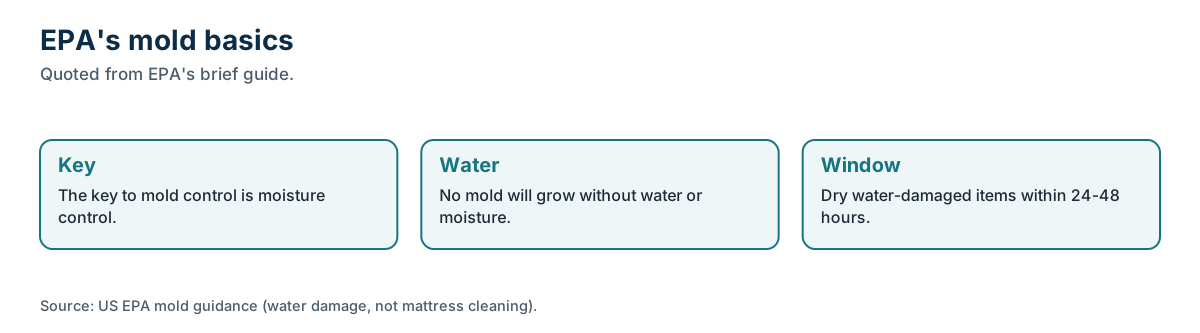
EPA's brief guide to mold starts here: "The key to mold control is moisture control." It explains why: "There are many types of mold, and none of them will grow without water or moisture." And it describes how growth begins: "Molds are usually not a problem indoors, unless mold spores land on a wet or damp spot and begin growing."
EPA says mold spores "float through outdoor and indoor air." What decides whether they grow on a mattress is whether part of it stays wet or damp.
EPA's 24-48 hour guidance, and what it covers
EPA says: "It is important to dry water-damaged areas and items within 24-48 hours to prevent mold growth." In its prevention tips: "If wet or damp materials or areas are dried 24-48 hours after a leak or spill happens, in most cases mold will not grow."
That's EPA's guidance for water damage, meaning leaks, floods and spills. EPA doesn't test mattresses, and it doesn't describe a cleaning visit. Hub 3 defines this as the mold drying window. We quote it as EPA's guidance and don't present it as our drying time.
EPA's water-damage table adds a line for upholstered furniture: "May be difficult to completely dry within 48 hours." A mattress soaked by a large spill or accident is in the same position: padded, porous and slow to dry. Why foam mattresses are slow to dry explains why.
Porous materials are hard to rescue
EPA is direct about what happens once mold takes hold in porous materials: "Absorbent or porous materials, such as ceiling tiles and carpet, may have to be thrown away if they become moldy. Mold can grow on or fill in the empty spaces and crevices of porous materials, so the mold may be difficult or impossible to remove completely."
A mattress is porous. Its foam is open-celled, its fiber batting is loose, and its cover is fabric. That's why prevention matters more than cleanup here. We don't offer mold remediation, and if you find mold in a mattress, EPA's guidance is the place to start.
What one steam study found after 30 days
The only study we found that checked steamed mattress material for mold was by Puckett, McDonald and Gold, published in 2013. It was a bed bug study. Small arenas of Sealy mattress material on a wooden base, five replicates per treatment, were steamed with a J-4000DM Jiffy steamer at three pass speeds and weighed. Average weight gain at five minutes was 0.92 to 1.44 grams. The arenas were then stored "in an exposed air-conditioned environment (simulating a home) for a period of 30 days," and "no mold was found on any arenas".
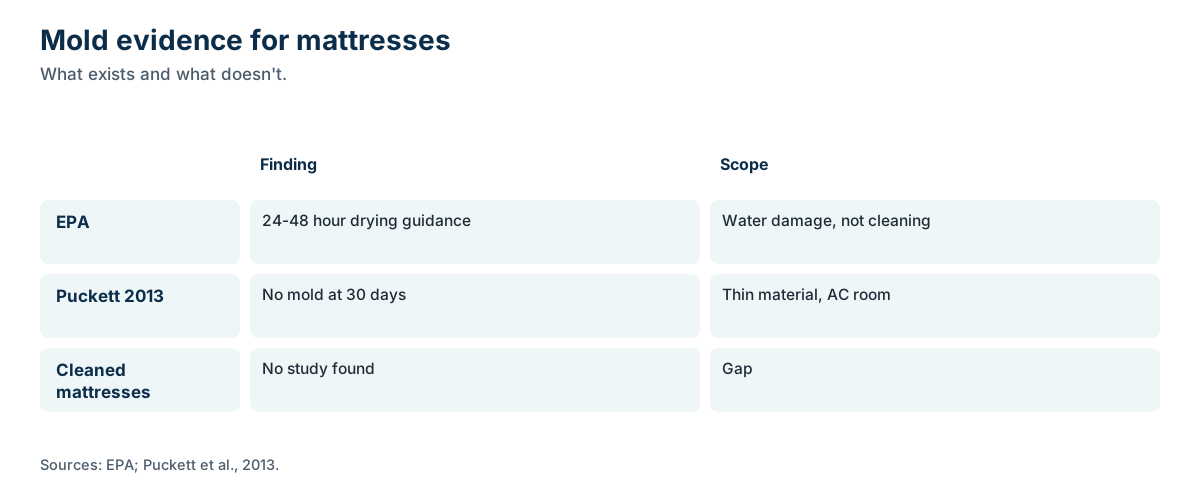
That's a useful result within its scope: thin mattress material, a moving steamer, air-conditioned storage, uncovered. It doesn't tell us about thick foam, a made-up bed, a humid room or a different machine.
When steam can add mold risk
Steam can add water if it's used badly. A bed bug manual reprinting an Armed Forces Pest Management Board guide warns that "If the tip is too close, excess moisture may be injected into the treated material, which may lead to other problems (e.g., facilitating dust mite population survival and increase; growth of surface molds)." Cornell IPM's draft steam guidance, also written for bed bugs, says that when treating a mattress or box spring, "consider using an encasement only after it has dried to avoid the development of mold."
Both points are about technique and timing. Keep the tip at a sensible distance, keep it moving, and let the surface dry before you seal it in.
Smell can be the first sign
You can't see inside a mattress, so a musty smell may be the first hint that water stayed too long. EPA makes the same point about buildings: "You may suspect hidden mold if a building smells moldy, but you cannot see the source, or if you know there has been water damage". A mattress that smelled fine before a spill and smells musty a few days later deserves attention. It doesn't prove mold, since other odors can build up in a damp bed, but it is a reason to check how wet the inside is. How to tell if moisture reached a mattress core covers the checks, and Hub 3's why urine odor comes back after a mattress dries covers a different source of smell.
The room matters too
Damp air slows drying. EPA advises: "If possible, keep indoor humidity below 60 percent (ideally between 30 and 50 percent) relative humidity." Hub 4 defines relative humidity in the dust mite context. Tempur's UK care page makes a related point about beds: "TEMPUR ® mattresses must always be placed on a ventilated bed base e.g. with springs or slats, or a platform topped unit on castors, legs or feet to allow air to circulate freely, preventing moisture from accumulating." The same page is strict about cleaning: "There is a high risk that soaking with water or other cleaning fluids will cause irreversible damage, destroying the benefits of comfort and support which the TEMPUR ® Material provides. It will also invalidate your guarantee. Do not steam-clean or dry-clean the TEMPUR ® Material."
After a visit
Our side of this is simple: keep water low so there's little to dry. A visit opens with a materials inspection that sets steam temperature and pass speed. Dry vapor covers the surface, then the seams, tufts, ridges and edges where dust and shed skin flakes collect. We use Italian-made Vapor Clean machines, the Magnum XP with its built-in vac, the ProV 350 and the Pro6 Duo. Organic cleaning methods are our default.
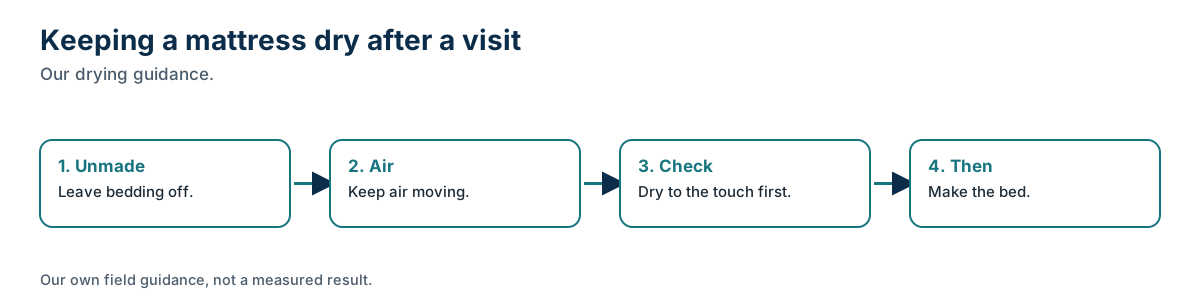
Before we go, we give drying guidance: leave the bed unmade, keep air moving, and wait until the surface is dry to the touch. Our dry-vapor method is our own choice and reasoning, not a manufacturer exemption; the care label and warranty terms on your bed govern your decision, so check your warranty before booking. The standard pricing covers this, with severe or biohazard contamination quoted as a custom surcharge before we start. On terms, Hub 2 explains the CDC's cleaning and sanitizing terms; we make no disinfection claim, and none about mold.
Where to read next
The moisture and heat guide puts mold beside the foam and drying evidence, and this hub lists every article. For how to judge whether water went deep, read how to tell if moisture reached a mattress core. For the drying side, see how quickly a treated mattress should dry.
What we don't know
- How quickly mold can grow in a damp mattress. We found no study on mattresses.
- Whether the Puckett no-mold result would hold for thick foam, a covered bed or a humid room.
- How much moisture a mattress can hold without mold risk. EPA gives a drying window, not a moisture threshold.
- Whether fiber batting, foam and latex differ in how readily mold takes hold once damp. EPA groups porous materials together, and we found no mattress-specific comparison.
Changelog
- 3 October 2026: First published. Sources accessed on this date.
Sources
- A brief guide to mold, moisture and your home · US EPA
- Mold Remediation in Schools and Commercial Buildings, Table 1: Water Damage, Cleanup and Mold Prevention · US EPA
- Comparison of multiple steam treatment durations for control of bed bugs (Puckett, McDonald and Gold, Pest Manag Sci, 2013) · Texas A&M Urban Entomology (author copy)
- Bed Bug IPM manual, including Armed Forces Pest Management Board Technical Guide 44 (University of Florida, 2008) · University of Tennessee (hosted copy)
- 6. Using Steam to Eliminate Bed Bugs (draft help article, accessed 2026-10-03) · Cornell IPM Help Center
- Caring for your TEMPUR (UK, updated 11 July 2023, accessed 2026-10-02) · Tempur UK
- Thermal conductivity of common materials · Engineering ToolBox
- Magnum XP-Vac product page (maker's claims, accessed 2026-10-02) · Vapor Clean
- ProV 350 product page ('Italian Made'; maker's claims, accessed 2026-10-02) · Vapor Clean
- Pro6 Duo product page ('Made in Italy'; maker's claims, accessed 2026-10-02) · Vapor Clean
- Cleaning and disinfecting your school (definitions) · CDC
Last reviewed October 3, 2026. Manufacturer specifications and care instructions change; check the current version for your exact model. This page is general information, not medical advice. How we source and check pages: editorial standards.