
Short answer
It stays where the water left it. As cleaning solution evaporates, the detergent doesn't; it concentrates in the ticking, quilting and foam. A 1977 carpet patent describes alkaline residue that left fiber at the detergent's own pH and attracted soil, so carpet resoiled faster. Carpet can be rinsed through and extracted again. A mattress can't, so residue in a bed tends to stay longer.
Key terms used on this page
- Alkaline cleaning residue:
- Detergent left in fibers after cleaning with a high-pH solution. A 1977 carpet patent says the cleaned fiber reads as alkaline as the detergent used, and that the residue stays a long time.
- Resoiling:
- Fabric getting dirty again faster after cleaning than before. The Carpet and Rug Institute links it to cleaning solution used at higher concentration than recommended, which leaves excess residue in the pile.
- Detergent residue:
- Cleaning chemistry left behind in the fabric after cleaning. The Carpet and Rug Institute says residue from over-concentrated solution contributes to rapid re-soiling, which is why extraction cleaners are told to rinse.
- Capillary imbibition:
- Uptake of a liquid into a dry porous solid driven by capillary pressure alone. Zhao and colleagues studied it in open-cell polymer foams and found that how well the liquid wets the cell walls largely controls it.
- pH:
- A scale for how acidic or alkaline a solution is. Wool is damaged by too much alkali, while cotton's cellulose is broken down by strong acid, so a cleaner's pH matters as much as its strength.
- IICRC S300:
- The ANSI/IICRC procedural standard for professional upholstery cleaning, covering fibers, equipment, methods and inspections. It addresses upholstery; we found no equivalent consensus standard written for mattresses.
Detergent residue left in a mattress stays where the water left it. As cleaning solution evaporates, the detergent doesn't; it concentrates in the ticking, quilting and foam. A 1977 carpet patent describes alkaline residue that left fiber at the detergent's own pH and attracted soil, so carpet resoiled faster. Carpet can be rinsed through and extracted again. A mattress can't, so residue in a bed tends to stay longer.
General information about mattress cleaning methods, not medical advice.
Doesn't Hub 1 cover detergent already?
It covers whether a mattress needs it. Hub 1's article does professional mattress cleaning need detergent answers that question, and its glossary defines detergent residue. This article picks up where those leave off: what physically happens to detergent that stays in a mattress after a wet clean, and why the carpet trade's fix for residue doesn't transfer.
How does residue form?
By evaporation. Detergent dissolves in the cleaning water, and water is the only part that leaves as vapor. Whatever solution suction doesn't recover, and the suction article explains why some always stays, dries in place. The water goes; the detergent concentrates where the last of the water sat.
That's often not where the spray landed. Water spreads sideways and sinks, as where water goes explains, and as the surface dries, capillary action pulls water upward toward the evaporating face. Dissolved material rides along and is left at the surface or at the edge of the wet zone, which is the same mechanism Hub 7 describes in why stains come back after drying.
What did carpet cleaners find about residue?
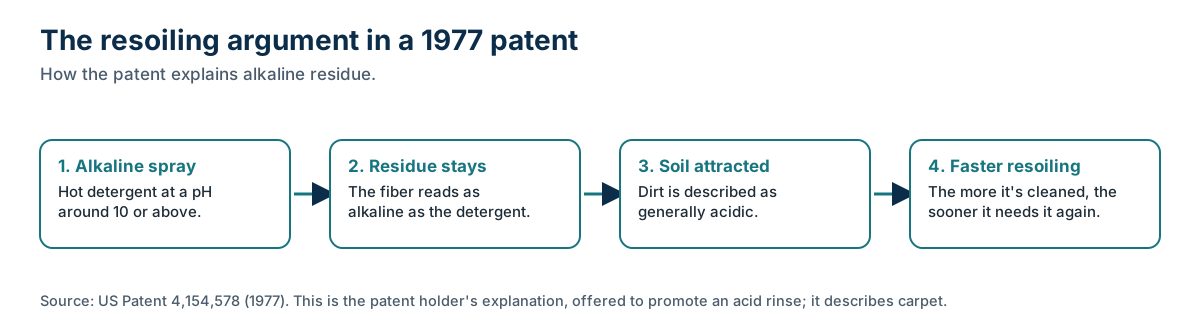
That it brought soil back faster. A 1977 carpet patent describes the steam cleaning of its day as spraying "a dilute, hot detergent solution having a pH registering in the area of 10 or above," and then names the problem: "the strong alkaline residue left on the carpets after cleaning."
It goes on: "Upon checking the alkalinity of the carpet fiber immediately following such a cleaning, it is found that the carpet registers a pH just as high as the alkaline detergent used in the method. Such high alkalinity remains with the carpet fiber for a long time and greatly accelerates and increases the rate of resoiling." Its explanation is that "dirt is generally acidic in character and will therefore be attracted to the alkaline residue."
This is the patent holder's argument, offered to promote the acid rinse the invention adds, and we treat it as a claim. Its conclusion is striking anyway: "the more an individual carpet is cleaned using such a method, the sooner the carpet will have to be cleaned again." That's a description of a method, not of any business, and it's in the trade's own record.
What does the carpet standard say?
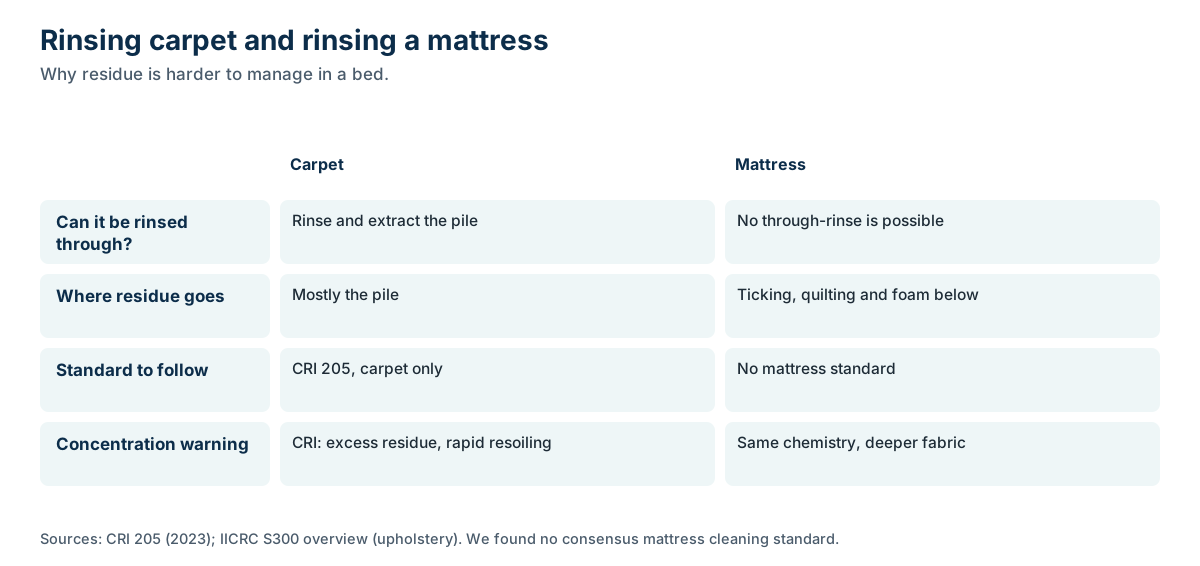
Something similar, in plainer words. CRI's residential carpet standard warns against making solution stronger than directed: "Using higher concentration of cleaning solution than recommended may cause excess residues left in the carpet. This will contribute to rapid resoiling." It adds that "If an in-tank cleaning solution is used in the equipment, cleaning should be followed up with a clear water rinse."
That rinse is the carpet trade's answer to residue. It works on carpet because carpet can take a second pass of water and give most of it back, thanks to the backing and floor below. Hub 9's carpet gear article explains why a mattress has neither.
Why can't a mattress be rinsed the same way?
Because rinsing means more water. A clear-water rinse on a mattress pushes a second volume of liquid through the ticking into a thick, undrained stack, the exact situation that left residue there in the first place. Each rinse dilutes what's present and adds water that suction can only partly recover. The fix for residue recreates the conditions for residue, plus more moisture.
Ticking adds its own complication. Many covers are quilted to a layer of fiber or foam, so solution that dries in the fabric also dries in the batting stitched beneath it. Rubbing or blotting the surface afterward reaches only the top of that sandwich. Residue lower down stays out of reach until the next liquid arrives, dissolves it again and carries it somewhere new.
There's no consensus standard to follow here, either. The IICRC publishes S300 for upholstery, and CRI publishes carpet standards, but we found no equivalent for mattresses. The carpet add-on article explains how mattresses ended up borrowing carpet methods without a standard of their own.
Does residue change how water behaves later?
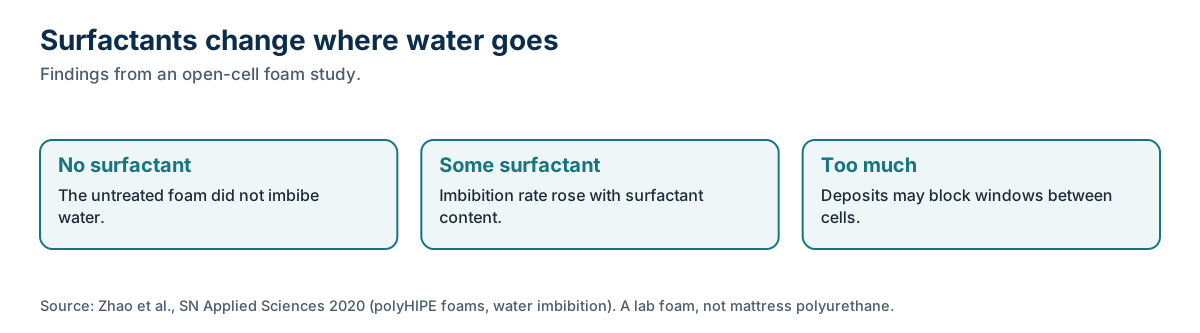
It can, by our reading of a foam study. Zhao and colleagues studied water uptake in open-cell polymer foams (SN Applied Sciences, 2020). "The sample with no added emulsifier did not imbibe water," they report, while surfactant-treated foams did, and "The imbibition rate was found to increase with the surfactant content up to around 25 wt%." At higher levels, "deposits may block windows within the foam."
Their foam was a lab material, not mattress polyurethane, so we offer this as a mechanism, not a measured effect in beds. The point is that surfactants change wetting. Detergent left on foam and fiber may make them easier to wet the next time a drink spills or a child has an accident. Hub 3 explains why urine odor comes back after a mattress dries, which is worse when liquid travels further.
What about wool?
Alkaline residue matters more on protein fiber. Woolwise course notes on aqueous scouring explain that alkali can turn grease into soap, "but too much alkali can damage wool." Hub 7 covers pH and mattress materials in detail, and Hub 2 covers wool cleaning compatibility. We don't repeat those here.
Has residue always been part of wet cleaning?
As long as soap has been involved. The 1917 carpet washing patent fed "a soapy water" through its brush and used a roller "to squeeze out the soapy substance" before a fan pulled it up. Removing soap from the fabric was a design problem from the start. On carpet over a floor, a roller and fan could do much of it. In a mattress, there's nothing for a roller to press against but more foam.
Sleep Sanitation's view
This section is our view. Leaving cleaning solution to dry inside a bed is exactly what we try to avoid, so detergent never gets soaked through the cover on our jobs. Stains get spot work only where a stain family calls for it; everything else is vapor and HEPA vacuuming. We'd call that sound reasoning, not a manufacturer exemption, and so the care label and the warranty's exclusions remain the rule; checking your warranty terms before you book is the safe habit. Our sanitizing claims stay within the CDC's terms, with no disinfection claim. Read the full process, or return to the hub on mattress cleaning done wrong.
What we don't know
- How much detergent typically remains in a mattress after wet extraction. We found no measurement.
- Whether residue in mattress foam changes later wetting in practice. The foam study we cite used a lab polymer foam.
- How long alkaline residue persists in mattress ticking. The 1977 patent's claim is about carpet fiber.
Changelog
- 6 October 2026: First published. Sources accessed on this date.
Sources
- US Patent 4,154,578: Method and apparatus for cleaning a carpet on location (filed 1977) · Google Patents (USPTO record)
- CRI 205 Residential Carpet Standard for Maintenance and Cleaning (2023) · Carpet and Rug Institute
- Fluid transport in open-cell polymeric foams: effect of morphology and surface wettability (Zhao et al., SN Applied Sciences, 2020) · Springer Nature (DOI)
- ANSI/IICRC S300 Standard for Professional Upholstery Cleaning (overview page) · IICRC
- Aqueous Scouring and Detergents (Wool 482/582 lecture notes) · Australian Wool Education Trust / University of New England (Woolwise)
- US Patent 1,240,799: Carpet washing and rinsing machine (filed 1917) · Google Patents (USPTO record)
Last reviewed October 6, 2026. Manufacturer specifications and care instructions change; check the current version for your exact model. This page is general information, not medical advice. How we source and check pages: editorial standards.