
Short answer
Foam dries slowly because its open cells hold water deep in the layer, its insulating structure slows the heat evaporation needs, and a cover and bedding block the air that carries vapor away. EPA's water-damage table says upholstered furniture may be difficult to completely dry within 48 hours. We found no measured drying time for mattresses.
Key terms used on this page
- Open-cell foam:
- Foam whose cells connect, so air can move through it. The PFA primer says foam performance is optimized when air flow is maximized, which indicates the cells are open. The same open structure that lets air through also lets liquid water in.
- Thermal conductivity:
- How readily a material passes heat. Engineering ToolBox lists polyurethane foam at 0.03 W/(m K) and liquid water at 0.606 W/(m K). Foam is an insulator, which is one reason surface heat does not travel far into a thick foam layer.
- Water-damage drying guidance:
- EPA's advice for materials soaked by leaks and floods. EPA says to dry water-damaged areas and items within 24-48 hours to prevent mold growth, and its Table 1 says upholstered furniture may be difficult to completely dry within 48 hours.
- Mattress saturation:
- Water filling the open cells of a foam or fiber layer below the cover, rather than sitting at the surface. Casper's care page warns that the foam in the mattress core will soak up water and detergent; saturation is that outcome.
- Viscoelastic foam:
- The foam sold as memory foam. The Polyurethane Foam Association describes it as a type of open cell, flexible polyurethane foam with slow recovery after compression, and says its firmness, support and recovery rate are affected by temperature and humidity.
Foam is a good material for a bed and a poor one for drying. The same features that make it comfortable, open cells and insulation, are the ones that keep water in once it's there. Add a cover, sheets and the floor or base underneath, and a foam mattress that got wet deep inside can stay damp much longer than its surface suggests.
This article is general information about cleaning and materials, not medical or engineering advice. For mold or health questions, talk to a qualified professional.
Water sits inside the cells
Flexible polyurethane foam is open-celled. The Polyurethane Foam Association's primer puts it as a performance point: "Foam performance is optimized when air flow is maximized. This indicates that cells are open and as flexible as they should be." Its viscoelastic bulletin says memory foam is "a type of open cell, flexible polyurethane foam" too.
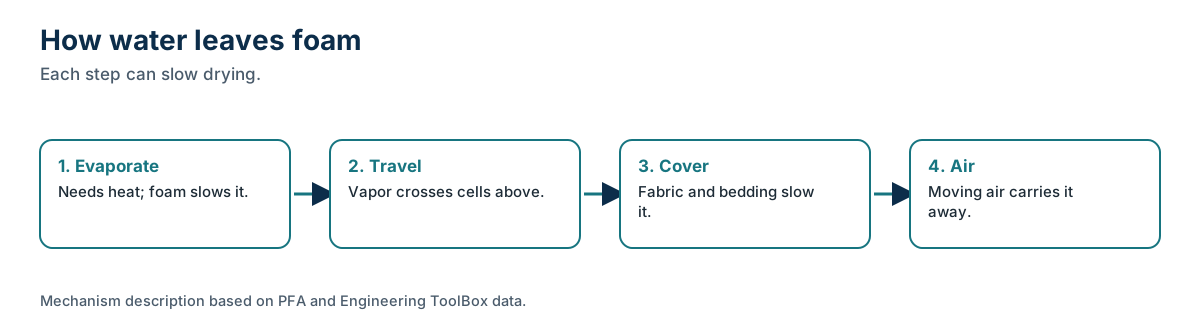
Water that reaches those cells spreads through them. It isn't sitting on a surface where air can reach it; it's inside a three-dimensional sponge. To leave, it has to evaporate and then travel through the cells above it to the cover and out. Hub 1 calls the inward movement wicking.
Foam insulates against the heat drying needs
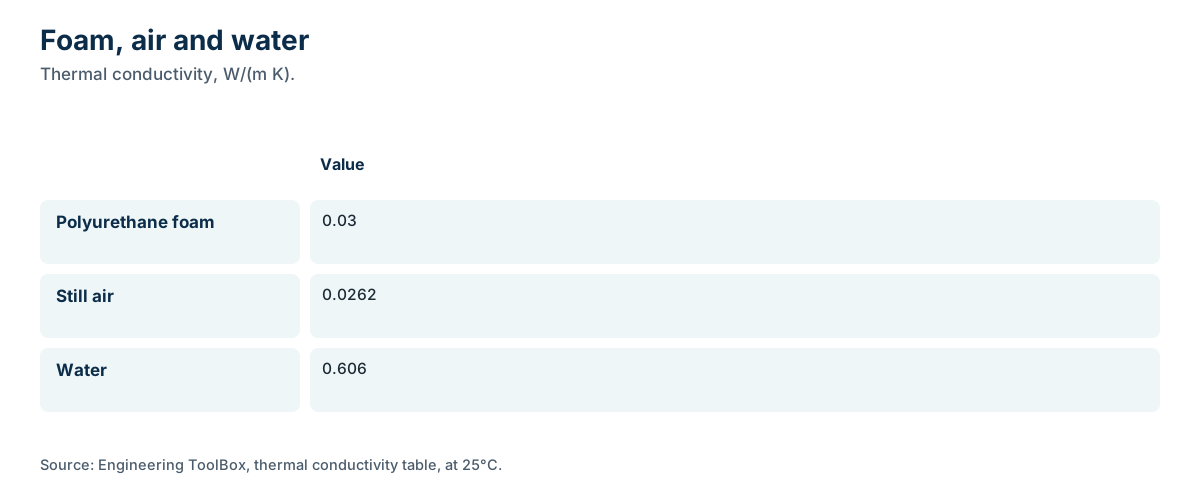
Evaporation takes energy. In a room, that energy comes from the air and from whatever the mattress is touching. Foam slows its arrival. Engineering ToolBox lists polyurethane foam's thermal conductivity at 0.03 W/(m K), close to still air at 0.0262, and far below water at 0.606.
That's why foam is in beds. It's also why water deep in foam cools as it evaporates and then waits for heat that comes in slowly. The surface, exposed to the room, gets warmth directly and dries first.
Covers and bedding block the air
Drying also needs air movement to carry vapor away. A mattress cover, a protector, sheets and a duvet all slow it. So does what's underneath: a solid platform blocks the bottom face.
Tempur's UK care page makes the ventilation point for its own beds: "TEMPUR ® mattresses must always be placed on a ventilated bed base e.g. with springs or slats, or a platform topped unit on castors, legs or feet to allow air to circulate freely, preventing moisture from accumulating." The same page, a few lines on, is strict about liquid: "There is a high risk that soaking with water or other cleaning fluids will cause irreversible damage, destroying the benefits of comfort and support which the TEMPUR ® Material provides. It will also invalidate your guarantee. Do not steam-clean or dry-clean the TEMPUR ® Material."
The first passage is about everyday moisture; the second is about cleaning. Read together, they show a maker treating air movement and liquid as the two sides of the same problem.
What EPA says about furniture
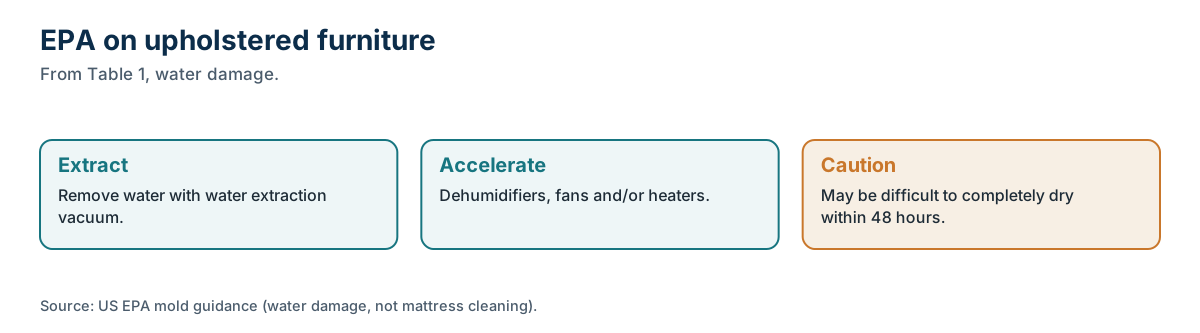
EPA's mold guidance is written for buildings, but its water-damage table includes upholstered furniture. Table 1 advises: "Remove water with water extraction vacuum. Accelerate drying process with dehumidifiers, fans, and/or heaters. May be difficult to completely dry within 48 hours." The table "presents strategies to respond to water damage within 24-48 hours."
That row describes furniture soaked by a leak or flood, not a cleaned mattress, and EPA doesn't test mattresses. We cite it because it's the closest published guidance on padded furniture, and because it says, in EPA's words, what the physics above predicts: padded items are hard to dry quickly once they're soaked.
Practical drying steps
For a foam mattress that has taken on water, the steps follow from the three causes. Tempur-Pedic's US care page, for spills, says: "Once excess moisture is removed, let the mattress air dry. To speed up the drying process, place a fan so that it blows on the mattress." In general:
- Take bedding and any protector off, so the cover meets the air.
- Blot, don't press. Pressing pushes water into the foam.
- Move air across the surface with a fan, and keep the room's air from going stale.
- If the base is solid, prop the mattress or raise it so the bottom face can breathe.
- Wait for the surface to stay dry to the touch before remaking the bed.
Avocado's cleaning guide, for its latex beds, gives its own drying advice and a steam warning in the same passage: "Allow any residual dampness to air-dry completely. You can place the mattress outside, since the natural latex is fully covered and not exposed to direct sunlight. However, a cool blow dryer will also work. Steam cleaners are not recommended because their excessive heat can over-bake the organic latex." That's Avocado's guidance for its own beds. Check your own care label before putting any mattress outside, and note the steam line if your bed is latex; Hub 2's Avocado page covers it.
Drying is slowest where water went deepest
All three causes get worse with depth. Water in the cover has a short path to air, sees room warmth directly and has no foam above it. Water a few inches down has the whole comfort layer to cross, gets heat only through insulation, and sits under whatever is on the bed. So the same spill can dry quickly or slowly depending on how far it travelled before anyone dealt with it. That's the practical reason to blot fast and press lightly, and the reason Hub 3 treats a saturated core as a separate problem from a damp surface.
Why this shapes our method
If water deep in foam is slow to leave, the best fix is not to put it there. That's the core of our reasoning for low-moisture work. The one weighed steam test we found, by Puckett, McDonald and Gold, recorded average gains of 0.92 to 1.44 grams at five minutes in small arenas of mattress material, five replicates per treatment, with the difference from untreated controls not significant by seven hours. That was thin mattress material on a wooden base, not thick foam, and a different steamer from ours.
Hub 1's why moisture matters when cleaning a mattress makes the general case.
How we approach a foam bed
We inspect each bed's materials first, and that sets steam temperature and pass speed. On foam, it means moving passes that keep water at the cover. Dry vapor covers the sleep surface, then the seams, tufts, ridges and edges where dust and shed skin flakes collect. Our equipment is Italian-made: the Magnum XP, which has a built-in vac, the ProV 350 and the Pro6 Duo. Organic cleaning methods are our default.
Using dry vapor on foam is our own choice and reasoning, not a manufacturer exemption. Your care label and warranty terms govern your decision, and it's worth checking your warranty before booking. Pricing is the standard price; severe or biohazard contamination is quoted as a custom surcharge before we start. Hub 2 explains the CDC's cleaning and sanitizing terms, and our use of "sanitize" is the cleaning sense, with no disinfection claim.
Where to read next
The moisture and heat guide connects drying to the heat and construction evidence, and this hub lists every article. For the mold side of slow drying, read can mattress moisture lead to mildew or mold?. For drying after a visit, see how quickly a treated mattress should dry, and for the difference between surface and deep water, surface moisture vs saturation.
What we don't know
- How long a wet foam mattress takes to dry under any set of conditions. No source we found measured it.
- How much a fan, dehumidifier or raised base shortens drying. EPA recommends them for furniture without giving times.
- Whether memory foam, polyfoam and latex dry at different rates once wetted. We found no comparison.
Changelog
- 3 October 2026: First published. Sources accessed on this date.
Sources
- IN-TOUCH Vol. 1 No. 1: Flexible Polyurethane Foam, a Primer (revised 2016) · Polyurethane Foam Association
- IN-TOUCH Vol. 11 No. 1: Viscoelastic (Memory) Foam (revised 2016) · Polyurethane Foam Association
- Thermal conductivity of common materials · Engineering ToolBox
- Mold Remediation in Schools and Commercial Buildings, Table 1: Water Damage, Cleanup and Mold Prevention · US EPA
- A brief guide to mold, moisture and your home · US EPA
- Caring for your TEMPUR (UK, updated 11 July 2023, accessed 2026-10-02) · Tempur UK
- Product care (US, accessed 2026-10-02) · Tempur-Pedic
- How to Clean Your Natural Mattress Without Using Harsh Chemicals (25 June 2026, accessed 2026-10-02) · Avocado
- Comparison of multiple steam treatment durations for control of bed bugs (Puckett, McDonald and Gold, Pest Manag Sci, 2013) · Texas A&M Urban Entomology (author copy)
- Magnum XP-Vac product page (maker's claims, accessed 2026-10-02) · Vapor Clean
- ProV 350 product page ('Italian Made'; maker's claims, accessed 2026-10-02) · Vapor Clean
- Pro6 Duo product page ('Made in Italy'; maker's claims, accessed 2026-10-02) · Vapor Clean
- Cleaning and disinfecting your school (definitions) · CDC
Last reviewed October 3, 2026. Manufacturer specifications and care instructions change; check the current version for your exact model. This page is general information, not medical advice. How we source and check pages: editorial standards.