
Short answer
Water moves into memory foam's open cells and is slow to leave. Foam industry data say viscoelastic foam softens in humid conditions, and a lab study tied rising humidity to lasting stiffness loss in soft polyurethane foam held for days. Tempur and Purple warn against wetting or steam cleaning memory foam. Nobody has published how much water causes lasting harm.
Key terms used on this page
- Viscoelastic foam:
- The foam sold as memory foam. The Polyurethane Foam Association describes it as a type of open cell, flexible polyurethane foam with slow recovery after compression, and says its firmness, support and recovery rate are affected by temperature and humidity.
- Open-cell foam:
- Foam whose cells connect, so air can move through it. The PFA primer says foam performance is optimized when air flow is maximized, which indicates the cells are open. The same open structure that lets air through also lets liquid water in.
- Humid heat aging:
- Lasting change in foam after long exposure to heat and moisture together. Lapčík and colleagues held soft polyurethane foam bought at a hobby market at 45 or 80°C, at two humidity levels up to 80 percent, for up to 300 hours, and tied rising humidity to stiffness loss and more permanent deformation.
- Permanent deformation:
- The height a foam sample fails to recover after being held compressed, sometimes called compression set. In the Lapčík study, 50 mm foam cubes were compressed to half their height for 30 minutes after 300 hours of conditioning, and humid heat increased the lasting loss.
- Mattress saturation:
- Water filling the open cells of a foam or fiber layer below the cover, rather than sitting at the surface. Casper's care page warns that the foam in the mattress core will soak up water and detergent; saturation is that outcome.
Memory foam reacts to water in two ways. The first is physical: the foam's open cells take liquid in, and the foam's insulating structure slows its exit. The second is in the material: foam industry data say viscoelastic foam softens with humidity, and one lab study tied humid conditions to lasting changes in soft polyurethane foam. The makers of memory foam beds are, for these reasons, the strictest about liquid.
This article is general information about cleaning and materials, not medical or engineering advice. For mold or health questions, talk to a qualified professional.
What memory foam is
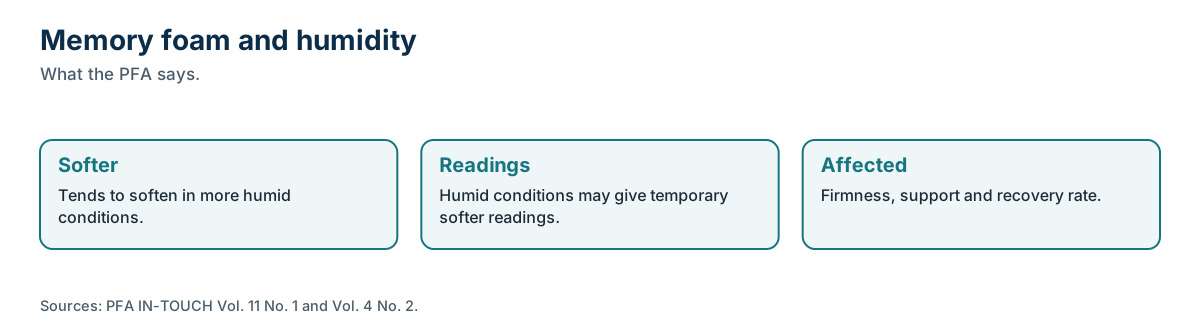
The Polyurethane Foam Association's bulletin on viscoelastic (memory) foam begins with the structure: "Viscoelastic foam is a type of open cell, flexible polyurethane foam." Its defining feature is slow recovery after compression. The same bulletin adds that "Viscoelastic foam firmness, support and height recovery rate are often affected by temperature and humidity."
Hub 1's entry on memory foam covers the basics; Hub 2's memory foam compatibility page covers what it tolerates.
How water gets in, and why it stays
Open cells connect. Liquid that crosses the cover moves into them and spreads along the connected structure, a process Hub 1 calls wicking. Once it's there, two things slow it down on the way out. Air can't move freely through a foam layer under a cover and bedding. And foam doesn't pass heat well: Engineering ToolBox gives polyurethane foam a thermal conductivity of 0.03 W/(m K), against 0.606 for water. The energy that evaporation needs arrives slowly.
Hub 1's article on what happens when water penetrates memory foam follows the water's path in more detail. Why foam mattresses are slow to dry covers the drying side.
What humidity does to the material
The PFA's viscoelastic bulletin says plainly: "Viscoelastic products tend to soften in more humid conditions." It describes this as a change in feel and in measured firmness, not as damage. A softer reading on a humid day isn't a broken mattress. The PFA's bulletin on laboratory foam tests makes the same point about firmness testing in general: "Warmer, more humid conditions may contribute to temporary softer readings." The word that matters there is temporary. Foam labs condition samples before testing precisely because the readings move with the air around them.
Lasting change is a different question, and the best data come from a lab study on soft polyurethane foam that wasn't memory foam. Lapčík and colleagues bought open-cell soft foam at a hobby market and held samples in a climate chamber at 45 or 80°C and two humidity levels, the higher of them 80 percent, for up to 300 hours. Each measurement was repeated five times. They reported that "the increasing relative humidity of the surrounding atmosphere leads to the initiation of the degradation processes," with lower stiffness and more permanent deformation. The results weren't all one way; hardness fell with time in every condition except 45°C.
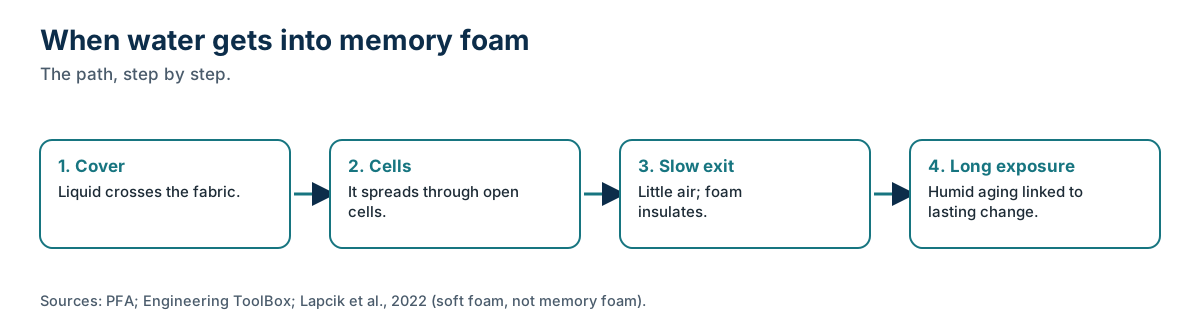
What that study supports: days of warm, humid exposure changed this foam. What it doesn't: what happens to a memory foam mattress wetted once and dried within a day or two. We found no study of that.
What memory foam makers say
The makers of memory foam beds are explicit, and their passages belong in full.
Tempur's UK care page: "There is a high risk that soaking with water or other cleaning fluids will cause irreversible damage, destroying the benefits of comfort and support which the TEMPUR ® Material provides. It will also invalidate your guarantee. Do not steam-clean or dry-clean the TEMPUR ® Material." Tempur-Pedic's US product care page: "Never wash the TEMPUR® material. TEMPUR® material should never become wet." Both passages describe Tempur's own material. Neither gives a moisture threshold, a temperature or a test, so they tell you the rule rather than the reason.
Purple's cleaning guide on memory foam in general: "Memory foam mattresses can absorb a lot of moisture. Avoid steam cleaning a memory foam mattress, as this can leave it waterlogged."
Beautyrest's help page, for its own beds: "We do not recommend applying liquids to the mattress. Applying liquids may stain the fabric and make the soiled area worse. Moisture or chemicals applied directly to the mattress can cause premature breakdown of the foam and damage the product." That phrase, "premature breakdown of the foam," is the nearest any maker we read comes to naming a mechanism. It sits alongside the Lapčík lab result on humid-aged soft polyurethane foam, though Beautyrest doesn't cite any test.
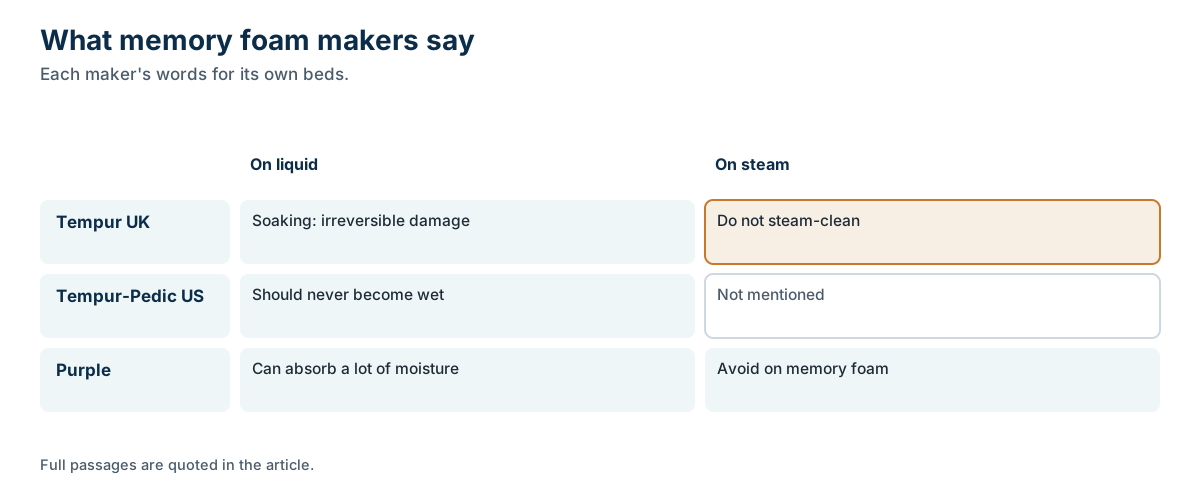
Each passage is the maker's guidance for its own products. They point to the same mechanism: water held in foam.
Our method on memory foam, and why
We clean memory foam beds with dry vapor, including Tempur beds. That's Sleep Sanitation's own choice and reasoning, not a manufacturer exemption, and it isn't a reading of the passages above. Tempur's UK page names steam cleaning directly, and nothing in it carves out low-moisture machines, so we don't claim one. Our reasoning is that the mechanism the makers describe is liquid water held in foam, and dry vapor in quick, moving passes is designed to keep water at the cover. Your care label and warranty terms govern your decision. Check your warranty, or ask the maker, before booking.
Hub 2's Tempur-Pedic guide and Purple page quote those makers on more topics.
If memory foam has already got wet
For a spill, Tempur-Pedic's US care page gives home steps: blot with towels, and "Once excess moisture is removed, let the mattress air dry. To speed up the drying process, place a fan so that it blows on the mattress." That's sensible for any foam bed. Avoid pressing hard, which pushes water deeper. Give the mattress moving air and time.
If water went in by the bucketful, or the bed stays damp, EPA's mold guidance applies: "It is important to dry water-damaged areas and items within 24-48 hours to prevent mold growth." That's EPA's guidance for water damage, and a soaked mattress is water damage. Hub 3 covers the special case of urine in how to get urine out of memory foam without soaking it.
What a visit to a memory foam bed looks like
Memory foam changes the passes, not the price. The inspection identifies the foam and its cover, and that decides steam temperature and pass speed: quicker, lighter passes than a coil bed would get. Dry vapor covers the surface and the seams, tufts, ridges and edges where dust and shed skin flakes collect. We work with Italian-made Vapor Clean machines: the Magnum XP with a built-in vac, the ProV 350 and the Pro6 Duo. Organic cleaning methods are our default, and urine or organic odor gets an enzyme cleaner applied to the affected area.
All of that sits inside the standard price; severe or biohazard contamination is quoted as a custom surcharge before we start. We use "sanitize" in the cleaning sense, and Hub 2 explains the CDC's cleaning and sanitizing terms.
Where to read next
The moisture and heat guide puts memory foam beside latex, coils and adhesives, and this hub lists every article. For the heat side of the same material, read what temperature mattress foam can tolerate. For how the two stresses compare, see heat vs water.
What we don't know
- How much water causes lasting change in a memory foam mattress. No source gives a threshold.
- Whether the Lapčík results, from a hobby-market soft foam held for days, apply to memory foam wetted once.
- How long a wetted memory foam mattress takes to dry in a bedroom.
- Whether humidity softening in memory foam fully reverses after a single wetting.
- Whether gel-infused or plant-based memory foams respond to water differently. The PFA bulletin describes viscoelastic foam in general, and Hub 2's cooling gel foam page covers what makers say.
Changelog
- 3 October 2026: First published. Sources accessed on this date.
Sources
- IN-TOUCH Vol. 11 No. 1: Viscoelastic (Memory) Foam (revised 2016) · Polyurethane Foam Association
- IN-TOUCH Vol. 1 No. 1: Flexible Polyurethane Foam, a Primer (revised 2016) · Polyurethane Foam Association
- IN-TOUCH Vol. 4 No. 2: Laboratory Tests of Foam Performance · Polyurethane Foam Association
- Effect of Conditioning on PU Foam Matrix Materials Properties (Lapcik et al., Materials, 2022) · PubMed Central
- Caring for your TEMPUR (UK, updated 11 July 2023, accessed 2026-10-02) · Tempur UK
- Product care (US, accessed 2026-10-02) · Tempur-Pedic
- How To Clean a Mattress in 9 Steps (last updated 16 Oct 2025, accessed 2026-10-02) · Purple
- How to clean your mattress: a mattress care guide (accessed 2026-10-02) · Casper
- How do I clean my mattress? (updated 16 Sep 2026, accessed 2026-10-02) · Beautyrest
- Thermal conductivity of common materials · Engineering ToolBox
- A brief guide to mold, moisture and your home · US EPA
- Magnum XP-Vac product page (maker's claims, accessed 2026-10-02) · Vapor Clean
- ProV 350 product page ('Italian Made'; maker's claims, accessed 2026-10-02) · Vapor Clean
- Pro6 Duo product page ('Made in Italy'; maker's claims, accessed 2026-10-02) · Vapor Clean
- Cleaning and disinfecting your school (definitions) · CDC
Last reviewed October 3, 2026. Manufacturer specifications and care instructions change; check the current version for your exact model. This page is general information, not medical advice. How we source and check pages: editorial standards.