
Skip to content

Knowledge Center · Moisture, Heat & Construction

Moisture, heat, drying and mattress construction

This hub covers the engineering questions behind mattress cleaning: how much water a bed takes on, what foam and adhesives do with heat and humidity, why some layers dry slowly, and how a mattress's construction changes the method. It explains why our process looks the way it does, and it marks plainly where the published evidence runs out.

Monday–Friday, 9am–6pm. Missed a call? We return calls and texts on Saturday and Sunday too.

Short answer

This hub treats water and heat as two separate stresses on a mattress. Foam industry data say heat and humidity soften memory foam, a lab study tied humid heat to stiffness loss in soft foam, and steamed mattress-material arenas gained 0.92 to 1.44 grams in one test. No source gives a mattress foam temperature limit, drying time or penetration depth.

By Matthew Brunken · Updated October 3, 2026 · Last reviewed October 3, 2026 · Sources · Editorial standards

This hub is the technical one. It doesn't argue for a service. It explains why water and heat behave the way they do inside a mattress, what the foam and adhesive makers publish about their own materials, and what the few relevant studies measured. Where nobody has published an answer, we say so.
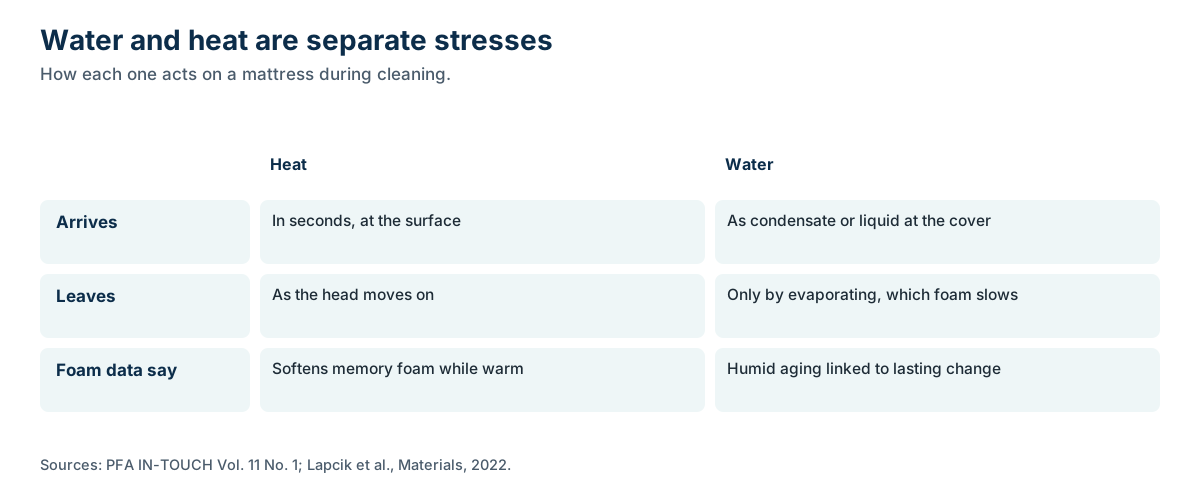
Grid comparing how heat and water each arrive at and leave a mattress
Heat and water behave differently. Diagram: Sleep Sanitation (original, illustrative).

This hub is general information about cleaning and materials, not medical or engineering advice. For mold, health or structural questions, talk to a qualified professional.

Why moisture and heat get their own hub

The first four hubs cover how cleaning methods work, what each mattress material tolerates, what urine and odor do inside a bed and what cleaning does about dust mites. Underneath all of them sit the same two variables. A cleaning puts some water into a mattress and some heat onto it. How much of each, where it goes and how long it stays decide whether a mattress comes through a cleaning well.

Hub 1 introduced the idea that heat and moisture are separate variables. This hub follows that idea into the materials: polyurethane and viscoelastic foam, latex, coils, cover fabric and the adhesives that hold the layers together.

What this hub covers

The flagship guide brings the evidence together. The articles each take one question. Some are about water: how wet a mattress should get, the difference between surface moisture and saturation, and why foam is slow to dry. Some are about heat: what temperature mattress foam can tolerate and whether heat or water is harder on materials. The rest are about construction, including adhesives and hybrids.
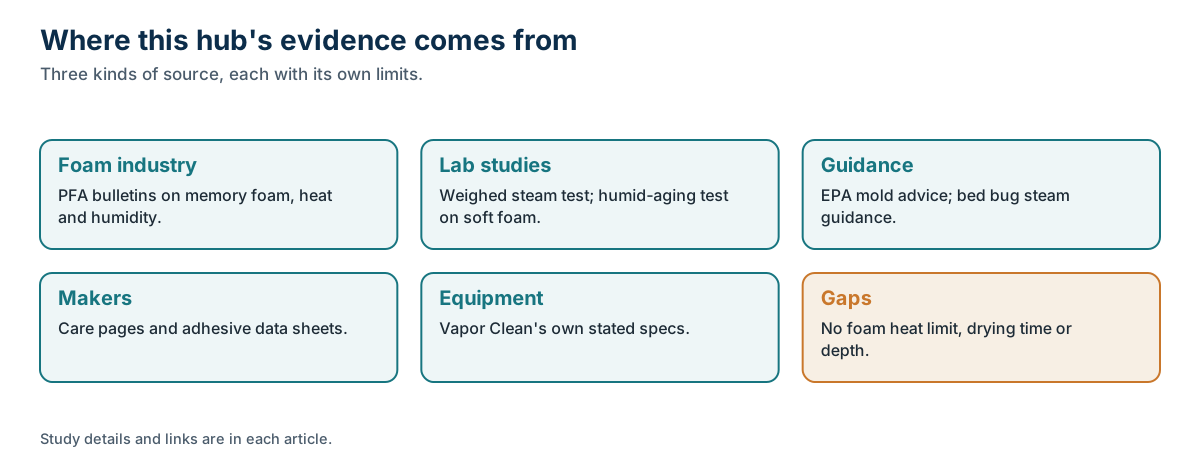
Six cards mapping foam data, lab studies, guidance, makers, equipment and gaps
Where the evidence comes from. Diagram: Sleep Sanitation (original, illustrative).

What the evidence says, in brief

Three kinds of source carry most of the weight here.

Foam industry data. The Polyurethane Foam Association's bulletin on viscoelastic foam says firmness, support and height recovery rate "are often affected by temperature and humidity." It adds that "Viscoelastic products tend to soften in more humid conditions." Those are statements about how memory foam feels and performs, not damage thresholds.

Laboratory studies. A 2022 study by Lapčík and colleagues held soft polyurethane foam bought at a local hobby market at 45 or 80°C and at two humidity levels, the higher of them 80 percent, for up to 300 hours. Higher humidity started degradation they could measure as lower stiffness and more permanent deformation. A 2013 steam study by Puckett, McDonald and Gold weighed small arenas of mattress material before and after steaming and recorded average gains of 0.92 to 1.44 grams at five minutes.

Guidance. EPA says to dry water-damaged areas and items within 24-48 hours to prevent mold growth. That guidance is about leaks and floods. We quote it as EPA's, and we don't turn it into a drying promise for a cleaning visit.

Where the evidence stops

This hub has more gaps than the others, and they're worth listing up front. We found no published upper temperature limit for mattress foam. We found no study that measured how deep steam heat travels into a mattress; the Puckett authors state that they made no attempt to find out. We found no published drying time for a mattress after dry-vapor cleaning. And no adhesive maker publishes what temperature a glue line inside a finished bed reaches during cleaning. Each article has a "What we don't know" section that names its own gaps.
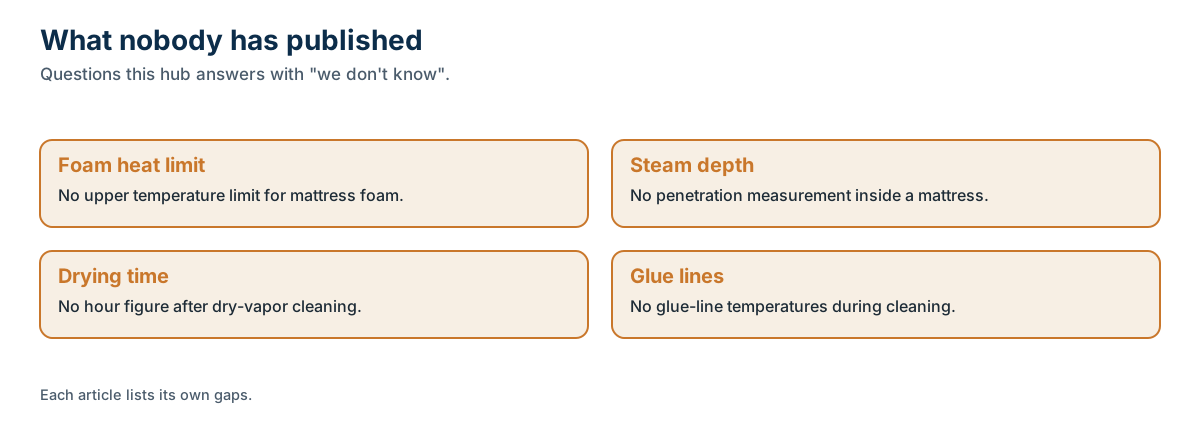
Four cards listing missing evidence on foam heat, steam depth, drying and glue
The gaps, stated plainly. Diagram: Sleep Sanitation (original, illustrative).

Sleep Sanitation's position

This section is our view.

Our method follows from the sources above. If water and heat are separate stresses, the sensible approach is to keep liquid water low and to control heat by how long the steam head stays on any one spot. That's why a visit starts with a materials inspection that sets steam output and pass speed for the bed in front of us. Then dry vapor goes across the sleep surface and into the seams, tufts, ridges and edges, where dust and shed skin flakes collect. The machines are Italian-made Vapor Clean units: the Magnum XP, which has a built-in vac, the ProV 350 and the Pro6 Duo. Their output and pass speed are adjustable. In our view and experience, that lets us treat any mattress or topper, and if a material reacts during a pass, we adjust or stop. That's our call, and your care label and warranty still govern. Organic cleaning methods are our default, and we use an enzyme cleaner for urine and organic odor.

Our dry-vapor method is our own choice and reasoning, not a manufacturer exemption. Your care label and warranty terms govern your decision, so check your warranty before booking any steam or vapor cleaning. Hub 2's compatibility guide quotes each maker we checked.

The visit is part of the standard price; severe or biohazard contamination is quoted as a custom surcharge before we start. We use "sanitize" in its cleaning sense; Hub 2 explains the CDC's cleaning and sanitizing terms, and we make no disinfection claim. Questions about a visit: call (402) 512-5658.

How to use this hub

If you want the full argument in one place, read the flagship. If you're worried about a specific bed, start with why construction matters, then the Hub 2 page for your material, such as memory foam or hybrid. If your question is about drying after a visit, go to how quickly a treated mattress should dry.

Start here

The flagship guide covers how water and heat each act on mattress materials, what every source measured, and where the evidence stops.

How much water

How wet a mattress should get, the line between surface moisture and saturation, and what dry vapor leaves behind.

Drying and mold

Why foam holds water, what EPA says about mold and drying, how to judge whether water went deep, and what drying should look like.

Foam and heat

What water and heat do to memory foam, which stress is harder on materials, and what the foam data say about temperature.

Construction

Why the build of a mattress changes the method, what adhesive data sheets show, how hybrids differ, and why makers disagree about steam.

Defined terms

The vocabulary of mattress cleaning methods

Every article in this Knowledge Center uses these words the same way. Each term has its own link, so you can point anyone (or any search engine) straight to the definition.

Viscoelastic foam
The foam sold as memory foam. The Polyurethane Foam Association describes it as a type of open cell, flexible polyurethane foam with slow recovery after compression, and says its firmness, support and recovery rate are affected by temperature and humidity.Source: IN-TOUCH Vol. 11 No. 1: Viscoelastic (Memory) Foam
Open-cell foam
Foam whose cells connect, so air can move through it. The PFA primer says foam performance is optimized when air flow is maximized, which indicates the cells are open. The same open structure that lets air through also lets liquid water in.Source: IN-TOUCH Vol. 1 No. 1: Flexible Polyurethane Foam, a Primer
Glass transition temperature
The temperature range where a polymer shifts between a stiff, glassy state and a soft, rubbery one. In one 2026 study of lab-made viscoelastic foams with up to 20 percent bio-based polyols, the glass transition stayed around 10°C. It explains why memory foam stiffens in the cold.Source: Bio-Based Viscoelastic Polyurethane Foams (Polymers, 2026)
Indentation force deflection (IFD)
A standard firmness test that measures the force needed to compress a foam sample by a set amount. The PFA notes that warmer, more humid conditions in the test room may contribute to temporary softer readings, so samples are conditioned first.Source: IN-TOUCH Vol. 4 No. 2: Laboratory Tests of Foam Performance
Heat softening
The temporary softening of viscoelastic foam as it warms. The PFA says heat, even body heat, can soften viscoelastic materials and, in extreme situations, affect the foam's ability to provide support. It gives an optimum range for memory action of 55°F to 85°F.Source: IN-TOUCH Vol. 11 No. 1: Viscoelastic (Memory) Foam
Humid heat aging
Lasting change in foam after long exposure to heat and moisture together. Lapčík and colleagues held soft polyurethane foam bought at a hobby market at 45 or 80°C, at two humidity levels up to 80 percent, for up to 300 hours, and tied rising humidity to stiffness loss and more permanent deformation.Source: Effect of Conditioning on PU Foam Matrix Materials Properties (Materials, 2022)
Permanent deformation
The height a foam sample fails to recover after being held compressed, sometimes called compression set. In the Lapčík study, 50 mm foam cubes were compressed to half their height for 30 minutes after 300 hours of conditioning, and humid heat increased the lasting loss.Source: Effect of Conditioning on PU Foam Matrix Materials Properties (Materials, 2022)
Thermal conductivity
How readily a material passes heat. Engineering ToolBox lists polyurethane foam at 0.03 W/(m K) and liquid water at 0.606 W/(m K). Foam is an insulator, which is one reason surface heat does not travel far into a thick foam layer.Source: Thermal conductivity of common materials
Dryness fraction
The share of steam, by mass, that is vapor rather than water droplets. Spirax Sarco's example: steam with 5 percent water by mass is 95 percent dry, a dryness fraction of 0.95. Wetter steam carries less usable heat and more liquid.Source: What is steam?
Vapor moisture claim
An equipment maker's stated water content for its steam. Vapor Clean lists 5-6% moisture for the Magnum XP, ProV 350 and Pro6 Duo. These are the maker's own claims; the pages do not describe how the figure was measured.Source: ProV 350 product page (maker's claims)
Surface moisture
Water held in the cover fabric and the top of the comfort layer, close enough to the air to evaporate quickly. It is the moisture a low-moisture method aims to leave, as opposed to water that has travelled down into the core.Source: Comparison of multiple steam treatment durations (Pest Manag Sci, 2013)
Mattress saturation
Water filling the open cells of a foam or fiber layer below the cover, rather than sitting at the surface. Casper's care page warns that the foam in the mattress core will soak up water and detergent; saturation is that outcome.Source: How to clean your mattress (Casper)
Weight-gain test
Weighing an item before and after treatment to measure how much water it took on. Puckett and colleagues weighed steam-treated mattress-material arenas at intervals from 5 minutes to 7 days and recorded average gains of 0.92 to 1.44 grams at 5 minutes.Source: Comparison of multiple steam treatment durations (Pest Manag Sci, 2013)
Steam tip distance
The gap between the steam nozzle and the surface. A bed bug manual reprinting an Armed Forces Pest Management Board guide puts it at about 2.5 to 3.8 cm and warns that a tip held too close may inject excess moisture.Source: Bed Bug IPM manual, AFPMB Technical Guide 44 (2008)
Steam penetration
How far steam heat reaches below a surface. In its bed bug guidance on lethal temperatures, Cornell IPM's draft says steam can penetrate 2 3/8 inches into a crack or crevice and less than one inch beneath a fabric surface, citing no study. No source we found measured it inside a mattress.Source: 6. Using Steam to Eliminate Bed Bugs (draft)
Hot-melt adhesive
A solvent-free adhesive applied molten and set by cooling. ADiNO's FG 8240.0, sold for bonding PU foam in the mattress and upholstery industry, is applied at 150 to 180°C and lists a softening point of about 87°C.Source: ADiNO FG 8240.0 technical product information
PUR hotmelt
A reactive polyurethane hot-melt adhesive that cures by chemical cross-linking after it is applied. Jowat's 639.10, sold for foam mattress assembly, is described as having very high heat resistance due to cross-linking, with a softening point of 60 ± 4°C.Source: Jowat 639.10 technical data
Softening point
The temperature at which an adhesive sample softens under a standard ring-and-ball test. It is measured on the adhesive alone, not inside a finished mattress, so it does not tell you what temperature a glue line reaches during cleaning.Source: Jowat 639.10 technical data
Waterborne adhesive
An adhesive carried in water that bonds as the water leaves. Worthen's FOAMLAM 1573, based on natural latex, is roll-applied for laminating foam layers in mattresses and lists solids of 50 ± 2 percent.Source: FOAMLAM 1573 Biobased technical data sheet
Shear adhesion failure temperature (SAFT)
A heat test in which a bonded joint under a small load is warmed step by step until it fails. 3M reports a SAFT above 149°C for its 1000NF foam adhesive, tested on birch plywood rather than foam.Source: Fast Tack Water Based Adhesive 1000NF technical data sheet
Foam lamination
Bonding foam layers to each other or to fiber and fabric to build a mattress. Adhesive data sheets from Jowat, ADiNO, Worthen and 3M each describe bonding foam, which tells us mattresses are glued in different ways with different chemistries.Source: FOAMLAM 1573 Biobased technical data sheet
Water-damage drying guidance
EPA's advice for materials soaked by leaks and floods. EPA says to dry water-damaged areas and items within 24-48 hours to prevent mold growth, and its Table 1 says upholstered furniture may be difficult to completely dry within 48 hours.Source: Mold Remediation in Schools and Commercial Buildings, Table 1

Frequently asked questions

How wet does a mattress get with dry vapor?+

No study has measured it on a full mattress. In one lab test on mattress material, steamed arenas gained 0.92 to 1.44 grams at five minutes, and the authors called the weight change negligible.

Can steam heat damage memory foam?+

The Polyurethane Foam Association says heat softens viscoelastic foam and, in extreme situations, can affect support. We found no published upper temperature limit for mattress foam, so we don't state one.

How long should a mattress take to dry?+

We give field guidance, not an hour figure, because no source we found measured drying time after dry-vapor cleaning. EPA's 24-48 hour advice is for water-damaged materials, not for a cleaning visit.

Is dry vapor gentle on mattress glue?+

We can't say it is for every bed. Mattress adhesives range from hot melts to waterborne latex, with different heat data, and nobody publishes glue-line temperatures during cleaning.

Why do some makers say no to steam?+

Each maker writes for its own materials and warranty. The articles in this hub quote them in full, and your care label and warranty terms govern your decision.

Does this affect the price of a visit?+

No. Every visit opens with an inspection that sets output and pass speed, all within the standard price. We quote a custom surcharge only for severe or biohazard contamination, and only before starting.

Sources

  1. Comparison of multiple steam treatment durations for control of bed bugs (Puckett, McDonald and Gold, Pest Manag Sci, 2013) · Texas A&M Urban Entomology (author copy)
  2. Efficacy of three different steamers for control of bed bugs (Wang et al., Pest Manag Sci, 2018) · PubMed
  3. 6. Using Steam to Eliminate Bed Bugs (draft help article, accessed 2026-10-03) · Cornell IPM Help Center
  4. Bed Bug IPM manual, including Armed Forces Pest Management Board Technical Guide 44 (University of Florida, 2008) · University of Tennessee (hosted copy)
  5. IN-TOUCH Vol. 11 No. 1: Viscoelastic (Memory) Foam (revised 2016) · Polyurethane Foam Association
  6. IN-TOUCH Vol. 4 No. 2: Laboratory Tests of Foam Performance · Polyurethane Foam Association
  7. IN-TOUCH Vol. 1 No. 1: Flexible Polyurethane Foam, a Primer (revised 2016) · Polyurethane Foam Association
  8. Effect of Conditioning on PU Foam Matrix Materials Properties (Lapcik et al., Materials, 2022) · PubMed Central
  9. Bio-Based Viscoelastic Polyurethane Foams: Functional Behavior Across Application Temperatures (Malewska et al., Polymers, 2026) · PubMed Central
  10. A brief guide to mold, moisture and your home · US EPA
  11. Mold Remediation in Schools and Commercial Buildings, Table 1: Water Damage, Cleanup and Mold Prevention · US EPA
  12. What is steam? (steam engineering tutorial, dryness fraction) · Spirax Sarco
  13. Thermal conductivity of common materials · Engineering ToolBox
  14. Jowat 639.10 PUR foam mattress assembly hotmelt, technical data (accessed 2026-10-03) · ECT Adhesives (Jowat distributor)
  15. ADiNO FG 8240.0 foam-bonding PO hotmelt, technical product information (January 2025) · Adino GmbH
  16. FOAMLAM 1573 Biobased waterborne mattress adhesive, technical data sheet · Worthen Industries
  17. Fast Tack Water Based Adhesive 1000NF, technical data sheet · 3M
  18. Magnum XP-Vac product page (maker's claims, accessed 2026-10-02) · Vapor Clean
  19. ProV 350 product page ('Italian Made'; maker's claims, accessed 2026-10-02) · Vapor Clean
  20. Pro6 Duo product page ('Made in Italy'; maker's claims, accessed 2026-10-02) · Vapor Clean
  21. Cleaning and disinfecting your school (definitions) · CDC

Last reviewed October 3, 2026. Each article in this hub lists its own sources. This page is general information, not medical advice. See our editorial standards for how sources are chosen and checked.

Ready for a cleaner bed?

Call or text to book. Tell us how many mattresses and your town, and we'll confirm a time and your price.

Fall 2026 promotion: first mattress $199 (regular $249). Additional cleaning scheduled within 7 days of your first service is also $199.

Monday–Friday, 9am–6pm. Missed a call? We return calls and texts on Saturday and Sunday too.

Call Text Book