
Short answer
Ticking is the outermost layer of fabric on a mattress, as federal flammability rules define it. It's often quilted, stitched through to fill or foam beneath, and may sit over a fire barrier. A California study found the covers it examined were mostly woven synthetic fiber mixes. Mattress outer coverings aren't covered by FTC textile labeling rules, so fiber content often isn't on the tag.
Key terms used on this page
- Ticking:
- The outer fabric cover of a mattress, often quilted to the comfort layers beneath. Avocado tells owners: 'Do not attempt to remove the mattress ticking to access the internal materials or support unit.'
- Upholstery material:
- Under 16 CFR 1633, all material, loose or attached, between the mattress ticking and the core. Quilting, comfort layers and barriers fall in this zone.
- Pillow-top and Euro-top:
- An extra padded layer sewn onto the top of a mattress. On a pillow-top it is stitched on as a separate pillow-like layer; on a Euro-top it is sewn flush with the sides. The padding is usually fiber, foam or both, and it sits directly under the cleaning surface.
- Comfort layer:
- The foam, latex or fiber layer between the quilting and the support core. Urine that reaches it is harder to treat than urine that stayed in the cover.
- Fire barrier fabric:
- A layer that helps a mattress meet federal flammability standards. CertiPUR-US says some makers surround the foam core with barrier fabrics made from fiberglass; others use flame-resistant fibers.
- Care label:
- The care instructions sewn into a mattress, topper or cover. Tempur UK notes that 'A label stitched inside the cover will give you specific care instructions for the item you have purchased.' A care label outranks general web guidance.
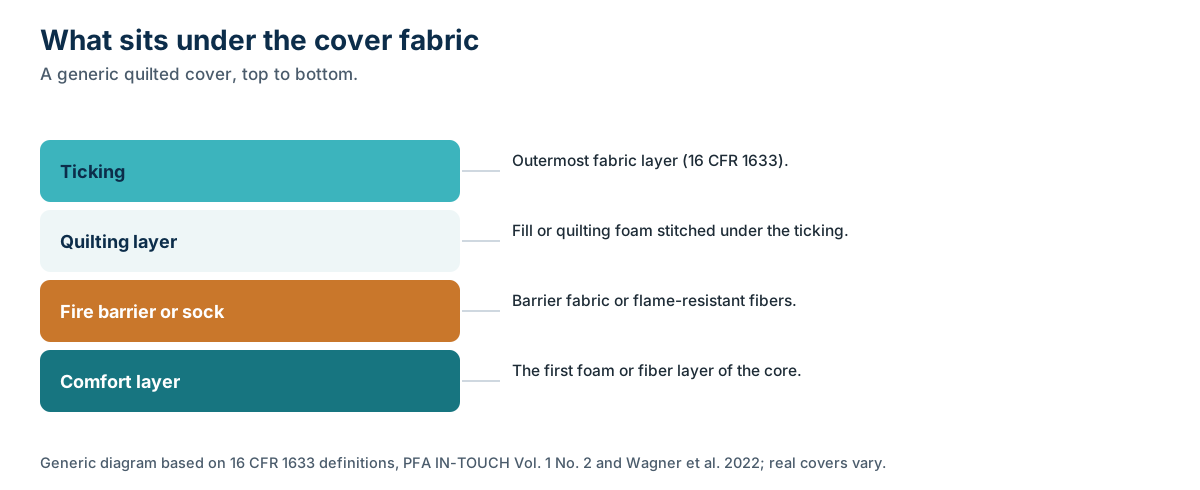
Ticking is the outermost layer of fabric on a mattress, as federal flammability rules define it. It's often quilted, stitched through to fill or foam underneath, and it may sit over a fire barrier or a flame-resistant sock. A California public health study found the covers it examined were mostly woven mixtures of synthetic fibers. Because the FTC's textile labeling rules don't cover mattress outer coverings, the fiber content often isn't printed anywhere on the mattress.
General information about mattress materials, not medical advice.
How do federal rules define ticking?
Two regulations define it in slightly different words. The open-flame rule, 16 CFR 1633, says "Ticking means the outermost layer of fabric or related material of a mattress or foundation." The cigarette rule, 16 CFR 1632, says it "encloses the core and upholstery materials of a mattress or mattress pad," and adds that "A mattress ticking may consist of several layers of fabric or related materials quilted together."
That last point is why a cover feels thicker than a single fabric. What you see is the face of a system.
Ticking is also part of what makes a mattress a mattress in the law's eyes. The open-flame rule says "Mattress means a resilient material or combination of materials enclosed by a ticking (used alone or in combination with other products) intended or promoted for sleeping upon." A box spring or base counts too: "Foundation means a ticking covered structure used to support a mattress or sleep surface." So the same vocabulary applies to the bed underneath.
What does "quilted" mean on a mattress?
The cigarette rule defines it: "Quilted means stitched with thread or by fusion through the ticking and one or more layers of upholstery material." Tufting is different. "Tufted means buttoned or laced through the ticking and upholstery material and/or core," or drawn together at intervals in a way that "produces a series of depressions on the surface."
Foam often goes into the quilting. The PFA's density bulletin notes that some mattress manufacturers use higher-density quilting foam to reduce body impressions, a link the density and firmness article explains. Pillow tops are their own case, and the compatibility hub's pillow-top page covers them in cleaning terms.
What is a tape edge?
It's the seam around the border. The cigarette rule says "Tape edge (edge) means the seam or border edge of a mattress or mattress pad." It's one of the surfaces the cigarette test checks, along with smooth, quilted and tufted areas. For cleaning, our own reasoning is that seams and borders are where fabric layers meet, so we treat them with the same light touch as the top panel.
What sits between the ticking and the core?
Everything the rules call upholstery material. The open-flame rule says "Upholstery material means all material, either loose or attached, between the mattress ticking and the core of a mattress." That can include quilting fill and foam, the comfort layers above the support core, and any fire barrier.
Barriers matter here. CertiPUR-US says some makers "surround a mattress's foam core with barrier fabrics made from fiberglass to help meet government standards for mattress flammability." In the California study, some covers had an inner "sock" layer, and "Two of the mattress covers contained over 50% fiberglass in their inner sock layers." The fire barrier article covers that study in full.
What are cover fabrics made of?
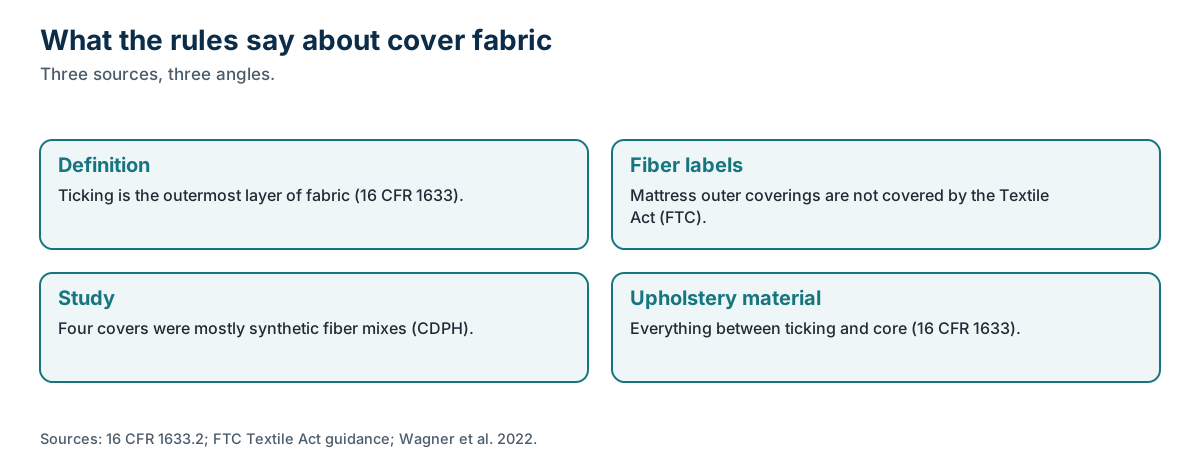
Mostly synthetics, in the one study we found that took covers apart. Wagner and colleagues at the California Department of Public Health examined four new mattresses and reported that "The various mattress cover components of FG-1 and FG-2 were mixtures of synthetic fibers, mostly in the form of woven materials." In one cover, "The limited FTIR of fibers from FG-1 variously matched polyester, polypropylene, and viscose (Rayon)." Sock layers in other covers contained fibers "consistent with flame resistant modacrylic containing vinyl chloride and antimony."
Four mattresses is a small sample, so we don't generalize from it about the market. The study's broader point is about knowledge: "Although mattress foam is often marketed as chemical-free, their cover compositions are not as well understood by the general public."
Why isn't the cover fabric on the label?
Because fiber labeling rules leave it out. The FTC's guide to the Textile and Wool Acts lists "Outer coverings of upholstered furniture, mattresses and box springs" among items "not covered by the Textile Act labeling requirements." It also lists "Upholstery or mattress stuffing that is not reused."
The federal flammability label can't fill the gap either; under 16 CFR 1633 it may carry only the required information "and no other information." State bedding tags, where they apply, describe filling materials. The law tag article explains all three systems. The California authors concluded that "further improvements are needed in mattress labeling and education of consumers."
Do foam certifications cover the cover?
No. CertiPUR-US is explicit about its scope: "We only certify flexible polyurethane foam." The California authors noted "The apparent non-inclusion of mattress covers in chemical-free certifications," which is part of why they called for better labeling. The off-gassing article explains what the foam certification does test.
Why does the cover matter for cleaning?
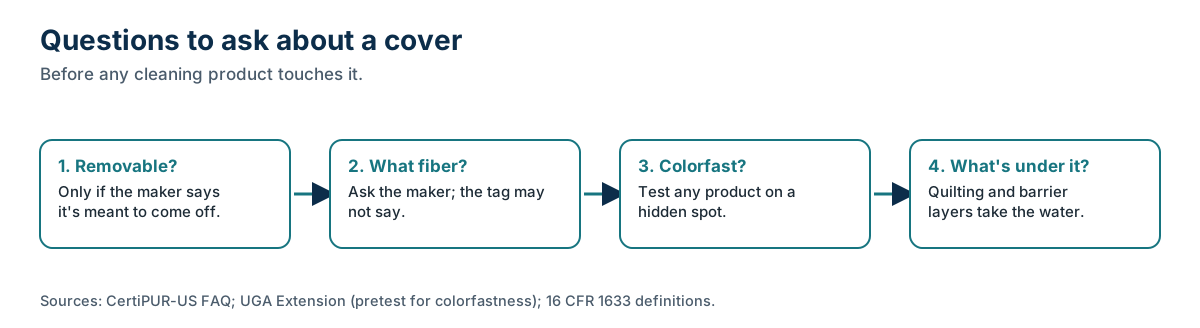
Because it's the only part anyone should touch. CertiPUR-US advises "never remove the cover of your mattress, even if it has a zipper, unless the mattress cover is specifically intended to be removed for laundering." Everything a cleaning does happens through the ticking. A cover that can't be removed can't be laundered, so moisture and products have to be controlled at the surface.
Fiber also matters for products. Wool, for example, carries its own warnings about ammonia, alkali and enzymes, which the wool article sets out. The University of Georgia Extension gives a simple rule for any fabric: "Always pretest each cleaning agent on an inconspicuous area first to determine colorfastness." Hub 2's moisture-sensitivity page, which mattress materials are most moisture-sensitive, compares layers.
Can odor live in the cover?
Sometimes, and Hub 6 has a page on telling whether odor is in the cover or the foam. The cover is the first thing a spill reaches, and Hub 5 explains how to tell if moisture reached the core. Keeping soil off the cover in the first place is the simplest step. CertiPUR-US says "The best way to protect your mattress from getting soiled is to use a mattress pad or mattress protector on top of the mattress."
Sleep Sanitation's view
This section is our view. The ticking is the only part of a mattress we touch. We don't open covers, and we keep moisture at the fabric surface. Our equipment is Italian-made Vapor Clean machines, our default is organic methods, and enzyme treatment is for urine and organic odor. Treat all of that as our own reasoning rather than a manufacturer exemption: the care label and warranty terms govern, so check your warranty terms before you book. For "sanitize" we follow the CDC's terms, and we make no disinfection claim. Once we're done, leave the bed unmade until it's dry to the touch; our moisture check confirms it. The first mattress is $249 (pricing), and the mattress materials hub maps every layer.
What we don't know
- The fiber content of a given cover when the maker doesn't publish it. It isn't required on the label.
- How common inner sock layers are across the market. The California study looked at four mattresses.
- How different cover fabrics hold up to repeated low-moisture cleaning over years. We found no study.
Changelog
- 5 October 2026: First published. Sources accessed on this date.
Sources
- 16 CFR Part 1633: Standard for the Flammability (Open Flame) of Mattress Sets · Electronic Code of Federal Regulations (eCFR)
- 16 CFR Part 1632: Standard for the Flammability of Mattresses and Mattress Pads (FF 4-72) · Electronic Code of Federal Regulations (eCFR)
- Fiberglass and Other Flame-Resistant Fibers in Mattress Covers (Wagner, Fowles and Barreau, Int J Environ Res Public Health, 2022) · PubMed Central
- Threading Your Way Through the Labeling Requirements Under the Textile and Wool Acts · Federal Trade Commission
- Remove Stains from Blood (accessed 2026-10-05) · University of Georgia Extension, Textiles
- Frequently Asked Questions (accessed 2026-10-05) · CertiPUR-US
- IN-TOUCH Vol. 1 No. 2: Foam density · Polyurethane Foam Association
- Cleaning and disinfecting your school (definitions) · CDC
Last reviewed October 5, 2026. Manufacturer specifications and care instructions change; check the current version for your exact model. This page is general information, not medical advice. How we source and check pages: editorial standards.