
Skip to content

Knowledge Center · Mattress Materials

What your mattress is made of

This hub explains the materials inside a mattress: how foam is made, why memory foam softens, how latex and wool differ, what cooling layers and fire barriers do, what the law tag and cover tell you, and how coils age. Cleaning rules for each material live in the compatibility hub; this one covers what the materials are.

Monday–Friday, 9am–6pm. Missed a call? We return calls and texts on Saturday and Sunday too.

Short answer

Most mattresses are a stack of layers: a ticking cover, sometimes a fire barrier, comfort layers of foam, latex, fiber or wool, and a support core of coils, foam or latex. Each material has its own chemistry. Foam is made from a polyol and an isocyanate, latex is vulcanized rubber, wool is a scaled protein fiber and coils are steel. That chemistry decides how each one ages and what care it tolerates.

By Matthew Brunken · Updated October 5, 2026 · Last reviewed October 5, 2026 · Sources · Editorial standards

A mattress looks like one object, but it's a stack of different materials, each with its own chemistry. Under the cover fabric there may be a fire barrier, then comfort layers of polyurethane foam, memory foam, latex, fiber or wool, and below them a support core of coils, foam or latex. Knowing what each material is made of explains why it feels the way it does, how it ages and what kind of care it can take.
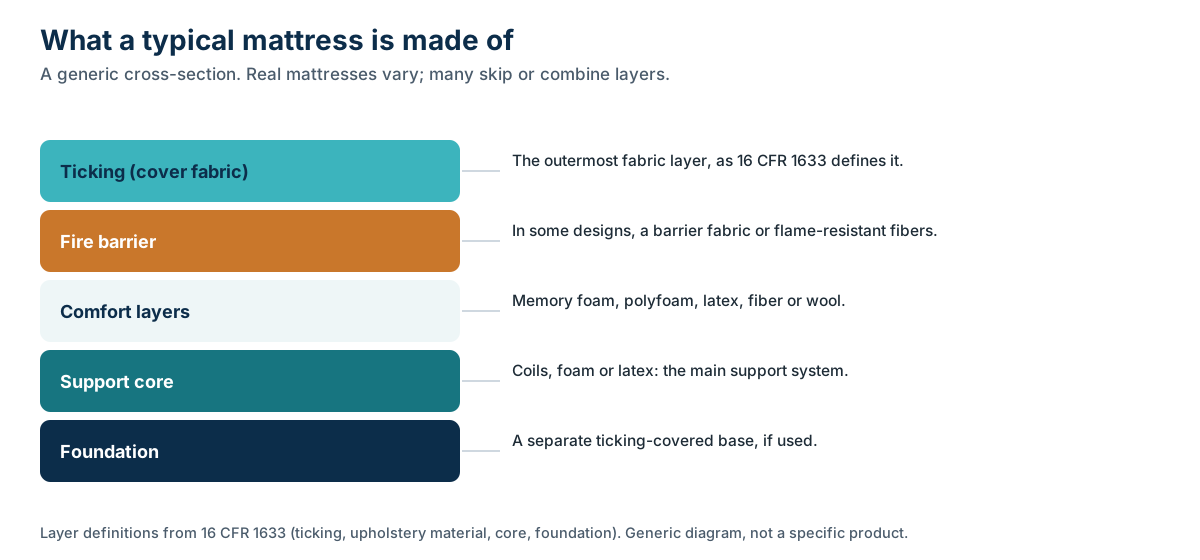
Layered cross-section of a generic mattress showing ticking, a fire barrier, comfort layers, the support core and a separate foundation
Five layers, each with its own chemistry. Diagram: Sleep Sanitation (original, illustrative).

This hub is general information about mattress materials, not medical advice. For health questions, ask a doctor.

Why materials, and why now

The earlier hubs in this Knowledge Center are about cleaning: methods, compatibility, accidents, allergens, moisture, decisions and, in the seventh hub, the chemistry of mattress stains. They keep running into the same question, which is what the mattress is made of. Memory foam behaves differently from latex, wool from polyester, a coil core from a foam core. This hub answers that question directly, so the cleaning pages can link here instead of repeating it.

We stick to what the materials are and how they behave. Whether a particular material tolerates a particular cleaning method, maker by maker, belongs to the compatibility hub. How water and heat move through a mattress belongs to Hub 5, starting with why construction matters for cleaning.

The layers, as the law defines them

The clearest vocabulary for the layers comes from federal flammability law. 16 CFR 1633 splits a mattress into three zones: the ticking on the outside, the core that does the supporting, and the upholstery material in between. Those legal terms are more precise than marketing names like "comfort system," so we use them throughout, especially in the ticking article and the law tag article.

Foam is chemistry, not just padding

Most mattress foam is flexible polyurethane, made by reacting a polyol and an isocyanate with water, as the Polyurethane Foam Association explains. The same basic chemistry makes soft and firm foams; the density and firmness article explains why the PFA insists density and firmness are independent. Memory foam is a viscoelastic version that the PFA says softens with warmth and humidity, covered in why memory foam softens with body heat. And foam ages: a foam maker's information sheet explains why most foam yellows over time, in why mattress foam turns yellow.
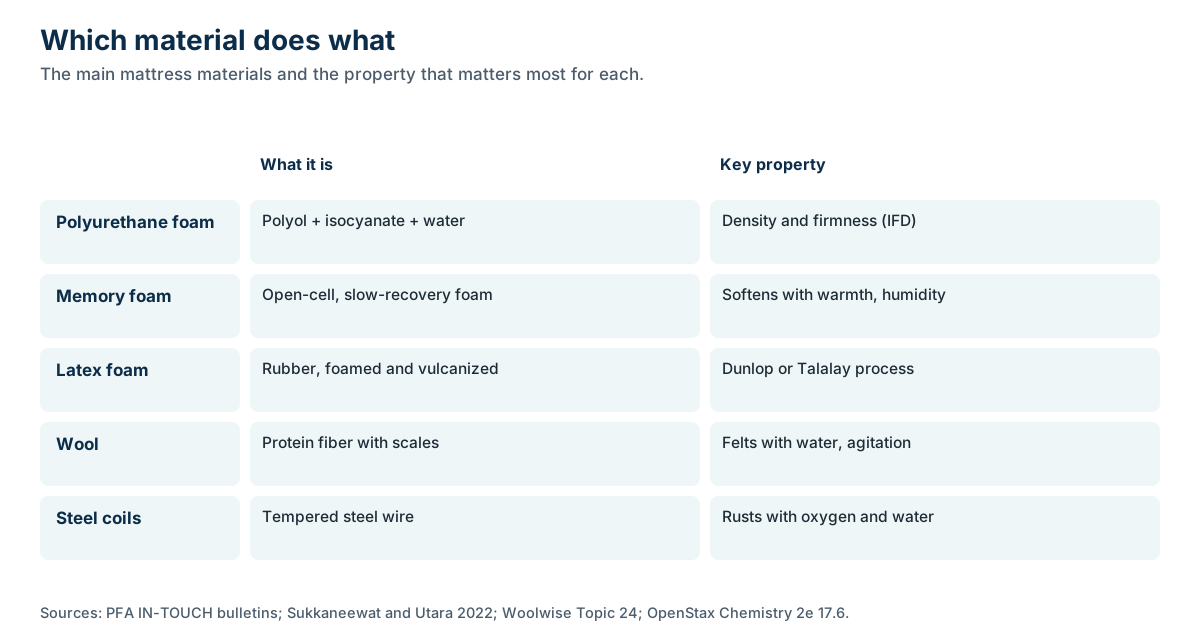
Grid of five mattress materials, what each is made of and the one property that matters most for cleaning and care
Different materials, different weak points. Diagram: Sleep Sanitation (original, illustrative).

Other materials, other rules

Latex foam is rubber, not polyurethane. It's made by the Dunlop or Talalay process, and researchers such as Sukkaneewat and Utara describe how the two differ. Cooling layers rely on phase-change materials, heat capacity or airflow, and the evidence behind each is narrower than marketing suggests. Wool is a protein fiber with surface scales, and Woolwise's textile notes explain why water and agitation can felt it. Coils are steel, and OpenStax Chemistry explains the basics of rust; a spring maker's descriptions explain the coil types.

Rules that shape what's inside

Some layers exist because of regulation. Mattresses must pass a cigarette test under 16 CFR 1632 and an open-flame test under 16 CFR 1633, and makers choose how to comply. CertiPUR-US says some use fiberglass barrier fabrics, which is why the fire barrier article explains why not to open a cover. Labeling rules also leave gaps: the FTC lists mattress outer coverings among items not covered by the Textile Act. And new foam off-gasses, which the EPA describes as VOCs emitted as gases from solids.

How we handle evidence here

Our sources are the federal regulations themselves, peer-reviewed studies, university and government references, the foam industry's own technical bulletins and, for coils, a spring manufacturer's product descriptions. Industry and manufacturer sources are named as such. Studies are cited for what they tested: a crib-mattress emissions study isn't an adult-bed study, and a bench test with scaled foam samples isn't a night's sleep. Where we couldn't find a source, we say so in each article's "What we don't know" list instead of guessing.

Sleep Sanitation's position

This section is our view. Material knowledge is why we ask what a mattress is made of before we start. We clean through the ticking and never open a cover. Organic cleaning methods are our default, with enzyme treatment for urine and organic odor, and our Italian-made Vapor Clean machines let us keep moisture low for foam, latex and wool alike. We use "sanitize" in the sense set out in the compatibility hub's entry on the CDC's cleaning and sanitizing terms, and we make no disinfection claim. That approach is our own reasoning, not a manufacturer exemption; your care label and warranty terms govern, so check your warranty terms before you book. The first mattress is $249, and the pricing page lists the rest.

How to use this hub

If you know what your mattress is made of, open that material's article. If you don't, start with how to read a mattress law tag and the ticking article. If you're curious about a smell from a new mattress, read off-gassing and CertiPUR-US. Then check the material's page in the compatibility hub before any cleaning.

What we don't know

  • What's inside a specific mattress. Makers aren't required to list cover fibers, barrier materials or foam formulas on the label.
  • How lab findings about foams, latex and cooling materials carry over to finished, branded mattresses, which combine many layers.
  • How long each material lasts in typical home use. The sources describe how materials change, not standard lifespans.

Changelog

  • 5 October 2026: First published. Sources accessed on this date.

Foam

How polyurethane foam is made, what density and firmness numbers mean, why memory foam softens with warmth, and why foam yellows.

Latex and cooling layers

How Dunlop and Talalay latex are made, and how phase-change materials and other cooling ideas work.

Fibers and covers

Why wool felts, and what ticking and cover fabrics are made of.

Rules and labels

Fire barriers and fiberglass, the law tag, and what off-gassing and CertiPUR-US mean.

Coils

Bonnell, continuous and pocketed coils, rust and spring fatigue.

Defined terms

The vocabulary of mattress cleaning methods

Every article in this Knowledge Center uses these words the same way. Each term has its own link, so you can point anyone (or any search engine) straight to the definition.

Polyol
One of the two main ingredients of polyurethane. Gama and colleagues' review explains that polyurethanes form when the hydroxyl groups of a polyol react with the isocyanate groups of an isocyanate; the polyol forms the foam's soft segments.Source: Polyurethane Foams: Past, Present, and Future (Gama, Ferreira and Barros-Timmons, Materials, 2018)
Isocyanate
The second main ingredient of polyurethane, carrying reactive NCO groups that link with a polyol. Gama and colleagues' review names MDI and TDI as the most commonly used isocyanates.Source: Polyurethane Foams: Past, Present, and Future (Gama, Ferreira and Barros-Timmons, Materials, 2018)
Slabstock foam
Foam made in a continuous block: the liquid mix rises on a conveyor and is later cut into sheets and shapes. It's the method behind most furniture and bedding foam, according to the Polyurethane Foam Association.Source: IN-TOUCH Vol. 1 No. 1: Flexible polyurethane foam, an introduction
Blowing agent
Whatever produces the gas that expands foam. Gama and colleagues' review explains that the isocyanate reacts with water to yield urea groups and carbon dioxide, and the PFA calls carbon dioxide the primary blowing agent.Sources: Polyurethane Foams: Past, Present, and Future (Gama, Ferreira and Barros-Timmons, Materials, 2018); IN-TOUCH Vol. 1 No. 1: Flexible polyurethane foam, an introduction
Foam fillers and additives
Materials added to foam that aren't part of the polymer. The PFA says large amounts can make foam more likely to tear and reduce durability, which is why it recommends judging foam by polymer density.Source: IN-TOUCH Vol. 1 No. 2: Foam density
Foam density
Mass per unit volume, given in pounds per cubic foot in the US. The PFA says flexible foam ranges from about 0.5 to 6 pcf and that density is independent of firmness.Source: IN-TOUCH Vol. 1 No. 2: Foam density
Polymer density
Density counted from the fully reacted foam polymer only. The Polyurethane Foam Association says it, not overall density, is the way to gauge performance, since added fillers can make a foam heavier.Source: IN-TOUCH Vol. 1 No. 1: Flexible polyurethane foam, an introduction
Support factor
A ratio comparing deep firmness with surface firmness: foam is tested at 65 and 25 percent indentation and the first reading is divided by the second. Per the PFA, values run from roughly 1.5 to 2.6.Source: IN-TOUCH Vol. 1 No. 1: Flexible polyurethane foam, an introduction
Compression set (height loss)
Foam's tendency to lose thickness after being compressed. The PFA's density bulletin says height loss decreases as density increases, so body impressions may be less noticeable.Source: IN-TOUCH Vol. 1 No. 2: Foam density
Ball rebound resilience
A measure of foam springiness: how high a dropped steel ball bounces. The PFA says flexible foams range from about 20 to 80 percent, and memory foam is below 20 percent.Source: IN-TOUCH Vol. 11 No. 1: Viscoelastic (memory) foam
Aromatic isocyanate
An isocyanate such as TDI or MDI. A foam maker's information sheet says foam made with an aromatic isocyanate yellows under UV light, and that quinones form only from aromatic isocyanates.Source: Discoloration of Polyurethane Foam (information sheet)
Foam yellowing
Discoloration of polyurethane foam from UV light, nitrogen oxides, ozone or heat. The Foamex sheet says UV and gas yellowing is permanent and that foams discolor before they lose physical properties.Source: Discoloration of Polyurethane Foam (information sheet)
BHT yellowing
Yellowing caused by the antioxidant butylated hydroxytoluene reacting with nitrogen oxides. The Foamex sheet says it is promoted by alkaline conditions and can be reversed with a dilute acid.Source: Discoloration of Polyurethane Foam (information sheet)
Natural rubber latex
The milky material from the rubber tree Hevea brasiliensis. A 2026 review says fresh latex is about 60% water, 35% polyisoprene and 5% proteins and lipids.Source: Natural rubber latex allergy (Lisiecka and Luczak, 2026)
Vulcanization
The curing step that stabilizes a rubber foam's structure. Both the Dunlop and Talalay latex processes end with heat vulcanization, according to published process descriptions.Sources: Chemistry, Processing, Properties, and Applications of Rubber Foams (2021); Ultrasonic-assisted Dunlop method for natural rubber latex foam production (2022)
Synthetic rubber latex
Latex made from a synthetic rubber rather than tree latex. A 2021 rubber foam review gives SBR as an example, describing it as a synthetic rubber derived from petroleum.Source: Chemistry, Processing, Properties, and Applications of Rubber Foams (2021)
Phase-change material (PCM)
A substance that stores and releases large amounts of energy as it melts and solidifies at a set temperature. The PFA says PCM in foam holds temperature near its melting point until its capacity is used up.Source: IN-TOUCH Vol. 11 No. 1: Viscoelastic (memory) foam
Heat capacity
How much heat an object takes in or gives off per degree of temperature change. In OpenStax's explanation, a larger pan of the same metal has a proportionally larger heat capacity, because the amount of material counts as well as its type.Source: Chemistry 2e, 5.1 Energy Basics
Differential frictional effect
The direction-dependent friction caused by the scales on wool and other animal fibers. Woolwise explains that it makes fibers move preferentially toward the root, which drives felting.Source: Wool 482/582, Topic 24: Principles of Wool Fabric Finishing
Felting shrinkage
Irreversible shrinkage when wool fibers mat together under mechanical action in water. Woolwise says it keeps progressing with washing time until the fabric reaches a limiting density.Source: Wool 482/582, Topic 24: Principles of Wool Fabric Finishing
Fire barrier fabric
A layer that helps a mattress meet federal flammability standards. CertiPUR-US says some makers surround the foam core with barrier fabrics made from fiberglass; others use flame-resistant fibers.Source: Frequently Asked Questions
Open-flame standard (16 CFR 1633)
The federal rule limiting the size of a mattress fire. A mattress set's peak heat release may not exceed 200 kW in a 30 minute test, and total heat release may not exceed 15 MJ in the first 10 minutes.Source: 16 CFR Part 1633
Cigarette ignition standard (16 CFR 1632)
The federal test of whether a lighted cigarette can ignite a mattress or mattress pad. Each test location passes if the char length is no more than 2 inches.Source: 16 CFR Part 1632
Upholstery material
Under 16 CFR 1633, all material, loose or attached, between the mattress ticking and the core. Quilting, comfort layers and barriers fall in this zone.Source: 16 CFR Part 1633
Mattress core
Under 16 CFR 1633, the main support system that may be present in a mattress, such as springs, foam, water bladder, air bladder or resilient filling.Source: 16 CFR Part 1633
Law tag
The required labels on a mattress. The federal 1633 label lists the maker, address, month and year of manufacture, model, prototype ID and certification; state bedding tags such as Pennsylvania's add filling materials.Sources: 16 CFR Part 1633; 34 Pa. Code § 47.11, Tags and stamps
Volatile organic compounds (VOCs)
Chemicals emitted as gases from certain solids or liquids. The EPA lists furnishings among sources and says many VOCs are consistently higher indoors than outdoors.Source: Volatile Organic Compounds' Impact on Indoor Air Quality
Off-gassing
The release of VOCs from a product into the air. The PFA says off-gassing naturally occurs with any product and advises ventilating memory foam before final assembly.Source: IN-TOUCH Vol. 11 No. 1: Viscoelastic (memory) foam
CertiPUR-US
A certification for flexible polyurethane foam only. The program says certified foam is tested for formaldehyde below 0.1 ppm and total VOCs below 0.5 ppm; it doesn't certify whole mattresses or latex.Source: About certified foam
Bonnell coil
An open-coil innerspring design. Spring maker Leggett & Platt calls Bonnell systems the mainstay of the industry.Source: Bonnell product sheet
Continuous coil
A spring unit formed from long strands of wire rather than separate springs. Leggett & Platt describes its Mira-Coil system as continuous strands of specially formed wire.Source: Mira-Coil product sheet
Pocketed coil
A spring sewn into its own fabric pocket. Leggett & Platt says its fabric-encased coils isolate motion transfer and that each coil flexes and moves independently.Source: ComfortCore (fabric-encased)
Tempered coil
A spring treated with heat or electricity to set its properties. Leggett & Platt says tempering gives its coils resilience and a uniform amount of resistance.Source: ComfortCore (fabric-encased)
Rust
Hydrated iron(III) oxide. OpenStax explains that iron rusts when exposed to oxygen and water, and that electrolytes such as sodium chloride speed the reaction.Source: Chemistry 2e, 17.6 Corrosion

Frequently asked questions

What is a mattress made of?+

Usually a ticking cover, sometimes a fire barrier, comfort layers of foam, latex, fiber or wool, and a support core of coils, foam or latex. Federal rules define the ticking, upholstery material and core.

Why does material matter for cleaning?+

Each material reacts differently. Memory foam softens with heat and humidity, wool felts with water and agitation, and steel coils can rust. The compatibility hub gives material-by-material cleaning guidance.

Is memory foam the same as polyurethane foam?+

Memory foam is a type of polyurethane foam. The Polyurethane Foam Association describes it as an open-cell, slow-recovery flexible polyurethane foam.

Can I open my mattress cover to see what's inside?+

Not unless it's designed to come off. CertiPUR-US advises never removing a cover unless it's intended for laundering, and a California study found fiberglass could reach layers inside some covers.

Where can I find out what's in my mattress?+

Start with the law tag, the product page and the manufacturer. The federal label lists the date and model; state tags may list filling materials; cover fiber content often isn't required.

Do you test mattress materials?+

No. We clean mattresses; we don't analyze materials. This hub explains published information about materials so you can read labels and ask makers the right questions.

Sources

  1. IN-TOUCH Vol. 1 No. 1: Flexible polyurethane foam, an introduction · Polyurethane Foam Association
  2. IN-TOUCH Vol. 1 No. 2: Foam density · Polyurethane Foam Association
  3. IN-TOUCH Vol. 11 No. 1: Viscoelastic (memory) foam (revised 2016) · Polyurethane Foam Association
  4. Discoloration of Polyurethane Foam (information sheet) · Foamex (foam manufacturer)
  5. Ultrasonic-assisted Dunlop method for natural rubber latex foam production (Sukkaneewat and Utara, Ultrasonics Sonochemistry, 2022) · PubMed Central
  6. Wool 482/582, Topic 24: Principles of Wool Fabric Finishing (Pailthorpe) · Australian Wool Education Trust, Woolwise
  7. 16 CFR Part 1633: Standard for the Flammability (Open Flame) of Mattress Sets · Electronic Code of Federal Regulations (eCFR)
  8. 16 CFR Part 1632: Standard for the Flammability of Mattresses and Mattress Pads (FF 4-72) · Electronic Code of Federal Regulations (eCFR)
  9. Threading Your Way Through the Labeling Requirements Under the Textile and Wool Acts · Federal Trade Commission
  10. Frequently Asked Questions (accessed 2026-10-05) · CertiPUR-US
  11. Volatile Organic Compounds' Impact on Indoor Air Quality · US EPA
  12. Chemistry 2e, 17.6 Corrosion · OpenStax (Rice University)
  13. ComfortCore fabric-encased coils · Leggett & Platt Bedding Group
  14. Cleaning and disinfecting your school (definitions) · CDC

Last reviewed October 5, 2026. Each article in this hub lists its own sources. This page is general information, not medical advice. See our editorial standards for how sources are chosen and checked.

Ready for a cleaner bed?

Call or text to book. Tell us how many mattresses and your town, and we'll confirm a time and your price.

First mattress $249 in any size. See the pricing page for the full price list and current offers.

Monday–Friday, 9am–6pm. Missed a call? We return calls and texts on Saturday and Sunday too.

Call Text Book