
Short answer
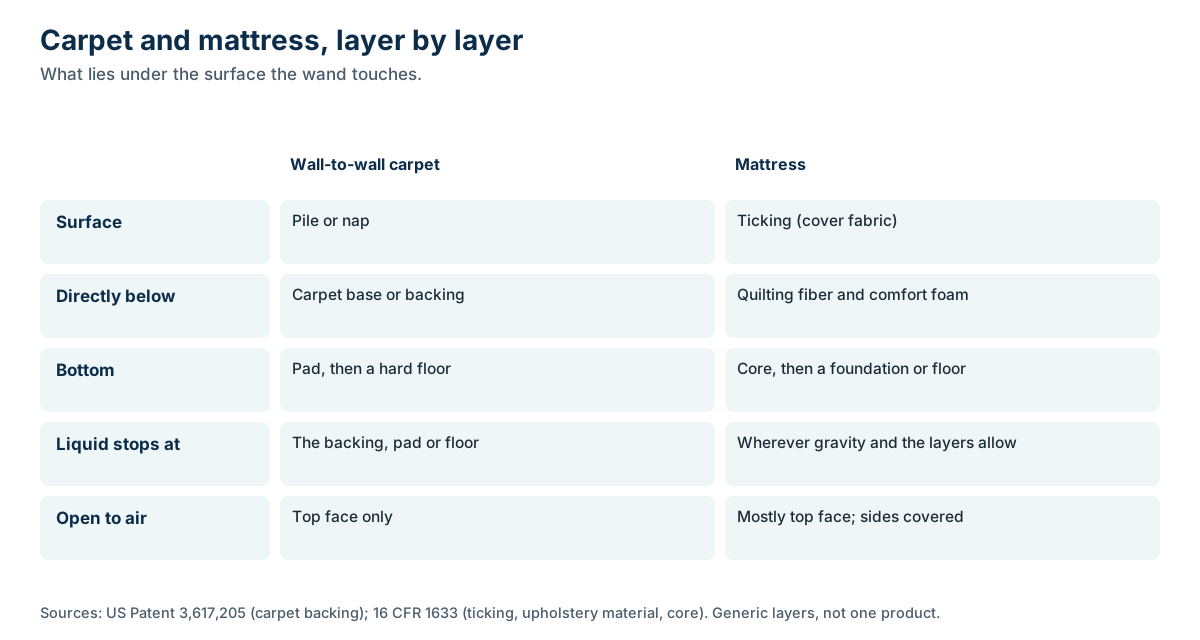
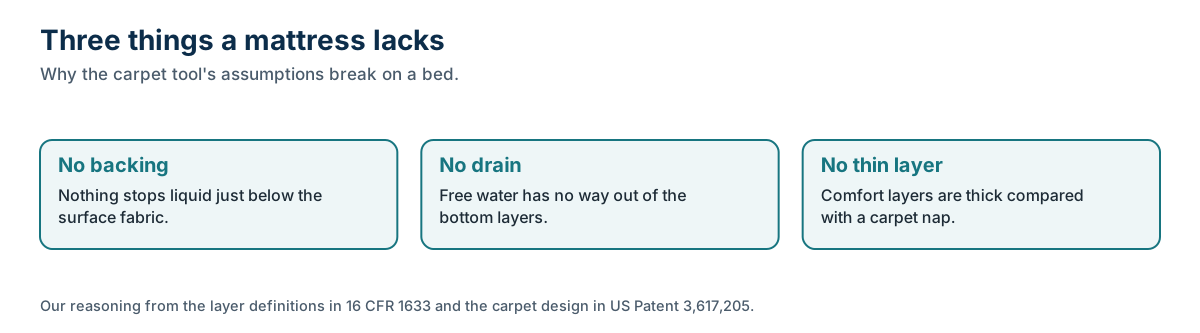
Carpet extraction tools are designed around a thin pile anchored in a backing that sits on a pad and a hard floor, so liquid can only go so deep. A mattress is a thick stack of fiber and foam enclosed by ticking, with no backing to stop liquid and no drain below. Tools that work well on carpet can push water past the reach of their own suction.
Key terms used on this page
- Carpet backing:
- The base layer that carpet pile is anchored in. A 1968 carpet-cleaning patent draws it as the carpet base or backing and angles its spray so soil isn't driven down toward it.
- Hot-water extraction (HWE):
- The carpet industry's most common professional method. The Carpet and Rug Institute defines an extractor as equipment that uses pressure, water or cleaning solution, and suction to remove soil. It is often marketed as 'steam cleaning' even though it sprays hot water rather than steam.
- Wicking:
- Moisture moving through a material as it dries, carrying dissolved soil or stain with it. When the moisture evaporates at the surface, the stain can reappear on a fabric that looked clean.
- Capillary action:
- The tendency of a liquid to be raised or suppressed in a narrow tube or passage. OpenStax traces it to the balance between the liquid's cohesion and its adhesion to the solid, which also explains why water beads on wax but spreads on bare paint.
- Upholstery material:
- Under 16 CFR 1633, all material, loose or attached, between the mattress ticking and the core. Quilting, comfort layers and barriers fall in this zone.
Carpet cleaning gear doesn't fit a mattress because it was designed around a different object. Carpet is a thin pile anchored in a backing over a pad and a hard floor, so liquid can only go so deep. A mattress is a thick stack of fiber and foam enclosed in ticking, with no backing to stop liquid and no drain beneath. A tool that works well on carpet can push water past the reach of its own suction.
General information about mattress cleaning methods, not medical advice.
What does carpet equipment assume?
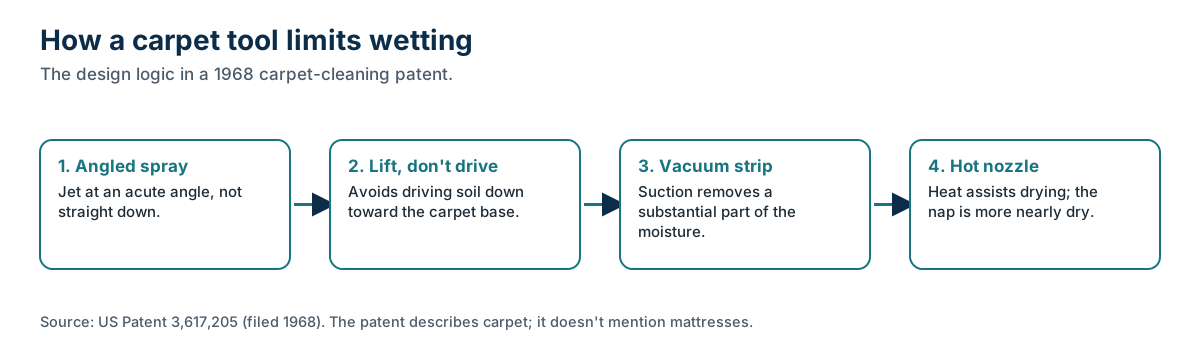
That there's a floor right under the fabric. Carpet extraction patents make the assumption visible. A 1968 carpet-cleaning patent labels the layers in its drawing: "the numeral 66 designating nap of the carpet, the carpet base or backing being indicated at 64." The whole design is about the nap, the thin layer above that backing.
The design goes further. The patent angles its spray rather than shooting straight down, explaining that "rather than driving embedded soil downwards through the nap towards the carpet base 64 as would be the case with a vertically impinging spray, acute impingement tends to loosen and dislodge embedded dirt and soil." Even on carpet, the designer was trying to keep things from heading down. Hub 1's article on carpet versus mattress equipment describes how such tools are used today; this article is about the layers underneath.
What does a mattress have instead of a backing?
More fabric and more foam. Federal flammability law gives the cleanest vocabulary. Under 16 CFR 1633, "Mattress means a resilient material or combination of materials enclosed by a ticking." Ticking is "the outermost layer of fabric or related material," and "Upholstery material means all material, either loose or attached, between the mattress ticking and the core of a mattress." The core is "the main support system," such as springs or foam.
So directly below a mattress's surface fabric there's quilting fiber and comfort foam, not a backing. Below those come more layers and then the core. Nothing in that stack is designed to stop liquid. Hub 8's ticking article explains what cover fabrics are made of.
Why does the missing backing matter?
Because it decides where liquid stops. On carpet, the backing, the pad and the floor set a limit. Liquid that gets past the nap meets layers that are thin and close to the surface, and a carpet lies open to the room on its top face. On a mattress, liquid that gets past the ticking keeps going into fiber and open-cell foam, pulled sideways by capillary action and down by gravity.
The 1968 patent names the forces at work even on carpet: "the hot solution penetrates the nap by the force of the jet, aided by capillarity and gravity." OpenStax's physics text explains that capillary action "can move liquids horizontally over very large distances," while the height it can lift a liquid "is limited by its weight." On a carpet, those forces have a short distance to act. In a mattress, they have the whole depth of the bed. Where water goes when it's pushed into a mattress follows each force through the layers.
What does "no drain" mean in practice?
That water can leave only by being pulled back out or by evaporating. Carpet guidance relies on both. CRI's residential standard tells DIY users to "Extract as much of the water as possible by making a dry pass after the initial wet pass. Multiple dry passes may be necessary." Then it relies on air: the carpet lies flat with its pile open to the room.
A mattress offers neither route well. Suction reaches the layers nearest the wand, as why suction can't pull water back out of foam explains. And the enclosed design limits airflow: the ticking wraps the sides and bottom, and the bottom usually rests on a foundation or platform. Water that sinks to the lower layers has nowhere to drain and only a slow path out as vapor. That's why Hub 5 explains why foam mattresses are slow to dry.
How does spray pressure change the picture?
It sets how deep liquid goes on the first pass. The 1977 patent reports, from its own experiments on carpet, that "pressures above about 120 psi tend to blow the solution too far down into the carpet often soaking the carpet bed and mat." It also found that low pressure soaked the fiber, so the inventor chose a middle range.
Those figures describe carpet, and they're one inventor's claims. But they show the trade-off designers faced: pressure drives liquid down, and on carpet "too far down" means the pad. On a mattress there's no pad and floor close beneath, so "too far down" means into the comfort layers. We don't know of any published test of spray pressure on mattresses, and we don't claim one.
Why did the same tools end up on mattresses?
Because, on our reading of the record, mattresses joined the carpet and upholstery route. The carpet add-on article traces that history, from a 1917 patent for washing carpets in place to van-mounted units in the 1970s. The 1964 patent built one machine for rugs and upholstery, and a mattress looks like upholstery.
Upholstery has its own standard, the IICRC's S300, which the IICRC says "provides a specific set of practical standards for upholstery cleaning." We found no equivalent written for mattresses. Without one, the carpet-and-upholstery toolkit is the default, and the physics of a thick, enclosed bed has to be handled case by case.
Is wicking the same problem on a mattress?
It's a bigger version of it. The carpet trade has long known wicking: the 1968 patent says "wicking is a problem," with adverse effects "well known both to the trade and to householders who have had carpets cleaned by in situ methods." Hub 1's glossary defines wicking as moisture moving through a material as it dries, carrying dissolved soil or stain with it to the surface.
In a mattress, the reservoir is deeper. Water and dissolved soil spread through foam and fiber, and as the surface dries, liquid moves toward it and leaves residue behind. Hub 7 explains why mattress stains come back after drying, including rings and wicking. The deeper the water went, the more there is to come back.
What should a careful cleaner do differently?
Change the starting assumption. Instead of put liquid in, then pull it back, start from put little liquid in. That's the logic behind the low-moisture approach described in what a low-moisture method does differently. Hub 1 compares the methods directly in dry vapor steam versus carpet extraction. Whatever the equipment, the useful question is where the water ends up, which is the first of this hub's method questions. The hub on mattress cleaning done wrong maps the rest of the failure modes.
Sleep Sanitation's view
This section is our view, and we have a stake in it as a mattress-only service. We don't think carpet equipment is bad; we think it's built for carpet, and its designers said as much in their patents. Our equipment choice follows from the layers: Italian-made Vapor Clean machines that put little water in, so there's no extraction step. That's our own reasoning, not a manufacturer exemption. Your care label and warranty terms govern, so check your warranty terms before you book. We make no disinfection claim, and we use "sanitize" in the CDC's terms. The bed stays unmade until it's dry to the touch, and the moisture check comes before we leave. See how we're different.
What we don't know
- How deep water travels in a mattress under typical extraction pressures. We found no published test on mattresses.
- How much the cover fabric slows or speeds liquid entry for different tickings. Covers vary widely and makers rarely publish this.
- Whether tool designs made specifically for mattress extraction change these results. We found no patents or studies addressing it.
Changelog
- 6 October 2026: First published. Sources accessed on this date.
Sources
- US Patent 3,617,205: Method for cleaning carpets and like materials (filed 1968) · Google Patents (USPTO record)
- US Patent 4,154,578: Method and apparatus for cleaning a carpet on location (filed 1977) · Google Patents (USPTO record)
- CRI 205 Residential Carpet Standard for Maintenance and Cleaning (2023) · Carpet and Rug Institute
- 16 CFR Part 1633: Standard for the Flammability (Open Flame) of Mattress Sets · Electronic Code of Federal Regulations (eCFR)
- College Physics 2e, 11.8 Cohesion and Adhesion in Liquids: Surface Tension and Capillary Action · OpenStax (Rice University)
- ANSI/IICRC S300 Standard for Professional Upholstery Cleaning (overview page) · IICRC
- US Patent 1,240,799: Carpet washing and rinsing machine (filed 1917) · Google Patents (USPTO record)
Last reviewed October 6, 2026. Manufacturer specifications and care instructions change; check the current version for your exact model. This page is general information, not medical advice. How we source and check pages: editorial standards.