
Skip to content

Knowledge Center · Cleaning Methods

Mattress cleaning methods: what actually happens to the mattress

This hub explains, in plain terms, what each mattress cleaning method physically does to a mattress: how much water goes in, how heat is delivered, what is removed and what is left behind. It defines the vocabulary that the rest of the Knowledge Center relies on.

Monday–Friday, 9am–6pm. Missed a call? We return calls and texts on Saturday and Sunday too.

Short answer

Every mattress cleaning method changes three things: how much water it leaves in the bed, how it delivers heat, and what it takes away or leaves behind. Extraction and shampooing are wet, detergent-based methods borrowed from carpet; dry-vapor steam is a heat method with little added water; HEPA vacuuming is removal only. Check your mattress maker's care instructions first.

By Matthew Brunken · Updated October 2, 2026 · Last reviewed October 2, 2026 · Sources · Editorial standards

Cleaning changes three things in a mattress: how much water goes into it, how heat reaches the fabric, and what is taken out or left behind. Hot-water extraction and shampooing put water and detergent in, then try to pull them back out. Dry-vapor steam delivers heat with a small amount of condensed water. HEPA vacuuming only removes. Whatever the method, the mattress maker's care label comes first.

Why this hub exists

Mattress cleaning is often offered as an add-on to carpet cleaning, using the same hot-water extraction equipment. That isn't a criticism of carpet cleaners. It does mean the tools and vocabulary used on many mattresses were designed for floors, where the Carpet and Rug Institute says hot-water extraction is the most common professional residential carpet cleaning system.

The result is that the same words can mean different things. "Steam cleaning" might mean hot-water extraction, a handheld garment steamer or a pressurized dry-vapor boiler. "Dry" might mean dry to the touch in an hour or dry all the way through by tomorrow. "Sanitize" might mean a measured reduction in germs, or it might just mean "cleaned."

This hub fixes the vocabulary first. Each article explains one mechanism: where the water goes, how heat gets into fabric, what gets removed and what stays behind. We cite equipment specifications, manufacturer care instructions, carpet-industry standards and peer-reviewed studies, and we say so plainly when the data doesn't exist.
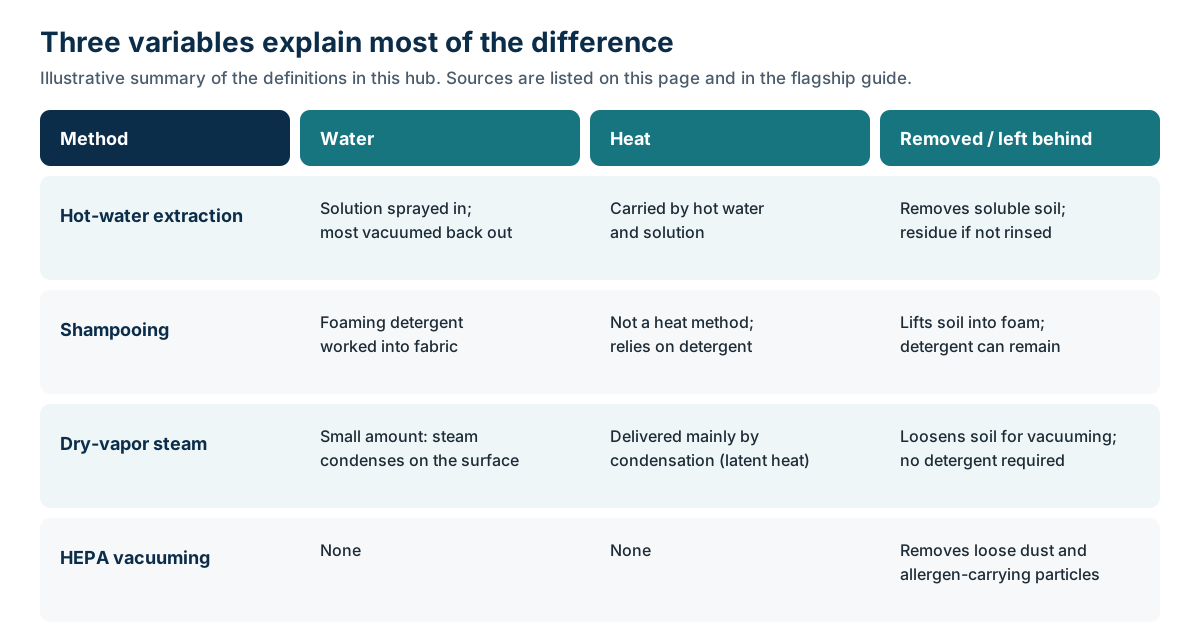
Table-style diagram comparing hot-water extraction, shampooing, dry-vapor steam and HEPA vacuuming on water, heat and what each removes or leaves behind
The four common methods side by side on the three variables this hub is organized around: how much water goes in, how heat is delivered, and what is removed or left behind. Extraction and shampooing are water-and-detergent methods; dry-vapor steam is a heat method that adds a little condensate; HEPA vacuuming adds neither water nor heat. Diagram: Sleep Sanitation (original, illustrative).

How to use this hub

How later guides build on this one

Later hubs in the Knowledge Center lean on the definitions here. The second, Can this mattress be professionally sanitized?, quotes what each manufacturer's care page says about steam, water, heat and chemicals. When a mattress maker writes a care instruction, that instruction governs. Tempur UK says "Do not steam-clean or dry-clean the TEMPUR Material." It warns "There is a high risk that soaking with water or other cleaning fluids will cause irreversible damage" and adds, "It will also invalidate your guarantee." Tempur-Pedic US says TEMPUR material "should never become wet" and notes "Due to the temperature-sensitivity of the TEMPUR-material, adding high heat can hinder its ability to react to your body temperature and conform to your body shape." Purple says "you should not steam clean a memory foam, latex, or adjustable mattress since the heat and water could damage its materials" and "you should not steam clean a Purple mattress". Sleep Sanitation does clean Tempur-Pedic and Purple mattresses with an Italian-made Vapor Clean dry-vapor system (Vapor Clean's product page claims "just 5-6% moisture," a maker claim, not a measurement of our equipment), in quick, low-moisture passes. That is our own method and reasoning, not an exemption from either maker. Your care label and warranty terms govern your own decision, and following the label is the safe default; check your warranty terms, or ask the manufacturer, before any steam or vapor cleaning. This hub explains the mechanisms behind instructions like these, so the reasons make sense and you can compare what different cleaning providers actually do.

The third hub, Mattress accidents: urine, pets, sweat and odor, applies these mechanisms to a specific problem: where urine goes inside a mattress, what can be removed, and why low moisture matters most when the stain is organic.

What we don't know

  • How much water a steam pass leaves in a mattress. Vendors publish water-flow and "5% moisture" figures for their machines, but we have not found an independent measurement of moisture left in a mattress after steam cleaning.
  • Fabric surface temperatures. Boiler and tip temperatures are published; the temperature the ticking and comfort layers actually reach during a normal pass generally is not.
  • A mattress-specific cleaning standard. We have not found a consensus standard written for in-home mattress cleaning. Carpet and upholstery standards from the IICRC and CRI are the closest references.
  • Clinical outcomes. The 2013 dust mite practice parameter says no clinical trials have shown a benefit from physical measures such as heating, so we don't claim health outcomes for any method.

Our editorial standard

Every figure in this hub's glossary has its source linked beside it, and each article names or links the source for every figure it uses and lists all sources at the end. Claims made by equipment sellers are labeled as vendor claims. Studies are described with their real conditions, such as carpet rather than mattresses or lab surfaces rather than homes, because those details change what a result means. Sleep Sanitation is a dry-vapor steam mattress sanitation company, so we have a point of view. We try to keep it out of the definitions.

Start here

The flagship guide compares every common method side by side and is the best single page to read first.

Understanding dry-vapor steam

What dry-vapor steam is, how dry it really is, and how it differs from the many machines also sold as steam cleaners.

Moisture, heat and the mattress

Why water is the variable that decides most outcomes, why heat has to be judged on its own terms, and what drying really involves.

Comparing methods, equipment and chemistry

Head-to-head comparisons and the practical questions people ask before booking a cleaning.

Defined terms

The vocabulary of mattress cleaning methods

Every article in this Knowledge Center uses these words the same way. Each term has its own link, so you can point anyone (or any search engine) straight to the definition.

Dry-vapor steam
Steam made in a sealed, pressurized boiler and released through a hose and nozzle as hot vapor with a low liquid-water content. In the vendor specifications we reviewed, professional units are rated from 80 psi (Ladybug 2350) to 150 psi (Daimer), with stated boiler temperatures from about 345°F (Optima) to 360°F (Daimer); these are maker claims. Daimer describes its steam as about 5% water or less and Vapor Clean claims 'just 5-6% moisture'; that is a vendor claim, not an independent standard.Sources: Daimer steam cleaner FAQ (150 psi, 360°F, 5% moisture); Vapor Clean Magnum XP (with vac): 145 psi, 356°F boiler, 5-6% moisture (maker claims); Optima Steamer model comparison chart (8.5 bar); Ladybug 2350 specifications (80 psi peak)
Saturated steam
Steam at the boiling point for its pressure: 212°F (100°C) at atmospheric pressure, about 324°F (162°C) at 80 psi gauge and about 352°F (178°C) at 123 psi gauge. Most portable vapor-steam boilers make saturated steam.Sources: What is steam? (steam tables and dryness fraction); Saturated steam properties; Thermophysical properties of fluid systems (water)
Superheated steam
Steam heated above the boiling point for its pressure, so it holds no liquid water until it cools. True superheating needs heat added after the boiler. Cleaning-equipment marketing often uses the word loosely for any high-temperature steam.Source: What is steam? (steam tables and dryness fraction)
Steam quality (dryness fraction)
The share of a steam mixture's mass that is vapor rather than suspended water droplets. Steam with a quality of 0.95 is 95% vapor and 5% liquid water by mass. This is the engineering idea behind the '5% moisture' claims in vapor-steam marketing.Source: What is steam? (steam tables and dryness fraction)
Wet steam
Steam that carries a noticeable amount of liquid water droplets, often from a cooling hose, spitting nozzle or condensate that wasn't purged. Wet steam puts more water on a surface and carries less heat per kilogram.
Latent heat (condensation)
The energy steam releases when it condenses back into water, about 2,257 kJ per kilogram at atmospheric pressure and somewhat less at higher boiler pressures (about 2,048 kJ/kg at 7 bar gauge). It is why steam heats a surface quickly, and why steam that heats a surface always leaves some condensed water behind.Sources: What is steam? (steam tables and dryness fraction); Saturated steam properties
Boiler temperature vs surface temperature
Boiler temperature is the temperature of steam inside the machine. Surface temperature is what the mattress fabric actually reaches. Surface temperature is always lower and depends on nozzle distance, pass speed, fabric and the tool, and manufacturers rarely publish it.
Dwell time
How long heat or a cleaning product stays in contact with a given spot. Heat-related lab results are reported as a temperature held for a time, so a temperature figure without a dwell time is incomplete.
Hot-water extraction (HWE)
The carpet industry's most common professional method. The Carpet and Rug Institute defines an extractor as equipment that uses pressure, water or cleaning solution, and suction to remove soil. It is often marketed as 'steam cleaning' even though it sprays hot water rather than steam.Source: CRI 205 Residential Carpet Cleaning Standard
Truckmount and portable extractors
The two common kinds of hot-water extraction equipment. A truckmount is a vehicle-powered system that pumps heated solution through long hoses; a portable extractor is a wheeled unit with its own tanks, pump and vacuum. Both are designed around carpet and upholstery.
Residual moisture
Water left in a material right after cleaning, before drying. For carpet, the Carpet and Rug Institute's test for its deep-cleaning extractor seal allows up to 8 ounces per square yard. We have not found an equivalent published test for mattresses.Source: CRI Test Method 118 (extractor residual moisture)
Moisture load
The total amount of water a cleaning process puts into a mattress, whether from spray, steam condensate, shampoo or rinse. It is the main thing that decides how long a mattress takes to dry.
Shampooing
Cleaning with a foaming detergent worked into the fabric by brush, bonnet or rotary machine, then left to dry or extracted. The Carpet and Rug Institute does not recommend the rotary method for residential carpet and warns that residue from over-concentrated solution speeds re-soiling.Source: CRI 205 Residential Carpet Cleaning Standard
Low-moisture cleaning
A carpet-industry label for methods such as encapsulation, bonnet and dry-compound cleaning that use less water than extraction. It is not the same thing as dry-vapor steam, which is a heat-delivery method rather than a detergent method.
HEPA vacuuming
Vacuuming with a sealed system and a filter meeting the HEPA standard, which the EPA says can theoretically remove at least 99.97% of airborne particles 0.3 microns in size. It removes loose dust and allergen-carrying particles without adding water or heat.Source: What is a HEPA filter?
Dry to the touch vs dry through
Dry to the touch means the surface fabric feels dry. Dry through means the moisture inside the comfort layers has also left. A mattress can feel dry on top while still holding water underneath.
Wicking
Moisture moving through a material as it dries, carrying dissolved soil or stain with it. When the moisture evaporates at the surface, the stain can reappear on a fabric that looked clean.
Detergent residue
Cleaning chemistry left behind in the fabric after cleaning. The Carpet and Rug Institute says residue from over-concentrated solution contributes to rapid re-soiling, which is why extraction cleaners are told to rinse.Source: CRI 205 Residential Carpet Cleaning Standard
Cleaning, sanitizing and disinfecting
As the CDC uses the words: cleaning removes dirt and germs from a surface; sanitizing lowers the number of germs to a safer level; disinfecting kills germs on a surface, usually with a registered chemical used as labeled. These words describe different results and should not be used interchangeably.Source: Cleaning and disinfecting your school (definitions)
Allergen reservoir
A material that collects and holds allergen-carrying particles over time. Allergy practice guidelines name mattresses, pillows and bedding as major reservoirs of dust mite allergen.Source: Dust mite practice parameter (Portnoy et al., 2013)
Der p 1
One of the main dust mite allergens, a protein carried mostly on mite fecal particles. It is the allergen most often measured in mattress and carpet studies. It is stable enough that removing it matters as much as killing live mites.Source: Dust mite practice parameter (Portnoy et al., 2013)
Encasement
A zippered, tightly woven cover that surrounds a mattress or pillow and blocks mite allergen from passing through. Allergy guidelines recommend encasements as one of the better-supported dust mite measures.Source: Dust mite practice parameter (Portnoy et al., 2013)
Mattress layers (ticking, comfort layers, support core)
Ticking is the outer fabric cover. Comfort layers are the foams, latex, fiber or wool directly under it. The support core is the coil unit or base foam underneath. Most mattresses also include a fire barrier between the ticking and the comfort layers.
Memory foam (viscoelastic foam)
An open-cell, slow-recovery polyurethane foam that softens with body heat and conforms to pressure. Because its cells are open, liquid can travel into it, and because it is dense and insulating, it is slow to dry.Source: Foam cushioning (NASA spinoff)

Frequently asked questions

What is the main difference between mattress cleaning methods?+

Water. Ask any method two questions, how much water goes into the bed and how much comes back out, and you can predict most of what follows: drying time, mold risk, residue and wicking. Heat is the second variable and is independent of water. The flagship guide walks through each method on both.

Is steam cleaning the same as hot-water extraction?+

No. Hot-water extraction sprays heated water and solution, then vacuums it back out; no steam is produced, even when advertising calls it steam cleaning. Dry-vapor steam is made in a pressurized boiler and delivers heat mainly by condensing on the surface. The first is a water-flushing method; the second is a heat method with little added water.

Which method is best for a memory foam mattress?+

Start with the maker's care page, because foam is the material water and heat harm most. Tempur UK's care page says 'Do not steam-clean or dry-clean the TEMPUR Material,' and Purple's guide says 'you should not steam clean a Purple mattress.' Both makers advise against steam, with no exception for dry vapor. Sleep Sanitation does clean these beds with an Italian-made Vapor Clean dry-vapor system in fast, low-moisture passes; that is our own choice and reasoning, not an exemption from the maker. Following the label is the safe default, and warranty terms come from the manufacturer, so check yours.

Do mattress cleaning methods kill dust mites?+

Heat can kill dust mites in laboratory and carpet studies, but the 2013 dust mite practice parameter from the AAAAI and ACAAI says no clinical trials have demonstrated a benefit from physical measures such as heating. Vacuuming removes allergen without reliably killing mites. We cover what the evidence does and doesn't show in each article.

Is there an industry standard for mattress cleaning?+

We have not found a published consensus standard written specifically for in-home mattress cleaning. The IICRC publishes standards for carpet (S100) and upholstery (S300), and the Carpet and Rug Institute publishes carpet guidance. Mattress cleaners usually borrow from those.

Why does a mattress cleaning company publish a reference like this?+

Because words like steam, dry and sanitize are used loosely in cleaning advertising, two providers can describe very different methods with the same words. Defining them openly, with sources, helps you compare any provider, including us. Our editorial standards page explains how we source and check each page.

Sources

  1. CRI 205 Residential Carpet Cleaning Standard · Carpet and Rug Institute
  2. CRI Test Method 118 (extractor residual moisture) · Carpet and Rug Institute
  3. ANSI/IICRC S100 carpet cleaning standard · IICRC
  4. ANSI/IICRC S300 upholstery cleaning standard · IICRC
  5. What is steam? (steam tables and dryness fraction) · Spirax Sarco
  6. Saturated steam properties · Engineering ToolBox
  7. Thermophysical properties of fluid systems (water) · NIST Chemistry WebBook
  8. Daimer steam cleaner FAQ · Daimer Industries
  9. Vapor Clean Magnum XP (with vac) product page · Vapor Clean
  10. Optima Steamer model comparison chart · Steamericas
  11. Ladybug 2350 specifications · Advanced Vapor Technologies (Ladybug)
  12. What is a HEPA filter? · US EPA
  13. Cleaning and disinfecting your school (definitions) · CDC
  14. Environmental assessment and exposure control of dust mites: a practice parameter (Portnoy et al., 2013) · Annals of Allergy, Asthma & Immunology / AAAAI-ACAAI
  15. Caring for your TEMPUR mattress · Tempur UK
  16. Product care · Tempur-Pedic (US)
  17. How to clean a mattress · Purple
  18. Foam cushioning (NASA spinoff) · NASA

Last reviewed October 2, 2026. Each article in this hub lists its own sources. This page is general information, not medical advice. See our editorial standards for how sources are chosen and checked.

Ready for a cleaner bed?

Call or text to book. Tell us how many mattresses and your town, and we'll confirm a time and your price.

Fall 2026 promotion: first mattress $199 (regular $249). Additional cleaning scheduled within 7 days of your first service is also $199.

Monday–Friday, 9am–6pm. Missed a call? We return calls and texts on Saturday and Sunday too.

Call Text Book