
Short answer
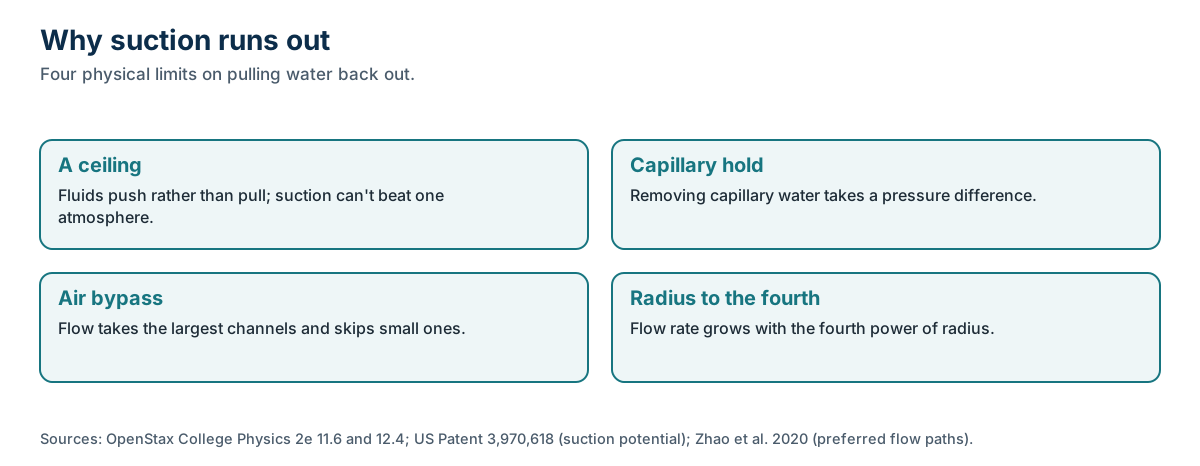
Because suction is really the atmosphere pushing, and it can never push harder than one atmosphere. Water held in small pores by capillary forces needs a pressure difference to come out, and some always stays. Air drawn by a wand also takes the widest channels first, since flow rises with the fourth power of channel radius, so narrow, wet passages are bypassed. Extraction clears a path, not the whole layer.
Key terms used on this page
- Gauge pressure:
- Pressure measured relative to the surrounding atmosphere rather than to a vacuum. OpenStax notes it can be negative, but never lower than minus one atmosphere, the point at which absolute pressure reaches zero.
- Absolute pressure:
- Gauge pressure plus atmospheric pressure. One standard atmosphere equals 14.7 pounds per square inch, or 760 mm of mercury, in OpenStax's conversion table; that figure is the ceiling on any suction.
- Suction potential (water-holding tension):
- The pressure difference needed to pull capillary water out of a porous material, usually stated in centimeters of water column. A 1970s foam patent borrows the idea from soil science to explain why some water always stays behind.
- Poiseuille's law:
- The relationship for steady flow through a tube. Flow rises with the pressure difference and with the fourth power of the radius, so halving a channel's width cuts its flow to a sixteenth, per OpenStax's treatment.
- Preferred flow path:
- A route through a porous material that carries most of the flow because its channels are wider. In the Zhao foam study, liquid favored voids with larger windows and air was trapped elsewhere, so no foam reached 100 percent saturation.
- Residual moisture:
- Water left in a material right after cleaning, before drying. For carpet, the Carpet and Rug Institute's test for its deep-cleaning extractor seal allows up to 8 ounces per square yard. We have not found an equivalent published test for mattresses.
Suction can't pull all the water back out of foam because suction is really the atmosphere pushing, and it can never push harder than one atmosphere. Water held in small pores by capillary forces needs a pressure difference to come out, and some always stays. Air drawn by a wand also takes the widest channels first, so narrow, wet passages are bypassed. Extraction clears a path through a wet layer, not the whole layer.
General information about mattress cleaning methods, not medical advice.
What is suction, physically?
A pressure difference. A vacuum pump lowers the pressure inside the wand, and the higher pressure outside pushes air and water toward it. OpenStax's physics text puts the principle bluntly: "Fluids push rather than pull, so the smallest absolute pressure is zero." Its treatment of gauge and absolute pressure explains that this makes the most negative possible gauge pressure equal to minus one atmosphere.
So no extractor, however powerful, can produce a pressure difference larger than the air around it. OpenStax's conversion table puts one atmosphere at 14.7 pounds per square inch, 760 mm of mercury or about 1,030 cm of water. It also notes elsewhere that "a column of water can only rise to a height of 10 m when there is a vacuum at the top." That's a perfect vacuum. Real machines work below it.
How close do cleaning machines get to the ceiling?
Two carpet patents give numbers. The 1964 steam-vacuum patent sets its relief valve "to maintain the vacuum in the tank 11 approximately 9 pounds below ambient atmospheric pressure." The 1977 on-location patent says its pump "draws a vacuum equivalent to about seven inches of mercury." By our arithmetic, those are roughly 61 percent and 23 percent of one atmosphere.
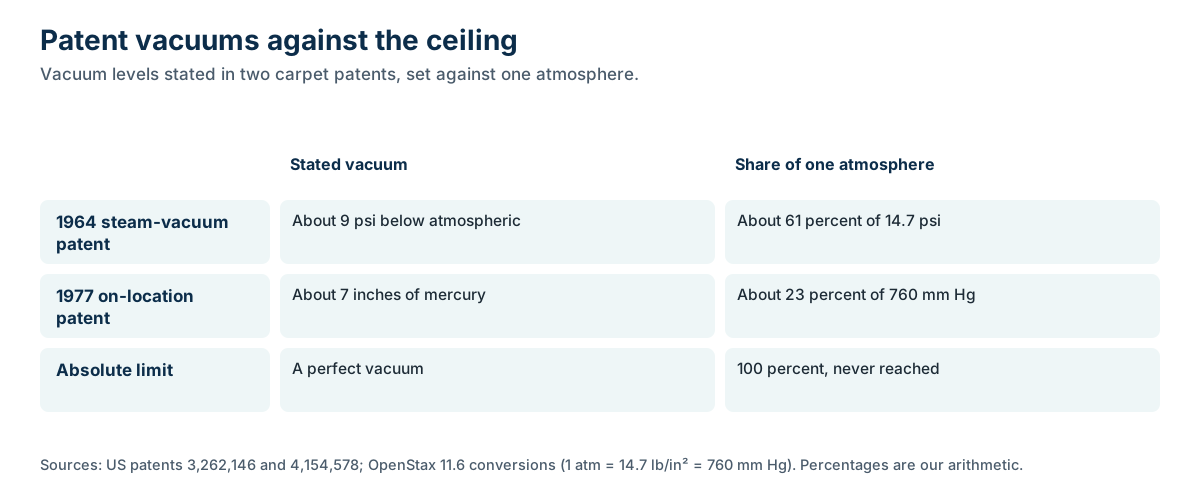
These are two patents, not a survey of modern equipment, and tank vacuum isn't the same as the pressure difference at the fabric, which is lower once air leaks in around the tool. The point isn't the exact figure. It's that every extractor works below a ceiling it can never pass, and the forces holding water in foam don't have that ceiling.
What holds water in foam?
Capillary forces. OpenStax's capillary action section shows that the height a liquid rises in a tube is inversely proportional to the tube's radius, so finer passages hold water more strongly. The same forces that pull water into fiber and foam, described in where water goes, resist pulling it out.
A 1970s polyurethane foam patent (US 3,970,618) defines a concept none of the cleaning patents we read names: "By suction potential is meant the pressure difference required to remove capillary water from porous materials." It goes on: "When a pressure difference is produced across a porous system, an equilibrium is established between the suction potential and the capillary tension, and a certain quantity of water remains behind in the porous system."
That last clause is the core of this article. Apply a pressure difference to a wet porous material and you reach a balance, not an empty material. The patent was written about horticultural foam, which shows how ordinary the idea is outside cleaning. It also illustrates the flip side: soil with "a much higher capillary activity" pulls water out of the foam. Suction pulls; capillary forces pull back.
Why does air skip the wet passages?
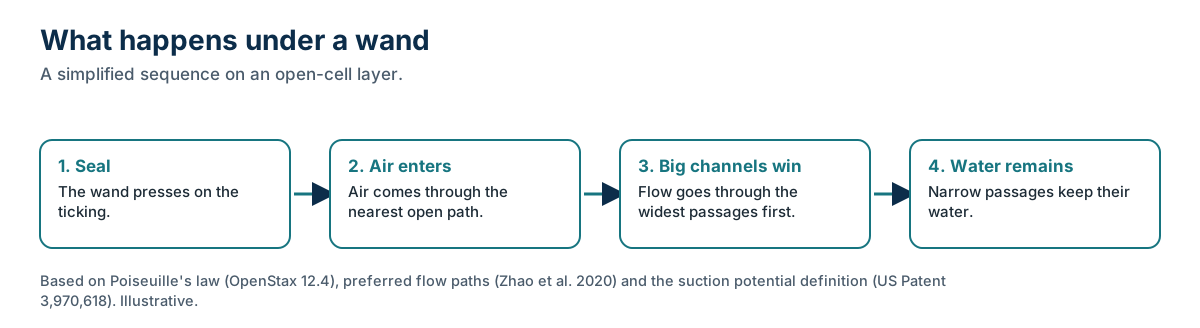
Because air is lazy. When a wand seals on wet ticking, it draws air through whatever path offers the least resistance. OpenStax's treatment of Poiseuille's law explains that resistance to flow depends on the fourth power of a channel's radius, so "any change in the radius of a tube has a very large effect on resistance." Doubling a channel's width cuts its resistance sixteenfold.
In a wet foam layer, the widest channels drain first and then carry most of the air. Narrow passages still full of water present far more resistance, so the airflow goes around them. Zhao and colleagues describe the same sorting for liquid entering open-cell foam (SN Applied Sciences, 2020): it "will preferentially pass through the larger channels," creating "a preferred flow path." Air leaving a wet layer behaves the same way.
Why does depth make it worse?
Because a mattress has no backing to keep water within reach. On carpet, as the carpet gear article explains, the backing and floor confine liquid to a thin layer right under the wand. In a mattress, water that sank through the comfort layer sits behind more foam, more resistance and more opportunities for air to bypass it. OpenStax's Poiseuille section also explains that pressure drops along a path with resistance, so the deepest water feels the least pull.
The 1977 patent hints at the same trade-off on carpet. It found that spray pressures "above about 120 psi tend to blow the solution too far down into the carpet often soaking the carpet bed and mat." Pushing liquid down is easier than pulling it back up, even on a material designed with a floor beneath it.
What do the patents themselves say about leftover water?
They describe partial removal. The 1968 carpet patent says the material is "subjected to vacuum which removes a substantial part of the moisture," and it adds a heated nozzle to help drying because vacuum alone doesn't finish the job. The 1964 patent claims its action leaves material "substantially dry and undamaged," which is the inventor's claim, made about rugs and upholstery, not a measurement on a mattress.
Hub 1 calls whatever stays residual moisture, and Hub 5 explains why that water lingers in foam in why foam mattresses are slow to dry. Hub 1's dry vapor versus extraction comparison sets the two methods side by side. This article supplies the physics of why extraction can't recover what it put in.
What happens to the water left behind?
It sets up the rest of this hub. If the water was hot, heat and moisture act together on foams and adhesives, as hot water versus dry heat explains. Deep, slow-drying water in thick beds is the setup for mold after a soak. Detergent stays behind as the water evaporates, covered in detergent residue. And Hub 5's surface moisture versus saturation explains why a dry-feeling surface says little about the layers below. This article is part of the hub on mattress cleaning done wrong.
Sleep Sanitation's view
This section is our view. If suction can't reliably get water back out of foam, the sensible move is to avoid putting a tank's worth in. We work at the ticking with low-moisture vapor, and our HEPA vacuum lifts debris rather than liquid. Because that choice rests on our own reasoning rather than any manufacturer exemption, your care label and the warranty's wording come first; read your warranty terms before you book. We follow the CDC's definition of sanitizing, with no disinfection claim attached. A moisture check closes every visit. See our process.
What we don't know
- The pressure difference that modern extraction wands achieve at the fabric of a mattress. The patent figures are tank vacuums on carpet machines.
- The suction potential curve for common mattress foams, meaning how much water stays at a given pressure difference. We found no published data.
- How much water typical extraction leaves in a mattress after one pass. We found no measurement.
Changelog
- 6 October 2026: First published. Sources accessed on this date.
Sources
- College Physics 2e, 11.6 Gauge Pressure, Absolute Pressure, and Pressure Measurement · OpenStax (Rice University)
- College Physics 2e, 11.8 Cohesion and Adhesion in Liquids: Surface Tension and Capillary Action · OpenStax (Rice University)
- College Physics 2e, 12.4 Viscosity and Laminar Flow; Poiseuille's Law · OpenStax (Rice University)
- US Patent 3,970,618: Process for the production of polyurethane foams (suction potential definition) · Google Patents (USPTO record)
- Fluid transport in open-cell polymeric foams: effect of morphology and surface wettability (Zhao et al., SN Applied Sciences, 2020) · Springer Nature (DOI)
- US Patent 3,262,146: Steam-vacuum generator for rug and upholstery cleaning (filed 1964) · Google Patents (USPTO record)
- US Patent 4,154,578: Method and apparatus for cleaning a carpet on location (filed 1977) · Google Patents (USPTO record)
- US Patent 3,617,205: Method for cleaning carpets and like materials (filed 1968) · Google Patents (USPTO record)
Last reviewed October 6, 2026. Manufacturer specifications and care instructions change; check the current version for your exact model. This page is general information, not medical advice. How we source and check pages: editorial standards.