
Short answer
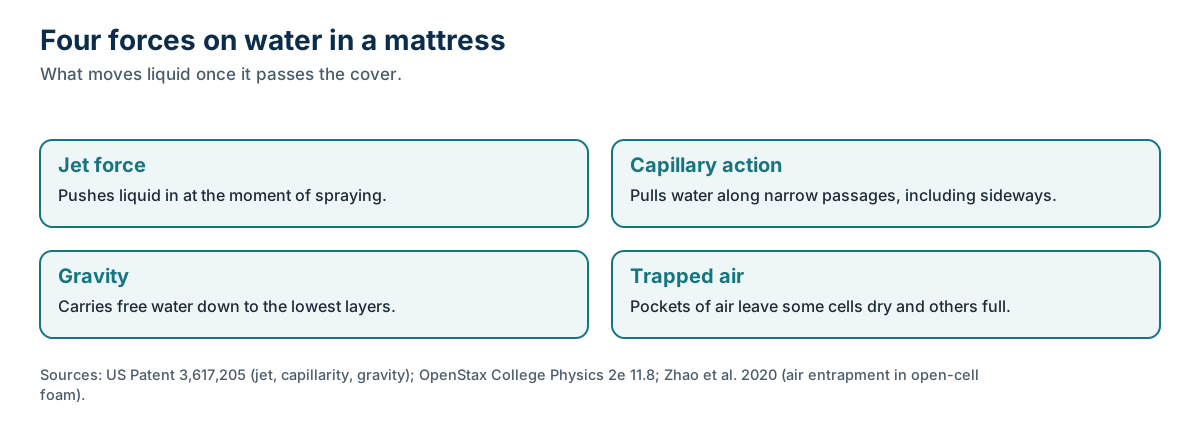
Four forces decide it. The spray's force drives water through the ticking. Capillary action then pulls it along narrow passages in fiber and foam, including sideways, often well beyond the wet spot. Gravity carries free water down to the lowest layers, where there's no drain. And trapped air leaves the result uneven, with some cells full and others dry. The water ends up wider and deeper than it looks.
Key terms used on this page
- Capillary action:
- The tendency of a liquid to be raised or suppressed in a narrow tube or passage. OpenStax traces it to the balance between the liquid's cohesion and its adhesion to the solid, which also explains why water beads on wax but spreads on bare paint.
- Capillary rise height:
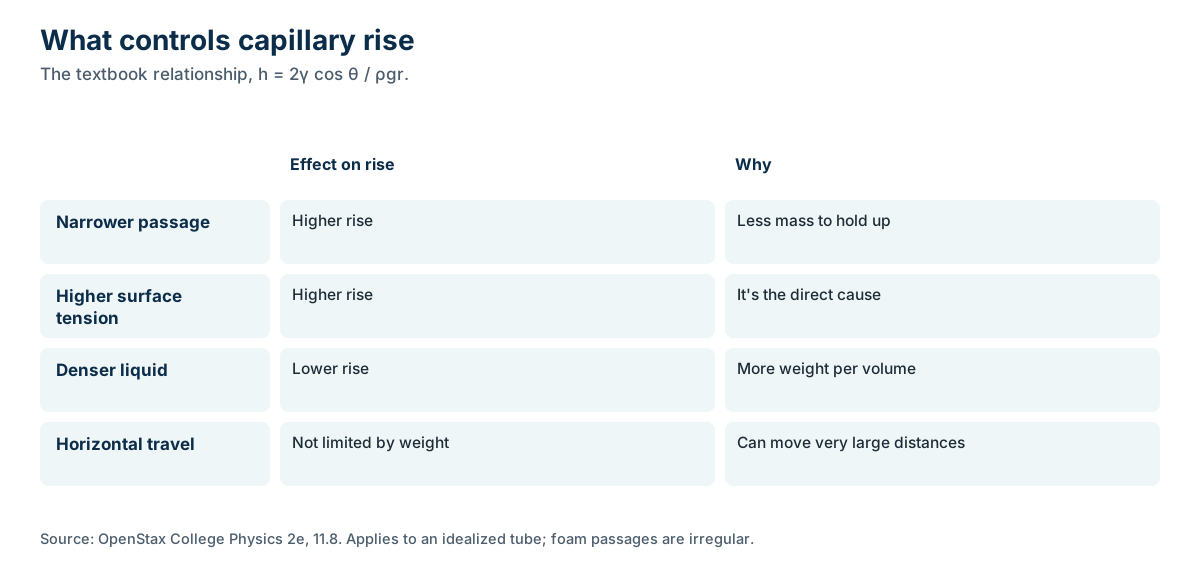
- How far a liquid climbs in a narrow passage, given by h = 2γ cos θ / ρgr. Height goes up with surface tension and down with tube radius and liquid density, so the finest passages lift water highest.
- Capillary imbibition:
- Uptake of a liquid into a dry porous solid driven by capillary pressure alone. Zhao and colleagues studied it in open-cell polymer foams and found that how well the liquid wets the cell walls largely controls it.
- Contact angle:
- The angle between a liquid's surface and the solid it touches. In OpenStax's account, a small angle means adhesion wins and the liquid flattens and climbs; above 90 degrees the liquid beads and is pushed down instead.
- Open-cell foam:
- Foam whose cells connect, so air can move through it. The PFA primer says foam performance is optimized when air flow is maximized, which indicates the cells are open. The same open structure that lets air through also lets liquid water in.
- Wicking (urine migration):
- Liquid moving through and along fabric and foam by capillary action, so the affected area below the surface is often wider than the visible stain. Quilting, fiber batting and open-cell foam all wick. It is why a spot can look small and still smell from a wider area.
Water pushed into a mattress goes wider and deeper than it looks, and four forces decide where. The spray's force drives it through the ticking. Capillary action pulls it along narrow passages in fiber and foam, sideways as well as up. Gravity carries free water down to the lowest layers, where there's no drain. And trapped air makes the result uneven, leaving some cells full and others dry. This article walks through each force.
General information about mattress cleaning methods, not medical advice.
Force one: the jet pushes it in
Spraying puts energy into the liquid, and that energy drives it into the fabric. A 1968 carpet-cleaning patent describes the sequence on carpet: a strip is "first subjected to a spray of hot-cleaning solution droplets and steam under pressure. Next, the hot solution penetrates the nap by the force of the jet, aided by capillarity and gravity."
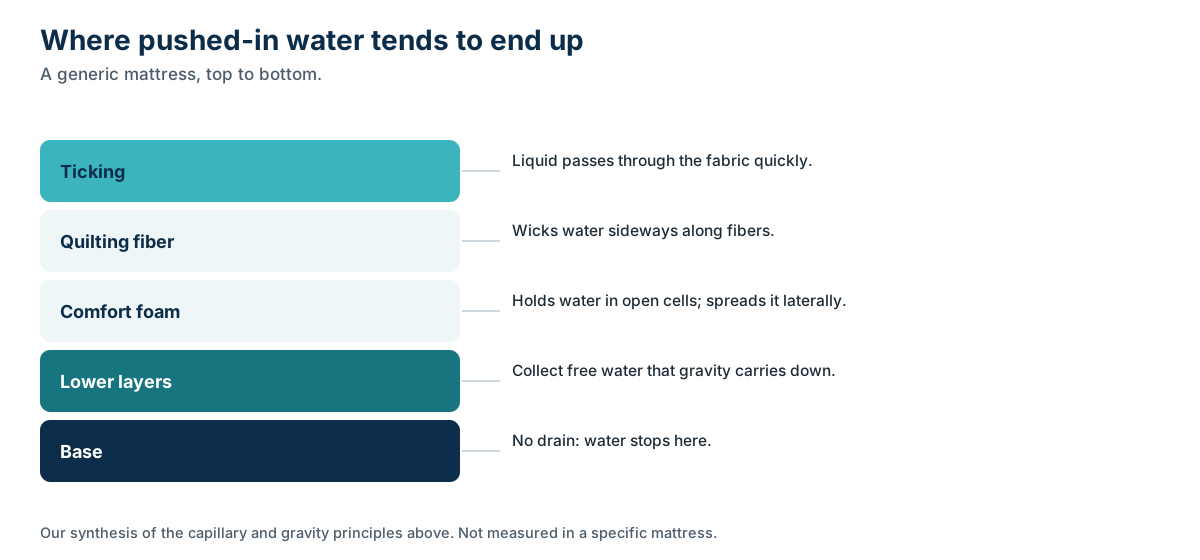
On a mattress, the jet's first obstacle is the ticking, which federal rules define as "the outermost layer of fabric or related material" of the mattress, per 16 CFR 1633. Ticking isn't a barrier; it's woven or knit fabric, and liquid driven at it under pressure passes through. Below it is "upholstery material," everything between the ticking and the core. That's where the other three forces take over. This article is part of the hub on mattress cleaning done wrong, which traces why the spray-and-suck method reached mattresses at all.
Force two: capillary action spreads it
Once inside, water is pulled along any passage narrow enough. OpenStax's physics text defines capillary action as "the tendency of a fluid to be raised or suppressed in a narrow tube, or capillary tube." It depends on how strongly the liquid sticks to the solid compared with how strongly it holds itself together, which shows up as the contact angle: below 90 degrees, the liquid is pulled in.
The key line for a mattress is about direction: "Capillary action can move liquids horizontally over very large distances, but the height to which it can raise or suppress a liquid in a tube is limited by its weight." Sideways travel doesn't fight gravity, so a wet patch in quilting fiber or foam keeps widening along the layer. That's why Hub 3 defines urine wicking as liquid moving through fabric and foam so the affected area below the surface is often wider than the visible stain.
How high can capillary action lift water?
Higher in finer passages. OpenStax gives the height as h = 2γ cos θ / ρgr and explains that a narrower tube lifts the fluid higher, "since a smaller tube holds less mass." Height rises with surface tension and falls with the liquid's density. In a mattress, that means fine fibers and small foam windows hold water against gravity better than coarse ones.
It also means capillary action works in both directions inside a mattress. It spreads water sideways from the spray zone, and as the surface dries, it can pull water back up toward the evaporating face. That upward pull is what carries dissolved soil to the surface and leaves rings, which Hub 7 explains in why stains come back after drying.
Does detergent change the picture?
Yes, because capillary action depends on wetting. Zhao and colleagues studied water uptake in open-cell polymer foams (SN Applied Sciences, 2020). With foams treated with varying amounts of surfactant, they report a stark result for the untreated foam: "The sample with no added emulsifier did not imbibe water." Adding surfactant let water in, and "The imbibition rate was found to increase with the surfactant content up to around 25 wt% but then decreases for higher concentrations."
Their foam was a lab material, not mattress polyurethane, so we don't claim the same numbers apply. The principle does: a cleaning solution designed to wet fabric also helps water wet the foam beneath it. The detergent residue article follows what happens to that surfactant once the water is gone.
Force three: gravity carries it down
Water that isn't held in narrow passages drains downward. Mattress foam gives it a route: the Polyurethane Foam Association describes memory foam as "a type of open cell, flexible polyurethane foam" in its viscoelastic foam bulletin. Open cells connect, so free water can work its way through a comfort layer into the layers below.
Flow through those passages follows the same physics as flow through tubes. OpenStax's treatment of Poiseuille's law explains that flow rate rises with the fourth power of a tube's radius; doubling the radius cuts resistance sixteenfold. So liquid drains far faster through wide channels than narrow ones. Free water runs down the wide paths; the narrow ones keep their share by capillary action. Gravity sorts the water by passage size.
Where does the water stop?
Where the layers stop. On carpet, liquid meets a backing, a pad and a hard floor within a short distance. A mattress has none of those close beneath the surface. Free water keeps sinking through the comfort layers toward the core and the base, and the base usually rests on a foundation or platform. There's no drain at the bottom, so water collects in the lowest layers until it evaporates. The carpet gear article explains why that missing backing matters for the tools.
Force four: trapped air makes it uneven
Capillary uptake doesn't fill foam evenly. Zhao and colleagues report that "None of the foams tested in this study showed a 100% saturation by the silicone oil," and they explain why: "The infiltrating liquid will preferentially pass through the larger channels (i.e., those voids with larger windows). This will eventually lead to a preferred flow path, and potentially trapping air pockets within the foam." They also observed that water "tends to penetrate into the foams faster near their periphery and slower near their center."
The practical result is a patchwork. Some regions hold a lot of water, some hold little, and the boundary isn't where the spray landed. That unevenness is one reason a mattress can feel dry in one spot and damp a hand's width away, and one reason Hub 5 says the clues for whether moisture reached the core have to be read together.
What happens next?
Three things, covered in the rest of this hub. Suction tries to pull the water back and runs into hard limits, explained in why suction can't pull water back out of foam. Heat, if the water was hot, travels down with it, the subject of hot water versus dry heat. And whatever stays behind sets the clock for odor and mold, especially in thick beds, as why premium mattresses can mold after a soak explains. Hub 1's memory foam article covers what water does to that material specifically.
Sleep Sanitation's view
This section is our view. Once water is past the ticking, it goes where capillary action and gravity send it, not where anyone intends, and that is the whole reason we never spray liquid into a bed. Our machines are Italian-made Vapor Clean boilers, run with quick passes so the moisture stays in the cover. Organic methods come first. None of this is a manufacturer exemption; it's our reading of the physics, so the care label and warranty terms still govern, and it pays to check your warranty terms before you book. "Sanitize" here carries the CDC's meaning, and we make no disinfection claim. The bed stays unmade until it's dry to the touch. Step-by-step details live on our process page.
What we don't know
- How far water spreads sideways in a typical mattress comfort layer for a given volume. We found no published measurement.
- How much commercial mattress foams differ from lab foams in wetting and capillary uptake. The study we cite used a lab polymer foam.
- How quilting patterns and stitching affect the spread. Stitch lines may act as channels or barriers; we found no study.
Changelog
- 6 October 2026: First published. Sources accessed on this date.
Sources
- College Physics 2e, 11.8 Cohesion and Adhesion in Liquids: Surface Tension and Capillary Action · OpenStax (Rice University)
- Fluid transport in open-cell polymeric foams: effect of morphology and surface wettability (Zhao et al., SN Applied Sciences, 2020) · Springer Nature (DOI)
- US Patent 3,617,205: Method for cleaning carpets and like materials (filed 1968) · Google Patents (USPTO record)
- 16 CFR Part 1633: Standard for the Flammability (Open Flame) of Mattress Sets · Electronic Code of Federal Regulations (eCFR)
- IN-TOUCH Vol. 11 No. 1: Viscoelastic (memory) foam (revised 2016) · Polyurethane Foam Association
- College Physics 2e, 12.4 Viscosity and Laminar Flow; Poiseuille's Law · OpenStax (Rice University)
Last reviewed October 6, 2026. Manufacturer specifications and care instructions change; check the current version for your exact model. This page is general information, not medical advice. How we source and check pages: editorial standards.