
Short answer
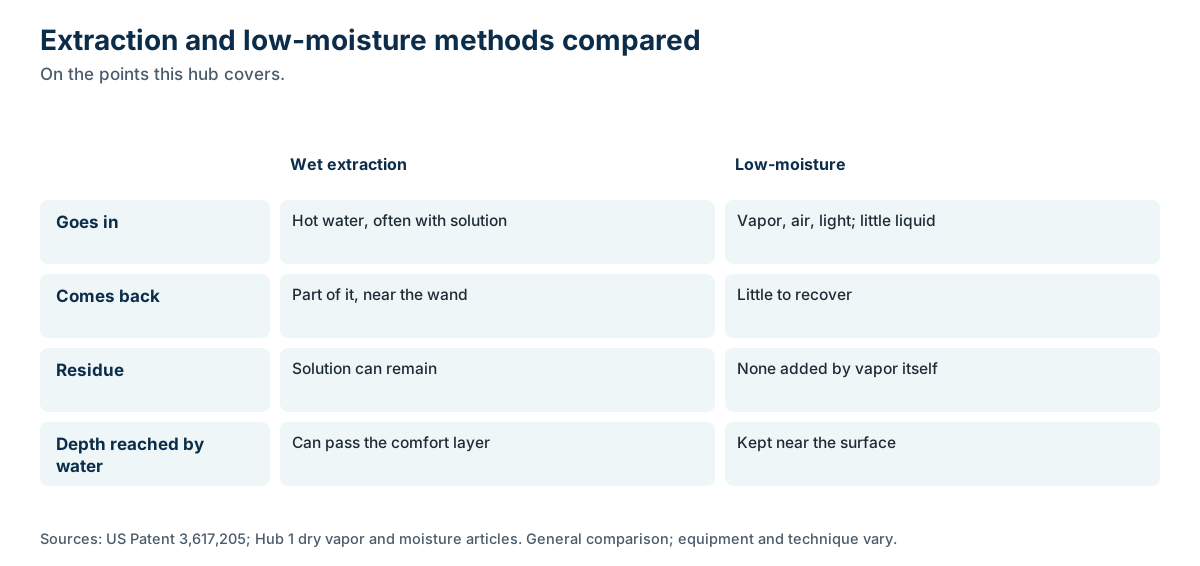
It starts from a different assumption. Wet extraction puts liquid in and tries to pull it back; a low-moisture method puts little in, so there's little to recover. Loosened soil is vacuumed off, not dissolved, heat arrives as vapor that condenses near the surface, and stains get targeted spot work instead of a flood. It's designed to sidestep most failure modes here, though no study has compared outcomes. It can't undo water already deep in a mattress.
Key terms used on this page
- Low-moisture cleaning:
- A carpet-industry label for methods such as encapsulation, bonnet and dry-compound cleaning that use less water than extraction. It is not the same thing as dry-vapor steam, which is a heat-delivery method rather than a detergent method.
- Dry-vapor steam:
- Steam made in a sealed, pressurized boiler and released through a hose and nozzle as hot vapor with a low liquid-water content. In the vendor specifications we reviewed, professional units are rated from 80 psi (Ladybug 2350) to 150 psi (Daimer), with stated boiler temperatures from about 345°F (Optima) to 360°F (Daimer); these are maker claims. Daimer describes its steam as about 5% water or less and Vapor Clean claims 'just 5-6% moisture'; that is a vendor claim, not an independent standard.
- HEPA vacuuming:
- Vacuuming with a sealed system and a filter meeting the HEPA standard, which the EPA says can theoretically remove at least 99.97% of airborne particles 0.3 microns in size. It removes loose dust and allergen-carrying particles without adding water or heat.
- Latent heat (condensation):
- The energy steam releases when it condenses back into water, about 2,257 kJ per kilogram at atmospheric pressure and somewhat less at higher boiler pressures (about 2,048 kJ/kg at 7 bar gauge). It is why steam heats a surface quickly, and why steam that heats a surface always leaves some condensed water behind.
- UV-C radiation:
- Short-wavelength ultraviolet light. The FDA describes it as a known disinfectant for air, water and nonporous surfaces, and warns that some consumer UV wands give off unsafe levels.
Low-moisture mattress cleaning starts from a different assumption. Wet extraction puts liquid in and tries to pull it back; a low-moisture method puts little in, so there's little to recover. Loosened soil comes off by vacuuming rather than being dissolved, heat arrives as vapor that condenses near the surface, and stains get targeted spot work instead of a flood. It's designed to sidestep most failure modes in this hub, though no study has compared outcomes. It can't undo water already deep in a mattress.
General information about mattress cleaning methods, not medical advice.
What do we mean by low-moisture?
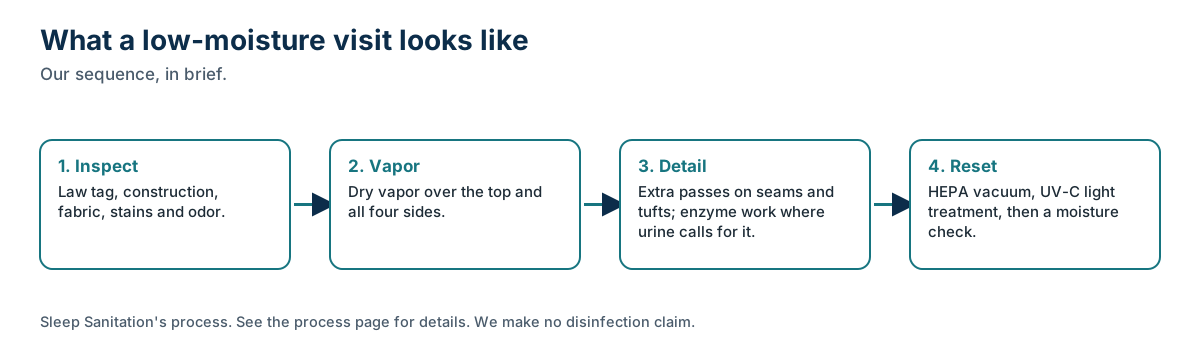
A method that keeps water near the surface. The carpet trade uses the phrase for specific techniques, and Hub 1's glossary notes that low-moisture cleaning there labels methods such as encapsulation and bonnet cleaning. For mattresses, we use it more broadly: any approach that avoids pushing liquid into the layers, chiefly HEPA vacuuming and boiler-made dry vapor steam.
Hub 1 already explains what dry vapor steam cleaning is, how much moisture it uses and how professional methods compare. This article doesn't repeat those. It sets the low-moisture approach against the failure modes this hub describes, one by one.
Isn't this just the newest fashion?
No; it's closer to the oldest. A 1921 USDA bulletin cleaned upholstery with "either a vacuum cleaner or a brush," and indoors under a cloth "dipped in water and wrung as dry as possible." A 1940 USDA radio script recommended "sunning and beating every week if possible, or at least once a month" for a cotton mattress, plus "a washable mattress slip cover." Wet extraction arrived later, from carpet, as the history article explains.
Failure one: water pushed deep
Wet extraction drives liquid through the ticking, where capillary action and gravity spread it, as where water goes explains. A low-moisture method doesn't deliver a volume of liquid to spread. Vapor gives up its heat by condensing on the surface it touches; Hub 1 explains this as latent heat. The aim is a thin film of condensate near the surface, not a column of water heading for the core; Hub 1 asks whether dry vapor steam is actually dry, and we list condensate depth under what we don't know.
The carpet trade recognized the value of less water long ago. A 1968 carpet patent applied vacuum "to prevent excessive wetting," and its abstract claims "faster drying than heretofor was common, with minimal wicking." A low-moisture approach takes that logic further by not adding the water in the first place.
Failure two: water suction can't reach
Suction has a hard ceiling and leaves water in small pores, as the suction article explains. If little liquid goes in, there's little for suction to fail to recover. A household steam patent with an Italian priority date of 1987 pairs its boiler with an aspirator to remove "the condensate left on the surface being cleaned." The water involved stays on the surface, where it can be dealt with.
Failure three: slow drying in deep layers
Diffusion time grows with the square of distance, as OpenStax's section on diffusion implies, so water near the surface leaves far faster than water deep in the foam. Keeping moisture at the ticking keeps drying in the fast regime. That matters most for the thick, premium beds described in why premium mattresses can mold after a soak.
Failure four: residue and masking
Vapor adds no detergent of its own, so there's nothing to concentrate as it evaporates; the detergent residue article explains why that matters. Where a stain or urine needs chemistry, it's applied as spot work rather than across the whole bed. And a method that doesn't rely on fragrance leaves the result to be judged by smell alone, which is the point of fragrance masking versus odor removal.
Where does vacuuming fit?
It removes soil without dissolving it. CRI's carpet standard says "According to studies, most of the loose dry soil is removed by vacuuming," and calls vacuuming before cleaning "an essential step for desired results." Soil dissolved in water can travel into the layers below and wick back as rings. Soil lifted dry by a sealed HEPA vacuum leaves the mattress instead.
In our sequence, the HEPA vacuum comes after the vapor passes, lifting debris the vapor and detail work have loosened, while the surface carries only a little condensate. Order varies between methods; the shared principle is that soil leaves as a solid, not as a solution.
Where does UV-C fit?
As one step, not a method. The FDA's consumer update on UV wands says "UV-C radiation is a known disinfectant for air, water, and nonporous surfaces," and warns that some consumer wands are unsafe. A mattress is porous; light reaches only what it shines on. We use UV-C light treatment after HEPA vacuuming as part of a sequence, and we make no disinfection claim for it.
What can't low-moisture cleaning do?
Several things, and we'd rather say so. It can't pull out water that's already deep in a mattress from an accident or an earlier wet cleaning; drying comes first, as signs your mattress was overwetted explains. It can't restore or protect warranty coverage, which only the warranty's terms decide, as the warranty article explains. And it can't promise that every stain or odor will lift; some have set in or soaked too deep.
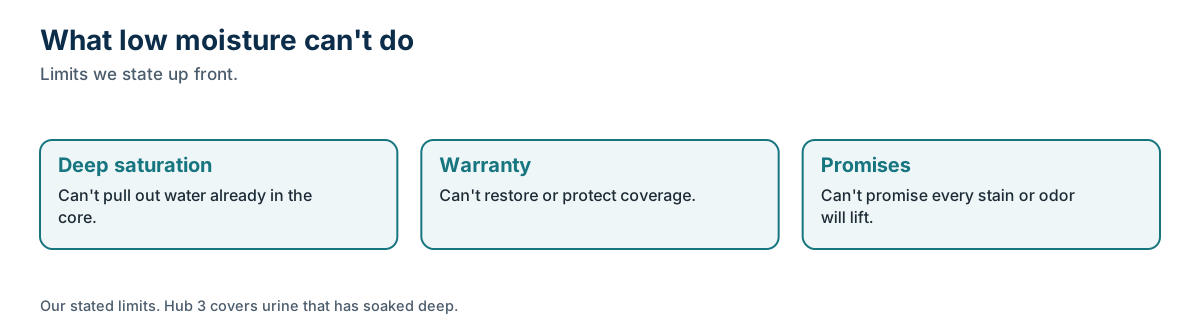
Hub 6 lists problems professional cleaning can't fix, and Hub 3 covers urine that has soaked deep in what happens when urine soaks into a mattress. A gentler method isn't a magic one.
How do you judge whether a method is low-moisture?
Ask the questions in questions to ask before hiring a mattress cleaner. What goes in, what comes back, whether any solution stays and how dryness is checked will tell you more than the label on the method. If the answers involve a waste tank of dirty water, the method is moving a lot of liquid, whatever it's called.
Sleep Sanitation's view
This section is our view, and this is the method we use. We inspect the mattress and its law tag first, make dry vapor passes with Italian-made Vapor Clean machines over the top and all four sides, give seams and tufts extra passes with enzyme treatment where urine or organic odor calls for it, then HEPA vacuum, follow with UV-C light treatment and run a moisture check. Every visit includes two checks, the moisture check and the built-in bed mite sensor on the vacuum; bedroom CO₂ testing is optional and priced by quote. The first mattress is $249. That's our own reasoning, not a manufacturer exemption; your care label and warranty terms govern, so check your warranty terms before you book. We use "sanitize" in the CDC's sense and make no disinfection claim. Leave the bed unmade until it's dry to the touch. Details are on our process page and pricing. This article closes the hub on mattress cleaning done wrong.
What we don't know
- How much less water a low-moisture visit leaves in a mattress than wet extraction does. We found no side-by-side measurement on mattresses.
- How odor and stain outcomes compare between low-moisture and wet methods on mattresses. We found no controlled study.
- How far vapor condensate penetrates different ticking fabrics. Hub 1 and Hub 5 discuss it; we found no published measurement for mattresses.
Changelog
- 6 October 2026: First published. Sources accessed on this date.
Sources
- US Patent 3,617,205: Method for cleaning carpets and like materials (filed 1968) · Google Patents (USPTO record)
- US Patent 4,896,396: Electrical household appliance for steam cleaning (Italian priority 1987) · Google Patents (USPTO record)
- CRI 205 Residential Carpet Standard for Maintenance and Cleaning (2023) · Carpet and Rug Institute
- Farmers' Bulletin 1180: Housecleaning Made Easier (1921) · US Department of Agriculture, via Internet Archive
- Housekeepers' Chat: Cotton Mattresses (radio script, 15 May 1940) · US Department of Agriculture, via Internet Archive
- Beware of Ultraviolet Wands That Give Off Unsafe Levels of UV Radiation · US Food and Drug Administration
- College Physics 2e, 12.7 Molecular Transport Phenomena: Diffusion, Osmosis, and Related Processes · OpenStax (Rice University)
Last reviewed October 6, 2026. Manufacturer specifications and care instructions change; check the current version for your exact model. This page is general information, not medical advice. How we source and check pages: editorial standards.