
Short answer
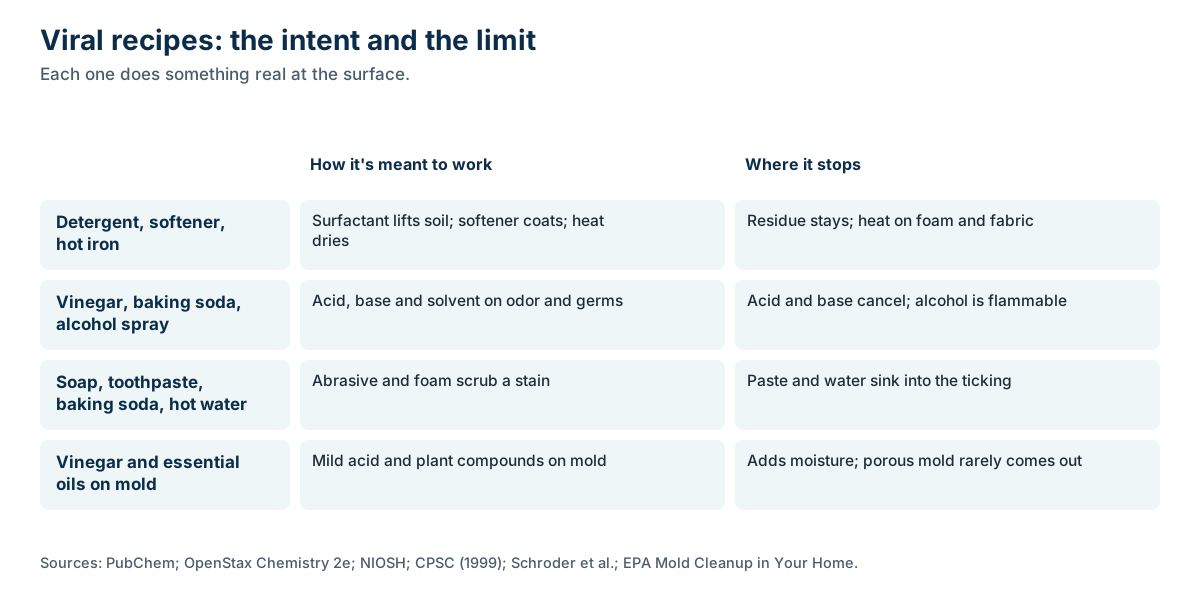
Each popular recipe does something real at the surface. Detergent lifts oily soil, softener coats fibers, vinegar and baking soda react, alcohol evaporates fast, toothpaste scrubs and some essential oils slow mold growth in a dish. The limits are depth and leftovers: liquid and residue sink into the ticking and quilting, some mixes cancel each other out, and porous mold rarely comes out. They're reasonable first aid, but no substitute for dry vapor steam cleaning.
Key terms used on this page
- Cationic fabric softener:
- A conditioner whose positively charged surfactants, often esterquats, deposit on fibers to soften them. That coating is the point of softener, and it stays in the fabric.
- Acid-base neutralization:
- A reaction in which an acid and a base produce a salt and water. Vinegar and baking soda react this way, releasing carbon dioxide as they use each other up.
- Flash point:
- The lowest temperature at which a liquid gives off enough vapor to ignite. NIOSH lists isopropyl (rubbing) alcohol at 53°F, a Class IB flammable liquid.
- Sodium bicarbonate (baking soda):
- A mildly alkaline white powder. PubChem lists the pH of a freshly prepared 0.1 molar solution as 8.3 and notes that it decomposes when heated.
- Alkaline cleaning residue:
- Detergent left in fibers after cleaning with a high-pH solution. A 1977 carpet patent says the cleaned fiber reads as alkaline as the detergent used, and that the residue stays a long time.
- Mixture suppression:
- When an odor mixture smells less intense than its parts added together. Fukutani and colleagues call it a commonly observed phenomenon and the basis of much odor masking.
Home cleaning recipes for mattresses spread because they make sense. The ingredients are already in the house, they cost little, and many of them fizz, foam or smell fresh, so it feels like something is happening. People who try them are doing a reasonable thing: trying to care for a bed they sleep on every night. This page takes the four recipes we see shared most often and goes through them ingredient by ingredient. For each, we start with how it's supposed to work and what it can genuinely do, then look at where it stops.
General information about household chemistry and mattress care, not medical advice. Always read product labels and your mattress care label.
Why these recipes look convincing
Most viral recipes are built from real chemistry. Surfactants do lift oil. Acids and bases do react. Alcohol does evaporate quickly, and abrasives do scrub. The before-and-after video usually shows a real change at the surface, because the surface is where every one of these ingredients acts first. What a short video can't show is what happens a few days later, or a few inches down: how much liquid went into the quilting and foam, what residue stayed behind, and whether a stain or smell returns as the bed dries. That's the gap this page fills.
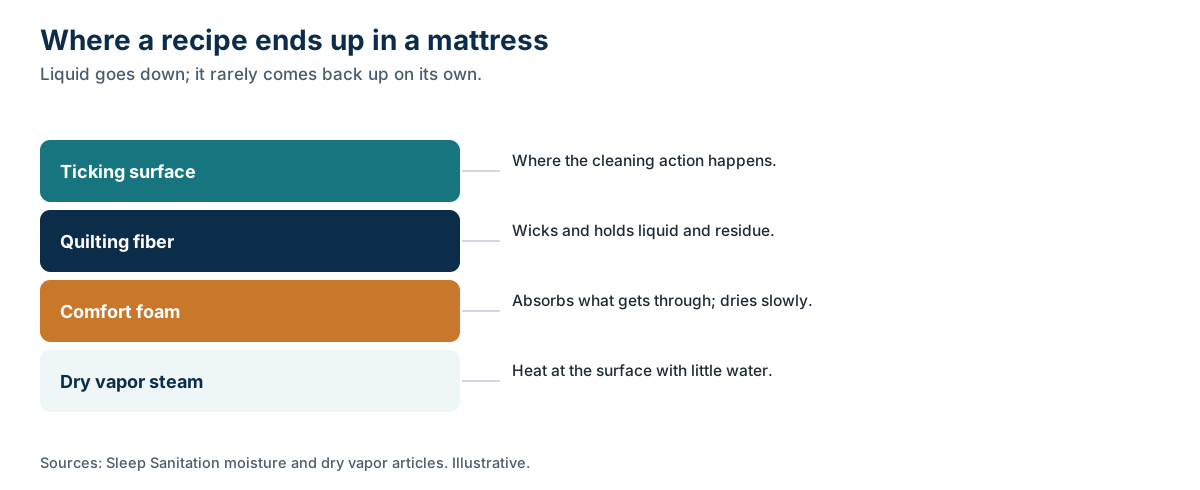
A mattress isn't a shirt. A shirt goes into a washer and rinses through. A mattress has a fabric ticking over fiber quilting and foam, and it can't be rinsed. Anything sprayed or scrubbed in tends to stay, which is why our pages on where water goes when it's pushed into a mattress and detergent residue matter for every recipe below.
Recipe 1: detergent, fabric softener and a hot iron
How it's meant to work. Laundry detergent contains surfactants, molecules with one end that likes water and one that likes oil, so they can loosen body oils and grime from fabric. Household fabric softener is a different kind of surfactant. A review of softener chemistry describes household softeners as mostly cationic surfactants called esterquats, which carry a positive charge and deposit on fibers as a thin layer that leaves fabric soft and carries fragrance. The hot iron, often pressed over a damp towel, drives off water quickly and adds a burst of heat to the top of the fabric.
What it can genuinely do. On the ticking, this combination can lift a little surface soil into the towel, leave the cover feeling smoother and smelling clean, and dry the top layer fast. If the goal is a fresher-feeling surface for a night or two, it delivers that.
Where it stops. Softener is designed to stay on fibers rather than rinse away, and so is much of the detergent when there's no rinse. Our detergent residue article explains why leftover cleaning chemistry tends to attract soil over time. Fragrance can also cover an odor rather than remove its source, which fragrance masking vs odor removal explains. There's a fire-safety angle too. In a 1999 Federal Register notice, the Consumer Product Safety Commission reported that one polyester fabric showed reduced flame resistance after laundering with a liquid softener, and noted that softener packages say not to use them on garments labeled flame resistant. That finding was about garments, not mattresses, so we can't say what softener does to a mattress's fire barrier. It's a good reason not to add it on purpose. The iron is the last limit: it heats only the patch under the plate, some cover fabrics can scorch or melt, and the federal care labeling rule defines Do not iron to mean an item is "not to be smoothed or finished with an iron". If the steam setting is used, that's more water pushed into the quilting.
Recipe 2: vinegar, baking soda and rubbing alcohol spray
How it's meant to work. Each ingredient brings something. White vinegar is a dilute solution of acetic acid, a mild acid people use against hard-water film and some odors. Baking soda is sodium bicarbonate, a mild base that PubChem describes as slightly alkaline, and it's long been used as a deodorizing powder. Rubbing alcohol is isopropyl alcohol, a solvent that evaporates quickly and is widely used to wipe hard surfaces. Combined in a spray bottle, the idea is acid for odor, base for odor, and alcohol for quick drying and germs.
What it can genuinely do. Alcohol on its own can dissolve some oily residue and leave the surface dry faster than water would. Dry baking soda sprinkled on and vacuumed off can absorb some odor from the top layer. Used one at a time, lightly, each has a modest surface role.
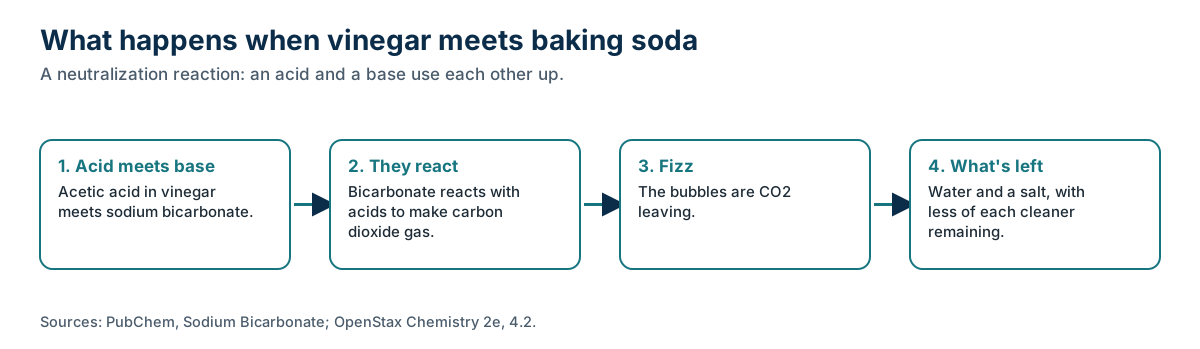
Where it stops. Mixed together, vinegar and baking soda neutralize each other. PubChem notes that sodium bicarbonate reacts with acids to generate carbon dioxide gas, and the OpenStax chemistry text summarizes the general pattern as acid plus base giving a salt and water. The fizz is real, but it's the sound of the two cleaners using each other up; what's left is mostly water and sodium acetate, a salt, which then sits in the fabric. Alcohol raises a different point. NIOSH lists isopropyl alcohol's flash point as 53°F and classes it as a flammable liquid, which means vapors can ignite at room temperature. On a bed, near a space heater, a candle, or a hair dryer used to speed drying, that's a real hazard. Like every spray, the mix also adds liquid, and our DIY mistakes page explains how even small amounts can wick past the cover.
Recipe 3: liquid soap, toothpaste, baking soda and hot water
How it's meant to work. This one borrows from stain-scrubbing tricks for sneakers and grout. Toothpaste contains fine abrasive particles such as silica or calcium carbonate, plus detergents such as sodium lauryl sulfate that foam and loosen deposits, according to a 2025 review of toothpaste ingredients. Liquid soap adds more surfactant, baking soda adds a gentle grit and mild alkalinity, and hot water helps it all dissolve and spread.
What it can genuinely do. On a small, fresh mark on the ticking, a gentle abrasive and some foam can lift surface discoloration. That's why the result can look good right away.
Where it stops. Toothpaste is formulated to stay on a toothbrush, not to rinse out of upholstery. The same review explains that humectants such as glycerol and sorbitol are added to toothpaste to prevent moisture loss and maintain the consistency of the product, so they tend to hold water in whatever they're worked into. Scrubbing a paste into quilting with a brush spreads it deeper and can rough up the ticking. Hot water speeds the paste into the fiber and foam, and with protein soils like blood or sweat, heat can make a stain harder to remove, as why heat can set a stain explains. What's left is a mix of abrasive, detergent, humectant, flavor and water inside a mattress, with no practical way to rinse it.
Recipe 4: vinegar and essential oils on mold
How it's meant to work. Vinegar's acidity and the plant compounds in essential oils such as clove, tea tree, eucalyptus and lavender both have a reputation against mold. There's some lab basis for this. In a 2018 study, researchers tested clove, lavender and eucalyptus oils on fungi collected from indoor air, using dishes of growth medium. Clove oil had the broadest effect, and every essential oil tested performed better than vinegar.
What it can genuinely do. On a hard, nonporous surface, wiping mold away and drying the area thoroughly is the standard approach. On fabric, a light wipe may reduce visible growth on the surface and leave a pleasant smell.
Where it stops. The lab study used fungi on dishes of growth medium, not mold growing through a mattress, and its authors called for further research on practical use. Spraying a solution adds moisture to a material that already grew mold because it was damp. EPA mold guidance says absorbent or porous materials, such as carpet, "may have to be thrown away if they become moldy", because mold can fill the spaces inside them. Essential oils also aren't harmless just because they're natural: dermatology reviews describe rising reports of allergic contact dermatitis from essential oils, and tea tree oil becomes more allergenic as it oxidizes. Applied to a bed where skin rests for hours, that matters. Some products used on bedding, including fabric softeners and fragranced products, can also cause skin sensations that people mistake for bites, according to Texas A&M entomologists. If a mattress has visible mold, see can mattress moisture lead to mildew or mold? and our clean-or-replace guidance.
What all four recipes have in common
Every recipe on this page works at the surface and leaves something behind. The intent is good and the chemistry is real, but in a mattress the leftovers stay: liquid soaks into quilting and foam, residue holds onto soil, fragrance fades, and in some mixes the active ingredients cancel each other before they reach the stain. None of them reach the deeper layers, and several add water to exactly the places that are slowest to dry. That doesn't mean you did something wrong if you tried one. A light spray rarely ruins a mattress. It does mean the results you saw at the surface may not be the whole story, and if a smell or stain came back, this is usually why. Our overwetting signs article lists what to watch for.
How dry vapor steam differs
Ultimately, none of these recipes is a substitute for dry vapor steam cleaning. The difference isn't a stronger chemical; it's that dry vapor steam brings heat to the surface with much less liquid water than a spray or scrub, and it doesn't need detergent, so there's no added residue left in the fabric. Our article on whether dry vapor steam is actually dry explains the honest version: it still leaves some moisture at the surface, and it works on the cover and seams rather than the core. Our page on whether professional cleaning needs detergent explains why we leave chemistry for targeted spot work instead.
What to do instead at home
- Fresh spill: blot with a dry towel, don't rub, and keep liquid to a minimum.
- Odor: a light, dry sprinkle of baking soda, left for a while and vacuumed off.
- Small mark: a dab of mild soap in cold water on a cloth, then blot dry. Check the care label first.
- Mold, deep stains or lingering smell: stop adding liquid and get advice; some mattresses can be cleaned and some shouldn't be.
Sleep Sanitation's view
This section is our view. We understand why people try these recipes, and most of the time the ingredients are fine for what they were made for. We'd simply rather the mattress get heat and HEPA suction with little water than a mix of residues. Our visits combine dry vapor steam, HEPA vacuuming and UV-C light, and every visit includes a moisture check after service and the built-in bed mite sensor on our UV-C vacuum. See what makes us different, browse more pages in mattress cleaning done wrong, or call or text (402) 512-5658.
What we don't know
- How softener residue affects the fire barrier in a modern mattress. The federal finding we cite was about garment fabrics.
- How deep a typical household spray travels into quilting and foam. We found no study measuring it in mattresses.
- Whether essential oils reduce mold inside porous bedding at all. The lab work used growth dishes.
Changelog
- 7 October 2026: First published. Sources accessed on this date.
Sources
- Advanced Eco-Friendly Formulations of Guar Biopolymer-Based Textile Conditioners (Materials, 2021) · PubMed Central
- Children's Sleepwear Flammability Standards: Proposed Rule (Federal Register, 17 March 1999) · US Consumer Product Safety Commission via GovInfo
- 16 CFR Part 423: Care Labeling of Textile Wearing Apparel and Certain Piece Goods · Electronic Code of Federal Regulations (eCFR)
- Sodium Bicarbonate (CID 516892) · PubChem (NIH)
- Chemistry 2e, 4.2 Classifying Chemical Reactions · OpenStax (Rice University)
- NIOSH Pocket Guide to Chemical Hazards: Isopropyl Alcohol · CDC / NIOSH
- Comparative Evaluation of the Biocompatibility and Antibacterial Efficacy of Various Toothpaste Formulations (Scientific Reports, 2026) · PubMed Central
- Antifungal Activity of Essential Oils Against Fungi Isolated From Air (Schroder et al.) · PubMed Central
- Art of Prevention: Essential Oils, Natural Products Not Necessarily Safe (Sindle and Martin, 2021) · PubMed Central
- Tea Tree Oil: Contact Allergy and Chemical Composition (de Groot and Schmidt, 2016) · PubMed
- Mold Cleanup in Your Home · US EPA
- Diagnosing Mysterious Bites and Itches (ENT-3006) · Texas A&M AgriLife Extension
- Antagonistic Interactions Between Odorants Alter Human Odor Perception (Current Biology, 2023) · PubMed Central
Last reviewed October 7, 2026. Manufacturer specifications and care instructions change; check the current version for your exact model. This page is general information, not medical advice. How we source and check pages: editorial standards.