
Short answer
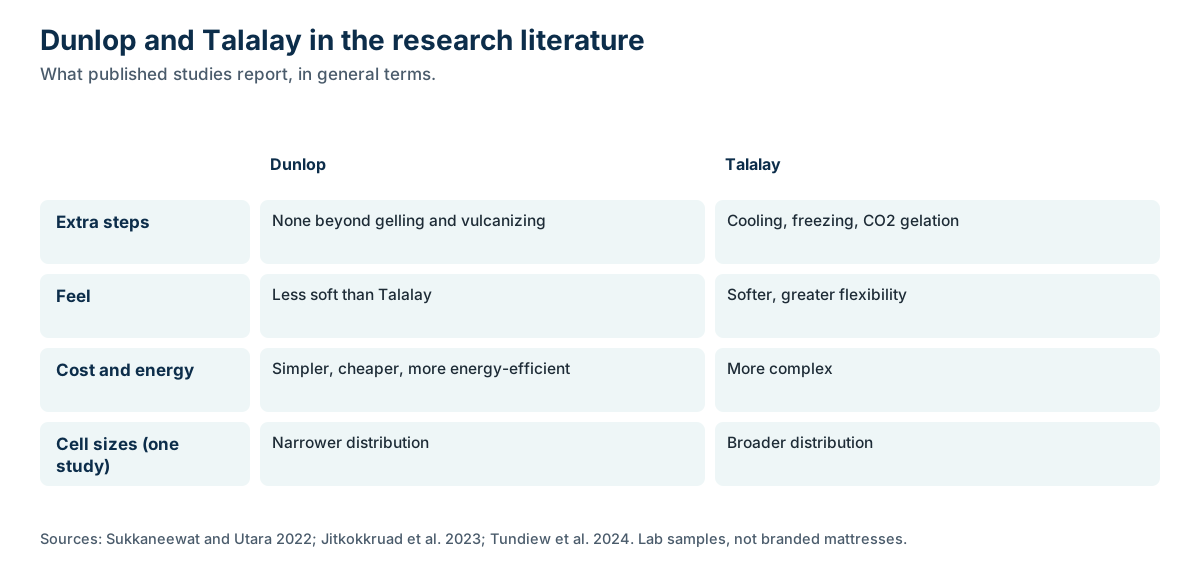
Dunlop and Talalay are two ways of turning liquid rubber latex into foam. Dunlop whips the latex into a froth, gels it in a mold and vulcanizes it in an oven. Talalay adds freezing and a carbon dioxide gelling step. Researchers describe Talalay foam as softer and more flexible, and Dunlop as simpler, cheaper and more energy-efficient to make.
Key terms used on this page
- Latex foam (Dunlop and Talalay):
- A foam made from natural rubber, synthetic rubber or a blend. Dunlop and Talalay are the two common production methods. Latex is an open-cell foam, but manufacturers describe its tolerance for water differently from memory foam: Avocado says water is not harmful to its organic latex, while warning that steam's heat can over-bake it.
- Dunlop latex:
- Latex foam made by pouring liquid latex into a mold and curing it. It is one of the two common production methods. We found no manufacturer care page that gives Dunlop latex its own cleaning rule.
- Talalay latex:
- Latex foam made with an extra vacuum and freezing stage before curing, the second common production method. We found no manufacturer care page that gives Talalay latex its own cleaning rule.
- Natural rubber latex:
- The milky material from the rubber tree Hevea brasiliensis. A 2026 review says fresh latex is about 60% water, 35% polyisoprene and 5% proteins and lipids.
- Vulcanization:
- The curing step that stabilizes a rubber foam's structure. Both the Dunlop and Talalay latex processes end with heat vulcanization, according to published process descriptions.
- Synthetic rubber latex:
- Latex made from a synthetic rubber rather than tree latex. A 2021 rubber foam review gives SBR as an example, describing it as a synthetic rubber derived from petroleum.
Dunlop and Talalay are the two standard ways to turn liquid rubber latex into a foam. In the Dunlop process, latex is whipped into a froth, set with a gelling agent in a mold and cured in an oven. The Talalay process adds extra steps: the foam is cooled and frozen, then exposed to carbon dioxide to gel. Researchers describe Talalay foam as softer and more flexible, and the Dunlop process as simpler, cheaper and more energy-efficient.
General information about mattress materials, not medical advice.
What is latex foam made from?
Natural latex comes from plants. A 2026 review by Lisiecka and Łuczak says "The principal source of natural rubber is the Hevea brasiliensis tree, cultivated in tropical regions." The same review says "Fresh latex comprises 60% water, 35% polyisoprene, and 5% proteins/lipids." Polyisoprene is the rubber itself. Synthetic rubbers can be used instead or blended in; a 2021 review of rubber foams by Rostami-Tapeh-Esmaeil and colleagues notes, for example, that "SBR is a synthetic rubber derived from petroleum."
Whatever the source, latex foam is a rubber, not a polyurethane. That separates it from the polyfoam and memory foam covered in the how foam is made article. A 2023 study by Jitkokkruad and colleagues notes that natural rubber foams "have been used as mattresses, pillows," cushions and padding.
How is Dunlop latex made?
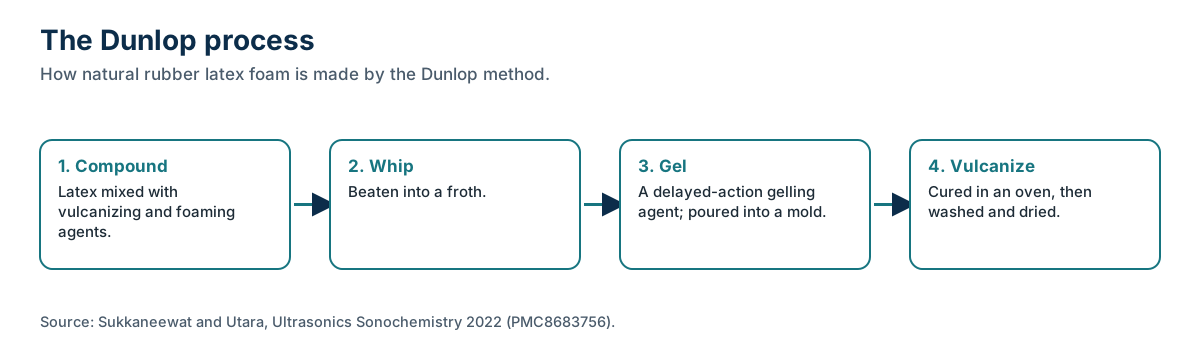
Sukkaneewat and Utara's 2022 paper describes the steps clearly. "In the Dunlop method, NR latex is first compounded with vulcanizing and foaming agents and whipped into a froth." The liquid foam is then mixed with "a delayed-action gelation reagent," sodium fluorosilicate, "and poured into a mold to gel and become a solid foam before being vulcanized in an oven." Afterward, the foam is washed and dried.
The recipes in research papers show how many ingredients go in. A 2024 Dunlop study by Danvanichkul and colleagues used sulfur as the vulcanizing agent, with zinc oxide added as a gelling agent and sodium silicofluoride after it. The authors kept the mixing room at 15 °C "To mitigate the risk of premature vulcanization and gelation associated with heat generation."
How is Talalay latex made?
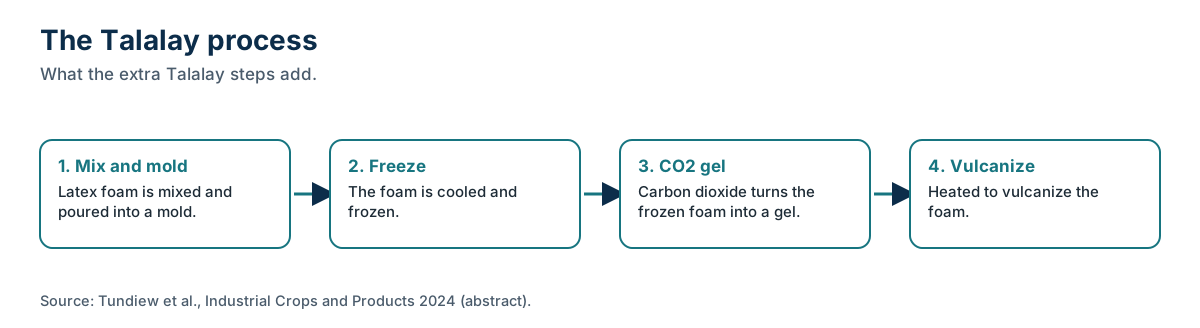
With extra cooling. A 2024 comparison by Tundiew and colleagues says both processes "involved mixing, moulding, and heating; the additional steps for the Talalay method involved cooling and gelation, a gel-freezing technique wherein the frozen foam is exposed to CO2 gas, inducing its transformation into a gel."
The extra steps come at a price, by the researchers' account. Jitkokkruad's study says the Dunlop process "has been widely used as it is a simpler process with a lower production cost and is more energy efficient than those of the Talalay process."
How do the two foams differ?
The published research points in a consistent direction on feel. Sukkaneewat and Utara write that "The Talalay method provides softer NRLFs with greater flexibility than the Dunlop method," where NRLF means natural rubber latex foam. They add that Dunlop "is commonly used as it is convenient, dependable, cost-effective, organic solvent-free and more energy-efficient."
The cell structure differs too. In Tundiew's lab comparison, "The cell size distribution of the NLF samples prepared using the Talalay method was broader than that of those prepared using the Dunlop method." The same study found its Talalay samples had "20% lower compressive strength and 7% lower energy absorption than the control sample." That was an in-house Talalay process on lab samples, so we don't treat the numbers as typical of commercial mattress layers.
What is vulcanization, and why does it matter?
It's the step that fixes the foam's structure. The 2021 rubber foam review breaks foaming into four steps, "gas dissolution, bubble nucleation, bubble growth and structure stabilization," and says the last of these "in rubber foams can be achieved by vulcanization (curing)." Both Dunlop and Talalay finish with heat to vulcanize the gelled foam. Ingredients in the recipe speed or control it, and the Danvanichkul study's cool mixing room shows that heat can start the process too early if it isn't managed.
Heat is also the theme in latex care advice. Our latex compatibility page sets out what manufacturers say about cleaning latex, including one maker's warning that steam's heat can "over-bake" organic latex.
Is latex foam-making still changing?
Yes, at least in the lab. Sukkaneewat and Utara point out a gap in the classic method: "the Dunlop method does not involve any technical step for controlling the microstructure quality of the foam." Their paper added ultrasound to the Dunlop process as "a novel alternative technique for producing natural rubber latex foam," aiming for a finer, more even cell structure.
Other groups are changing ingredients and heating. Jitkokkruad's team added bamboo leaf fiber to Dunlop latex foam "to enhance the biodegradation rate," and notes that "Heating in the vulcanization step may use either a conventional hot air oven and a microwave oven." Danvanichkul's group studied silica fillers "To reinforce natural rubber latex foam." In Tundiew's comparison, "Adding the blended surfactants reduced the porosity and increased the foam density of the NLF samples, improving mechanical properties." None of these studies tested a branded mattress, so they show where the chemistry is heading rather than what's in your bed.
Natural, synthetic and blended latex
Mattresses are sold as natural, organic, synthetic or blended latex. The research we cite here studied natural rubber latex. We found no peer-reviewed comparison of how Dunlop and Talalay foams made from synthetic or blended latex differ, so we don't extend the findings above to them.
Labels help. A law tag lists filling materials, and the law tag article explains how to read one. If the tag or product page names the latex type and process, that's the most reliable information you'll have.
What about latex allergy?
This is a health question, so we keep strictly to what's published. Lisiecka and Łuczak's review says fresh latex contains proteins, "with Hev b proteins being highly sensitising." Their review centers on medical devices and gloves, not bedding. We found no study measuring allergen exposure from sleeping on a covered latex mattress, so we make no claim either way. If you have a latex allergy, ask your doctor and the mattress maker before buying or sleeping on one.
Sleep Sanitation's view
This section is our view. Latex gets the same through-the-cover, low-moisture treatment we give foam, with heat kept in check given what latex makers say about it. Expect Italian-made Vapor Clean machines, organic methods as the starting point, and enzyme treatment if urine or organic odor is involved. Since this is our own reasoning, not a manufacturer exemption, the care label and warranty terms govern; please check your warranty terms before you book. Our sanitizing language follows the CDC's terms, and we make no disinfection claim. Pricing starts at $249 for the first mattress, with the rest on our pricing page. For how polyurethane foam responds to warmth, see the memory foam article; the mattress materials hub covers the other layers.
What we don't know
- Whether a given latex layer is Dunlop or Talalay when the label and product page don't say.
- How the lab differences between the processes carry over to commercial mattress layers made with different recipes and densities.
- Whether blended or synthetic latex foams follow the same Dunlop-versus-Talalay pattern as the natural latex studied.
Changelog
- 5 October 2026: First published. Sources accessed on this date.
Sources
- Ultrasonic-assisted Dunlop method for natural rubber latex foam production (Sukkaneewat and Utara, Ultrasonics Sonochemistry, 2022) · PubMed Central
- Effects of Bamboo Leaf Fiber Content on Cushion Performance and Biodegradability of Natural Rubber Latex Foam Composites (Jitkokkruad et al., Polymers, 2023) · PubMed Central
- A comparative study of surfactant-treated natural latex foam morphology: Talalay vs. Dunlop processing (Tundiew et al., Industrial Crops and Products, 2024) · Newcastle University ePrints
- Effects of BET Surface Area and Silica Hydrophobicity on Natural Rubber Latex Foam Using the Dunlop Process (Danvanichkul et al., Polymers, 2024) · PubMed Central
- Chemistry, Processing, Properties, and Applications of Rubber Foams (Rostami-Tapeh-Esmaeil et al., Polymers, 2021) · PubMed Central
- Natural rubber latex allergy: causes, symptoms, and modern diagnostic methods (Lisiecka and Luczak, Postepy Dermatologii i Alergologii, 2026) · PubMed Central
- Cleaning and disinfecting your school (definitions) · CDC
Last reviewed October 5, 2026. Manufacturer specifications and care instructions change; check the current version for your exact model. This page is general information, not medical advice. How we source and check pages: editorial standards.