
Short answer
Wool needs different care because it's a protein fiber covered in tiny surface scales. Textile scientists say those scales grip in one direction, so water plus agitation can make fibers mat together in irreversible felting shrinkage. Extension and wool industry sources also warn that ammonia, too much alkali and enzyme presoaks can damage wool. That's why we keep moisture and chemistry gentle.
Key terms used on this page
- Wool batting:
- A layer of wool fiber placed under the ticking, often in natural mattresses, for comfort and moisture management. Wool fiber takes up moisture from the air, which is why it matters how much water a cleaning method leaves behind.
- Differential frictional effect:
- The direction-dependent friction caused by the scales on wool and other animal fibers. Woolwise explains that it makes fibers move preferentially toward the root, which drives felting.
- Felting shrinkage:
- Irreversible shrinkage when wool fibers mat together under mechanical action in water. Woolwise says it keeps progressing with washing time until the fabric reaches a limiting density.
- Ticking:
- The outer fabric cover of a mattress, often quilted to the comfort layers beneath. Avocado tells owners: 'Do not attempt to remove the mattress ticking to access the internal materials or support unit.'
- Care label:
- The care instructions sewn into a mattress, topper or cover. Tempur UK notes that 'A label stitched inside the cover will give you specific care instructions for the item you have purchased.' A care label outranks general web guidance.
Wool in a mattress needs different care because wool is a protein fiber with microscopic scales on its surface. Textile scientists explain that those scales grip more in one direction than the other, so water combined with agitation can make the fibers lock together in a permanent felting shrinkage. Extension and wool industry sources also warn that ammonia, too much alkali and enzyme presoaks can damage wool. Gentle moisture and gentle chemistry are the rule.
General information about mattress materials, not medical advice.
Where is wool found in a mattress?
Usually just under the cover. The compatibility hub defines wool batting as a layer of wool fiber placed under the ticking, often in natural mattresses. The ticking article explains the cover layers, and the federal mattress rule calls everything between the ticking and the core "upholstery material," as the law tag article covers.
How much wool is in a mattress, and what's been done to it, varies by product. The label and product page are the best guide.
What makes wool a protein fiber?
Its chemistry. Woolwise, the Australian Wool Education Trust's teaching resource, contrasts "the protein of wool" with "the cellulose and lignins of the vegetable matter" when explaining how wool is cleaned of plant debris. That protein base sets wool apart from the polyurethane and latex foams elsewhere in the mattress materials hub.
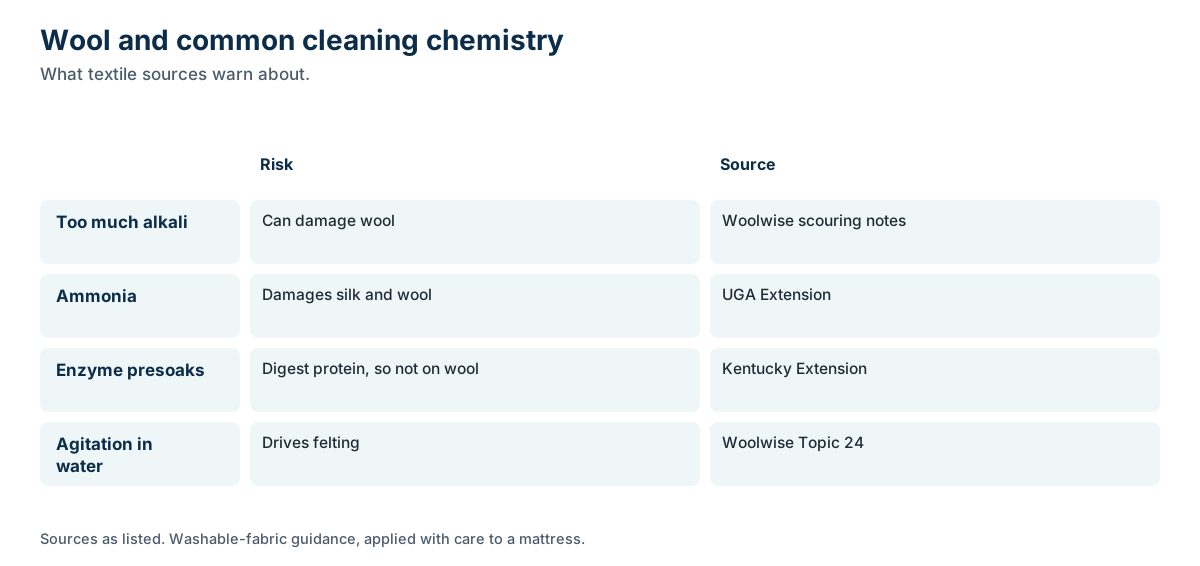
It also explains why some cleaners are a problem. The University of Kentucky Extension warns about enzyme presoak products: "Do not use on silk or wool since enzymes digest protein." Our reading: the action that makes enzymes useful on protein stains is the same action that works on the fiber itself.
Why does wool felt?
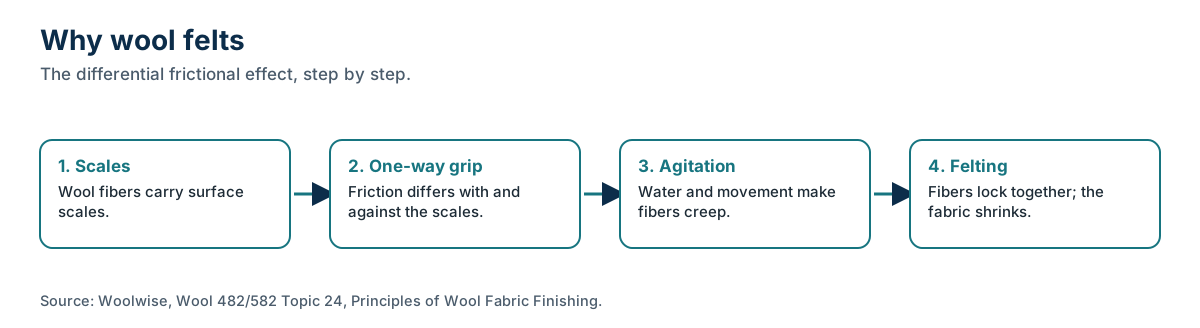
Because of its scales. Woolwise's fabric finishing notes explain that "Wool fibres, like all animal fibres, have surface scales that give rise to the so called differential frictional effect (DFE)." The scales "point to the tip direction of the fibres," and their "ratchet-like action, causes the fibres to move preferentially in the direction of the root of the fibre."
Put that in water with movement and the fibers creep and tangle. The notes say that when untreated wool is wet with soap or detergent it "will swell and consolidate. If, however, some mechanical action is applied, particularly in an acid medium, the fibres can mat together tending to give, in the end, a solid mass of fibres. The result is an irreversible shrinkage called felting shrinkage."
Is felting shrinkage the only way wool changes size?
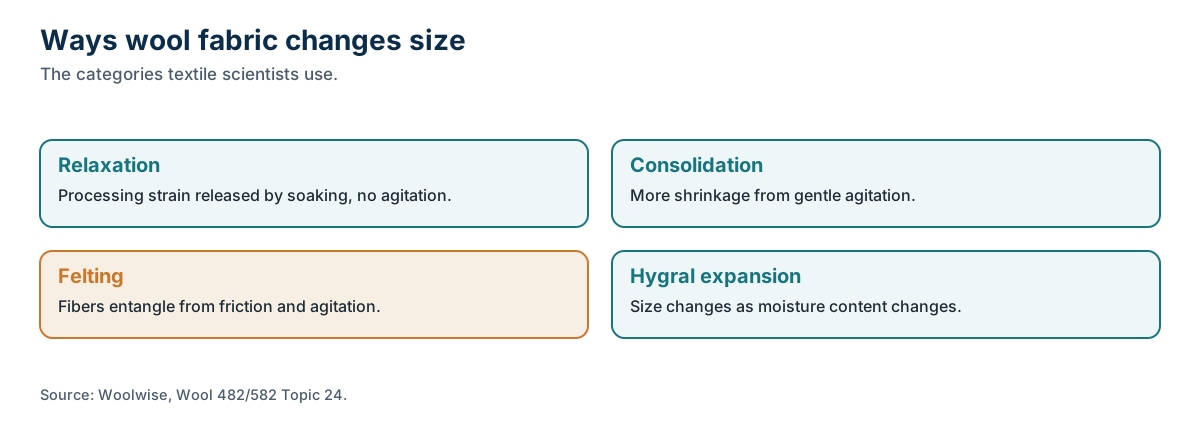
No. Woolwise lists several: changes of dimension "may be due to: (i) relaxation (ii) consolidation (iii) swelling (iv) felting, and (v) hygral expansion due to changes in moisture content." Relaxation shrinkage "occurs when the stresses or strains imposed during the processing of the textile materials are relaxed in water or water plus soap or detergent, without agitation." And "Further shrinkage; called consolidation shrinkage; can be brought about by gentle agitation in addition to simple soaking."
Felting is the one that keeps going. "Felting shrinkage, once commenced, continues to progress as the washing time is increased but ultimately approaches a limit," the notes say. The factors include fiber friction, elasticity and diameter, yarn twist and how loose the weave is.
How do manufacturers stop wool from felting?
By changing the scales. Woolwise describes processes such as "chlorination, to soften and round off the scales on the wool surface," while "additive processes use polymers to either coat and mask the scales or spot weld the wool fibres together, or both." These shrink-resist treatments matter for washable wool fabric. Whether a mattress's wool has been treated is a product detail the label may or may not give.
Felting isn't always bad, either. Finishers deliberately felt some fabrics in a process "known as milling (or fulling) to achieve consolidation of the fabric, increased fabric weight, reduced air permeability," per Woolwise. The point for a mattress is that felting happens with water and mechanical action, whether anyone intends it or not.
What cleaning chemistry harms wool?
Three warnings come up across the sources. The University of Georgia Extension says simply, "Ammonia damages silk and wool." Woolwise's scouring notes say alkali can turn grease into soap, "but too much alkali can damage wool." And the Kentucky Extension's enzyme presoak warning applies because wool is protein.
Woolwise's scouring notes also show what wool naturally carries. Raw wool carries grease and suint, a soluble salt, and "The salts in suint are water soluble and hence are easily removed," while grease needs more effort. The notes are a reminder that wool's cleaning chemistry was worked out for wool, not borrowed from foam.
Is wool fire resistant?
Woolwise's finishing notes say in passing that "wool fabrics are resistant to burning," while explaining that loose surface fibers can still be singed off with a high temperature gas flame. That's a fabric property, not a mattress certification. Federal law sets performance tests for whole mattresses, and the fire barrier article explains how makers meet them. We found no source we could cite on how much wool a mattress would need to pass, so we make no claim about it.
What do labels say about wool?
Less than you might expect. The FTC's labeling guide says "Most products that contain any amount of wool — including clothing, blankets, fabrics, yarns and other items — are covered by the Wool Act and Wool Rules." But the same guide lists "Upholstery or mattress stuffing that is not reused" among items not covered by the Textile Act. For wool products it does cover, the FTC says sellers "must disclose wool or recycled wool by name and percentage weight, even if it is less than 5% of the product." It defines recycled wool as "wool that has been returned to a fibrous state after having been woven, knitted or felted into a wool product, regardless of whether a consumer has ever used the product." And for stuffing, "If the stuffing is reused, the label must say so." How those rules apply to a particular wool mattress layer is a legal question we can't settle here. State law tags, covered in the law tag article, list filling materials.
Sleep Sanitation's view
This section is our view. Of all mattress materials, wool makes the strongest case for low moisture and no scrubbing, given what textile scientists say about felting. We work through the cover with Italian-made Vapor Clean machines and organic methods by default. Enzyme treatment for urine and organic odor is part of what we offer, so because of the Kentucky warning, tell us about any wool layer when you book and we'll plan around it. Check your warranty terms before you book, too: our method is our own reasoning, not a manufacturer exemption, and your care label and warranty terms govern. We use "sanitize" in the CDC's terms and make no disinfection claim. Leave the bed unmade until it's dry to the touch; our moisture check confirms it. Costs are on the pricing page.
What we don't know
- Whether the wool in a given mattress has had a shrink-resist treatment. Labels rarely say.
- How much moisture and movement it takes to start felting in a quilted mattress layer, as opposed to a washed fabric. The textile sources describe fabrics in wash liquor.
- How wool-labeling rules apply to every kind of mattress wool layer; the FTC guide doesn't address mattresses directly.
Changelog
- 5 October 2026: First published. Sources accessed on this date.
Sources
- Wool 482/582, Topic 24: Principles of Wool Fabric Finishing (Pailthorpe) · Australian Wool Education Trust, Woolwise
- Aqueous Scouring and Detergents (Wool 482/582 lecture notes) · Australian Wool Education Trust / University of New England (Woolwise)
- Remove Stains from Blood (accessed 2026-10-05) · University of Georgia Extension, Textiles
- Stain Removal for Washable Fabrics (FCS2-840) · University of Kentucky Cooperative Extension
- Threading Your Way Through the Labeling Requirements Under the Textile and Wool Acts · Federal Trade Commission
- Cleaning and disinfecting your school (definitions) · CDC
Last reviewed October 5, 2026. Manufacturer specifications and care instructions change; check the current version for your exact model. This page is general information, not medical advice. How we source and check pages: editorial standards.