
Short answer
Run four tests in order. Structural wear like sagging or broken coils means replace. A problem deep in the core, or mold through the layers, points the same way. Your care label and warranty set the limits on method. Bed bugs go to pest control first. A sound bed with a near-surface problem the label allows is where cleaning pays off.
Key terms used on this page
- Clean-or-replace decision:
- Our four-test framework for a problem mattress: whether the bed is structurally sound, how deep the problem goes, what the care label and warranty allow, and whether the cause is really a pest or health issue. It's our decision guidance, not a published standard.
- Structural wear:
- Loss of support or shape that no cleaning can reverse, such as sagging, lumps, broken springs or torn fabric. The Better Sleep Council, which is sponsored by the mattress industry's trade association (ISPA), lists sagging, tearing, ripping and holes among signs you may need a new mattress.
- Treatable depth:
- How far into a mattress a problem sits relative to what a surface method reaches. A problem in the cover or upper layers is within reach of low-moisture work; one in the core may not be. No published study measures it; it's our working term.
- Contamination limit:
- The point where a mattress is better replaced than cleaned, such as mold through the layers or a core soaked again and again. EPA says absorbent or porous materials may have to be thrown away if they become moldy.
- Custom surcharge:
- The extra charge for severe or biohazard contamination, quoted before any work starts. Ordinary urine accidents and pet odor are in the standard price.
- Dedicated mattress service:
- A visit planned only around mattresses: materials inspection, equipment chosen for mattress layers, and time per bed set by the job. It's the model we run; it differs from an add-on in what the visit is built around.
- Protector vs encasement:
- A protector covers the top and sides to keep spills and soil off; an encasement zips around all six sides. The AAAAI and ACAAI practice parameter recommends mite allergen-proof encasings, and says covers alone are in many cases unlikely to bring clinical benefit.
- Pest control first:
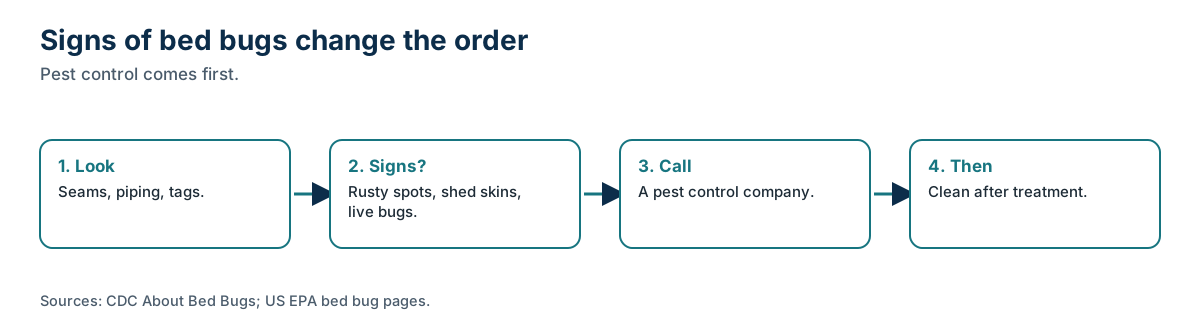
- The order to follow when bed bugs are suspected. CDC advises contacting a professional pest control company experienced with treating bed bugs. A cleaning visit comes after treatment, if at all, and is not a substitute for it.
Every question in this hub comes down to one decision: is this bed worth cleaning, should it be replaced, or does the problem belong to someone else entirely? This guide gives a four-test framework for that decision and applies it to the sixteen questions in this hub. It draws on all five earlier hubs, and it is honest about where cleaning stops being the answer. Sometimes the right move is a new mattress, a pest control company, a call to the maker or a talk with a doctor. We'd rather you hear that here than after paying for a visit that couldn't help.
This guide is general information to help you decide. It isn't medical, pest-control or engineering advice; ask a qualified professional about those.
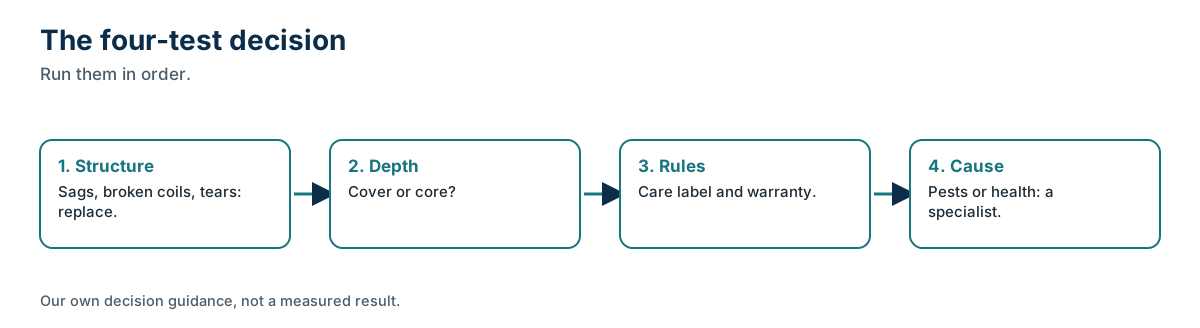
The four tests, in order
The order matters, because each test can end the decision before the next one starts.
- Structure. Does the bed still support you? If it has failed, cleaning can't fix it.
- Depth. Where does the problem sit: the cover, the upper comfort layers, or the core?
- Rules. What do your care label and warranty say about water, steam and chemicals?
- Scope. Is this really a cleaning problem, or a pest, mold or health problem wearing a cleaning label?
If a bed passes all four, meaning it's sound, the problem is within reach, the label allows a low-moisture method and nothing points to pests or a health question, cleaning is a reasonable choice. The rest of this guide explains each test and the evidence behind it.
Test 1: is the bed structurally sound?
Cleaning removes soil, odor and stains. It doesn't restore foam that has softened, springs that have broken or fabric that has torn. That makes structure the first test.
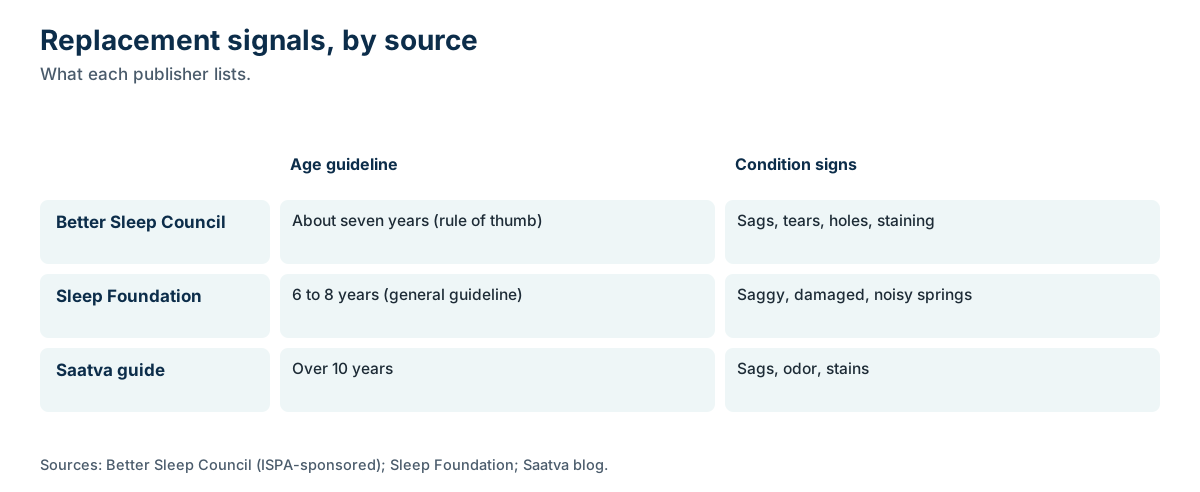
The replacement guidance we found is consistent on the signs, even where it differs on age. The Better Sleep Council, which is sponsored by the International Sleep Products Association, lists a mattress that "sags, has visible tearing, ripping, holes, staining or damage" among its signs. Sleep Foundation lists a bed that is noticeably saggy or damaged in certain areas, and one making more noise than usual, adding that "noisy springs are common in old innerspring mattresses." It also gives a simpler test: "Essentially, you should replace your bed if it's no longer helping you get restful sleep."
On age, the three publishers we checked give three rules of thumb. The Better Sleep Council says that "in general a mattress set that is seven years old has reached the end of the line and needs to be replaced," and calls this a rule of thumb. Sleep Foundation says: "Under normal conditions, mattresses should be replaced every 6 to 8 years." Saatva's blog, written by a mattress maker, says to replace a mattress "if it sags, has an odor, or is over 10 years old." None of these is a measured lifespan for your bed. Two of the three publishers are industry-linked: the Better Sleep Council through its trade-association sponsor, and Saatva as a mattress seller. We treat all three as guidelines, not expiry dates.
The practical point: an old bed that still supports you can be worth cleaning, and a newer bed with a broken coil isn't. Is a 10-year-old mattress worth cleaning? works through that case, and problems professional cleaning can't fix lists the structural ones in full.
Test 2: how deep is the problem?
Once you know the bed is sound, the question is reach. A low-moisture method works on the cover and the upper layers. It isn't designed to flush out the core, and it shouldn't be, because water pushed into foam is slow to leave. Hub 5 sets out the difference between surface moisture and saturation and explains why foam is slow to dry.
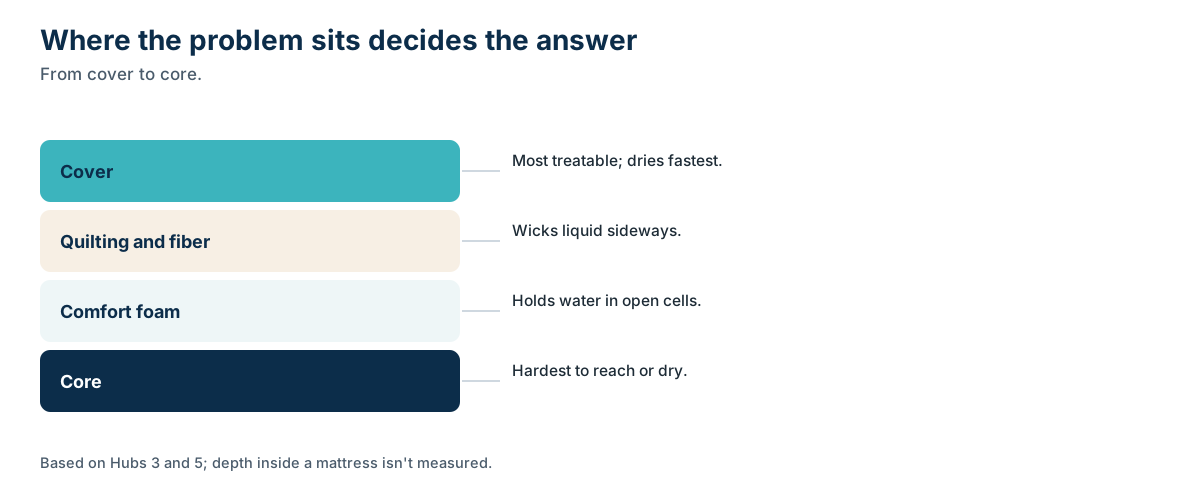
Urine is the clearest example. Hub 3 explains what happens when urine soaks into a mattress and why odor can come back after a mattress dries. The Carpet and Rug Institute's pet urine bulletin is written for carpet, not mattresses, but its point about hidden sources carries over: masked odor "may reappear" in high humidity, and "Unless the cat urine can be completely removed, complete odor removal is unlikely." In a mattress, a fresh, single accident that stayed in the upper layers is a different job from a spot that has been soaked many times and reached the core.
Mold is the other depth problem. EPA's brief guide to mold says: "Absorbent or porous materials, such as ceiling tiles and carpet, may have to be thrown away if they become moldy. Mold can grow on or fill in the empty spaces and crevices of porous materials, so the mold may be difficult or impossible to remove completely." Mattresses aren't on EPA's list, but foam is porous. EPA's remediation table says upholstered furniture may be difficult to completely dry within 48 hours. If mold has grown through the layers, we'd replace the bed, not clean it.
When is a mattress too contaminated to clean? draws those lines, and is the odor in the cover or the foam? gives a home check for where a smell sits.
What a visit can and can't reach
Putting the first two tests together gives a rough map of what a cleaning visit can do.
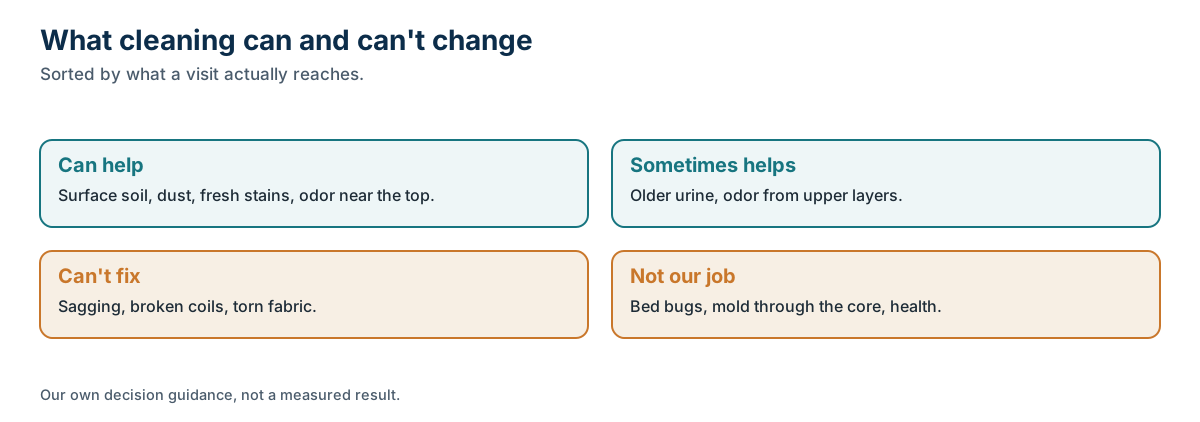
Within reach: surface stains, body-oil discoloration, settled dust on the surface and in seams, fresh or single urine accidents in the upper layers, and odors whose source sits in the cover or comfort layers. Partly within reach: old stains that have set (they may lighten, not vanish), and repeated urine where some has reached deeper. Out of reach: sagging, body impressions, broken coils, torn fabric, mold through the core, and anything that needs pest treatment. Hub 1's methods guide explains why each method reaches as far as it does.
Test 3: what do the label and warranty say?
This test applies whoever does the work, us included. Mattress makers write care rules for their own materials and warranties. We quote those rules in full, and we don't guess at the reasons behind them. Hub 2's compatibility guide covers the brands we checked.
Some makers rule steam out. Tempur UK's care page says: "There is a high risk that soaking with water or other cleaning fluids will cause irreversible damage, destroying the benefits of comfort and support which the TEMPUR ® Material provides. It will also invalidate your guarantee. Do not steam-clean or dry-clean the TEMPUR ® Material." That applies regardless of how much moisture a method claims to use. Purple's guide says: "After vacuuming, you can steam clean your innerspring or hybrid mattress, but you should not steam clean a memory foam, latex, or adjustable mattress since the heat and water could damage its materials. Note that you should not steam clean a Purple mattress. If you have any doubts, refer to the manufacturer’s care instructions and your warranty." So the general allowance for hybrids comes with a direct "no" for Purple's own beds.
Others write about water rather than steam, which matters for any method that adds liquid, whether it's a home spot clean or a professional visit. Casper's care page is specific about the order of operations and the risk to the core: "If you need to clean your Casper mattress or cover, we suggest spot-cleaning affected areas with water and mild detergent. Be careful not to saturate the mattress with too much water and/or detergent, as the foam in the mattress core will soak up water and detergent. Allow the treated area to air dry completely before putting your sheets and bedding back on."
Tempur UK also points owners to the label itself: "A label stitched inside the cover will give you specific care instructions for the item you have purchased." That's the right first stop for any mattress. Hub 2's entries on the care label and warranty exclusions explain what to look for. If the label says no steam, a maker's silence about any particular kind of steam isn't permission.
Test 4: is it really a cleaning problem?
Some problems look like cleaning jobs and aren't.
Bed bugs. CDC's bed bug page says that "How clean a place is does not determine whether bed bugs are present," and that if you think you have an infestation, you should "contact a professional pest control company experienced with treating bed bugs." EPA's guide to finding bed bugs says that around the bed "they can be found near the piping, seams and tags of the mattress and box spring, and in cracks on the bed frame and headboard." If you see signs, pest control comes first. EPA's treatment preparation page describes what a pest professional may ask you to do, including encasements with zippers that close completely.
There is steam research on bed bugs, and we cite it narrowly. Puckett and colleagues' 2013 study tested a J-4000DM Jiffy garment steamer on small boxed arenas of Sealy mattress material, with 5 replicates, in an air-conditioned room. It didn't test dry vapor or a full mattress, and it doesn't show that a cleaning visit clears an infestation. We don't claim it does.
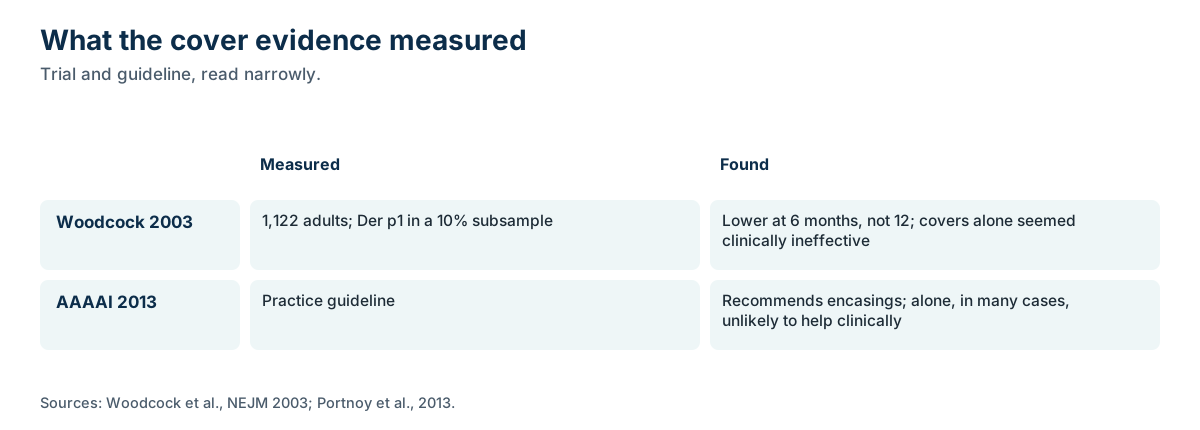
Allergy and asthma. If the reason for cleaning is a health condition, the question belongs with a doctor. Hub 4's dust mite guide explains what the studies measured. The best-known trial, Woodcock and colleagues in 2003, gave allergen-impermeable bed covers to 1,122 adults with asthma. In a 10% random subsample of homes in that trial, mite allergen in mattress dust was lower in the cover group at 6 months but not at 12 months, and the authors concluded that the covers, as a single intervention, "seem clinically ineffective in adults with asthma." The AAAAI and ACAAI practice parameter recommends mite allergen-proof encasings, and adds that "in many cases mite covers alone are unlikely to achieve a clinical benefit unless they are used as part of a more comprehensive multifaceted avoidance plan." Neither source studied mattress cleaning. We make no health claims for it.
Applying the tests to everyday situations
Urine. A single fresh accident on a sound bed is a cleaning job. Repeated soaking into the core, or urine plus mold, points to replacement. Should I clean or replace my mattress after urine? walks through it with Hub 3's evidence.
An old bed. Age alone doesn't decide. Run the structure test first, then weigh the cost of a visit against the bed's remaining life. See is a 10-year-old mattress worth cleaning?.
A used mattress. EPA's bed bug fact sheet says: "Do not bring second-hand furniture into your home unless you have thoroughly inspected and cleaned the items first." Inspection comes before anything else, and cleaning isn't pest treatment. Can a used mattress be sanitized? explains what cleaning can and can't promise.
Moving and storage. A move exposes a bed to trucks, storage units and other people's furniture. CDC notes that bed bugs can travel in "seams and folds of luggage" and furniture. Inspect first, then decide. See should you sanitize a mattress after moving?.
A guest room. A bed nobody sleeps on still collects dust, and a room that sits closed can turn musty. See should you clean a guest-room mattress?.
A smell you can't place. Work out whether it's in the cover or below it before choosing a fix: is the odor in the cover or the foam?.
Too far gone. For the cases where cleaning isn't the right call at all, read when is a mattress too contaminated to clean? and problems professional cleaning can't fix.
A protector, an encasement or a cleaning?
These do different jobs. A protector is a fitted cover for the top and sides that keeps new spills and soil off the mattress. An encasement zips around all six sides; it's the product the AAAAI recommends for mites and that EPA mentions for bed bugs. A cleaning deals with what's already in the bed. None replaces the others. Hub 4 asks whether sanitation can replace a dust mite encasement, and the answer is no. The reverse holds too: a cover doesn't remove existing soil. Is mattress sanitation worth it with a protector? covers the order we'd use: clean if there's a reason, let it dry, then cover.
Who to call: methods and service models
Many kinds of business clean mattresses, and the method matters more than the name on the van. Hub 1 explains the main methods: HEPA vacuuming, steam and extraction, dry vapor vs carpet extraction, and how carpet cleaning equipment compares with mattress sanitation equipment.
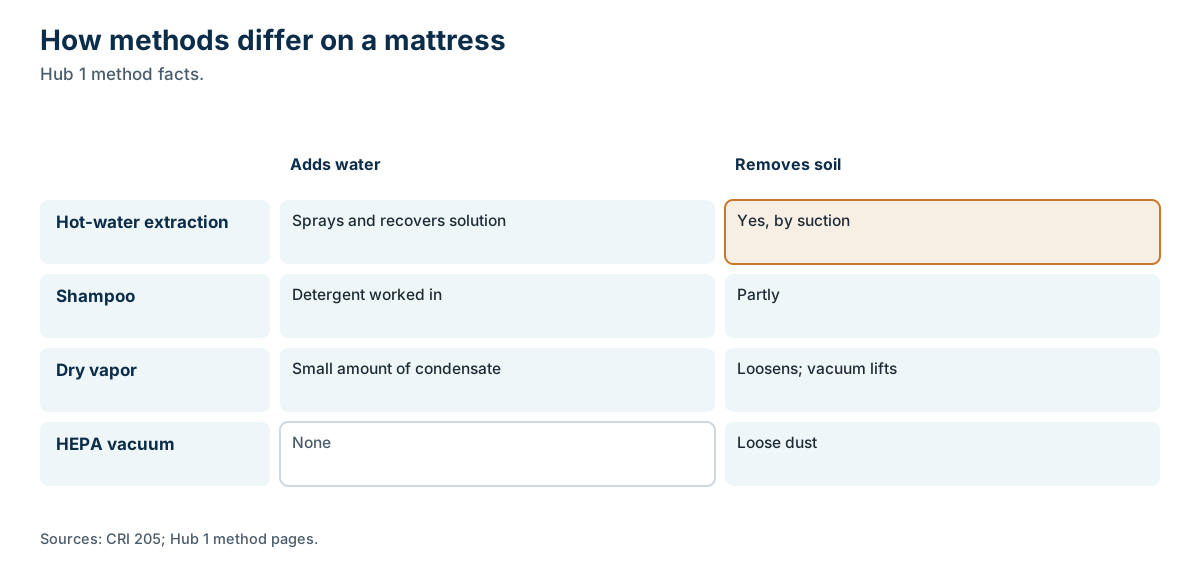
The Carpet and Rug Institute's residential guide defines an extractor as equipment "that uses pressure, water/cleaning solution, and suction to extract deeply embedded soil or stains from carpeting," and says that "The most common professional residential carpet cleaning systems used is a hot water extraction (HWE) system." Those are carpet facts. A mattress is thicker, has foam layers that hold water, and can't be laid flat to dry the way carpet can, so the amount of water matters more.
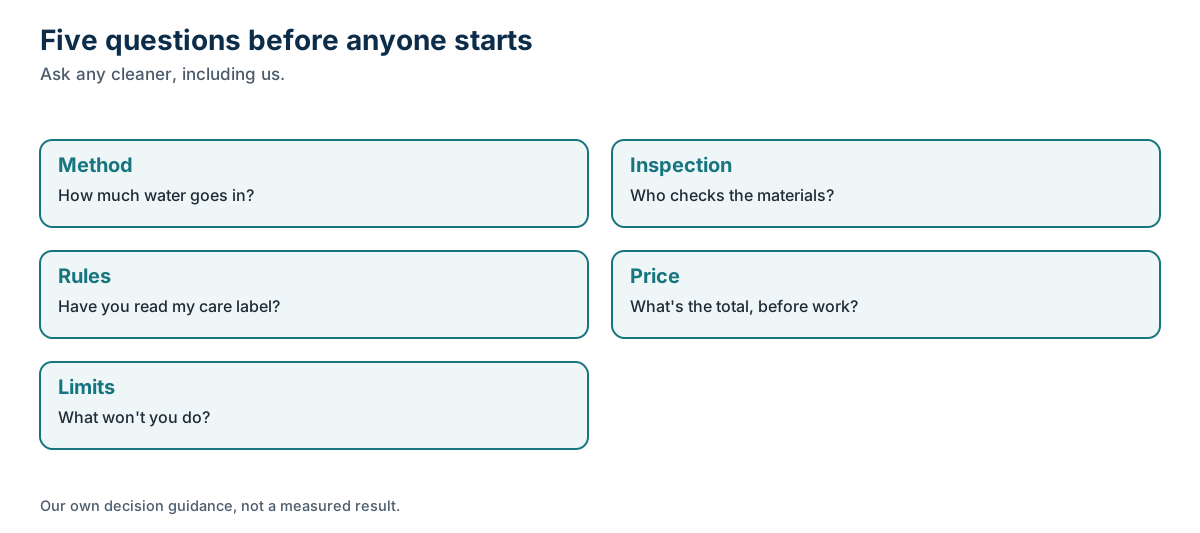
Service models differ as well. Mattress cleaning is sold both as an add-on to carpet or upholstery work and as a dedicated mattress service. Either can do good work. A dedicated service differs in what the visit is planned around: a materials inspection, equipment chosen for mattress layers, and time set per bed. Whoever you call, ask the same questions. Carpet cleaner or mattress specialist?, questions to ask before cleaning an expensive mattress and how professional cleaning methods differ go into detail.
What it costs, and why prices differ
For a national reference, Angi's cost guide, updated 3 August 2026, says: "Professional mattress cleaning costs $130 on average." It puts basic cleaning at $80 to $130 on average and deep cleaning at $130 to $200, and says that "Mattress size is the biggest factor when estimating mattress cleaning costs." We cite those as Angi's figures. They aren't local quotes and they don't describe any one company.
Our own prices are published. The first mattress, any size, is $249. Under our limited-time Fall 2026 offer it's $199, and another cleaning within 7 days of your service is also $199. Additional full, queen or king mattresses are $199, and additional kids' beds (twin or full) are $149. Normal stain treatment, pet odor treatment and ordinary urine accident treatment are included. Severe or biohazard contamination is quoted as a custom surcharge before we start.

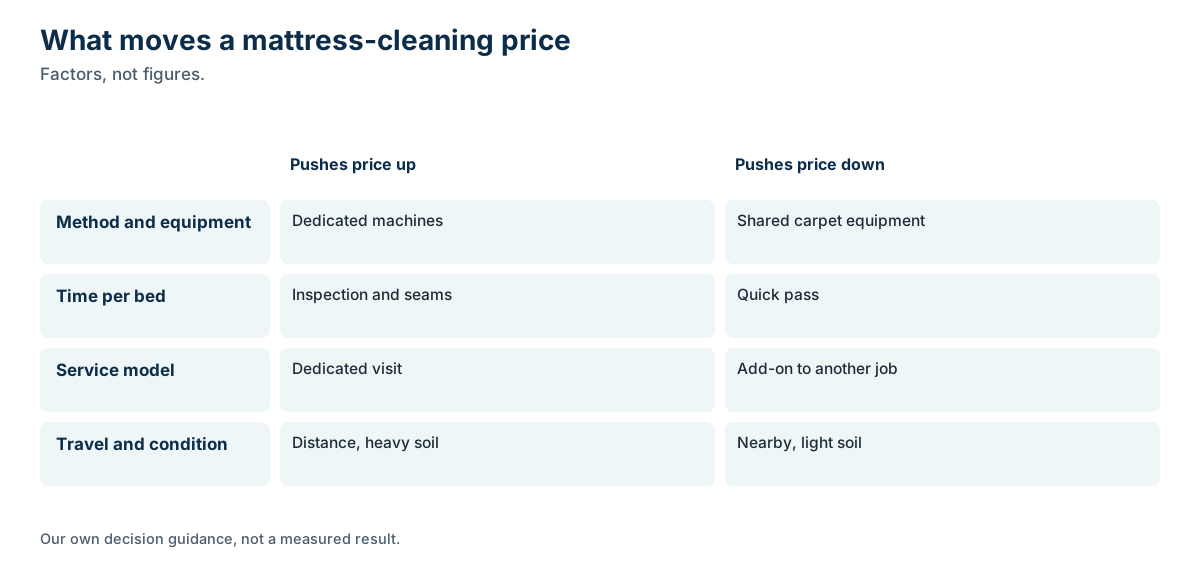
What drives the spread between quotes? Six things, in general terms: the method, the equipment, the time spent per bed, whether there's a materials inspection, whether the cleaning is an add-on or the whole visit, and travel and contamination level. Angi notes the last of these too: "A mattress with tough, ground-in stains will cost more to clean than a new mattress that's only affected by dust buildup." Two quotes can describe two different jobs. How much should mattress sanitation cost? and why prices range from $80 to $300 break that down.
Is it worth it?
Put the tests and the price together and the value question gets simpler. Cleaning is worth considering when the bed is sound, the problem is within reach, the label allows the method, and the cost is reasonable next to the bed's value and remaining life. It isn't worth it when any test fails. For a high-end bed, the label and warranty test carries extra weight, because the downside of the wrong method is larger. Is professional mattress sanitation worth it? and should I professionally clean a $3,000 mattress? apply this.
Our visit, when cleaning is the answer
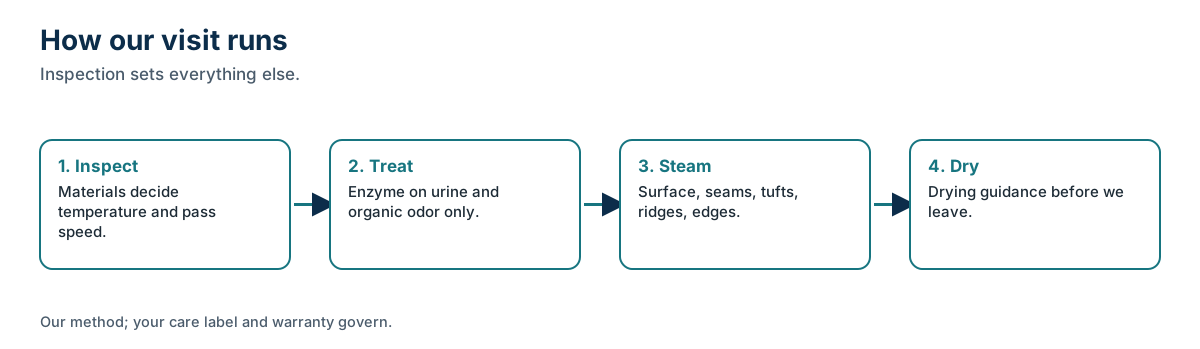
This section is our view. A visit starts with a materials inspection, and that inspection decides steam temperature and pass speed for that bed. Dry vapor then covers the sleep surface and the seams, tufts, ridges and edges where dust and shed skin flakes collect, with the vac pulling loosened material away. Organic cleaning methods are our default, with enzyme treatment for urine and organic odor. Our machines are Italian-made Vapor Clean units: the Magnum XP with its built-in vac, the ProV 350 and the Pro6 Duo. In our view and experience, their adjustable steam and pass speed let us treat any mattress or topper, and if a material reacts, we adjust or stop. That's our call; your care label and warranty still govern.
This is our own method and reasoning, not a manufacturer exemption. If your label rules out steam, tell us and we'll talk through what that leaves. We use "sanitize" in its cleaning sense, as Hub 2's note on the CDC's cleaning and sanitizing terms explains, and we make no disinfection or health claim.
If your bed passes the four tests, you can book a visit online. The first mattress is $249, or $199 under the limited-time Fall 2026 offer, and the pricing page lists every line, including the 7-day $199 rebook and how severe or biohazard surcharges are quoted before we start. Prefer to talk it through first? Call (402) 512-5658.
Where to read next
The sixteen articles in this hub, by group:
- Clean or replace: urine, a 10-year-old bed, too contaminated to clean, what cleaning can't fix
- Value: is sanitation worth it?, a $3,000 mattress, with a protector
- Situations: a used mattress, after moving, a guest room, cover or foam odor
- Hiring and cost: carpet cleaner or specialist, questions to ask, how methods differ, what it should cost, why prices vary
The hub page groups them the same way. For the evidence underneath, see the flagships for methods, materials, urine, dust mites and moisture.
What we don't know
- How a full professional cleaning visit changes a mattress over time. We found no study of one.
- How long any particular mattress will last. The age figures above are publishers' guidelines, and two of the three publishers are industry-linked.
- How Angi's national averages compare with prices in any one city. We cite them as Angi's figures.
- Whether any published standard defines a mattress cleaning. We found carpet standards and guidance, not mattress ones.
- How cleaning and a protector compare head to head. We found no study.
- What cleaning does for a used mattress with an unknown history. We found no study, which is one reason inspection and pest control come first.
Changelog
- 3 October 2026: First published. Sources accessed on this date.
Sources
- Replacing a Mattress (accessed 2026-10-03) · Better Sleep Council (sponsored by the International Sleep Products Association)
- When Should You Replace Your Mattress? (accessed 2026-10-03) · Sleep Foundation
- How to Clean Your Mattress in 5 Simple Steps (blog, accessed 2026-10-02) · Saatva
- How Much Does Mattress Cleaning Cost? (updated 3 Aug 2026, accessed 2026-10-03) · Angi
- About Bed Bugs (26 April 2024, accessed 2026-10-03) · CDC
- How to Find Bed Bugs (accessed 2026-10-03) · US EPA
- Bed Bug Prevention, Detection and Control (fact sheet, 2014) · US EPA
- Preparing for Treatment Against Bed Bugs (accessed 2026-10-03) · US EPA
- A brief guide to mold, moisture and your home · US EPA
- Mold Remediation in Schools and Commercial Buildings, Table 1: Water Damage, Cleanup and Mold Prevention · US EPA
- Control of exposure to mite allergen and allergen-impermeable bed covers for adults with asthma (Woodcock et al., N Engl J Med, 2003) · PubMed
- Environmental assessment and exposure control of dust mites: a practice parameter (Portnoy et al., Ann Allergy Asthma Immunol, 2013) · AAAAI and ACAAI
- CRI 205 Residential Carpet Cleaning Standard · Carpet and Rug Institute
- Pet Urine and Carpet (technical bulletin, revised 27 July 2017) · Carpet and Rug Institute
- Comparison of multiple steam treatment durations for control of bed bugs (Puckett, McDonald and Gold, Pest Manag Sci, 2013) · Texas A&M Urban Entomology (author copy)
- Caring for your TEMPUR (UK, updated 11 July 2023, accessed 2026-10-02) · Tempur UK
- How To Clean a Mattress in 9 Steps (last updated 16 Oct 2025, accessed 2026-10-02) · Purple
- How to clean your mattress: a mattress care guide (accessed 2026-10-02) · Casper
- Magnum XP-Vac product page (maker's claims, accessed 2026-10-02) · Vapor Clean
- ProV 350 product page ('Italian Made'; maker's claims, accessed 2026-10-02) · Vapor Clean
- Pro6 Duo product page ('Made in Italy'; maker's claims, accessed 2026-10-02) · Vapor Clean
- Cleaning and disinfecting your school (definitions) · CDC
Last reviewed October 3, 2026. Manufacturer specifications and care instructions change; check the current version for your exact model. This page is general information, not medical advice. How we source and check pages: editorial standards.