
Short answer
Carpet extraction sprays heated water and cleaning solution into the fabric under pressure, then vacuums most of it back. Dry-vapor steam delivers heat as vapor that condenses on the surface and adds no solution. On a mattress, the key difference is where the water goes: extraction can push water past the ticking, beyond what a surface wand can recover, while dry-vapor steam keeps moisture near the surface but doesn't flush soil out.
Key terms used on this page
- Hot-water extraction (HWE):
- The carpet industry's most common professional method. The Carpet and Rug Institute defines an extractor as equipment that uses pressure, water or cleaning solution, and suction to remove soil. It is often marketed as 'steam cleaning' even though it sprays hot water rather than steam.
- Dry-vapor steam:
- Steam made in a sealed, pressurized boiler and released through a hose and nozzle as hot vapor with a low liquid-water content. In the vendor specifications we reviewed, professional units are rated from 80 psi (Ladybug 2350) to 150 psi (Daimer), with stated boiler temperatures from about 345°F (Optima) to 360°F (Daimer); these are maker claims. Daimer describes its steam as about 5% water or less and Vapor Clean claims 'just 5-6% moisture'; that is a vendor claim, not an independent standard.
- Truckmount and portable extractors:
- The two common kinds of hot-water extraction equipment. A truckmount is a vehicle-powered system that pumps heated solution through long hoses; a portable extractor is a wheeled unit with its own tanks, pump and vacuum. Both are designed around carpet and upholstery.
- Residual moisture:
- Water left in a material right after cleaning, before drying. For carpet, the Carpet and Rug Institute's test for its deep-cleaning extractor seal allows up to 8 ounces per square yard. We have not found an equivalent published test for mattresses.
- Moisture load:
- The total amount of water a cleaning process puts into a mattress, whether from spray, steam condensate, shampoo or rinse. It is the main thing that decides how long a mattress takes to dry.
- Detergent residue:
- Cleaning chemistry left behind in the fabric after cleaning. The Carpet and Rug Institute says residue from over-concentrated solution contributes to rapid re-soiling, which is why extraction cleaners are told to rinse.
- Wicking:
- Moisture moving through a material as it dries, carrying dissolved soil or stain with it. When the moisture evaporates at the surface, the stain can reappear on a fabric that looked clean.
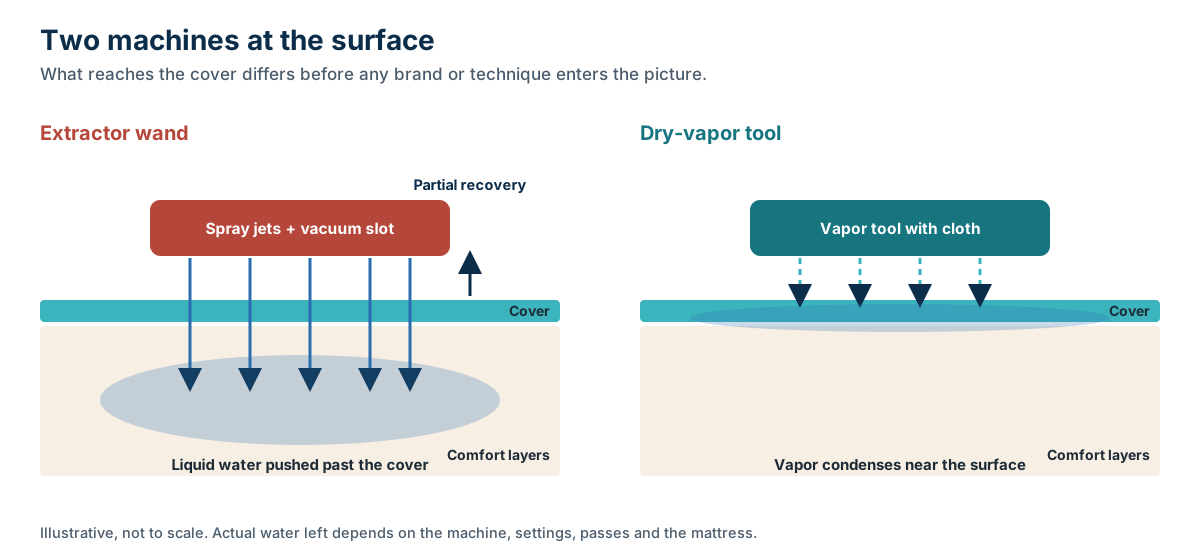
Carpet extraction sprays heated water and cleaning solution into fabric under pressure, then vacuums most of it back out. Dry-vapor steam delivers heat as vapor that condenses on the surface, and adds no solution at all. On a mattress, the difference that matters most is where the water goes. Extraction can push water past the ticking into the comfort layers, beyond the reach of a surface wand. Dry-vapor steam keeps moisture near the surface, but it doesn't flush soil out, so it has to be paired with vacuuming.
Both methods are legitimate; they were designed for different jobs. The comparison below goes variable by variable: water in, water out, heat, residue, drying and what manufacturers say. The flagship guide adds shampooing and HEPA vacuuming, and the Cleaning Methods hub defines each term. If you're in Omaha or Lincoln and want to know how we apply this in local homes, see dry vapor steam mattress cleaning in Omaha and Lincoln.
Two different machines
Hot-water extraction is the carpet industry's most common professional method. The Carpet and Rug Institute defines an extractor as equipment that uses "pressure, water/cleaning solution, and suction" to remove soil, and lists truckmounted, portable and self-contained types (see truckmount and portable extractors). It's widely advertised as steam cleaning. Daimer, which sells vapor steamers, calls that a misnomer: extractors spray hot water, they don't make steam.
Dry-vapor steam comes from a pressurized boiler that turns water into vapor well above 212°F. It's explained in what is dry-vapor steam cleaning?
Side-by-side on a mattress
| Variable | Hot-water extraction | Dry-vapor steam |
|---|---|---|
| What goes in | Hot water and cleaning solution, sprayed under pressure | Vapor, with a small share of droplets |
| Typical published equipment figures | Truckmount: up to 250°F, 1,500 psi, 3.4 gpm (Sapphire 370ss). Portable: 120 psi, 1.3 gpm (Mytee HP90) | Maker claims: 80 psi (Ladybug) to 150 psi (Daimer); stated boiler temperatures 356°F (Vapor Clean) to 360°F (Daimer); water use in quarts per hour or fractions of a liter per minute |
| How heat is delivered | Hot liquid | Condensation on the fabric |
| What's removed | Water-soluble soil the vacuum recovers | Nothing by itself; loosened soil is vacuumed or wiped |
| What can stay behind | Residual moisture and detergent residue | A small amount of condensate |
| Where moisture goes | Into the fabric and possibly comfort layers | Mostly at and near the surface |
| Rinse step | Recommended for carpet after in-tank solution (CRI) | Not needed; no solution is added |
| Designed for | Carpet and upholstery | Hard surfaces, fabric and detail work |
Where the water goes
The core issue is depth. An extractor wand sprays solution down and pulls water up at the same spot. On carpet, that works because the fiber layer is thin and sits on a backing and pad. On a mattress, the ticking sits over a fire barrier and many inches of foam, latex or fiber with no drain underneath. Water that passes the ticking during spraying is beyond the wand's reach.
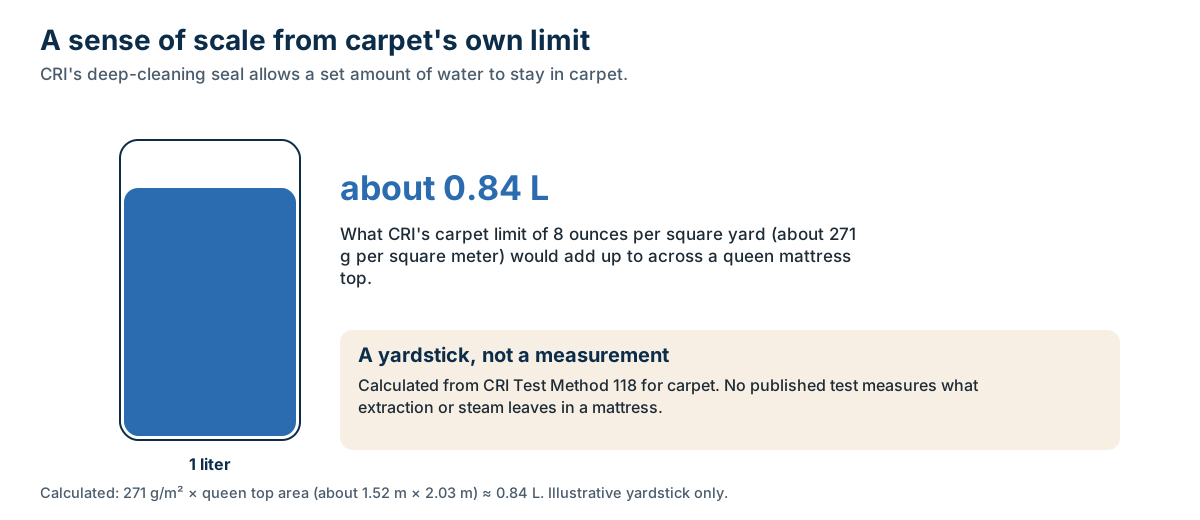
Carpet gives us a sense of scale. CRI's Test Method 118 allows a deep-cleaning extractor to leave up to 8 ounces of water per square yard on carpet and still earn its seal. Applied to a queen mattress top purely as an illustrative yardstick (calculated from that CRI limit), that would be about 0.84 liters. We haven't found a mattress measurement for extraction or for steam, and we say more about that in how much moisture does dry-vapor steam use?
Manufacturers worry about the same thing. Purple warns that a carpet cleaner "could overly saturate a memory foam mattress," and in a separate article says a saturated dense-foam mattress would take days to dry.
Heat: hot water vs condensing steam
Extraction delivers heat as hot liquid. Truckmounts are rated to heat water up to about 250°F at the machine (the Sapphire 370ss spec, for example). Dry-vapor steam delivers heat by condensing, which releases about 2,257 kJ per kilogram at atmospheric pressure according to steam tables, many times more energy per gram than hot water cooling down. That means steam can heat a surface with far less water.
For either method, the temperature that matters is the one at the fabric, held for some time, and neither industry publishes it for mattresses. The article on why heat and moisture have to be considered separately explains why the two variables shouldn't be traded off without thinking.
Residue and rinsing
Extraction's advantage is that it can rinse. CRI recommends a clear-water rinse after using in-tank solution, because over-concentrated solution leaves residue that "will contribute to rapid resoiling." On a mattress, though, every rinse adds more water. If the rinse is skipped, detergent stays in the ticking you sleep on, and dissolved soil can travel back to the surface as the fabric dries, which is called wicking.
Dry-vapor steam doesn't need detergent, so there's nothing to rinse. The trade-off is that it doesn't flush soluble soil out. See does professional mattress cleaning have to use detergent?
What the evidence says about mites and allergen
Neither method has been tested head to head on mattresses in a study we can find. The closest evidence comes from carpet and rugs:
- The AAAAI/ACAAI practice parameter notes that rugs that were wet-cleaned or shampooed did not have their mites killed, though allergen was removed.
- Steam on carpet, measured over months. When Colloff, Taylor and Merrett (1995) steam-treated mite-infested carpet with a domestic unit, follow-up samples over four months turned up no live mites, and Der p 1 was down 86.7% versus 4.7% where carpet was left alone. There is no equivalent trial of an extractor on a mattress to set beside it.
That suggests extraction is better understood as removal and steam as heat treatment, which is one reason steam is usually paired with vacuuming.
When each makes sense
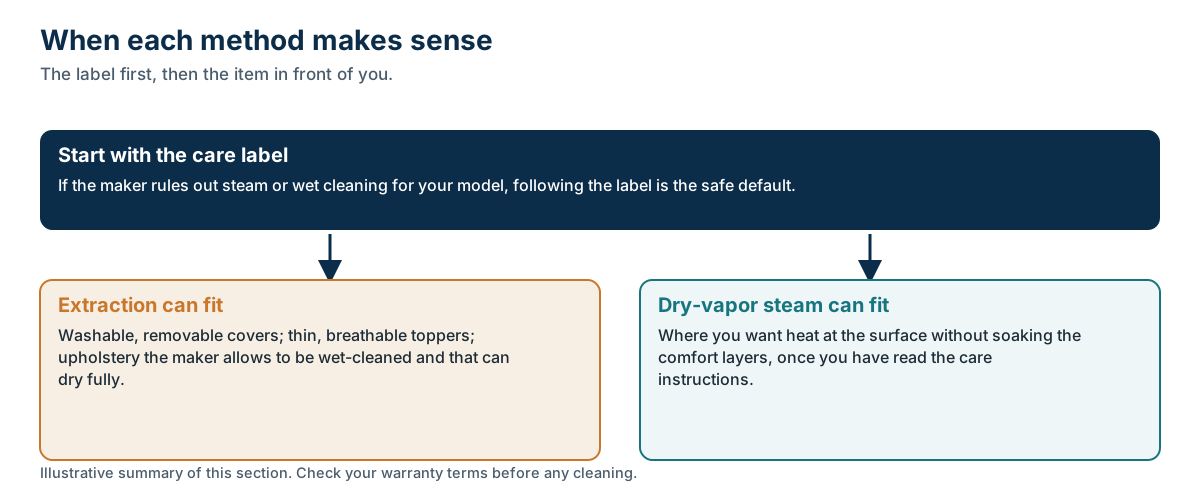
- Extraction can fit washable, removable covers; thin, breathable toppers; or upholstery the manufacturer allows to be wet-cleaned.
- Dry-vapor steam can fit mattresses where you want heat at the surface without soaking the comfort layers, once you've read the manufacturer's care instructions (see the next point).
- Where the manufacturer restricts steam, the exact words matter. Tempur's UK care page reads "Do not steam-clean or dry-clean the TEMPUR Material," then goes on: "There is a high risk that soaking with water or other cleaning fluids will cause irreversible damage" and "It will also invalidate your guarantee." Its US site, Tempur-Pedic, adds a heat caution: "Due to the temperature-sensitivity of the TEMPUR-material, adding high heat can hinder its ability to react to your body temperature and conform to your body shape." For foam, latex and adjustable models, Purple is just as clear: "you should not steam clean a memory foam, latex, or adjustable mattress since the heat and water could damage its materials," and "you should not steam clean a Purple mattress". It also warns separately against carpet cleaners on memory foam. Both brands rule out extraction, and both rule out steam with no carve-out for dry vapor. We still dry-vapor clean these brands, keeping water low (Vapor Clean's product page claims "just 5-6% moisture," a maker claim, not a measurement of our equipment) and the tool moving. That is our own decision, with the reasoning set out in what happens when water penetrates memory foam, and not something either maker endorses. The label is the safe default; check your manufacturer's warranty terms.
Questions to ask a provider
If a company offers to clean your mattress, these questions show which of the two methods you're actually getting and how much water it involves:
- "Is your mattress tool fed by a boiler or by a solution tank?" A solution tank with vacuum recovery is hot-water extraction, whatever the advertising calls it. A sealed, pressurized boiler means steam.
- "How long does the wand or trigger run on a queen mattress?" Extractor water use is published as a flow rate, such as 1.3 gallons a minute for the Mytee HP90, so run time tells you roughly how much water was sprayed. For steam, ask how long the trigger is held per section.
- "Do you rinse, and how is the mattress dried afterward?" The CRI residential standard says cleaning with an in-tank solution should be followed by a clear-water rinse. On a mattress, that rinse is more water to dry.
- "What does my mattress manufacturer say, and how do you handle it?" Tempur and Purple both restrict steam, and Purple warns that a carpet cleaner could overly saturate memory foam. A provider should know the rule for your brand and tell you plainly what they do about it.
- "How will we know it's dry through, not just dry to the touch?" Ask what the technician checks before you remake the bed. The difference is explained under dry to the touch vs dry through.
Sleep Sanitation doesn't use extraction on mattresses; we use our Vapor Clean dry-vapor equipment (we run the Magnum XP, ProV 350 and Pro6 Duo and match the machine to the job) and a heated UV-C mattress vacuum. How we're different explains the choice, and hardware differences are covered in why carpet-cleaning equipment and mattress-sanitation equipment aren't necessarily interchangeable. Omaha and Lincoln homeowners can book online.
What we don't know
- Head-to-head data. We haven't found a study comparing extraction and dry-vapor steam on mattresses, for soil, allergen, microbes or moisture.
- Mattress dry times. We haven't found published dry times for either method on mattresses.
- Residual moisture in mattresses. CRI measures it on carpet. We haven't found an equivalent for mattresses.
Sources
- CRI 205 Residential Carpet Cleaning Standard · Carpet and Rug Institute
- CRI Test Method 118 (extractor residual moisture) · Carpet and Rug Institute
- Steam cleaners vs carpet shampooers · Daimer Industries
- Sapphire 370ss truckmount specifications · Hi-Pressure Cleaning Systems
- HP90 Stingray portable extractor specifications · Mytee
- How to clean a mattress · Purple
- Can you use a carpet cleaner on a mattress? · Purple
- Caring for your TEMPUR mattress · Tempur UK
- Dust mite practice parameter (Portnoy et al., 2013) · AAAAI-ACAAI
- Colloff, Taylor & Merrett (1995), steam cleaning of carpets and dust mites · Clinical & Experimental Allergy
- Saturated steam properties · Engineering ToolBox
Last reviewed October 2, 2026. Manufacturer specifications and care instructions change; check the current version for your exact model. This page is general information, not medical advice. How we source and check pages: editorial standards.