
Short answer
Surface moisture is water held in the cover fabric and the top of the comfort layer, close enough to the air to evaporate. Saturation is water that has moved down into the open cells of the foam or fiber below. The amount can be similar; the location is what changes the outcome, because foam insulates and its cells hold liquid.
Key terms used on this page
- Surface moisture:
- Water held in the cover fabric and the top of the comfort layer, close enough to the air to evaporate quickly. It is the moisture a low-moisture method aims to leave, as opposed to water that has travelled down into the core.
- Mattress saturation:
- Water filling the open cells of a foam or fiber layer below the cover, rather than sitting at the surface. Casper's care page warns that the foam in the mattress core will soak up water and detergent; saturation is that outcome.
- Open-cell foam:
- Foam whose cells connect, so air can move through it. The PFA primer says foam performance is optimized when air flow is maximized, which indicates the cells are open. The same open structure that lets air through also lets liquid water in.
- Thermal conductivity:
- How readily a material passes heat. Engineering ToolBox lists polyurethane foam at 0.03 W/(m K) and liquid water at 0.606 W/(m K). Foam is an insulator, which is one reason surface heat does not travel far into a thick foam layer.
- Viscoelastic foam:
- The foam sold as memory foam. The Polyurethane Foam Association describes it as a type of open cell, flexible polyurethane foam with slow recovery after compression, and says its firmness, support and recovery rate are affected by temperature and humidity.
Two mattresses can hold the same amount of water and be in very different shape. In one, the water sits in the quilted cover and the first fraction of an inch of foam. In the other, it has run down into the comfort layer and the core. The first dries in the room's air. The second can stay damp for a long time. That's the difference between surface moisture and saturation, and it's the line a low-moisture method is built around.
This article is general information about cleaning and materials, not medical or engineering advice. For mold or health questions, talk to a qualified professional.
Two zones in one mattress
Think of a mattress, for this purpose, as two zones. The surface zone is the cover fabric, any quilting fiber and the top of the first foam layer. It's in contact with room air, so water there can evaporate. The deep zone is everything below: comfort foam, transition layers, the core and any coil unit. Air moves through it slowly, if at all, once the bed is made up. Where the surface zone ends depends on the build. A thin knit cover over foam has a shallow surface zone; a quilted pillow top with fiber batting has a thicker one that can hold more water before any reaches the foam. Hub 2's pillow-top page covers that construction.
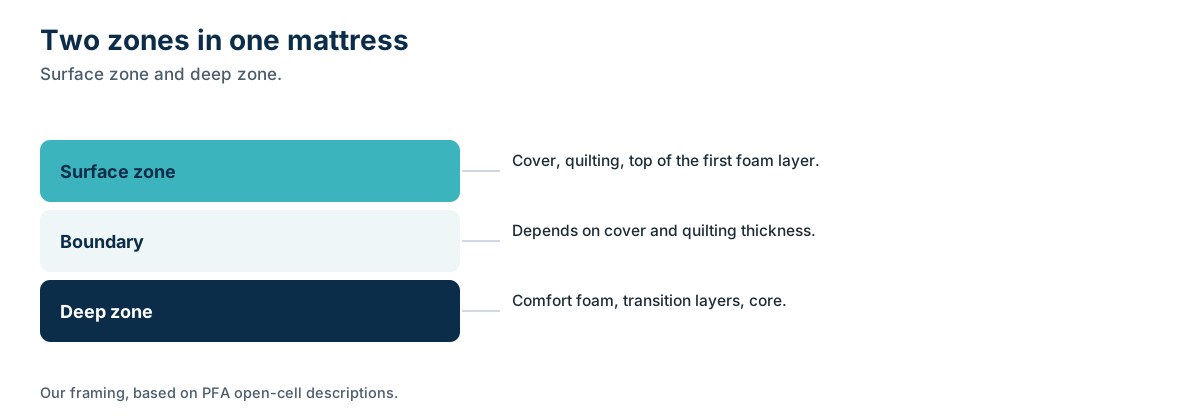
Surface moisture is water in the first zone. Saturation is water that has reached the second and filled the open cells there. Hub 3 uses saturated core for the extreme case, where a large accident has soaked down through the layers.
Why foam takes water in
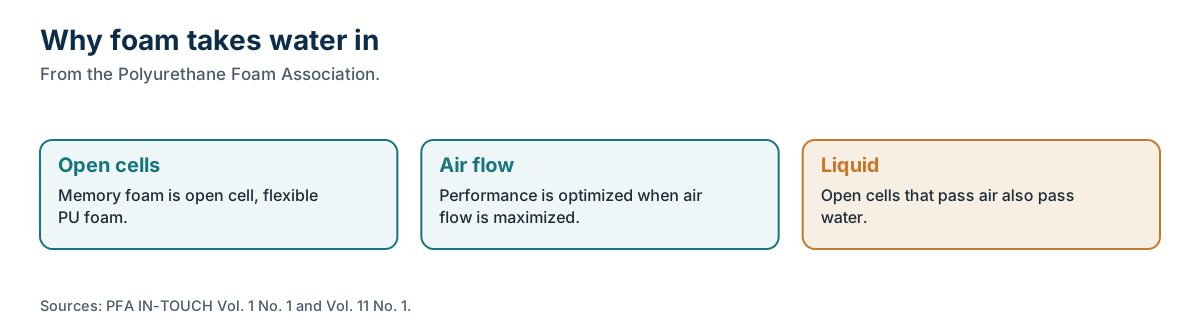
Foam in a mattress is meant to let air through, and that matters for water. The Polyurethane Foam Association's primer ties performance to air flow: "Foam performance is optimized when air flow is maximized. This indicates that cells are open and as flexible as they should be." For memory foam, its viscoelastic bulletin opens with the structure: "Viscoelastic foam is a type of open cell, flexible polyurethane foam." Open passages that carry air can also carry liquid, which is where saturation begins.
Open cells pass air, and they pass water too. Liquid that gets through the cover isn't stopped by the foam's surface; it moves into the connected cells and spreads. Hub 1 calls this wicking.
What makers warn about
Mattress makers who address liquid put the problem in the foam, not the cover. Casper's care page says: "If you need to clean your Casper mattress or cover, we suggest spot-cleaning affected areas with water and mild detergent. Be careful not to saturate the mattress with too much water and/or detergent, as the foam in the mattress core will soak up water and detergent. Allow the treated area to air dry completely before putting your sheets and bedding back on." Beautyrest's help page is stricter: "We do not recommend applying liquids to the mattress. Applying liquids may stain the fabric and make the soiled area worse. Moisture or chemicals applied directly to the mattress can cause premature breakdown of the foam and damage the product." Each maker writes for its own beds. Both describe saturation as the outcome to avoid, which is the same line this article draws.
Why saturation is harder to undo
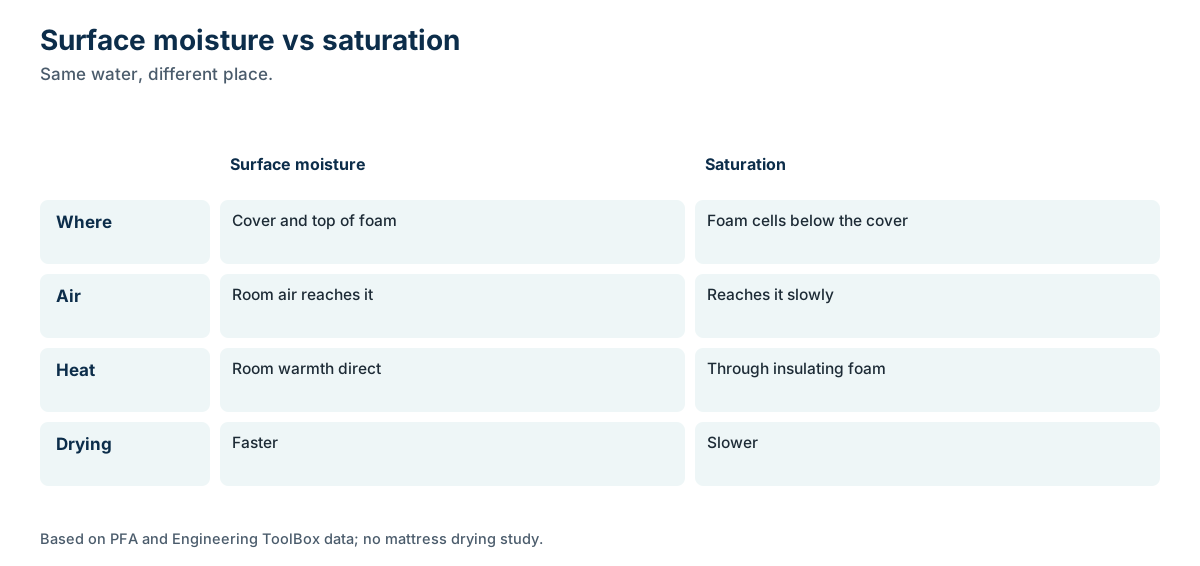
Water in the deep zone is slow to leave for two reasons. The first is air. Evaporation needs air to carry vapor away, and air reaches the core of a made bed poorly. The second is heat. Evaporation also needs energy, and foam is an insulator. Engineering ToolBox lists thermal conductivity for polyurethane foam at 0.03 W/(m K), compared with 0.606 for water. Warmth from the room reaches the core slowly.
The cover, by contrast, is thin and exposed. Water there sees moving air and room heat directly. That's why surface moisture behaves so differently from the same amount of water further down. Why foam mattresses are slow to dry follows that reasoning further.
Where mold enters the picture
EPA's guide to mold says "The key to mold control is moisture control," and that it is "important to dry water-damaged areas and items within 24-48 hours to prevent mold growth." That's EPA's guidance for water damage, not a test on mattresses. But it explains why saturation matters more than surface moisture: water that can't leave is the water that stays long enough to be a problem. A bed bug manual reprinting an Armed Forces Pest Management Board guide makes a related point about steam: a tip held too close may inject excess moisture, which "may lead to other problems" including "growth of surface molds."
Can mattress moisture lead to mildew or mold? covers this in full.
What one steam test measured
The only weighed steam test we found on mattress material is by Puckett, McDonald and Gold in 2013. Small arenas of Sealy mattress material on a wooden base, five replicates per treatment, gained 0.92 to 1.44 grams on average at five minutes after steaming at three pass speeds. By seven hours the difference from untreated controls was not significant.
That's useful evidence about surface moisture from a moving steam head. It says nothing about the deep zone, because the material was a thin layer and the authors made no attempt to measure how deep steam went. How wet should a mattress get? looks at the same test from a different angle.
Dry to the touch is not dry through
A surface that feels dry is only telling you about the surface. Hub 1 defines dry to the touch, and Hub 3 explains why being surface-dry is not the same as dry through. After a large spill or an accident, the top can dry first while water stays below. After a low-moisture cleaning, the hope is the opposite: little water ever went deep, so the surface drying is most of the story. How to tell if moisture reached the core covers the checks.
How a visit keeps water in the surface zone
Our approach is built on this line. We start with an inspection of the bed's materials, and that inspection sets steam temperature and pass speed. Dry vapor then goes across the surface in steady passes, including the seams, tufts, ridges and edges where dust and shed skin flakes collect. The machines are Italian-made Vapor Clean units, the Magnum XP with its built-in vac, the ProV 350 and the Pro6 Duo. Organic cleaning methods are our default.
The method is our own choice and reasoning, not a manufacturer exemption. Your care label and warranty terms govern your decision, so check them before booking. The visit is covered by the standard price, with severe or biohazard contamination quoted as a custom surcharge before we start. "Sanitize" here means cleaning, not disinfection; Hub 2 explains the CDC's cleaning and sanitizing terms.
Where to read next
For the whole picture, the moisture and heat guide brings water, heat and construction together, and this hub lists every article. To see how heat travels through the same layers, read does steam penetrate a mattress or treat the surface?.
What we don't know
- Where exactly the surface zone ends in a given mattress. It depends on the cover, the quilting and the first foam layer, and no source defines it.
- How much water a mattress can hold at the surface before it starts moving down. We found no study.
- How long saturated foam inside a mattress takes to dry. EPA's guidance is for water-damaged materials generally.
- Whether latex and polyurethane foam differ in how readily surface water moves down. We found no comparison.
Changelog
- 3 October 2026: First published. Sources accessed on this date.
Sources
- IN-TOUCH Vol. 1 No. 1: Flexible Polyurethane Foam, a Primer (revised 2016) · Polyurethane Foam Association
- IN-TOUCH Vol. 11 No. 1: Viscoelastic (Memory) Foam (revised 2016) · Polyurethane Foam Association
- How to clean your mattress: a mattress care guide (accessed 2026-10-02) · Casper
- How do I clean my mattress? (updated 16 Sep 2026, accessed 2026-10-02) · Beautyrest
- Comparison of multiple steam treatment durations for control of bed bugs (Puckett, McDonald and Gold, Pest Manag Sci, 2013) · Texas A&M Urban Entomology (author copy)
- Thermal conductivity of common materials · Engineering ToolBox
- A brief guide to mold, moisture and your home · US EPA
- Bed Bug IPM manual, including Armed Forces Pest Management Board Technical Guide 44 (University of Florida, 2008) · University of Tennessee (hosted copy)
- Magnum XP-Vac product page (maker's claims, accessed 2026-10-02) · Vapor Clean
- ProV 350 product page ('Italian Made'; maker's claims, accessed 2026-10-02) · Vapor Clean
- Pro6 Duo product page ('Made in Italy'; maker's claims, accessed 2026-10-02) · Vapor Clean
- Cleaning and disinfecting your school (definitions) · CDC
Last reviewed October 3, 2026. Manufacturer specifications and care instructions change; check the current version for your exact model. This page is general information, not medical advice. How we source and check pages: editorial standards.