
Short answer
Because carpet-cleaning equipment is designed around a thin, drained layer of fiber, and a mattress is a deep, undrained stack of foam and fabric. Extractors are built to flush large volumes of water through carpet and recover it from the same spot; on a mattress, water that passes the ticking is out of reach. Mattress work favors low-moisture heat, sealed vacuuming and tools kept for beds. Some equipment overlaps, but the defaults differ.
Key terms used on this page
- Hot-water extraction (HWE):
- The carpet industry's most common professional method. The Carpet and Rug Institute defines an extractor as equipment that uses pressure, water or cleaning solution, and suction to remove soil. It is often marketed as 'steam cleaning' even though it sprays hot water rather than steam.
- Truckmount and portable extractors:
- The two common kinds of hot-water extraction equipment. A truckmount is a vehicle-powered system that pumps heated solution through long hoses; a portable extractor is a wheeled unit with its own tanks, pump and vacuum. Both are designed around carpet and upholstery.
- Dry-vapor steam:
- Steam made in a sealed, pressurized boiler and released through a hose and nozzle as hot vapor with a low liquid-water content. In the vendor specifications we reviewed, professional units are rated from 80 psi (Ladybug 2350) to 150 psi (Daimer), with stated boiler temperatures from about 345°F (Optima) to 360°F (Daimer); these are maker claims. Daimer describes its steam as about 5% water or less and Vapor Clean claims 'just 5-6% moisture'; that is a vendor claim, not an independent standard.
- Residual moisture:
- Water left in a material right after cleaning, before drying. For carpet, the Carpet and Rug Institute's test for its deep-cleaning extractor seal allows up to 8 ounces per square yard. We have not found an equivalent published test for mattresses.
- HEPA vacuuming:
- Vacuuming with a sealed system and a filter meeting the HEPA standard, which the EPA says can theoretically remove at least 99.97% of airborne particles 0.3 microns in size. It removes loose dust and allergen-carrying particles without adding water or heat.
- Mattress layers (ticking, comfort layers, support core):
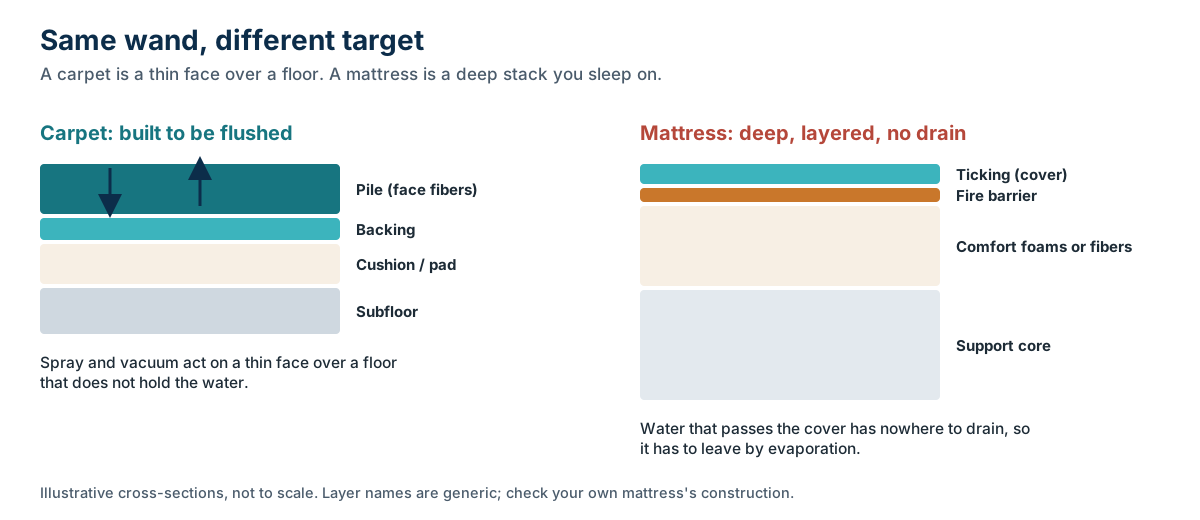
- Ticking is the outer fabric cover. Comfort layers are the foams, latex, fiber or wool directly under it. The support core is the coil unit or base foam underneath. Most mattresses also include a fire barrier between the ticking and the comfort layers.
- Low-moisture cleaning:
- A carpet-industry label for methods such as encapsulation, bonnet and dry-compound cleaning that use less water than extraction. It is not the same thing as dry-vapor steam, which is a heat-delivery method rather than a detergent method.
Carpet-cleaning equipment and mattress-sanitation equipment aren't necessarily interchangeable because they're designed around different objects. Carpet equipment is built for a thin layer of fiber on a backing and pad: it flushes large volumes of water through the pile and recovers it from the same spot. A mattress is a deep, undrained stack of foam, fiber and fabric, so water that passes the ticking is out of a carpet wand's reach. Mattress work favors low-moisture heat, sealed vacuuming and tools kept only for beds. Some equipment overlaps, and a careful operator can adapt, but the defaults are different.
This isn't a knock on carpet cleaners. A truckmount is built for wall-to-wall carpet, and the reasons it fits a thick foam mattress less well come down to water volume, heat delivery and what gets left behind. The flagship guide covers the methods themselves; here we look at the hardware, using definitions from the Cleaning Methods hub.
What carpet equipment is designed to do
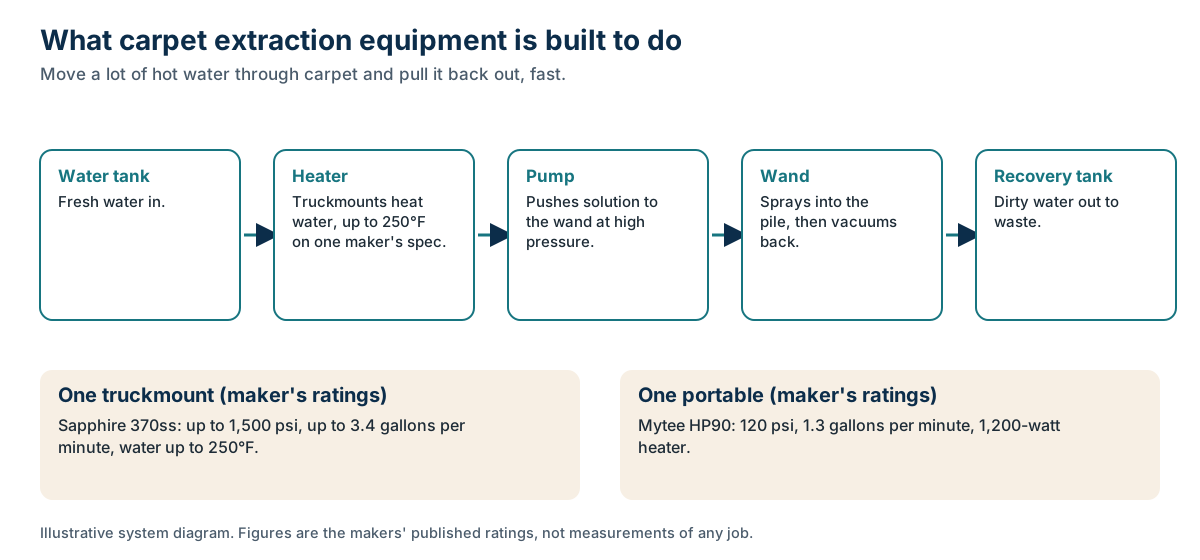
The carpet industry's most common professional method is hot-water extraction. The Carpet and Rug Institute's residential standard describes extractors as using pressure, water or cleaning solution, and suction, and lists three types: truckmounted, portable and self-contained (see truckmount and portable extractors).
The numbers show what they're built for:
- A Sapphire 370ss truckmount is rated up to 1,500 psi, up to 3.4 gallons per minute and water up to 250°F.
- A compact portable such as the Mytee HP90, marketed for auto detailing and upholstery, is rated at 120 psi and 1.3 gallons per minute with a 1,200-watt heater.
On carpet, that volume is the point. Water flushes soil out of the pile, and a powerful vacuum recovers it. CRI even measures the leftover: its Test Method 118 allows up to 8 ounces of water per square yard for a deep-cleaning extractor to earn its seal. The IICRC's S100 carpet standard and S300 upholstery standard build procedures around these machines.
Why a mattress changes the equation
A mattress differs from carpet in three ways that matter for equipment:
- Depth. Under the ticking are a fire barrier, comfort layers and a support core (see mattress layers), many inches of material with no drain. An extractor recovers water from the surface, and water past the ticking stays.
- Sensitivity. Foam soaks up water and detergent, and some manufacturers prohibit steam or wet cleaning outright. Purple says a carpet cleaner could overly saturate a memory foam mattress.
- Use. You lie on a mattress, face down, for hours. Residue, odor and hygiene matter more than they do on a hallway floor.
There's also no mattress equivalent to S100 or S300 that we've found. Mattress cleaning tends to borrow carpet and upholstery procedures, which is how carpet defaults end up on beds.
Side-by-side: typical defaults
| Carpet-cleaning default | Mattress-sanitation default | |
|---|---|---|
| Primary machine | Truckmount or portable extractor | Low-moisture heat source, such as a pressurized dry-vapor steam unit |
| Water used | Gallons per minute, mostly recovered | Small amounts, delivered as vapor and condensate |
| What's left behind | Residual moisture; residue if not rinsed | A small amount of condensate |
| Vacuum | Wet recovery vacuum through the wand | Dry vacuum, ideally sealed with HEPA filtration, used before and after heat |
| Tools | Wide floor wands; upholstery tools for furniture | Small tools for tufts, seams, borders and tape edges |
| Chemistry | Pre-spray, in-tank solution, rinse | Little or none; targeted spot products where needed |
| Hygiene | Tools used across floors, entryways and furniture | Tools and cloths kept for sleep surfaces |
| Governing guidance | CRI, IICRC S100 and S300 | No dedicated standard found; manufacturer care instructions |
The table describes defaults, not rules. Some carpet companies keep separate tools and use upholstery extractors gently. Some steam operators run wet. What matters is what happens on your mattress.
Where the equipment overlaps
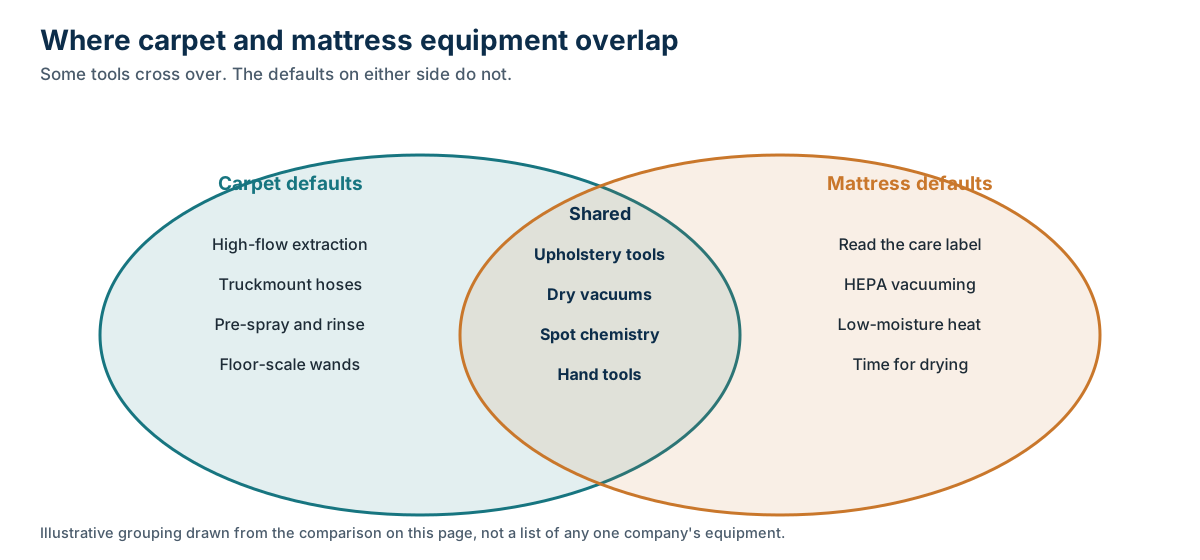
None of this means a carpet company can't do good mattress work. Some equipment genuinely overlaps:
- Upholstery tools. Extractor upholstery tools are smaller than floor wands and spray less, and the IICRC's S300 upholstery standard exists precisely because furniture needs gentler handling than carpet. A careful operator can use one sparingly on a mattress surface.
- Dry vacuums. A good dry vacuum with a sealed, filtered system is useful on both floors and beds, as long as the attachments used on the mattress are kept clean and separate.
- Spot-cleaning chemistry. Mild spot products used on upholstery can suit a mattress stain, applied by hand and blotted.
What doesn't overlap is the default: a high-volume extraction pass across the whole surface, the way carpet is cleaned. That's the step that puts the most water into a mattress, and it's the one to ask about.
Steam equipment isn't universal either
The reverse is also true. Vapor-steam makers generally position their machines for detail work, not whole-room carpet cleaning. Daimer's FAQ says its steam cleaners are ideal for hard surfaces and can be used on upholstery and to spot clean many carpets, with "one notable exception: natural fibers, like wool, which cannot handle high heat." It also notes that non-vacuum steam cleaners require a towel to wipe away the moisture and residue left behind.
That last point matters for mattresses. A steamer doesn't remove anything on its own, so mattress work pairs it with a vacuum. And the wool warning matters too, because many premium and organic mattresses have wool comfort layers. Commercial steamers built for detailing can also run much wetter than mattress work needs; Optima's manual tells users to keep the moisture valve fully closed on water-sensitive surfaces.
The hygiene question
This part is about common sense rather than published data. A carpet wand or brush that has been dragged across entryways, hallways and pet areas carries what was on them. Using it on a pillow-top afterward isn't ideal, even if it's been wiped down. For a surface you sleep on, it's reasonable to expect tools, cloths and attachments reserved for beds. Sleep Number's guidance to use a non-bristled attachment is a reminder that even the choice of tool matters to manufacturers.
Questions to ask a provider
- What machine will you use on the mattress itself, not just on the carpet?
- Is it an extractor or a steam boiler?
- Are the tools and cloths used on the mattress also used on floors?
- How do you control how much water goes into the mattress?
- What do you do differently for memory foam, latex, wool or adjustable bases?
See also dry-vapor steam vs carpet extraction for mattresses and steam cleaner vs dry-vapor steam cleaner.
Where Sleep Sanitation fits
Sleep Sanitation is mattress-only: we don't clean carpet, so nothing in our kit was built for floors. How we're different lays out the equipment, and pricing lists per-mattress rates.
What we don't know
- A mattress cleaning standard. We haven't found a consensus standard, from the IICRC or elsewhere, written specifically for mattresses.
- Comparative outcomes. We haven't found studies comparing carpet-industry equipment with dedicated mattress equipment on mattresses.
- Cross-contamination data. We haven't found studies measuring transfer of soil or microbes from floor tools to mattresses; the hygiene point above is a precaution, not a measured risk.
Sources
- CRI 205 Residential Carpet Cleaning Standard · Carpet and Rug Institute
- CRI Test Method 118 (extractor residual moisture) · Carpet and Rug Institute
- ANSI/IICRC S100 carpet cleaning standard · IICRC
- ANSI/IICRC S300 upholstery cleaning standard · IICRC
- Sapphire 370ss truckmount specifications · Hi-Pressure Cleaning Systems
- HP90 Stingray portable extractor specifications · Mytee
- Steam cleaner FAQ · Daimer Industries
- Optima Steamer XDm/XEm user manual · SJE Corp / Optima Steamer
- How to clean a mattress · Purple
- What is a HEPA filter? · US EPA
- Cleaning your mattress · Sleep Number
Last reviewed October 2, 2026. Manufacturer specifications and care instructions change; check the current version for your exact model. This page is general information, not medical advice. How we source and check pages: editorial standards.