
Short answer
Urine passes through the cover, spreads sideways through quilting and fiber, and sinks into the foam below. As it sits, bacteria break its urea down into ammonia, which is the sharp smell of an old accident. As it dries, dissolved solids stay in the layers. The deeper it goes and the longer it sits, the less of it any cleaning method can reach.
Key terms used on this page
- Wicking (urine migration):
- Liquid moving through and along fabric and foam by capillary action, so the affected area below the surface is often wider than the visible stain. Quilting, fiber batting and open-cell foam all wick. It is why a spot can look small and still smell from a wider area.
- Urea and ammonia:
- Urea is the main nitrogen-carrying compound in urine. Bacteria that make the enzyme urease break it down into ammonia and carbon dioxide, which is why stale urine smells sharper than fresh urine. NASA's study of stored human urine found that bacterial action decomposed the urea and released large amounts of ammonia.
- Uric acid:
- A normal, minor component of urine. NASA's table of urine constituents lists its solubility in water as very low, far below that of urea. Many cleaning guides blame uric acid for odor that returns after cleaning; we haven't found a study measuring that inside a mattress, so we treat it as a plausible explanation, not a proven one.
- Mattress layers (ticking, comfort layers, support core):
- Ticking is the outer fabric cover. Comfort layers are the foams, latex, fiber or wool directly under it. The support core is the coil unit or base foam underneath. Most mattresses also include a fire barrier between the ticking and the comfort layers.
- Saturated core:
- A mattress whose interior layers, not just the cover and quilting, were soaked by a large accident or several in one place. Surface treatment can't reach all of it. Some saturated cores improve with treatment and drying; some don't, and we say so before charging for work that won't help.
- Residual moisture:
- Water left in a material right after cleaning, before drying. For carpet, the Carpet and Rug Institute's test for its deep-cleaning extractor seal allows up to 8 ounces per square yard. We have not found an equivalent published test for mattresses.
A urine accident looks like a stain on the surface. Inside the mattress, it's a moving liquid for the first few hours and a changing mixture for days after. Understanding what happens in those layers explains almost everything about what can be removed later.
Not affiliated with or endorsed by any manufacturer listed. Brand names are used only to identify products and their published care instructions.
Minute one: the cover and quilting
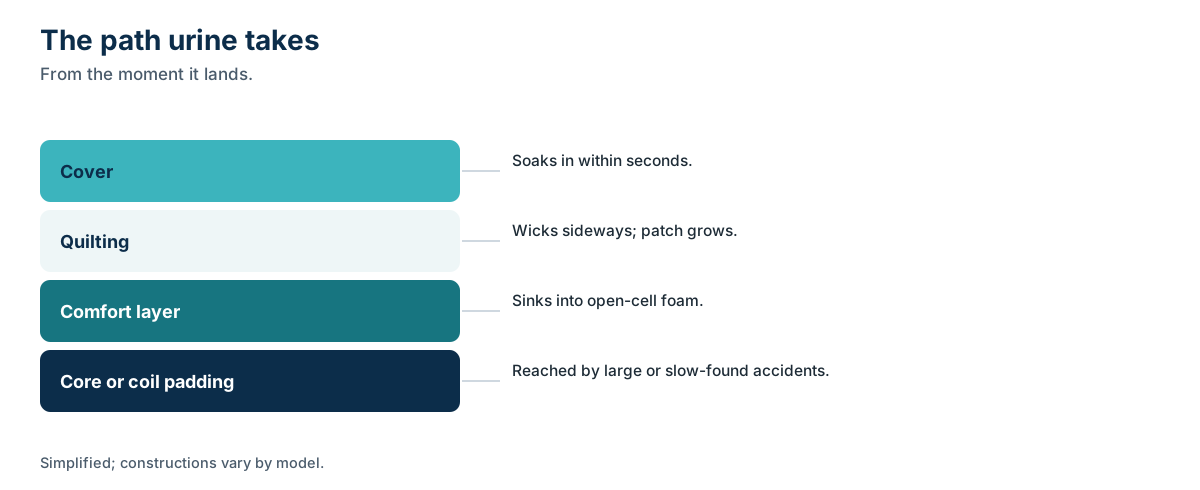
Most mattress covers are woven or knit fabric over a thin layer of quilting: fiber batting, thin foam, or both, stitched together. None of that is waterproof. Urine soaks straight in.
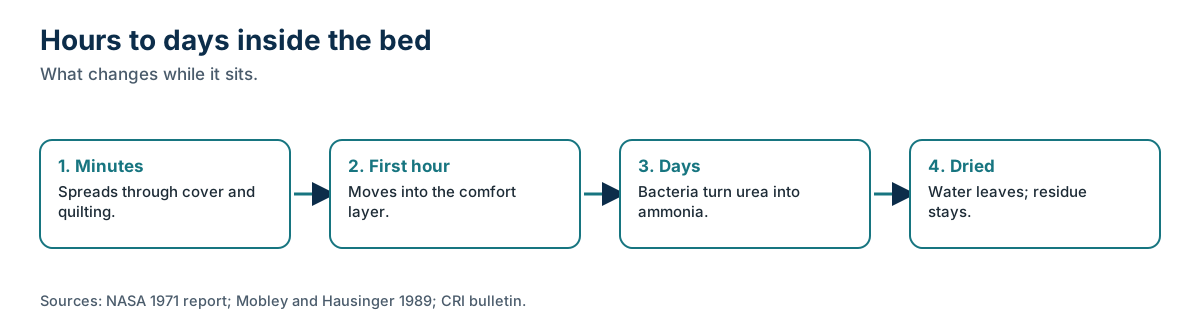
Quilting is the first place urine spreads sideways. Fiber pulls liquid along its strands by capillary action, the same reason a paper towel dipped at one corner gets wet across. We call this wicking. It's why a palm-sized accident can become a plate-sized damp patch within the first few minutes.
Nectar's care page is built around this moment: clean the cover right away, and don't let liquid travel down into the foam. Once urine is past the quilting, it's harder to get back.
The first hour: into the comfort layer
Under the quilting sits the comfort layer, usually memory foam, latex or polyfoam. Most of these are open-cell foams. Liquid moves into the cells and spreads through them.
Casper's care guide makes the same point about cleaning liquid: the core foam absorbs it if the bed is saturated. Urine is no different.
How deep it goes depends on volume and time. A small accident blotted quickly may stay in the top inch. A large one, or one left for hours, can reach the support layer.
Below that: support core and coils
In an all-foam bed, the support core is dense polyfoam, and urine that reaches it is very hard to treat from the top. In a hybrid or innerspring, the coils themselves don't hold liquid, but the padding over and around them does: insulator pads, foam encasements, edge supports. Our hybrid page describes those layers.
Hand-built beds with natural fills add another variable. Hästens, whose beds use natural materials, says in its care booklet: "But accidents do happen and a textile cleaner or furniture foam should be sufficient to clean any stains." Our Hästens page quotes the rest of its advice.
Hours to days: urine changes
While urine sits damp in the layers, it doesn't stay the same.
Urea becomes ammonia. Urea is the largest single dissolved compound in urine, according to NASA's 1971 composition study. Bacteria with the enzyme urease break it down: "Microbial ureases hydrolyze urea to ammonia and carbon dioxide," as a 1989 review puts it. NASA observed the same in its samples: "This bacterial action resulted in the decomposition of urea and the evolution of large amounts of ammonia." That's why an accident smells stronger on day three than on day one.
Fabric can change color. The Carpet and Rug Institute's bulletin says of carpet: "Some urine spots may be immediately noticeable, while others may take weeks or months for a reaction." The same delayed staining shows up on mattress covers.
Those bacteria are why our wording stays with cleaning; Hub 2 explains the CDC's definitions of cleaning and sanitizing.
Days later: what's left when it dries
Eventually the water evaporates. What it carried stays behind. NASA's table lists dozens of dissolved compounds, and some barely dissolve in water. Uric acid is the clearest example: the table gives its solubility as 0.00645 grams per 100 grams of water, against 119 grams for urea.
That residue sits where the liquid spread. It may smell faintly or not at all while dry. When moisture comes back, from humid air, a sweaty night or a cleaning rinse, the smell can return. Why urine odor comes back covers that in detail.
Why depth decides what's possible
Every cleaning method works best near the surface. The deeper urine went, the more any method has to do to reach it, and the more liquid it's tempted to add.
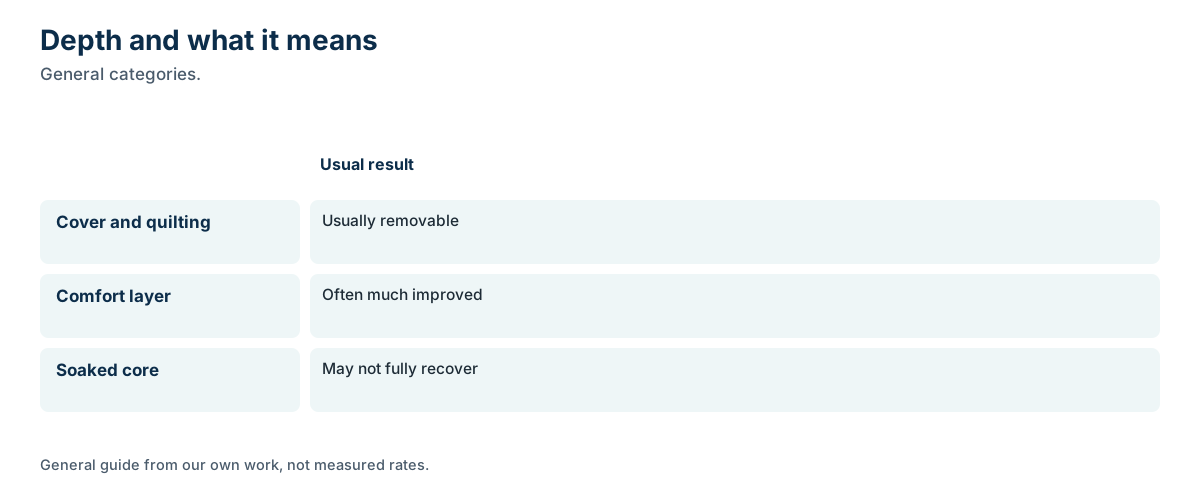
- Cover and quilting only: usually removable.
- Comfort layer: often much improved; a faint smell may return on humid days.
- Support core, soaked through: may not be fully recoverable.
That's why the most valuable thing you can do after an accident is stop it going deeper: press towels into it, don't pour anything onto it, and move air across it.
Why flooding it makes things worse
The natural response to urine deep in a bed is to pour cleaner in after it. That follows the same path the urine took, pushing it further down and sideways. It also leaves a wetter bed than the accident did, and a longer drying time. The EPA's mold guide advises drying wet materials within 24 to 48 hours. A flooded foam core can struggle to meet that.
Why moisture matters when cleaning a mattress and whether you can sanitize a mattress without soaking it go into the moisture side. Our comparison of HEPA vacuuming, steam and extraction explains why rinse-based methods aren't a good fit for urine in foam.
How we work with what's there
Knowing the path urine takes shapes our treatment. We map the spread first, then apply enzyme product lightly along that map, not just on the visible mark, and allow its dwell time. Dry-vapor passes from a Magnum XP, ProV 350 or Pro6 Duo follow, set for the layers involved. Organic methods are our default.
Treating an ordinary accident is within the standard price; severe, biohazard or extensive contamination is quoted first, and a soaked-through bed gets an honest view of what's recoverable.
That approach is our own method, not manufacturer guidance. Your care label and warranty terms govern; check your warranty before booking.
The edges matter most
When we map an accident, the edges of the wet area tell us more than the middle. A sharp edge close to the visible stain means the urine stayed put. A soft edge that keeps going, with odor well beyond the mark, means it wicked through the quilting. On pillow-tops and thick fiber layers it tends to go furthest; our pillow-top page explains why those layers behave that way.
We treat to the edge we find, not the edge we see. That's one of the simplest reasons a professional treatment can succeed where a home one didn't.
Two quick checks you can do
- Feel the underside. If the bottom of the mattress under the stain is cool or damp, urine went all the way through.
- Smell the border. If the side panel near the stain smells, urine ran down it.
The guide to urine and odor in mattresses brings the layers together with treatment. Clean or replace after urine and how professionals treat urine without flooding pick up from here.
What this means for you, right now
If an accident has just happened, every minute of pressing towels into the spot keeps urine out of a deeper layer. That single habit changes which group the bed ends up in more than any product does. Then leave the bed bare with air moving across it, and call before the stain is a week old.
What we don't know
- How deep any given accident went without checking the bed.
- How fast urine moves through a specific foam. Manufacturers don't publish it.
- Whether the residue left behind in your bed is mostly uric acid, salts or something else. No mattress study we've found has measured it.
Changelog
- 2 October 2026: First published. Sources accessed on this date.
Sources
- Composition and Concentrative Properties of Human Urine (NASA contractor report, July 1971) · NASA
- Microbial ureases: significance, regulation, and molecular characterization (Mobley and Hausinger, Microbiol Rev, 1989) · PubMed Central
- Pet Urine and Carpet (technical bulletin, revised 27 July 2017, accessed 2026-10-02) · Carpet and Rug Institute
- How to clean your mattress: a mattress care guide (accessed 2026-10-02) · Casper
- Care Instructions (PDF, accessed 2026-10-02) · Hästens
- Nectar Sleep FAQ (accessed 2026-10-02) · Nectar
- A brief guide to mold, moisture and your home · US EPA
- Magnum XP-Vac product page (maker's claims, accessed 2026-10-02) · Vapor Clean
- ProV 350 product page ('Italian Made'; maker's claims, accessed 2026-10-02) · Vapor Clean
- Pro6 Duo product page ('Made in Italy'; maker's claims, accessed 2026-10-02) · Vapor Clean
Last reviewed October 2, 2026. Manufacturer specifications and care instructions change; check the current version for your exact model. This page is general information, not medical advice. How we source and check pages: editorial standards.