
Short answer
Either can clean a mattress, so ask both the same questions instead of choosing by the name on the van. How much water reaches the bed? Do you inspect the materials first? Will you read my care label? What's the drying plan? A mattress is thicker than carpet and holds water in foam, so the answers on water and drying matter most.
Key terms used on this page
- Add-on mattress cleaning:
- Mattress cleaning sold alongside another service, such as carpet or upholstery cleaning, which may use the same equipment. A neutral description of a service model, not a judgment of quality.
- Dedicated mattress service:
- A visit planned only around mattresses: materials inspection, equipment chosen for mattress layers, and time per bed set by the job. It's the model we run; it differs from an add-on in what the visit is built around.
- Quote comparison:
- Lining up two mattress cleaning quotes item by item: method, inspection, seams and edges, urine treatment, drying guidance and surcharges. The cheaper quote may be for a different job.
- Care label first:
- The rule that a mattress's own care label and warranty come before any cleaner's method, ours included. Tempur UK notes that a label stitched inside the cover gives specific care instructions for the item purchased.
- Treatable depth:
- How far into a mattress a problem sits relative to what a surface method reaches. A problem in the cover or upper layers is within reach of low-moisture work; one in the core may not be. No published study measures it; it's our working term.
Either kind of business can clean a mattress. The better question isn't who to call but what to ask, because the method and the amount of water matter more than the name on the van. Ask both the same things: how much water reaches the bed, whether there's a materials inspection, whether they'll read your care label first, and what the drying plan is. A mattress is a deeper, more water-retentive object than carpet, so the answers on water and drying deserve the most weight.
This is general consumer information. It isn't a review of any company or franchise.
Two service models, described neutrally
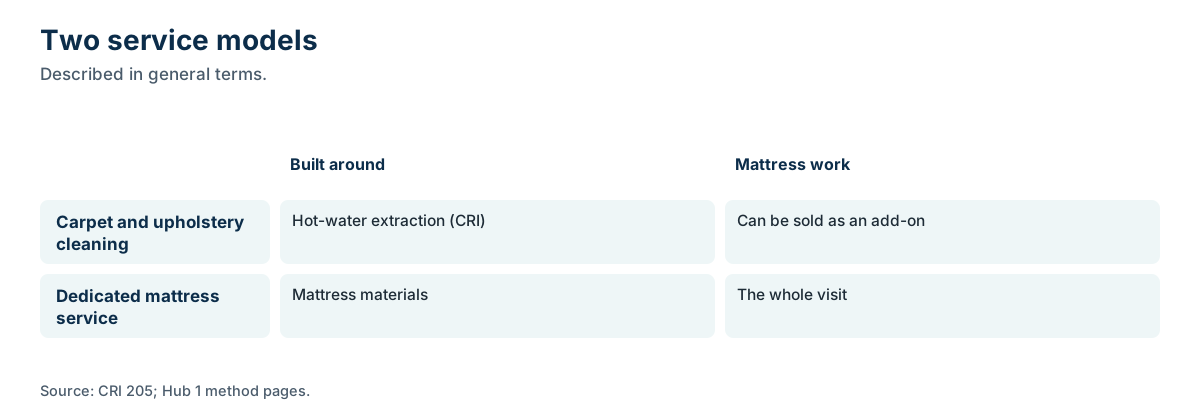
Carpet and upholstery cleaning. These businesses are built around floors and furniture. Mattress cleaning may be sold as an add-on to that work, using equipment designed for carpet and upholstery. That's a description of a service model, not a judgment. Skilled operators work this way, and the convenience of one visit for carpets and beds is real.
Dedicated mattress service. These businesses build the visit around mattresses: a materials inspection, equipment chosen for mattress layers, and time set per bed. That's the model we run. It differs in what the visit is planned around, not in whether the people doing it care about their work.
Neither label tells you how a particular job will go. The questions below do.
Why the object matters
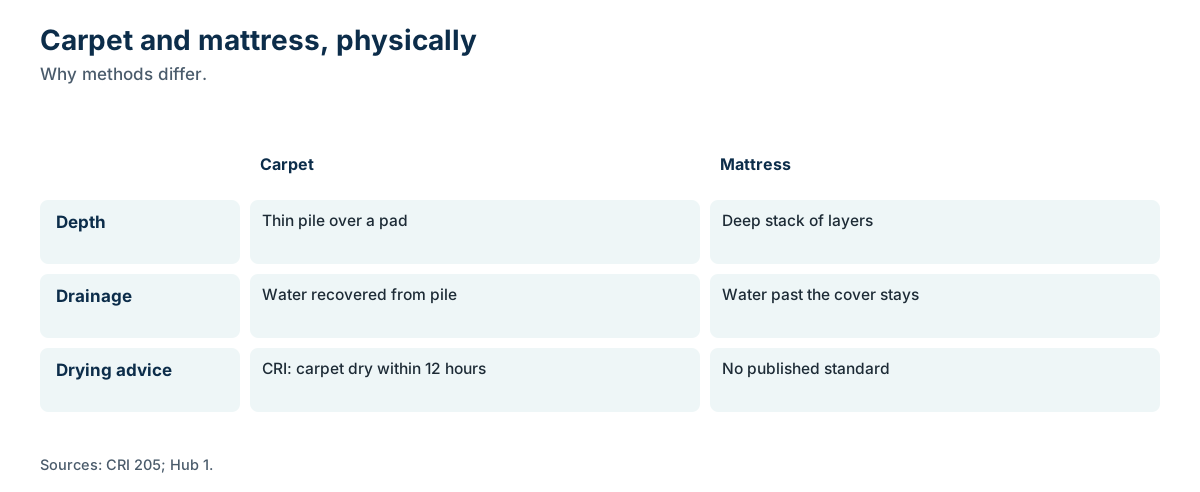
Carpet and mattresses are physically different things to clean. The Carpet and Rug Institute's residential guide defines an extractor as "a type of cleaning equipment that uses pressure, water/cleaning solution, and suction to extract deeply embedded soil or stains from carpeting," and says that "The most common professional residential carpet cleaning systems used is a hot water extraction (HWE) system," whether truck-mounted, portable or self-contained. Its DIY section says that "The carpet should be dry within 12 hours." Those are carpet facts, written for carpet.
A mattress is a deep stack of foam, fiber and sometimes coils, under a quilted cover. Water that gets past the cover tends to stay in the foam, and a mattress can't be laid out flat on a floor to dry. Mattress makers write about this directly. Casper's care guidance says: "Be careful not to saturate the mattress with too much water and/or detergent, as the foam in the mattress core will soak up water and detergent." We found no published drying standard for mattresses equivalent to the CRI's carpet guidance.
Hub 1 goes into the equipment side: carpet cleaning equipment vs mattress sanitation equipment, dry vapor vs carpet extraction for mattresses, and the glossary entries for hot water extraction, truckmount and residual moisture.
What to ask either one
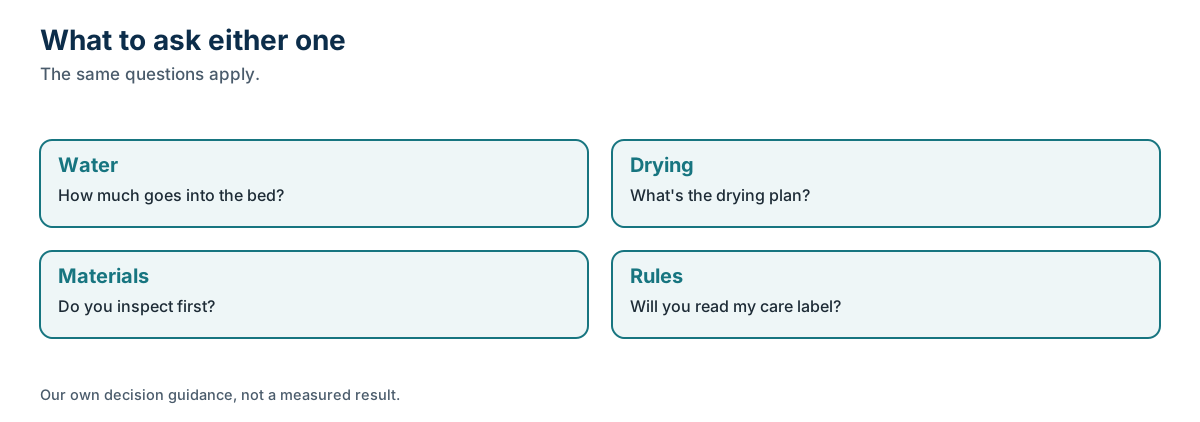
Water. How much liquid goes into the bed, and how is it recovered? For a mattress, less is the better default.
Drying. What's the drying plan, and how will I know the bed is ready? Hub 1's how long a mattress should take to dry explains what to expect.
Materials. Do you identify the materials before starting, and does that change what you do?
Rules. Will you read my care label and respect what it says? Some makers prohibit steam or wet cleaning, and a cleaner of either kind should be willing to stop at that line. Hub 2's compatibility guide quotes the makers we checked.
Products. What goes on the bed, and where? Hub 1 asks does professional mattress cleaning need detergent?.
Price. What's the total, and what would change it?
The full list is in questions to ask before cleaning an expensive mattress.
Method, not business type
The method is what touches the mattress. Hub 1's methods explainer covers each one. In brief: hot water extraction sprays solution and vacuums it back; shampooing works detergent into fabric; dry vapor uses heat with a little condensate; and HEPA vacuuming lifts loose dust with no water. Any of these can be offered by either kind of business. Our article on how professional mattress cleaning methods differ compares them for mattresses.
Makers draw their own lines by construction and brand, which is why the method has to suit the bed in front of you rather than the equipment on the van. Hub 2's Purple page is one example of a maker that allows steam on some constructions in general but says not to steam clean a Purple mattress.
When one visit for everything makes sense
Convenience is a fair reason to choose. If you're having carpets cleaned anyway, the mattress is in good shape with light soil, and its care label allows the method on offer, one visit for both can be a sensible choice. Ask about water and drying, and ask how much time the bed itself gets. The calculation changes when the bed is expensive, made of water-sensitive foam or latex, or carrying a urine accident. Then the method and the inspection matter more, and it's worth asking each business the full set of questions before deciding. Either way, you're choosing a method for your mattress, not a category of company.
Standards
For carpet, there are published standards and guidance, including the IICRC's S300 standard for upholstery and the CRI's residential guide. We found no consensus standard written specifically for mattress cleaning. That gap is one reason the questions above matter more than any badge.
Price and the service model
Service model can affect price, because it affects time per bed, equipment and whether there's an inspection. An add-on priced alongside a carpet job and a dedicated mattress visit are different products. Our article on why mattress cleaning prices range from $80 to $300 explains the drivers in general terms, without claims about what any company charges.
What our model looks like
This section is our view. We're the second model: everything about the visit is planned for mattresses, and nothing else is on the job sheet. The first thing that happens at your door is a look at the bed's label and materials, because that inspection is what sets steam temperature and pass speed for that mattress. The equipment was chosen for mattress layers rather than floors: Italian-made Vapor Clean units, namely the Magnum XP with a built-in vac, the ProV 350 and the Pro6 Duo. Dry vapor keeps liquid water low while we go over the sleep surface and spend time on the seams, tufts, ridges and edges where dust and shed skin flakes collect. Enzyme treatment is there for urine and organic odor, and organic cleaning methods are our default. From what we've seen, that setup lets us treat any mattress or topper; when a material reacts, we change the settings or we stop. That's our call and our own reasoning, not a manufacturer exemption, so your care label and warranty terms still govern. "Sanitize" is a cleaning word for us, in the sense Hub 2's CDC terms entry describes; we make no disinfection or health claim.
If a dedicated mattress visit fits what you need, schedule one. The first mattress is $249, or $199 under the limited-time Fall 2026 offer, and the pricing page lists every line.
Where to read next
The decision guide covers who to call alongside the other decisions, and this hub lists every article. For cost, read how much should mattress sanitation cost?.
What we don't know
- How much water a given extraction or dry-vapor visit leaves in a full mattress. No one has published measurements.
- How service models compare on outcomes. We found no study.
- Whether any drying time applies to mattresses. The CRI's figure is for carpet.
- Whether a mattress-specific cleaning standard is in development. We found none.
Changelog
- 3 October 2026: First published. Sources accessed on this date.
Sources
- CRI 205 Residential Carpet Cleaning Standard · Carpet and Rug Institute
- Pet Urine and Carpet (technical bulletin, revised 27 July 2017) · Carpet and Rug Institute
- ANSI/IICRC S300 upholstery cleaning standard · IICRC
- Caring for your TEMPUR (UK, updated 11 July 2023, accessed 2026-10-02) · Tempur UK
- How To Clean a Mattress in 9 Steps (last updated 16 Oct 2025, accessed 2026-10-02) · Purple
- How to clean your mattress: a mattress care guide (accessed 2026-10-02) · Casper
- Magnum XP-Vac product page (maker's claims, accessed 2026-10-02) · Vapor Clean
- ProV 350 product page ('Italian Made'; maker's claims, accessed 2026-10-02) · Vapor Clean
- Pro6 Duo product page ('Made in Italy'; maker's claims, accessed 2026-10-02) · Vapor Clean
- A brief guide to mold, moisture and your home · US EPA
- Cleaning and disinfecting your school (definitions) · CDC
Last reviewed October 3, 2026. Manufacturer specifications and care instructions change; check the current version for your exact model. This page is general information, not medical advice. How we source and check pages: editorial standards.