
Short answer
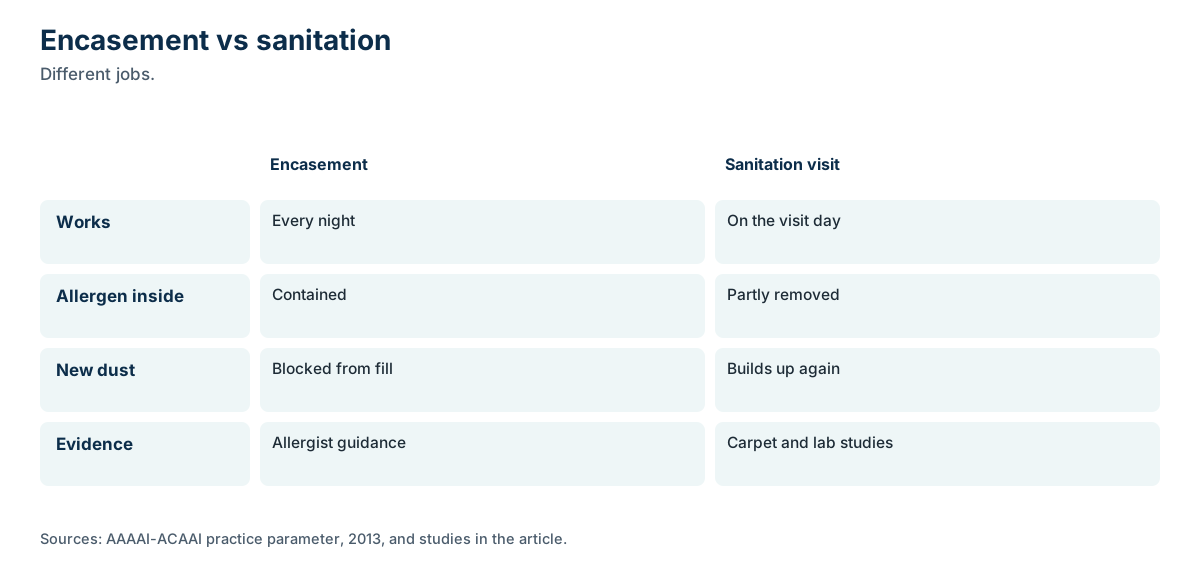
No. An encasing works every night by keeping mite allergen inside the mattress and away from you; a cleaning visit happens on one day. Allergist guidance recommends woven, mite-impermeable mattress, box spring and pillow encasings, and also says covers alone are unlikely to give clinical benefit. They're complementary, and we suggest both rather than one.
Key terms used on this page
- Mite-impermeable encasing:
- A zippered cover that fully encloses a mattress, box spring or pillow so mite allergen can't pass through. The practice parameter says woven microfiber with a mean pore size smaller than 10 micrometers can block Der p 1, and it does not recommend nonwoven covers.
- Multifaceted control:
- Using several dust mite measures together, such as encasing, washing, vacuuming and humidity control. The practice parameter says mite covers alone are unlikely to achieve a clinical benefit unless used as part of a more comprehensive plan.
- Clinical outcome:
- A health result, such as symptoms, lung function or medication use, as opposed to an environmental result such as allergen in dust. A 2008 Cochrane review of 54 trials found no effect of mite control measures on asthma outcomes. We report environmental results only.
- Allergen load:
- The total amount of allergen collected from a surface, as opposed to its concentration per gram of dust. Studies report both. A surface can lose dust and allergen load while the concentration per gram stays about the same. The Vojta study (19 homes; carpet comparison 11 homes, 5 steamed) reported both.
- HEPA filtration:
- High-efficiency particulate air filtration. The practice parameter recommends vacuums with HEPA filtration, or a central vacuum that vents outside, so mite fecal particles stay in the machine instead of going back into the room.
- Settled dust:
- Dust collected from a surface such as a mattress, carpet or sofa, usually with a vacuum and a sampling filter. The practice parameter prefers settled-dust samples over air samples for measuring mite allergen.
It's a fair question if you've just paid for a professional cleaning: is the encasement your allergist suggested still necessary? The answer is yes, and the reason is simple. They do different jobs on different timescales. A cleaning visit acts on one day. An encasing acts every night.
This article is general information about cleaning, not medical advice. For allergy or asthma questions, talk to your doctor or an allergist.
What an encasement does
A mite-impermeable encasing is a zippered cover that fully encloses a mattress, box spring or pillow. The allergist practice parameter gives it a strong recommendation: "Recommend that patients should use mite allergen-proof mattress, box spring, and pillow encasings to decrease exposure to mite allergens."
It describes the purpose this way: "The most effective way to prevent mite colonization is to encase a mattress, box spring, or pillow in a mite allergen-impermeable encasing." And it adds that an old bed doesn't need replacing first: "Existing mattresses, box springs, and pillows can be kept if they are encased in allergen-impermeable covers to entrap already-present mites and mite allergens."
That last point matters for this question. Encasing doesn't depend on cleaning first. It's designed to seal in whatever is already there.
What a cleaning visit does
A cleaning visit acts on the mattress surface and folds on one day. Ours includes an inspection that identifies the materials and sets steam output and pass speed, and dry-vapor steaming of the sleep surface and of the seams, tufts, ridges and edges where dust and shed skin flakes collect. Heat kills mites it reaches, and steam studies on carpet and mattress samples back that up.
What a visit can't do is stop new skin flakes, new mites and new allergen arriving the next night. NIEHS says "No matter how clean a home is, dust mites cannot be completely eliminated."
Different timescales
Think of it as a one-time event against an ongoing barrier. After a cleaning, the mattress starts collecting skin flakes again immediately. Carpet data illustrate how quickly allergen can return: in the Vojta study (19 homes; the carpet comparison used 11 homes, 5 of them steamed), carpet allergen after intensive vacuuming alone "approached pretreatment values by 4 weeks," though steam plus vacuuming held it down for up to 8 weeks. An encasing, by contrast, sits between you and the mattress every night.
What kind of encasing
The practice parameter is specific. "Woven microfiber fabrics with a mean pore size smaller than 10 m can effectively block passage of Der p 1, whereas a mean pore size smaller than 6 m is necessary to block cat allergen Fel d 1." (The unit, lost in the document's typesetting, is micrometers.) It steers people away from one type: "Nonwoven encasings are not recommended because they trap mite allergens and are not washable, leading to allergen accumulation."
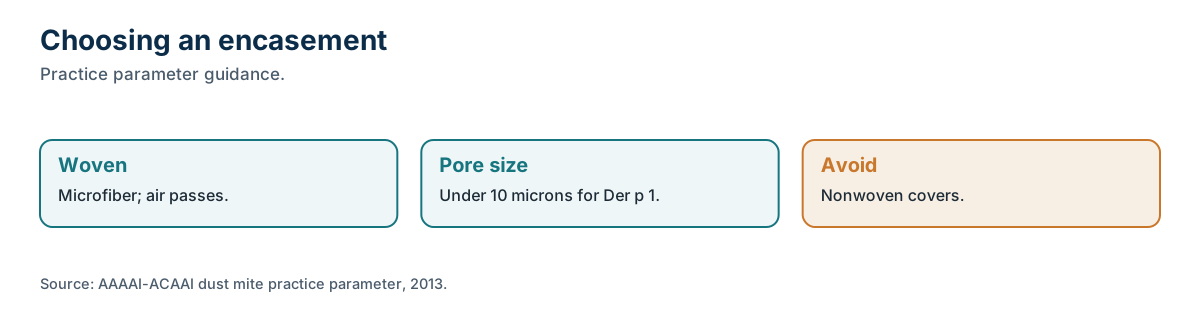
Woven covers also "allow air and water vapor to pass freely through the fabric," which matters for comfort and for a mattress that needs to breathe. Hub 1 defines the encasement; Hub 2's glossary covers the mattress protector, which is a different product.
Protector or encasing?
A waterproof protector, the kind Hub 3 recommends for urine accidents, usually covers the top and sides of the mattress to stop liquid. An encasing zips around the entire mattress and is chosen for pore size to block allergen. Some products are both. If dust mite allergen is your concern, check the product's pore size and whether it fully encloses the mattress, not just whether it's waterproof.
What the largest trial found
The biggest test of bed covers is Woodcock and colleagues, published in 2003. It enrolled 1,122 adults with asthma and gave half impermeable covers and half ordinary ones, double-blind. Der p 1 was measured in mattress dust in a 10 percent random subsample of homes.
At 6 months, Der p 1 was lower with the impermeable covers: a geometric mean of 0.58 micrograms per gram against 1.71 in the control group. At 12 months the difference was no longer significant, 1.05 against 1.64. On health outcomes, the authors concluded that covers "as a single intervention for the avoidance of exposure to dust-mite allergen, seem clinically ineffective in adults with asthma."
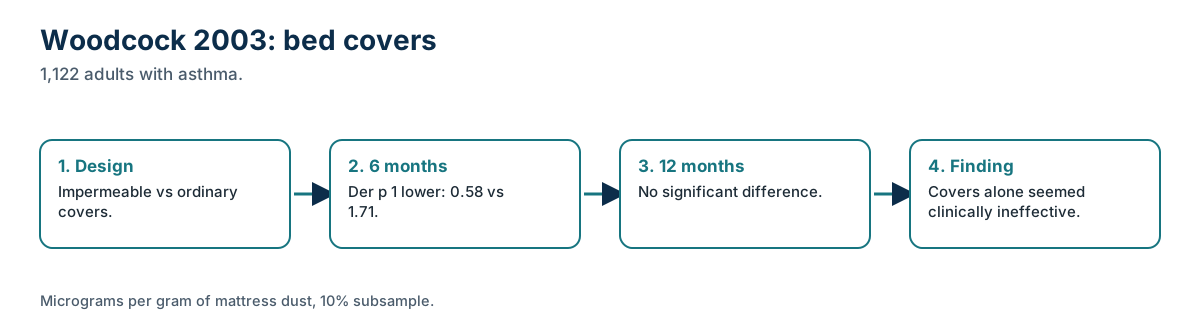
That result doesn't make encasings pointless. It says one measure on its own didn't change clinical outcomes in that trial. The practice parameter reaches the same place: "mite covers alone are unlikely to achieve a clinical benefit unless they are used as part of a more comprehensive multifaceted avoidance plan." The 2008 Cochrane review, which included 26 trials of mattress encasings among its 54, also reported that "we did not find an effect of the interventions" on asthma outcomes.
What about cleaning plus encasing?
The Vojta study tested beds with encasing plus weekly laundering of the non-encased bedding, either professional or at home, and found "Significant decreases in bed house dust mite allergen concentration and load" with both. Professionally laundered beds had less allergen load than home-laundered ones. That's an encasing-plus-laundry result, not an encasing-plus-steam result; no study we found combined steam cleaning of a mattress with encasing.
So the combination we'd describe is this: an encasing as the nightly barrier, weekly washing of the sheets and pillowcases it doesn't cover, regular vacuuming, humidity control, and a cleaning visit if you want the mattress surface and folds treated with heat. None of that is a medical treatment, and the clinical evidence for these measures is weak, as the Woodcock trial and the practice parameter above show.
Questions to ask before buying an encasing
The practice parameter gives you most of what you need to shop sensibly:
- Is the fabric woven, and what is its mean pore size? Under 10 micrometers is the figure for Der p 1.
- Does it fully enclose the mattress with a zipper, or only cover the top and sides?
- Is it washable? Nonwoven covers that can't be washed are the type the parameter advises against.
- Does air pass through it? Woven microfiber lets air and water vapor through.
- Are there matching covers for the box spring and pillows? The recommendation covers all three.
A product page that answers those plainly is more useful than one that promises allergy relief.
Our role
We clean mattresses, and we don't sell or fit encasings, so we have no stake in which one you choose. If you already have an encasing, its maker's care instructions say how to wash it. A cleaning is billed at the standard price; severe or biohazard contamination is quoted as a custom surcharge before we start. Organic cleaning methods are our default. Whether steam suits the mattress under the encasing is a question for its care label and warranty terms, which govern; check your warranty before booking.
If you already have an encasing, it comes off for the visit and goes back on once the mattress is dry, following the drying guidance we give before we leave. Wash or wipe the encasing per its own label.
We describe all of this as cleaning, in the CDC's sense; Hub 2 explains the CDC's cleaning and sanitizing terms. We make no health claims.
Where to read next
The dust mite guide puts the encasing evidence next to the steam and vacuuming studies, and this hub lists every article. Why dust mite control needs more than one step explains why no single measure is enough, and does washing sheets clean the mattress? covers the bedding an encasing leaves exposed.
What we don't know
- Whether cleaning a mattress before encasing it changes allergen exposure compared with encasing alone. We found no study that tested it.
- How long a given encasing keeps blocking allergen as it ages and is washed.
- Whether the Woodcock results apply to children or to people without asthma; the trial enrolled adults with asthma.
Changelog
- 3 October 2026: First published. Sources accessed on this date.
Sources
- Environmental assessment and exposure control of dust mites: a practice parameter (Portnoy et al., Ann Allergy Asthma Immunol, 2013) · AAAAI and ACAAI
- Control of exposure to mite allergen and allergen-impermeable bed covers for adults with asthma (Woodcock et al., N Engl J Med, 2003) · PubMed
- Effects of physical interventions on house dust mite allergen levels in carpet, bed, and upholstery dust in low-income, urban homes (Vojta et al., Environ Health Perspect, 2001) · PubMed Central
- Dust Mites and Cockroaches (accessed 2026-10-03) · National Institute of Environmental Health Sciences (NIH)
- House dust mite control measures for asthma (Gotzsche and Johansen, Cochrane review, 2008) · PubMed
- Daily vacuuming of mattresses significantly reduces house dust mite allergens, bacterial endotoxin, and fungal beta-glucan (Wu et al., J Asthma, 2012) · PubMed
- Cleaning and disinfecting your school (definitions) · CDC
Last reviewed October 3, 2026. Manufacturer specifications and care instructions change; check the current version for your exact model. This page is general information, not medical advice. How we source and check pages: editorial standards.