
Short answer
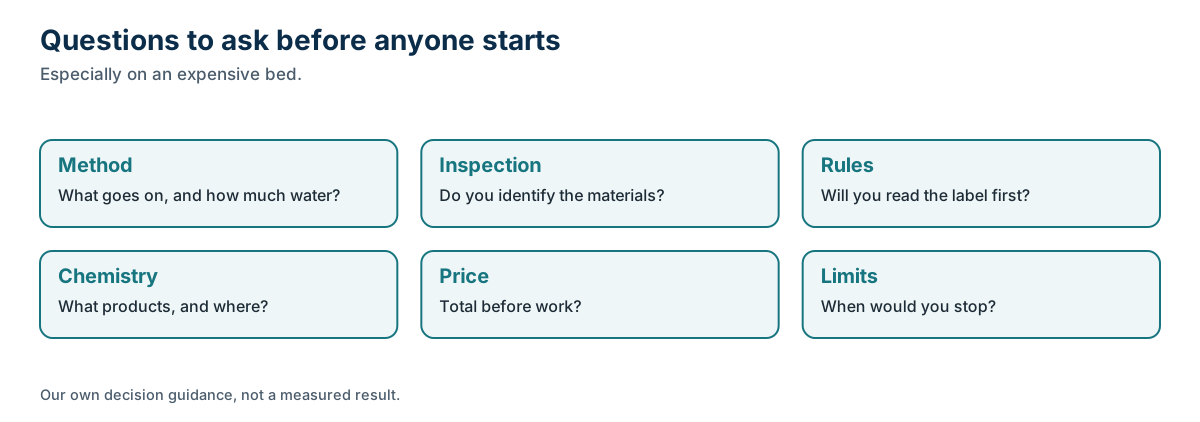
Read your care label and warranty first, then ask six things. What method, and how much water reaches the bed? Do you inspect the materials before starting? Will you follow my care label? What products go on, and where? What's the total before work? When would you stop? Specific answers are a good sign; general reassurance isn't.
Key terms used on this page
- Care label first:
- The rule that a mattress's own care label and warranty come before any cleaner's method, ours included. Tempur UK notes that a label stitched inside the cover gives specific care instructions for the item purchased.
- Quote comparison:
- Lining up two mattress cleaning quotes item by item: method, inspection, seams and edges, urine treatment, drying guidance and surcharges. The cheaper quote may be for a different job.
- Dedicated mattress service:
- A visit planned only around mattresses: materials inspection, equipment chosen for mattress layers, and time per bed set by the job. It's the model we run; it differs from an add-on in what the visit is built around.
- Treatable depth:
- How far into a mattress a problem sits relative to what a surface method reaches. A problem in the cover or upper layers is within reach of low-moisture work; one in the core may not be. No published study measures it; it's our working term.
- Custom surcharge:
- The extra charge for severe or biohazard contamination, quoted before any work starts. Ordinary urine accidents and pet odor are in the standard price.
Before anyone touches an expensive mattress, read its care label and warranty, then ask six questions. What method, and how much water reaches the bed? Do you inspect the materials first? Will you follow my care label? What products go on, and where? What's the total before you start? And when would you stop? The answers matter less for what they promise than for how specific they are. A cleaner who explains how they'd handle your bed's materials is giving you something to judge. One who says every bed is fine is giving you nothing.
General consumer information, not legal, warranty or medical advice. Your maker's terms are the authority on your warranty. For symptoms, ask a doctor.
First: your own homework
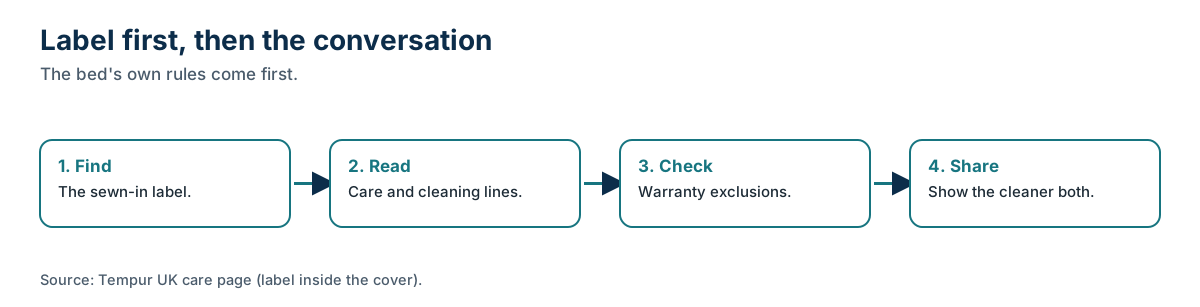
The questions work better if you've done one thing first. Find the care label. Tempur UK's care page says: "A label stitched inside the cover will give you specific care instructions for the item you have purchased." Read its cleaning lines. Then read your warranty's exclusions, looking for anything about liquids, stains, steam or cleaning products. Hub 2's entries on the care label and warranty exclusions explain what to look for, and its compatibility guide quotes the makers we checked.
Some makers rule things out plainly. Tempur UK's care page says: "There is a high risk that soaking with water or other cleaning fluids will cause irreversible damage, destroying the benefits of comfort and support which the TEMPUR ® Material provides. It will also invalidate your guarantee. Do not steam-clean or dry-clean the TEMPUR ® Material." Avocado says: "Steam cleaners are not recommended because their excessive heat can over-bake the organic latex." Beautyrest says: "We do not recommend applying liquids to the mattress. Applying liquids may stain the fabric and make the soiled area worse. Moisture or chemicals applied directly to the mattress can cause premature breakdown of the foam and damage the product." If your label says something like this, the first question isn't for a cleaner; it's for the maker.
The six questions, and why each matters
1. What method, and how much water reaches the bed? This is the big one. Foam holds water; Casper's care guidance warns that "the foam in the mattress core will soak up water and detergent." Hub 5's how wet should a mattress get? explains why less is better. Hub 1's methods explainer explains the options.
2. Do you inspect the materials first? Memory foam, latex, wool and coils behave differently. Ask whether the method changes based on what they find, and how.
3. Will you follow my care label? Show them the label and warranty. Ask how their method fits. Rules differ by brand and by construction; Hub 2's Purple page, for instance, quotes a maker that allows steam on some constructions but says not to steam clean a Purple mattress. A cleaner who reads the label with you is taking your rules seriously.
4. What products go on, and where? Ask what's applied to the bed and why. Hub 1 asks does professional mattress cleaning need detergent?.
5. What's the total before work? Ask what's included and what would add to it, especially for urine or heavy soil. Our article on why prices range from $80 to $300 explains what to compare.
6. When would you stop? Ask how they'd know a material was reacting and what they'd do. The answer tells you whether they've thought about it.
Follow-up questions worth asking
How do you handle seams and edges? Dust and shed skin flakes collect in seams, tufts and edges. Ask whether those get specific attention.
What's the drying plan? Ask how long before you can make the bed and how you'll know it's ready. Hub 1's how long a mattress should take to dry gives context.
How long have you been doing this? The Carpet and Rug Institute's residential guide suggests asking a carpet cleaner "How long have you been in business?" and "How is your pricing structured?" Those are sensible questions for a mattress cleaner too.
Do you make health claims? If the answer is yes, ask what evidence backs them. The best-known trial, by Woodcock and colleagues, tested allergen-impermeable covers, not cleaning, in adults with asthma, and found the covers alone "seem clinically ineffective." We make no health claims.
What a useful answer sounds like
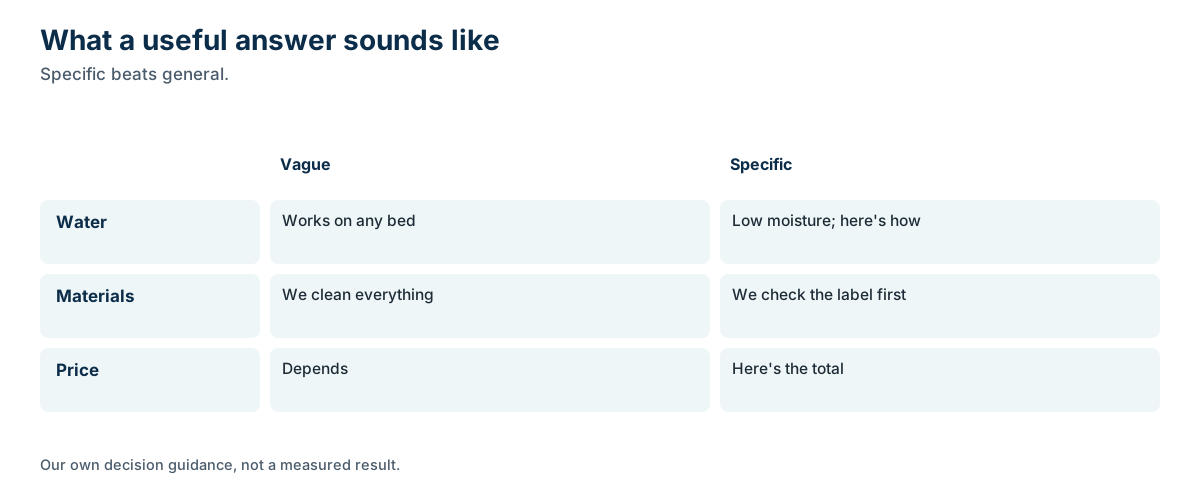
The difference between a useful and a vague answer is easy to hear side by side. On water, "low moisture" is a start; "low moisture, and here's how we keep it low" is an answer. On materials, "works on any bed" is a claim we make ourselves, so ask the follow-up we'd expect you to ask us: how do they adjust for each material, and what would make them stop? "We'll check the label, inspect first and set the method for that bed" is a process. On price, "it depends" leaves you guessing; "here's the total, and here's what would change it" lets you decide. Specific doesn't mean right, but it gives you something to check.
Extra questions for a urine or pet accident
An accident adds a few questions. Ask how the cleaner judges how deep the urine went, and what they'd tell you if it reached the core. Ask whether they use an enzyme product and how much liquid it involves, since adding liquid to a urine spot can carry it further into foam. Ask whether urine treatment costs extra and how that's decided. And ask what happens if the odor returns, because Hub 3 explains why urine odor can come back after a mattress dries. Hub 3's article on restoring an expensive mattress after a pet accident covers the high-end case in more depth.
Red flags
- A claim that one method suits every mattress, with no inspection.
- Reluctance to read or discuss your care label.
- A price that can grow after the work without a quote first.
- Strong health or disinfection claims.
- No answer to "when would you stop?"
None of these is proof of a bad job. Each is a reason to ask more. A good cleaner won't mind the questions; answering them takes a few minutes, and the answers are what let you compare one offer with another on something other than price.
How we'd answer
This section is our view. Method and water: dry vapor from Italian-made Vapor Clean machines, the Magnum XP with its built-in vac, the ProV 350 and the Pro6 Duo, with liquid water kept low. Inspection: yes; it decides steam temperature and pass speed. Care label: yes; it and your warranty govern, and our method is our own reasoning, not a manufacturer exemption. Products: organic cleaning methods are our default, with enzyme treatment for urine and organic odor. Seams: we work the seams, tufts, ridges and edges where dust and shed skin flakes collect. Stopping: in our view and experience we can treat any mattress or topper, and if a material reacts, we adjust or stop. Claims: "sanitize" is a cleaning term for us, as Hub 2's CDC terms entry explains; no disinfection or health claim.
Price: if those answers suit you, reserve a time. The first mattress is $249, any size, or $199 under the limited-time Fall 2026 offer; ordinary urine accidents are included, and severe or biohazard contamination is quoted before we start. The pricing page has every line.
Where to read next
The decision guide puts these questions in context, and this hub lists every article. For a high-end bed, read should I professionally clean a $3,000 mattress?. For who to call, see carpet cleaner or mattress specialist?.
What we don't know
- How well any set of questions predicts a good outcome. This list is our guidance, not a tested tool.
- How much water a given method leaves in a full mattress. No one has published measurements.
- Whether any maker would accept a particular cleaning method under warranty. Only the maker can say.
- Whether a mattress-specific cleaning standard exists. We found none.
Changelog
- 3 October 2026: First published. Sources accessed on this date.
Sources
- Caring for your TEMPUR (UK, updated 11 July 2023, accessed 2026-10-02) · Tempur UK
- Product care (US, accessed 2026-10-02) · Tempur-Pedic
- How To Clean a Mattress in 9 Steps (last updated 16 Oct 2025, accessed 2026-10-02) · Purple
- How to clean your mattress: a mattress care guide (accessed 2026-10-02) · Casper
- How do I clean my mattress? (updated 16 Sep 2026, accessed 2026-10-02) · Beautyrest
- How to Clean Your Natural Mattress Without Using Harsh Chemicals (25 June 2026, accessed 2026-10-02) · Avocado
- Control of exposure to mite allergen and allergen-impermeable bed covers for adults with asthma (Woodcock et al., N Engl J Med, 2003) · PubMed
- CRI 205 Residential Carpet Cleaning Standard · Carpet and Rug Institute
- Magnum XP-Vac product page (maker's claims, accessed 2026-10-02) · Vapor Clean
- ProV 350 product page ('Italian Made'; maker's claims, accessed 2026-10-02) · Vapor Clean
- Pro6 Duo product page ('Made in Italy'; maker's claims, accessed 2026-10-02) · Vapor Clean
- Cleaning and disinfecting your school (definitions) · CDC
Last reviewed October 3, 2026. Manufacturer specifications and care instructions change; check the current version for your exact model. This page is general information, not medical advice. How we source and check pages: editorial standards.