
Short answer
Possibly, but read the care label and warranty before anything else. A high price doesn't make a mattress tougher; it raises the cost of the wrong method. If the maker allows the approach, the bed is sound and the problem is odor, stains or dust near the surface, a careful low-moisture clean can make sense. If not, ask the maker first.
Key terms used on this page
- Care label first:
- The rule that a mattress's own care label and warranty come before any cleaner's method, ours included. Tempur UK notes that a label stitched inside the cover gives specific care instructions for the item purchased.
- Clean-or-replace decision:
- Our four-test framework for a problem mattress: whether the bed is structurally sound, how deep the problem goes, what the care label and warranty allow, and whether the cause is really a pest or health issue. It's our decision guidance, not a published standard.
- Treatable depth:
- How far into a mattress a problem sits relative to what a surface method reaches. A problem in the cover or upper layers is within reach of low-moisture work; one in the core may not be. No published study measures it; it's our working term.
- Dedicated mattress service:
- A visit planned only around mattresses: materials inspection, equipment chosen for mattress layers, and time per bed set by the job. It's the model we run; it differs from an add-on in what the visit is built around.
- Quote comparison:
- Lining up two mattress cleaning quotes item by item: method, inspection, seams and edges, urine treatment, drying guidance and surcharges. The cheaper quote may be for a different job.
Yes, if the rules allow it and the problem suits it. No, if your care label or warranty rules it out. That's the decision for a $3,000 mattress, and it's the same decision as for a $300 one. The price doesn't make the bed tougher. What it does is raise the cost of getting the method wrong, so the label-and-warranty check carries more weight. Read both before any cleaner, including us, touches the bed.
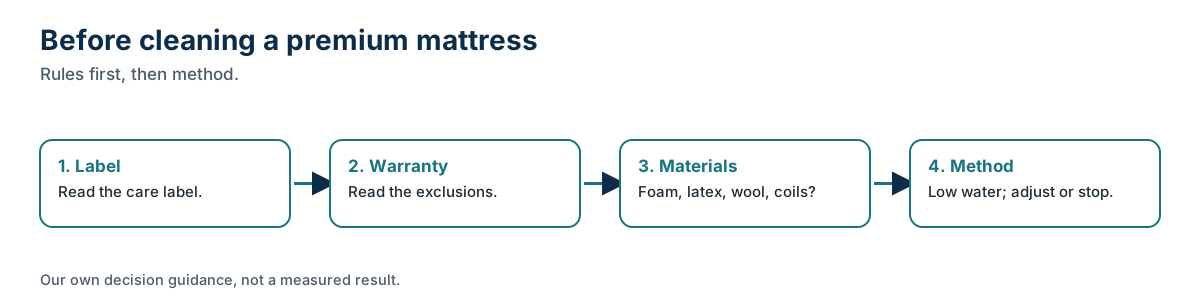
General information on mattress care. It isn't legal or warranty advice; your maker's terms are the authority.
Start with the label and the warranty
Expensive mattresses are built from the same families of materials as cheaper ones: memory foam, latex, polyfoam, wool and other natural fills, pocketed coils. What tends to change is the amount of each and the construction. Hub 2's compatibility guide covers the main brands, and its material pages cover memory foam, latex, wool and hybrids.
The maker's own words decide what's open to you. Some prohibit steam outright. Tempur UK's care page says: "There is a high risk that soaking with water or other cleaning fluids will cause irreversible damage, destroying the benefits of comfort and support which the TEMPUR ® Material provides. It will also invalidate your guarantee. Do not steam-clean or dry-clean the TEMPUR ® Material." Tempur's US page is shorter: "Never wash the TEMPUR® material. TEMPUR® material should never become wet." Both apply whatever moisture level a cleaning method claims.
Purple's general cleaning guide is worth reading closely, because it does two things at once. It allows steam for some constructions and rules it out for others, and then it adds a separate line about Purple's own beds that overrides the general allowance for them: "After vacuuming, you can steam clean your innerspring or hybrid mattress, but you should not steam clean a memory foam, latex, or adjustable mattress since the heat and water could damage its materials. Note that you should not steam clean a Purple mattress. If you have any doubts, refer to the manufacturer’s care instructions and your warranty."
Avocado, which makes natural latex beds, says: "Steam cleaners are not recommended because their excessive heat can over-bake the organic latex." Beautyrest's guidance says: "We do not recommend applying liquids to the mattress. Applying liquids may stain the fabric and make the soiled area worse. Moisture or chemicals applied directly to the mattress can cause premature breakdown of the foam and damage the product."
If your mattress's label says no steam, no water or no chemicals, take that at face value. Silence about a particular kind of steam isn't permission.
What's at stake
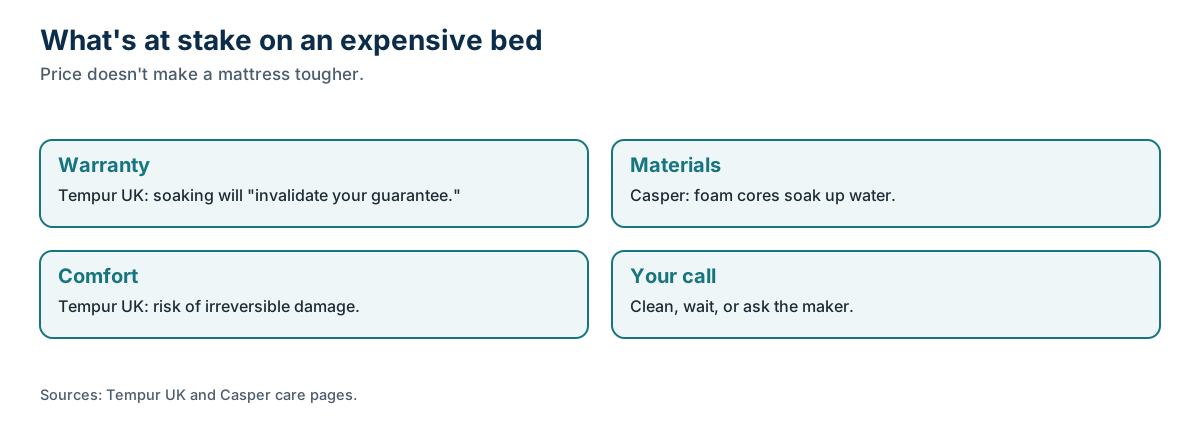
On an expensive bed, three things are at risk if the method is wrong. The first is warranty cover, which some makers tie directly to care. The second is materials: Casper's care page warns that "the foam in the mattress core will soak up water and detergent," and foam that has taken on water is slow to dry. The third is comfort, which is what the money bought. Hub 5 explains what happens when memory foam gets wet and why foam is slow to dry. EPA's remediation table says upholstered furniture "May be difficult to completely dry within 48 hours," and suggests that for a valuable piece, "you may wish to consult a restoration/water damage professional." That's water-damage guidance, not cleaning guidance, but it frames why water is the main risk.
The three options
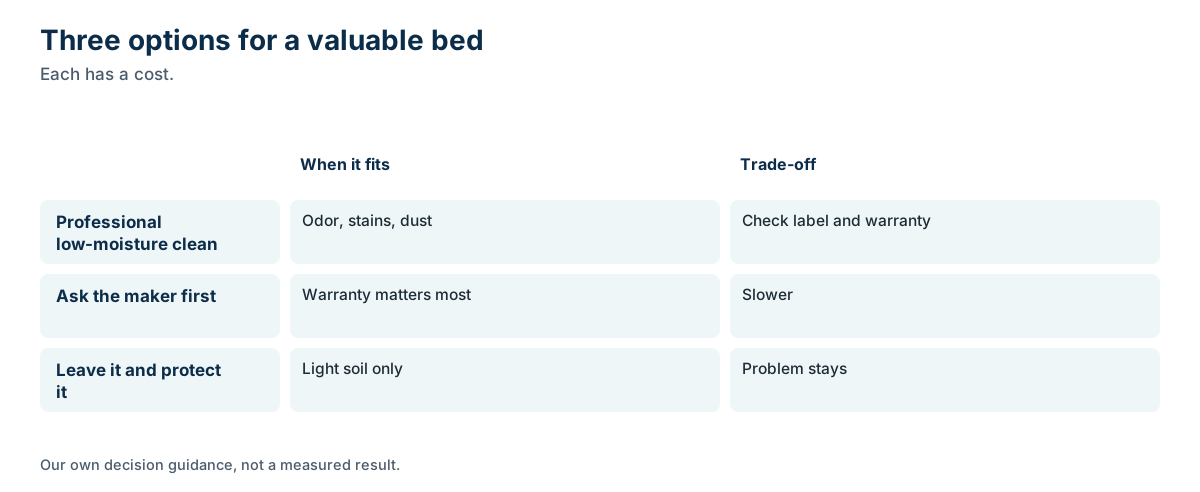
A professional low-moisture clean. This fits when the label allows it, the bed is sound and the problem sits near the surface: odor, body-oil staining, dust in the seams, a recent accident. The method should keep liquid water low and the cleaner should inspect the materials first.
Ask the maker first. This fits when the label is restrictive, unclear or missing, or when the warranty is the biggest thing you'd lose. It's slower, but the answer comes from the people who write the terms.
Leave it and protect it. This fits when the bed is in good shape and lightly used. A protector keeps new soil off. It does nothing about what's already there, so it isn't a fix for an odor or a stain. See is mattress sanitation worth it with a protector?.
There's also a fourth answer that nobody likes: a premium bed that has failed structurally, or that has mold through its layers, isn't a cleaning job at any price. EPA's mold guide says porous materials "may have to be thrown away if they become moldy." See when is a mattress too contaminated to clean?.
Questions worth asking any cleaner
With money at stake, specifics matter. Ask whether there's a materials inspection before any steam or solution goes on, how much water reaches the bed, how they treat seams and edges, what they do if a material reacts, and whether they'll read your care label with you. The full list is in questions to ask before cleaning an expensive mattress. Hub 3's restoring an expensive mattress after a pet accident covers the accident case in detail.
Timing: now, or wait?
For an expensive bed, timing changes the answer. A fresh spill or accident is easier to deal with than one that has set, and a problem near the surface today may be deeper next month if the same spot keeps getting wet. On the other hand, a clean, lightly used bed doesn't need a visit just because it was costly. Our suggestion for a premium bed is to clean when there's a reason, such as a smell, a stain, an accident or a stretch of heavy use, and to protect it in between. Hub 3's article on how professionals treat urine without flooding a mattress covers the accident case.
How we handle an expensive bed
This section is our view. We don't change our price for an expensive bed, and we don't change our care either, because every bed gets the same start: a materials inspection that decides steam temperature and pass speed. Our machines are Italian-made Vapor Clean units, the Magnum XP with its built-in vac, the ProV 350 and the Pro6 Duo, and their adjustable output lets us keep heat and moisture low on sensitive layers. We work the seams, tufts, ridges and edges where dust and shed skin flakes collect. Organic cleaning methods are our default, and enzyme treatment handles urine and organic odor. In our view and experience we can treat any mattress or topper, and if a material reacts, we adjust or stop. That's our call. It's our own method and reasoning, not a manufacturer exemption, and your care label and warranty terms still govern. If your maker prohibits steam, we'd rather you knew that before we arrive. We use "sanitize" in its cleaning sense, as Hub 2's CDC entry sets out, and make no health claim.
Once you've read the label and warranty and the method fits, book your visit. The first mattress is $249, any size, or $199 under the limited-time Fall 2026 offer; see the pricing page for everything else.
Where to read next
The decision guide covers the four tests that apply to every bed, and this hub lists all sixteen questions. For value in general, read is professional mattress sanitation worth it?. For the cost side, see how much mattress sanitation should cost. Hub 2's Tempur-Pedic guide is the closest match if you own one.
What we don't know
- How a premium mattress's materials respond to dry vapor over time. We found no study of any brand.
- Whether a given maker would treat a professional low-moisture clean as a warranty issue. Only the maker can say.
- How much water any method leaves in a premium mattress. Nobody has published measurements for full mattresses.
- Whether price tracks durability to cleaning. We found no evidence either way.
Changelog
- 3 October 2026: First published. Sources accessed on this date.
Sources
- Caring for your TEMPUR (UK, updated 11 July 2023, accessed 2026-10-02) · Tempur UK
- Product care (US, accessed 2026-10-02) · Tempur-Pedic
- How To Clean a Mattress in 9 Steps (last updated 16 Oct 2025, accessed 2026-10-02) · Purple
- How to clean your mattress: a mattress care guide (accessed 2026-10-02) · Casper
- How do I clean my mattress? (updated 16 Sep 2026, accessed 2026-10-02) · Beautyrest
- How to Clean Your Natural Mattress Without Using Harsh Chemicals (25 June 2026, accessed 2026-10-02) · Avocado
- A brief guide to mold, moisture and your home · US EPA
- Mold Remediation in Schools and Commercial Buildings, Table 1: Water Damage, Cleanup and Mold Prevention · US EPA
- Cleaning and disinfecting your school (definitions) · CDC
- Magnum XP-Vac product page (maker's claims, accessed 2026-10-02) · Vapor Clean
- ProV 350 product page ('Italian Made'; maker's claims, accessed 2026-10-02) · Vapor Clean
- Pro6 Duo product page ('Made in Italy'; maker's claims, accessed 2026-10-02) · Vapor Clean
Last reviewed October 3, 2026. Manufacturer specifications and care instructions change; check the current version for your exact model. This page is general information, not medical advice. How we source and check pages: editorial standards.