
Short answer
Less than spraying, but the exact amount left in a mattress has not been published by anyone we can find. Makers describe the steam as about 5% liquid water, one vendor claims about 1.5 quarts of water an hour, and two Optima detailing models are rated at 0.25 to 0.5 and 0.25 to 0.6 liters a minute, with larger models rated higher. How much ends up in the mattress depends on trigger time, pass speed, settings and the fabric.
Key terms used on this page
- Moisture load:
- The total amount of water a cleaning process puts into a mattress, whether from spray, steam condensate, shampoo or rinse. It is the main thing that decides how long a mattress takes to dry.
- Steam quality (dryness fraction):
- The share of a steam mixture's mass that is vapor rather than suspended water droplets. Steam with a quality of 0.95 is 95% vapor and 5% liquid water by mass. This is the engineering idea behind the '5% moisture' claims in vapor-steam marketing.
- Residual moisture:
- Water left in a material right after cleaning, before drying. For carpet, the Carpet and Rug Institute's test for its deep-cleaning extractor seal allows up to 8 ounces per square yard. We have not found an equivalent published test for mattresses.
- Dry-vapor steam:
- Steam made in a sealed, pressurized boiler and released through a hose and nozzle as hot vapor with a low liquid-water content. In the vendor specifications we reviewed, professional units are rated from 80 psi (Ladybug 2350) to 150 psi (Daimer), with stated boiler temperatures from about 345°F (Optima) to 360°F (Daimer); these are maker claims. Daimer describes its steam as about 5% water or less and Vapor Clean claims 'just 5-6% moisture'; that is a vendor claim, not an independent standard.
- Hot-water extraction (HWE):
- The carpet industry's most common professional method. The Carpet and Rug Institute defines an extractor as equipment that uses pressure, water or cleaning solution, and suction to remove soil. It is often marketed as 'steam cleaning' even though it sprays hot water rather than steam.
- Dry to the touch vs dry through:
- Dry to the touch means the surface fabric feels dry. Dry through means the moisture inside the comfort layers has also left. A mattress can feel dry on top while still holding water underneath.
Less than spraying water, but nobody we can find has published how much dry-vapor steam actually leaves in a mattress. What is published describes the machines. Makers say the steam is about 5% liquid water, one vendor claims its machine uses about 1.5 quarts of water an hour, and two Optima detailing models are rated at 0.25 to 0.5 and 0.25 to 0.6 liters a minute, with larger models in the same line rated higher. The amount that ends up in the mattress depends on how long the trigger is held, pass speed, nozzle distance, settings and the fabric.
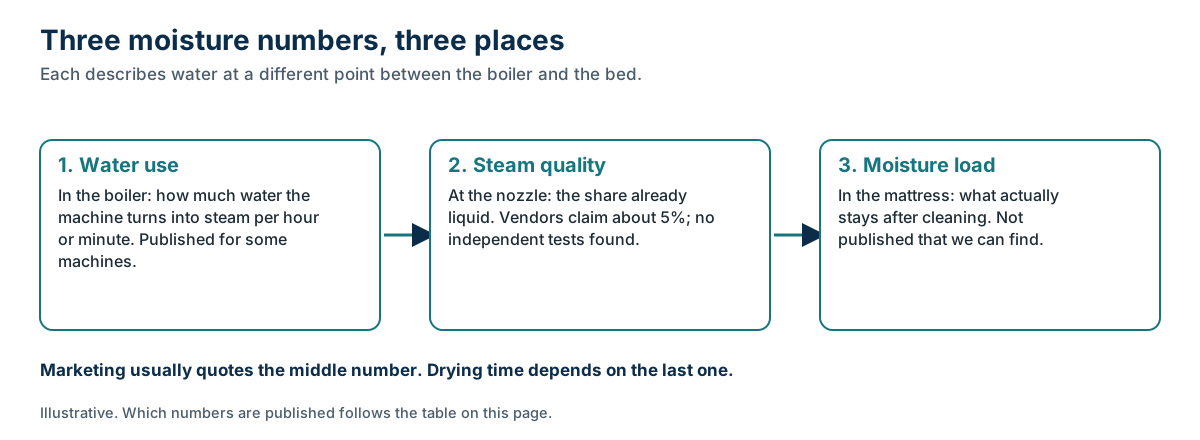
Three numbers often get blurred together: how wet the steam is, how much water the machine uses per minute, and how much stays in the mattress. Makers publish the first two; nobody we've found publishes the third. For how steam's moisture compares with extraction and shampoo, see the flagship guide in the Cleaning Methods hub.
Three different moisture numbers
| Number | What it describes | Is it published? |
|---|---|---|
| Steam quality | Share of the steam leaving the nozzle that's already liquid droplets | Vendor claims of about 5%; no independent tests found |
| Water use or steam output | How much water the boiler turns into steam per hour or minute | Yes, for some machines |
| Moisture load | How much water actually stays in the mattress after cleaning | Not that we can find |
Marketing usually quotes the first. Drying time depends on the third.
What makers publish about water use
- Advanced Vapor Technologies (Ladybug). The company claims, as reported by Green Lodging News, that its machine uses about 1.5 quarts of water per hour and that only 5% of what comes out of the nozzle is moisture. Those are vendor claims.
- Optima Steamer. Optima's commercial units are built for jobs such as vehicle detailing and have much higher output. The XDm/XEm manual lists rated steam output of about 0.25 to 0.5 liters per minute for the XDm and 0.25 to 0.6 liters per minute for the XEm. Optima's model comparison chart shows how wide the range is across one product line: maximum flow rates from 95 cc per minute on the smallest models to roughly 2,000 cc per minute on the largest. The same manual describes a moisture control valve and says to keep it fully closed on water-sensitive surfaces to minimize surface moisture.
- Daimer and Vapor Clean. Daimer's FAQ describes its steam as about 5% water or less, and the Vapor Clean Magnum XP (with vac) page claims "just 5-6% moisture." Neither figure is a water-use rate.
Output ratings describe the trigger held open continuously. In real mattress work the trigger is pulsed and the tool keeps moving, so actual water use is a fraction of the rating.
Water use is a ceiling, not the answer
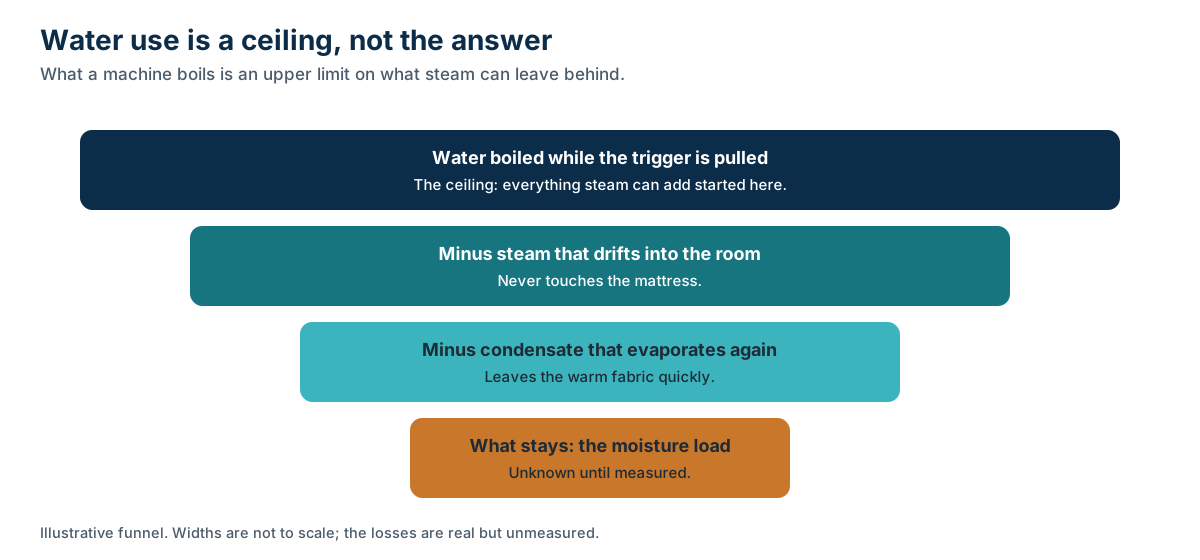
Here's a useful way to reason about it. Everything a steam machine puts on a mattress started as water in its boiler. So the water the machine boils while the trigger is pulled is an upper limit on what steam can add. Some of that steam never touches the mattress, drifting into the room instead, and some that condenses on the warm fabric evaporates again before it soaks in.
As illustrative arithmetic only: at the 1.5 quarts an hour one vendor quotes, holding the trigger for a combined 20 minutes would boil about half a quart, roughly 0.47 liters. The mattress would receive some unknown fraction of that. We are not saying any particular job uses 20 minutes of steam or that any machine performs exactly as its maker says. The point is the order of magnitude, and the fact that the true number has to be measured, not assumed.
How that compares with hot-water extraction
Hot-water extraction moves far more water, and is designed to vacuum most of it back:
| Equipment | Published water flow | Designed to recover it? |
|---|---|---|
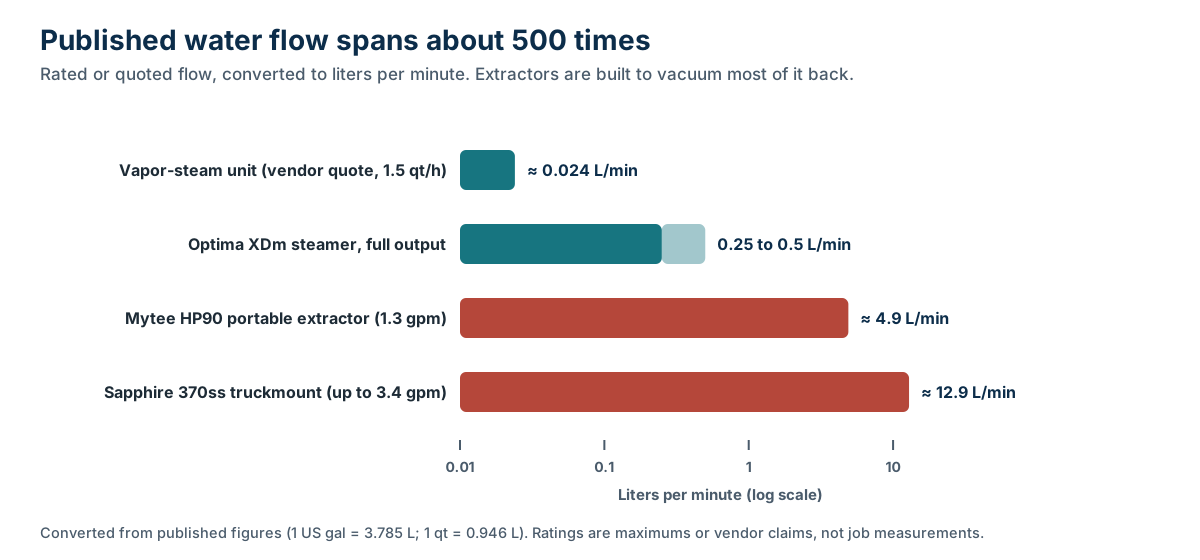
| Vapor-steam unit (vendor quote) | About 1.5 quarts per hour | No; it's delivered as vapor and condenses |
| Optima XDm commercial steamer (full output) | About 0.25 to 0.5 liters per minute | No |
| Mytee HP90 portable extractor (maker) | 1.3 gallons per minute | Yes, by vacuum |
| Sapphire 370ss truckmount (maker) | Up to 3.4 gallons per minute | Yes, by vacuum |
Flow alone doesn't decide the outcome. What matters is the residual moisture left behind. On carpet, CRI's Test Method 118 allows up to 8 ounces per square yard (271 g/m²) for a deep-cleaning extractor to earn its seal. Applied to a queen-size mattress surface of about 3.1 square meters purely for scale, that rate would be about 0.84 liters. Again, that's a carpet benchmark used as a yardstick, not a mattress measurement. The difference on a mattress is that water past the ticking is hard for a surface wand to pull back. We cover this in dry-vapor steam vs carpet extraction for mattresses.
What changes how much water stays
Five things an operator controls make the biggest difference:
- Trigger time. The less time steam is flowing, the less water is available to condense.
- Pass speed. A moving tool spreads condensate thinly. A stationary tool concentrates it.
- Nozzle distance and tool. Working very close condenses more steam into the fabric. Cloth-covered tools catch some condensate.
- Purging. Water that sits in the hose comes out as a spurt on the next trigger pull unless it's purged into a towel first.
- Machine settings. Moisture valves or water-injection settings, where the machine has them, change the steam's wetness.
The room matters afterward. Airflow and humidity decide how quickly the moisture that does go in will leave. See how long should a mattress take to dry after professional cleaning?
How the real number could be measured
The gap in the data isn't because the measurement is impossible. It's because it's inconvenient in a home. Three approaches would work:
- Weigh the water. Weighing the machine's water tank before and after a job gives the total water boiled. It's an upper limit, not what stayed in the mattress, but it's a real number rather than a rating.
- Weigh a test panel. Cleaning a weighed sample of mattress material, such as a cut section of ticking and foam, with the same technique shows how much water stays behind, the same idea CRI uses for carpet.
- Use a moisture meter. Readings before and after, at the surface and pressed into the comfort layer, show where the water went and how quickly it leaves, even if they don't give a total.
Any company that quotes a precise moisture figure for its mattress cleaning should be able to tell you which of these it used.
Why it matters
The EPA's mold guidance says wet materials should be dried within 24 to 48 hours to prevent mold in most cases. A low moisture load keeps a mattress far inside that window. It also matters more for some materials than others; memory foam is the least forgiving, as explained in what happens when water penetrates memory foam?
Sleep Sanitation's process is built around keeping the moisture load low: our Vapor Clean equipment, moving passes, a purged hose and a room with airflow. Step-by-step details are on our process page, and current rates are on pricing.
What we don't know
- Water left in a mattress by dry-vapor steam. We have not found any published measurement, by weight or moisture meter, from any company or researcher.
- Independent steam-quality data. The "about 5%" figure is a vendor claim.
- Real-world water use per job. Output ratings assume continuous steam. We have not found published per-mattress water-use figures.
Sources
- More on steam cleaning, this time with TANC technology · Green Lodging News
- Optima Steamer XDm/XEm user manual · SJE Corp / Optima Steamer
- Optima Steamer product catalog · SJE Corp / Optima Steamer
- Steam cleaner FAQ · Daimer Industries
- Magnum XP (with vac) product page · Vapor Clean
- Sapphire 370ss truckmount specifications · Hi-Pressure Cleaning Systems
- HP90 Stingray portable extractor specifications · Mytee
- CRI Test Method 118 (extractor residual moisture) · Carpet and Rug Institute
- A brief guide to mold, moisture and your home · US EPA
Last reviewed October 2, 2026. Manufacturer specifications and care instructions change; check the current version for your exact model. This page is general information, not medical advice. How we source and check pages: editorial standards.