
Short answer
Dry-vapor steam cleaning uses a sealed, pressurized boiler to turn water into steam far hotter than 212°F, then releases it through a hose and tool as a jet of vapor carrying little liquid water. The steam heats the surface by condensing on it, which loosens soil and delivers heat with much less water than spraying. It doesn't remove soil by itself, so it is paired with vacuuming or wiping.
Key terms used on this page
- Dry-vapor steam:
- Steam made in a sealed, pressurized boiler and released through a hose and nozzle as hot vapor with a low liquid-water content. In the vendor specifications we reviewed, professional units are rated from 80 psi (Ladybug 2350) to 150 psi (Daimer), with stated boiler temperatures from about 345°F (Optima) to 360°F (Daimer); these are maker claims. Daimer describes its steam as about 5% water or less and Vapor Clean claims 'just 5-6% moisture'; that is a vendor claim, not an independent standard.
- Saturated steam:
- Steam at the boiling point for its pressure: 212°F (100°C) at atmospheric pressure, about 324°F (162°C) at 80 psi gauge and about 352°F (178°C) at 123 psi gauge. Most portable vapor-steam boilers make saturated steam.
- Superheated steam:
- Steam heated above the boiling point for its pressure, so it holds no liquid water until it cools. True superheating needs heat added after the boiler. Cleaning-equipment marketing often uses the word loosely for any high-temperature steam.
- Steam quality (dryness fraction):
- The share of a steam mixture's mass that is vapor rather than suspended water droplets. Steam with a quality of 0.95 is 95% vapor and 5% liquid water by mass. This is the engineering idea behind the '5% moisture' claims in vapor-steam marketing.
- Latent heat (condensation):
- The energy steam releases when it condenses back into water, about 2,257 kJ per kilogram at atmospheric pressure and somewhat less at higher boiler pressures (about 2,048 kJ/kg at 7 bar gauge). It is why steam heats a surface quickly, and why steam that heats a surface always leaves some condensed water behind.
- Boiler temperature vs surface temperature:
- Boiler temperature is the temperature of steam inside the machine. Surface temperature is what the mattress fabric actually reaches. Surface temperature is always lower and depends on nozzle distance, pass speed, fabric and the tool, and manufacturers rarely publish it.
- Dwell time:
- How long heat or a cleaning product stays in contact with a given spot. Heat-related lab results are reported as a temperature held for a time, so a temperature figure without a dwell time is incomplete.
Dry-vapor steam cleaning uses a sealed, pressurized boiler to turn water into steam that is much hotter than 212°F, then releases it through a hose and tool as a jet of vapor that carries relatively little liquid water. When that vapor touches a cooler surface, it condenses and gives up its heat all at once, which loosens soil and heats the fabric while putting in far less water than spraying would. It doesn't pick anything up on its own, so on a mattress it is paired with vacuuming or wiping.
That's the short definition. What follows covers why pressure raises the temperature, what "dry" means, how four machines look on paper, and where the method's limits are. The flagship comparison places it alongside extraction, shampooing and vacuuming, and the Cleaning Methods hub defines each term used here.
How a dry-vapor steam cleaner works
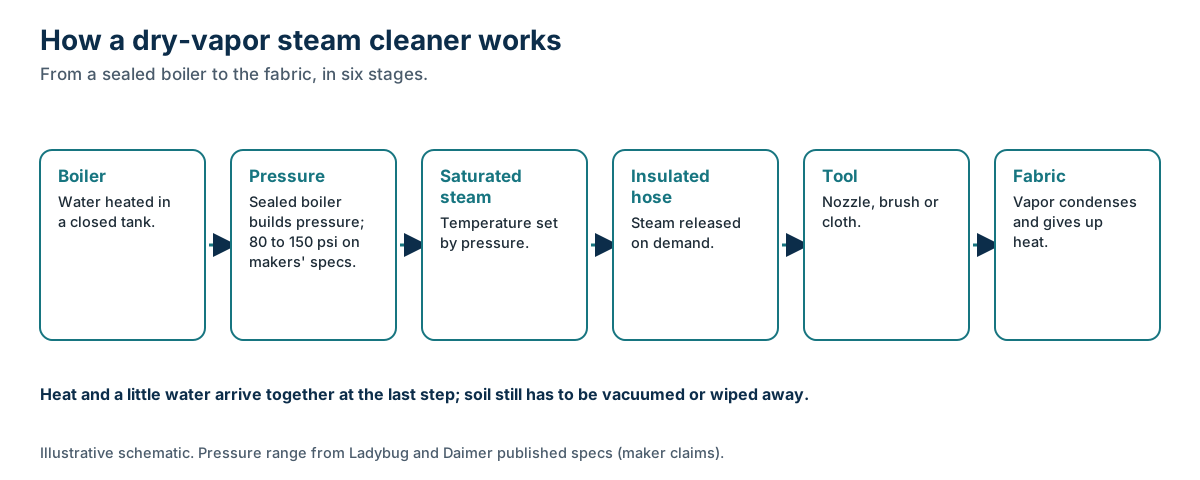
A dry-vapor machine has four basic parts: a boiler, a heating element (electric on most indoor units), a pressure control, and a hose with interchangeable tools.
- Water is heated in a closed boiler. Because the boiler is sealed, pressure builds as the water heats. Higher pressure raises the boiling point.
- The boiler holds steam at a set pressure. The professional units in the table below are rated from 80 psi (Ladybug 2350) to 150 psi (Daimer), per their makers.
- The operator releases steam on demand. Steam travels through an insulated hose to a nozzle, brush or cloth-covered tool.
- Steam condenses on the surface. That's where the heat is delivered, and where a small amount of water ends up.
The defining feature is the pressurized boiler. A kettle-style or garment steamer boils water at roughly atmospheric pressure, so its steam is close to 212°F and often carries droplets. We explain that distinction in steam cleaner vs dry-vapor steam cleaner: are they the same?
Why pressure means temperature
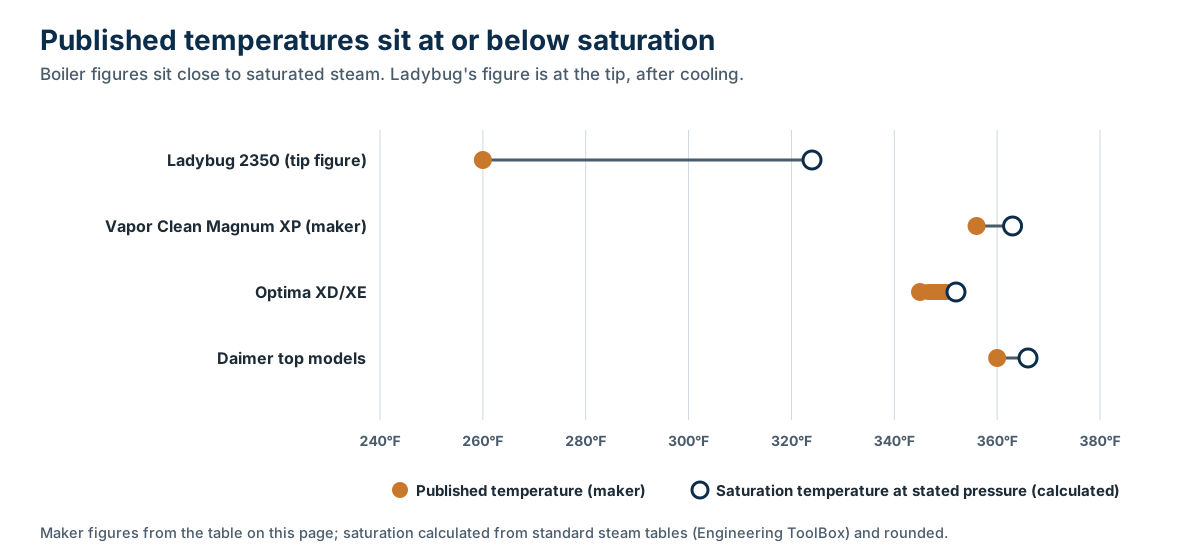
For saturated steam, the kind most boilers make, pressure and temperature are locked together. You can't raise one without the other. That's why vapor-steam spec sheets list both, and why the numbers tend to line up.
| Published spec | Pressure | Published boiler temperature | Saturation temperature at that pressure |
|---|---|---|---|
| Ladybug 2350 (maker) | 80 psi (peak) | Not listed; maker lists 260°F at the tip | about 324°F |
| Vapor Clean Magnum XP (with vac) (maker) | 145 psi (10 bar) | 356°F | about 363°F |
| Optima Steamer XD/XE (Steamericas) | 8.5 bar (about 123 psi) | about 345 to 352°F | about 352°F |
| Daimer top models (maker FAQ) | up to 150 psi | up to 360°F | about 366°F |
Saturation temperatures are calculated from standard steam tables and rounded. Where a boiler temperature is published, it sits close to the saturation column, which tells you these machines make saturated steam. Ladybug's 260°F is a tip figure, measured after the steam has left the boiler and started to cool, which is a useful reminder of how much temperature drops between boiler and tool. Some brochures call their output "superheated." In engineering terms, superheated steam is steam heated beyond its saturation point by an extra heater. Unless a maker describes a superheater, treat "superheated" as a marketing word for "hot."
Why steam delivers so much heat with so little water
The reason steam is useful for cleaning is latent heat. Turning water into vapor takes a large amount of energy, about 2,257 kJ per kilogram at atmospheric pressure according to steam tables. That energy comes back out when the vapor condenses. For comparison, heating a kilogram of water from room temperature to boiling takes roughly 335 kJ, calculated from the water enthalpy values in the same steam tables. So a gram of steam that condenses on fabric delivers several times more heat than a gram of very hot water would.
In practice, that means a steam tool can heat the surface of a mattress quickly while adding only the water that condenses there. A spray of hot water, by contrast, has to bring a lot more water along to deliver the same heat, and that water has to go somewhere.
What "dry" means
"Dry" vapor is a relative term. Engineers describe steam by its steam quality, or dryness fraction: the share of the steam's mass that is vapor rather than suspended droplets. Spirax Sarco gives the example that steam with a dryness fraction of 0.95 is 95% vapor and 5% water.
Equipment makers commonly claim their vapor is about 5% water. That is a claim about the steam leaving the machine. It is not a measurement of how wet the mattress gets, because every bit of steam that condenses on the fabric becomes water too. We break this down in is dry-vapor steam actually "dry"? and how much moisture does dry-vapor steam use?
Boiler temperature is not mattress temperature
The temperature on a spec sheet is inside the boiler. Steam loses heat in the hose, expands and mixes with air as it leaves the nozzle, and heats fabric only as fast as condensation and contact allow. That gap between boiler temperature and surface temperature is large. Optima is one of the few makers to publish both: about 175°C in the boiler and 120°C at the gun tip on electric models or 135°C on diesel-heated models.
How hot the ticking of a mattress actually gets depends on nozzle distance, pass speed, the tool and the fabric. We have not found a published measurement of mattress surface temperature under a moving dry-vapor tool. That also means dwell time, how long a spot stays at a given temperature, is usually unknown, even though it's the number that matters for any heat-related result. See why heat and moisture have to be considered separately.
What dry-vapor steam does and doesn't do on a mattress
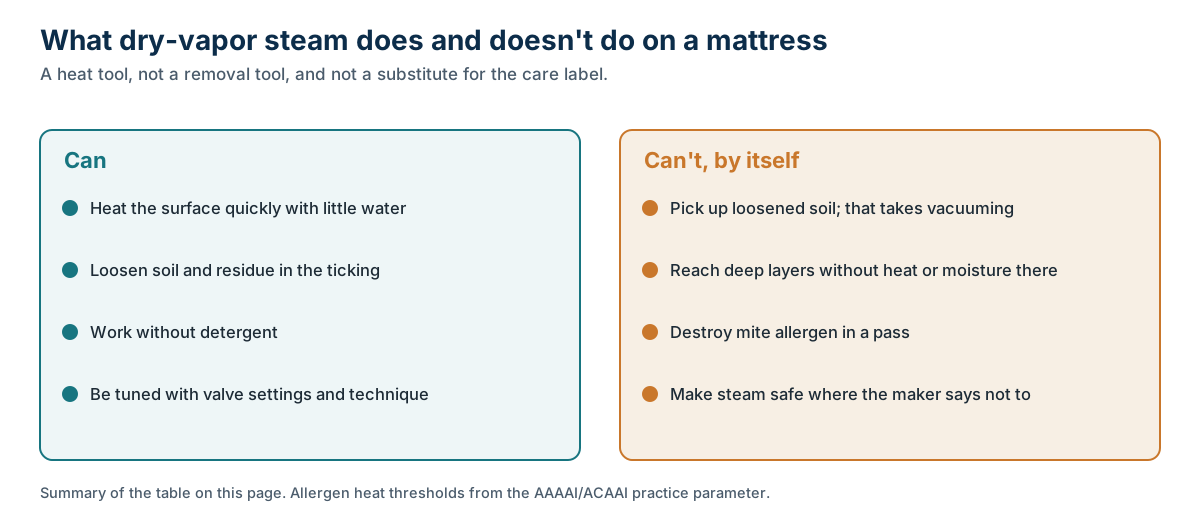
| Dry-vapor steam can | Dry-vapor steam can't, by itself |
|---|---|
| Heat the surface quickly with little added water | Pick up loosened soil, dust or allergen; that takes vacuuming or wiping |
| Loosen soil and residue in the ticking | Reach deep comfort layers without putting heat or moisture there |
| Work without detergent | Destroy dust mite allergen, which needs far more heat for far longer |
| Be tuned for moisture-sensitive surfaces with valve settings and technique | Make a material safe to steam if its manufacturer says not to |
The evidence base is real but limited. In a 1995 study, Colloff, Taylor and Merrett found that carpet squares treated with a domestic steam cleaner had no live mites at any point over four months, and allergen fell 86.7% compared with 4.7% in controls. That was carpet. The AAAAI/ACAAI practice parameter says physical measures such as heating theoretically should be effective against mites, but that no clinical trials have demonstrated a benefit from them.
Manufacturer instructions come first, and they govern. Purple's cleaning guide allows a steam cleaner on innerspring and hybrid beds, yet it says you "should not steam clean a memory foam, latex, or adjustable mattress since the heat and water could damage its materials," and it rules out steaming a Purple mattress. Tempur goes further. Its UK care page is blunt: "Do not steam-clean or dry-clean the TEMPUR Material." The same page adds "There is a high risk that soaking with water or other cleaning fluids will cause irreversible damage" and "It will also invalidate your guarantee." On heat, Tempur-Pedic US explains "Due to the temperature-sensitivity of the TEMPUR-material, adding high heat can hinder its ability to react to your body temperature and conform to your body shape." A dry-vapor machine is still a steam machine under those words; neither maker writes an exception for it. We do use one on these brands, an Italian-made Vapor Clean dry-vapor system whose maker claims "just 5-6% moisture" (its claim, not our measurement). That is our own call, based on the reasoning in what happens when water penetrates memory foam, not a manufacturer exemption. The label remains the safe default, and owners should check their manufacturer's warranty terms before any cleaning.
How Sleep Sanitation uses it
Dry-vapor steam is the core of the Sleep Sanitation process. We apply it with our Vapor Clean dry-vapor equipment (we run the Magnum XP, ProV 350 and Pro6 Duo and match the machine to the job) in controlled, moving passes, pair it with a heated UV-C mattress vacuum, and adjust technique for the materials found during inspection. Our process walks through each stage, and our Omaha and Lincoln service pages cover local details.
What we don't know
- Independent steam-quality tests. The "about 5% water" figure comes from equipment sellers. We have not found independent measurements at the nozzle.
- Mattress surface temperatures. We have not found published data on how hot ticking gets during a professional pass.
- Mattress-specific outcome studies. The steam studies we cite were done on carpet or lab surfaces, not in-home mattresses.
Sources
- What is steam? (steam tables and dryness fraction) · Spirax Sarco
- Saturated steam properties · Engineering ToolBox
- Optima Steamer model comparison chart · Steamericas
- Optima Steamer XDm/XEm user manual · SJE Corp / Optima Steamer
- Ladybug 2350 specifications · Advanced Vapor Technologies (Ladybug)
- Magnum XP (with vac) product page · Vapor Clean
- Steam cleaner FAQ · Daimer Industries
- Colloff, Taylor & Merrett (1995), steam cleaning of carpets and dust mites · Clinical & Experimental Allergy
- Dust mite practice parameter (Portnoy et al., 2013) · AAAAI-ACAAI
- Caring for your TEMPUR mattress · Tempur UK
- How to clean a mattress · Purple
Last reviewed October 2, 2026. Manufacturer specifications and care instructions change; check the current version for your exact model. This page is general information, not medical advice. How we source and check pages: editorial standards.