
Skip to content

Knowledge Center · Care schedule & myths

Mattress care schedule and myths: what the evidence says

This hub checks the rules people repeat about mattress care against the sources behind them. How often to clean a mattress and wash bedding, where the 7-year replacement rule came from, whether an unmade bed or autumn matters for bed mites, which home methods reach inside a mattress, and what protectors, toppers and care labels actually do. Where the evidence is thin, we say so.

Monday–Friday, 9am–6pm. Missed a call? We return calls and texts on Saturday and Sunday too.

Short answer

Most mattress care rules are habits, marketing or headlines rather than findings. The well-supported ones are few: wash bedding weekly, keep indoor humidity down, use a protector, and deal with accidents promptly. No study sets a mattress cleaning interval, the 7-year rule is an industry rule of thumb, the unmade-bed claim came from a lab-based model, and bed mites don't bite.

By Matthew Brunken · Updated October 7, 2026 · Last reviewed October 7, 2026 · Sources · Editorial standards

Mattress care is full of confident numbers: clean every six months, replace every seven years, wash pillows monthly, leave the bed unmade to starve the mites. Some of them are sensible habits. Very few came from a study. This hub takes the rules people repeat most and traces each one to its source, so you can tell the well-supported advice from the marketing and the headlines.
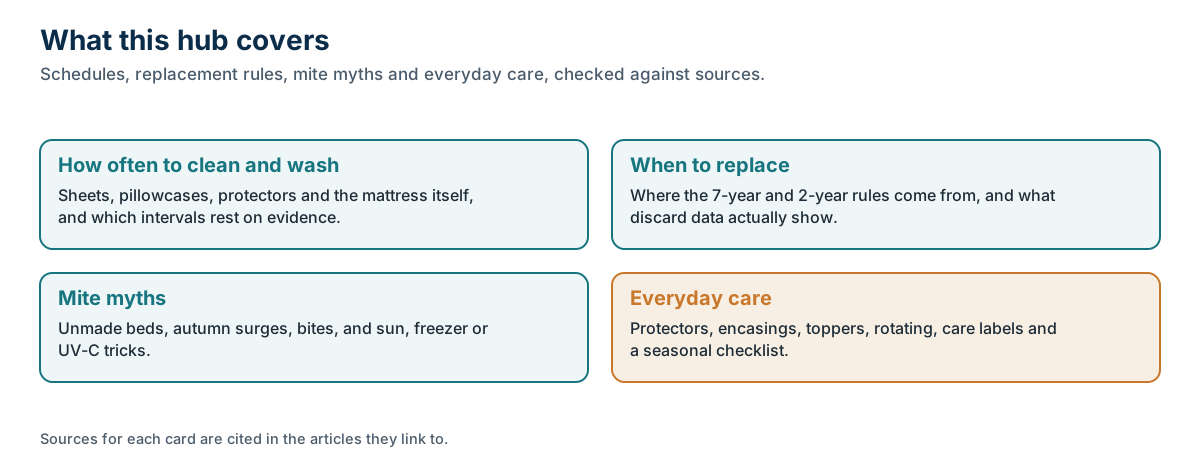
Four cards summarizing the hub: cleaning and washing schedules, replacement rules, bed mite myths, and everyday mattress care
Four groups of questions, one hub. Diagram: Sleep Sanitation (original, illustrative).

This hub is general information about mattress care and allergens, not medical advice. For allergy or skin concerns, talk with a doctor.

Why a hub on care schedules and myths

Ask how often to clean a mattress, wash pillows or replace a bed, and you'll get answers from two years to twenty. People share them as facts, often with "studies show" attached. We wanted to know which studies, so we went looking: allergy practice parameters, randomized trials, extension entomology guides, federal rules and, where it existed, real-world data. The result is a shorter list of well-supported rules than you might expect, and a longer list of things that are habits or guesses.
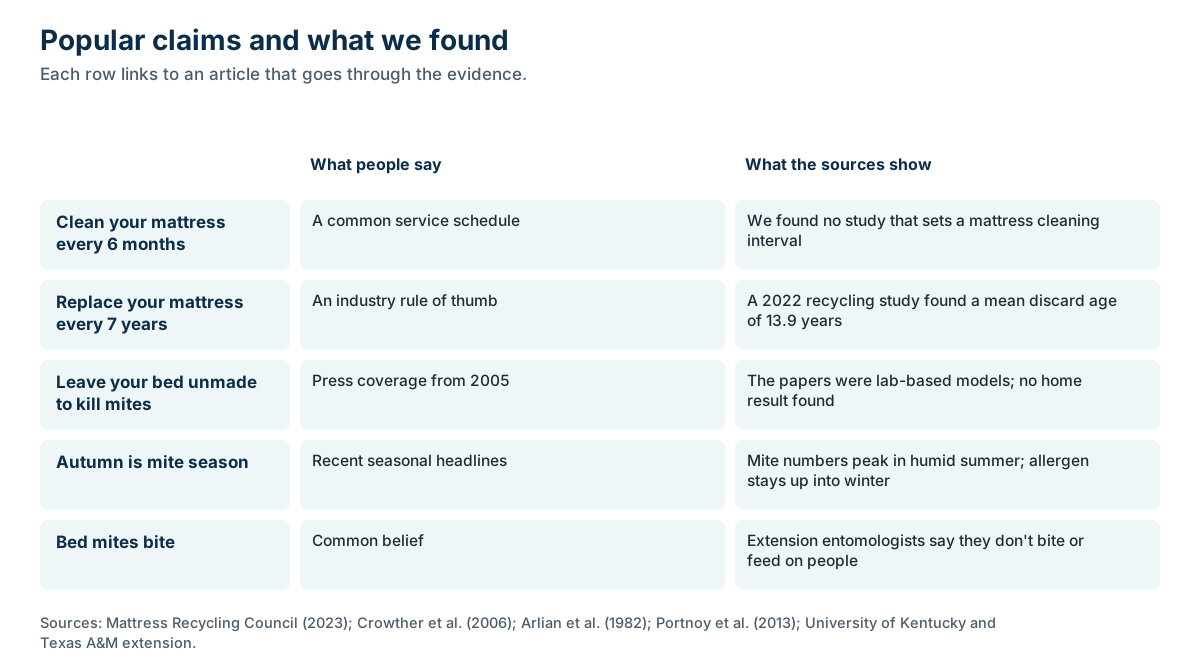
Grid of five popular claims about mattress care, each paired with a one-line summary of what published sources show
Five claims, five short answers. The articles give the detail. Diagram: Sleep Sanitation (original, illustrative).

How often to clean and wash

Start with how often to clean a mattress. We found no study that sets a mattress cleaning interval, so any schedule, including our own twice-a-year suggestion, is a rule of thumb. The interval that does have graded evidence is for bedding: wash sheets and pillowcases weekly. Sources disagree on water temperature, and that article lays out why. The seasonal checklist puts the whole routine on a calendar for a Lincoln or Omaha home.

When to replace

Is the 7-year rule real? traces the number to mattress-industry consumer education and compares it with a 2022 study of discarded mattresses that found an average age of 13.9 years. Replacement myths checks the two-year rule, fixed pillow schedules and the idea that an old mattress is necessarily a dirty one. Our decision center helps with the clean-or-replace choice itself.

Bed mite myths

Should you leave your bed unmade? shows that the famous claim came from a 2005 press release about a lab-calibrated model, with a skeptical allergist quoted in the same coverage. Is autumn mite season? uses published seasonal data from Ohio homes: mites peak in humid summer, and allergen stays high into winter. Sun, freezer, dryer, iron or UV-C explains why every home method, including the UV-C and steam we use, works at or near the surface. And do bed mites bite? answers no, then sets out what does. Our allergens hub covers mite control in depth.

Everyday care

Protectors vs encasings separates spill protection from allergen barriers and reports the trial evidence honestly, including the results that didn't favor encasings. Toppers covers which fills can be washed and when to replace. Rotating, flipping and care labels explains what care label words legally mean and which tags to keep.

Related articles in other hubs

Two companion pieces sit in other hubs. Viral mattress cleaning recipes, ingredient by ingredient looks fairly at detergent-and-iron, vinegar-and-baking-soda and similar home recipes, and why one side of the bed turns darker answers a question about sweat and body oils.

The short list that holds up

After checking dozens of claims, the rules with real support fit on one hand. Weekly washing of sheets and pillowcases carries a graded recommendation in the allergy practice parameter. Keeping indoor humidity down has the strongest home evidence against mites: in a Dayton study, homes held below 51% relative humidity through humid summers ended up with far less mite allergen than homes that weren't. A protector or encasing keeps new soil and allergen from building up in the mattress, though encasings alone rarely change allergy symptoms. Small washables respond to a hot dryer cycle or a night in the freezer. And accidents are best handled promptly, by blotting rather than soaking.

Almost everything else is a habit, a rule of thumb or a misreading. That doesn't make those habits bad. Rotating a mattress, airing a bed in the morning or putting bedding in the sun are all reasonable things to do. They simply aren't the evidence-backed rules they're often presented as, and none of them replaces the short list above.

Why myths spread so easily

Care rules are easy to share and hard to check. A number like seven years or six months sounds precise, a headline about mites starving in an unmade bed is memorable, and a fixed schedule is simpler to follow than a judgment about condition. Many of the claims we traced began with something real, a press release, an industry guide or a lab model, and lost their caveats as they traveled. Our approach is to restore the caveat rather than to mock the claim.

How we handle evidence here

We lean on primary sources: an allergy practice parameter, randomized trials and Cochrane reviews, extension entomology guides, federal regulations and published data. We refer to industry groups generically in our text and name them in the source lists. Where a source has a conflict of interest, as the practice parameter notes for its encasing section, we say so. Where we give our own suggestion, such as a twice-a-year cleaning rhythm, we label it as ours.

Sleep Sanitation's position

This section is our view. The best mattress care is mostly free: weekly sheets, a washed protector, sensible humidity and prompt attention to accidents. A deeper cleaning is one step among those, not a replacement for them, and it works at the surface, where skin flakes, dust and spills collect. Our visits use dry vapor steam with little water, HEPA vacuuming and UV-C light, and every visit includes two checks: a moisture check after service and the built-in bed mite sensor on our UV-C vacuum. We serve Lincoln, Omaha and surrounding towns. See our process, call or text (402) 512-5658, or email info@sleepsanitation.com.

What we don't know

  • Whether any mattress cleaning interval changes allergen, odor or mattress life over time. We found no study comparing intervals.
  • What happened to the 36-house field test planned in 2005 to check the unmade-bed model. We found no published result.
  • How mite and allergen seasonality in Nebraska homes compares with the Ohio data. We found no local survey.

Changelog

  • 7 October 2026: First published. Sources accessed on this date.

How often to clean and wash

Which care intervals have evidence behind them, how often to wash sheets, pillowcases and protectors, and a season-by-season checklist for a Nebraska home.

When to replace

Where the 7-year rule comes from and what discard data show, plus the 2-year rule, pillow schedules and other replacement myths.

Bed mite myths

The unmade-bed claim and the research behind it, whether autumn is mite season, which home methods reach inside a mattress, and why bed mites don't bite.

Everyday care

Protectors versus encasings and the honest trial results, toppers, and rotating, flipping and reading care labels.

Defined terms

The vocabulary of mattress cleaning methods

Every article in this Knowledge Center uses these words the same way. Each term has its own link, so you can point anyone (or any search engine) straight to the definition.

Care interval
How often a care step is repeated, such as weekly bedding washes. For mattresses, we found no study that sets a cleaning interval; the weekly bedding interval comes from graded allergy guidance.Source: Environmental Assessment and Exposure Control of Dust Mites: A Practice Parameter (Portnoy et al., 2013)
Event-based cleaning
Cleaning a mattress because something happened to it, such as an accident, heavy sweating or a move, rather than because a date arrived. A mattress-industry care page advises blotting any damp spot promptly and never soaking the mattress.Source: Caring for a Mattress
Bedding wash cycle
The routine of laundering sheets and pillowcases. An allergy practice parameter recommends weekly washing and says high water temperature isn't needed to cut allergen.Source: Environmental Assessment and Exposure Control of Dust Mites: A Practice Parameter (Portnoy et al., 2013)
Dryer heat treatment
Using a clothes dryer's heat to kill mites in bedding. The practice parameter cites 10 minutes killing all mites seeded into blankets and an hour killing 99% in used duvets.Source: Environmental Assessment and Exposure Control of Dust Mites: A Practice Parameter (Portnoy et al., 2013)
Pillow condition check
Judging a pillow by lumps, loss of spring and odor rather than age. One study of pillows used 1.5 to more than 20 years found 4 to 16 fungal species per pillow.Source: Fungal Contamination of Bedding (Woodcock et al., Allergy, 2006)
Discard age
How old a mattress is when it's thrown out. A 2022 California study found a mean of 13.9 years and cautioned that it doesn't represent durability or useful life.Source: Mattress and Foundation Age Analysis (July 2023)
Replacement rule of thumb
A round number for when to replace a mattress, such as seven years. The best-known version comes from mattress-industry consumer education, not from wear testing.Source: Replacing a Mattress
Flex fatigue
Loss of firmness and height in foam after repeated compression. Foam industry tests compress samples thousands of times and measure the percentage of firmness lost.Source: Foam Performance
Hygrothermal model
A computer model predicting how temperature and humidity affect something, here mite populations. The 2006 model behind the unmade-bed claim was calibrated on laboratory cultures.Source: A Simple Model for Predicting the Effect of Hygrothermal Conditions on Populations of House Dust Mite (Crowther et al., 2006)
Population Equilibrium Humidity (PEH)
The relative humidity, at a given temperature, at which a mite population neither grows nor declines. The term was defined in a 2006 model paper.Source: A Simple Model for Predicting the Effect of Hygrothermal Conditions on Populations of House Dust Mite (Crowther et al., 2006)
Critical Equilibrium Humidity
The humidity below which an individual mite can't keep its water balance. The 2006 paper contrasts it with Population Equilibrium Humidity, which describes whole populations.Source: A Simple Model for Predicting the Effect of Hygrothermal Conditions on Populations of House Dust Mite (Crowther et al., 2006)
Allergen seasonality
The yearly rise and fall of mite allergen indoors. The practice parameter describes levels rising in humid summer, staying elevated through winter and falling in late winter and spring.Source: Environmental Assessment and Exposure Control of Dust Mites: A Practice Parameter (Portnoy et al., 2013)
Heating season
The months a home's heating runs, when indoor air is drier. A 1982 Ohio study found mite numbers lowest in the dry, late heating season.Source: The Prevalence of House Dust Mites and Associated Environmental Conditions in Homes in Ohio (Arlian et al., 1982)
Photophobic
Avoiding light. The practice parameter describes mites as light sensitive and photophobic, living deep in pillows, mattresses and carpets.Source: Environmental Assessment and Exposure Control of Dust Mites: A Practice Parameter (Portnoy et al., 2013)
Line-of-sight exposure
Treatment that only acts on what it can directly reach, like light. In a lab study, UV-C killed all exposed mites only at close range for an hour, with less effect when shielded.Source: Effect of Germicidal UV-C Light (254 nm) on Eggs and Adults of House Dust Mites (Lah et al., 2012)
Freeze treatment
Putting small items in a freezer to kill mites. Overnight freezing cut live mites by 95.1% in soft toys; mite eggs resisted all but a minus 70°C freezer in another study.Source: Effect of Freezing, Hot Tumble Drying and Washing With Eucalyptus Oil on House Dust Mites in Soft Toys (Chang et al., 2011)
Parasitic mite
A mite that feeds on a living host. Bed mites aren't parasitic; scabies mites, and bird and rodent mites that stray from nests, can bite or burrow.Source: House Dust Mites (ENTFACT-646)
Scabies
A skin infestation by a human itch mite that burrows into skin. CDC lists intense itching, especially at night, and a pimple-like rash as the most common symptoms.Source: About Scabies
Bite mimic
A skin reaction mistaken for an insect bite. Texas A&M lists detergents, fabric softeners, soaps and toiletries among common causes.Source: Diagnosing Mysterious Bites and Itches (ENT-3006)
Encasing pore size
The average gap between fibers in an encasing fabric. The practice parameter says under 10 microns blocks the main mite allergen and under 6 microns blocks cat allergen.Source: Environmental Assessment and Exposure Control of Dust Mites: A Practice Parameter (Portnoy et al., 2013)
Woven microfiber encasing
A breathable zippered cover made of tightly woven ultrathin filaments that filter allergen. The practice parameter prefers it over nonwoven covers, which can't be washed.Source: Environmental Assessment and Exposure Control of Dust Mites: A Practice Parameter (Portnoy et al., 2013)
Partial bedroom control
Using only encasings and hot-washing bedding against mites. A 2024 meta-analysis found it didn't help on its own and did not recommend it as a stand-alone strategy.Source: House Dust Mite Allergen Avoidance Strategies for the Treatment of Allergic Asthma: A Hypothesis-Generating Meta-Analysis (van Boven et al., 2024)
End-to-end rotation
Turning a mattress 180 degrees so head and foot swap, spreading wear. Industry care advice suggests periodic rotation unless the care instructions say otherwise.Source: Caring for a Mattress
Care Labeling Rule
The FTC rule, 16 CFR Part 423, that defines care terms such as hot water and No steam. It covers apparel and certain piece goods, not mattresses.Source: 16 CFR Part 423: Care Labeling of Textile Wearing Apparel and Certain Piece Goods
Cationic fabric softener
A conditioner whose positively charged surfactants, often esterquats, deposit on fibers to soften them. That coating is the point of softener, and it stays in the fabric.Source: Advanced Eco-Friendly Formulations of Guar Biopolymer-Based Textile Conditioners (Materials, 2021)
Acid-base neutralization
A reaction in which an acid and a base produce a salt and water. Vinegar and baking soda react this way, releasing carbon dioxide as they use each other up.Source: Chemistry 2e, 4.2 Classifying Chemical Reactions
Flash point
The lowest temperature at which a liquid gives off enough vapor to ignite. NIOSH lists isopropyl (rubbing) alcohol at 53°F, a Class IB flammable liquid.Source: NIOSH Pocket Guide to Chemical Hazards: Isopropyl Alcohol
Sweat gland output
How much sweat each active gland produces. A lab study found men sweated more than women at high heat loads during exercise, entirely because of greater output per gland.Source: Sex Differences in Thermoeffector Responses During Exercise at Fixed Requirements for Heat Loss (Gagnon and Kenny, 2012)

Frequently asked questions

How often should a mattress be cleaned?+

No study sets an interval. Allergy guidance sets a weekly interval for bedding, not mattresses. Clean the mattress after accidents, heavy sweating or a move, vacuum the surface when the protector is off, and add a deeper cleaning once or twice a year if your household is busy. That last part is a rule of thumb.

Is the 7-year mattress rule true?+

It's a rule of thumb from mattress-industry consumer education, not a measured lifespan. A 2022 study found discarded mattresses and foundations averaged 13.9 years, though its authors say that isn't a durability measure. Replace when support, damage, comfort or uncleanable contamination says so.

Does leaving the bed unmade kill bed mites?+

Not proven. The claim began with a 2005 press release about a humidity model built from lab cultures, published in 2006 with a note that it needed validation. We found no published home test. Airing the bed is harmless; lowering indoor humidity has much stronger evidence.

Do bed mites bite?+

No. University of Kentucky and Texas A&M entomologists say they don't bite or feed on people. Their effect is allergy, from fragments of their bodies and droppings. Bites in bed point to other causes, such as bed bugs, scabies or bird mites, or to irritants that mimic bites.

Do sun, freezing or UV-C kill mites in a mattress?+

They act at a surface or on small items. Mites avoid light and live in deeper layers. Freezing and hot dryer cycles work on items that fit the appliance. Sunlight and UV-C affect the exposed surface; UV-C killed mites in a lab only with close, long, direct exposure.

Do mattress encasings help with allergies?+

They reduce mite allergen in mattress dust, but symptom results are mixed. Large adult trials found no benefit as a single measure; a trial in children with asthma found fewer hospital visits. Allergy guidance recommends encasings as part of a wider plan, alongside washing and humidity control.

Sources

  1. Environmental Assessment and Exposure Control of Dust Mites: A Practice Parameter (Portnoy et al., 2013) · PubMed Central
  2. Dust Mites and Cockroaches · National Institute of Environmental Health Sciences (NIH)
  3. Mattress and Foundation Age Analysis (July 2023) · Mattress Recycling Council
  4. Replacing a Mattress · Better Sleep Council (mattress industry consumer site)
  5. A Simple Model for Predicting the Effect of Hygrothermal Conditions on Populations of House Dust Mite (Crowther et al., 2006) · PubMed
  6. Messy bedroom could spell end for creepy crawlies (press release, 17 January 2005) · Kingston University London
  7. Untidy beds may keep us healthy (18 January 2005) · BBC News
  8. The Prevalence of House Dust Mites and Associated Environmental Conditions in Homes in Ohio (Arlian et al., 1982) · PubMed
  9. Reducing Relative Humidity Is a Practical Way to Control Dust Mites and Their Allergens in Homes in Temperate Climates (Arlian et al., 2001) · PubMed
  10. Effect of Germicidal UV-C Light (254 nm) on Eggs and Adults of House Dust Mites (Lah et al., 2012) · PubMed Central
  11. Beware of Ultraviolet Wands That Give Off Unsafe Levels of UV Radiation · US Food and Drug Administration
  12. House Dust Mites (ENTFACT-646) · University of Kentucky Entomology
  13. Diagnosing Mysterious Bites and Itches (ENT-3006) · Texas A&M AgriLife Extension
  14. About Scabies · US Centers for Disease Control and Prevention
  15. Evaluation of Impermeable Covers for Bedding in Patients With Allergic Rhinitis (Terreehorst et al., NEJM, 2003) · PubMed
  16. Control of Exposure to Mite Allergen and Allergen-Impermeable Bed Covers for Adults With Asthma (Woodcock et al., NEJM, 2003) · PubMed
  17. Preventing Severe Asthma Exacerbations in Children: A Randomized Trial of Mite-Impermeable Bedcovers (Murray et al., 2017) · PubMed
  18. House Dust Mite Allergen Avoidance Strategies for the Treatment of Allergic Asthma: A Hypothesis-Generating Meta-Analysis (van Boven et al., 2024) · PubMed Central
  19. 16 CFR Part 423: Care Labeling of Textile Wearing Apparel and Certain Piece Goods · Electronic Code of Federal Regulations (eCFR)
  20. Children's Sleepwear Flammability Standards: Proposed Rule (Federal Register, 17 March 1999) · US Consumer Product Safety Commission via GovInfo

Last reviewed October 7, 2026. Each article in this hub lists its own sources. This page is general information, not medical advice. See our editorial standards for how sources are chosen and checked.

Ready for a cleaner bed?

Call or text to book. Tell us how many mattresses and your town, and we'll confirm a time and your price.

First mattress $249 in any size. See the pricing page for the full price list and current offers.

Monday–Friday, 9am–6pm. Missed a call? We return calls and texts on Saturday and Sunday too.

Call Text Book