
Short answer
Usually because some of the stain was still there, just below the surface. As a mattress dries, water moves toward the face and the edge where it evaporates, and it carries dissolved residue with it. Physicists call the edge effect the coffee-ring effect. Too much water makes it worse, and a ring can also come from fabric finishes, not just the stain. Less water, center-out strokes and full drying help.
Key terms used on this page
- Coffee-ring effect:
- The way a drying drop carries dissolved and suspended material to its edge, leaving a dark ring. Deegan and colleagues explained it in Nature in 1997 as capillary flow toward a pinned edge.
- Wicking:
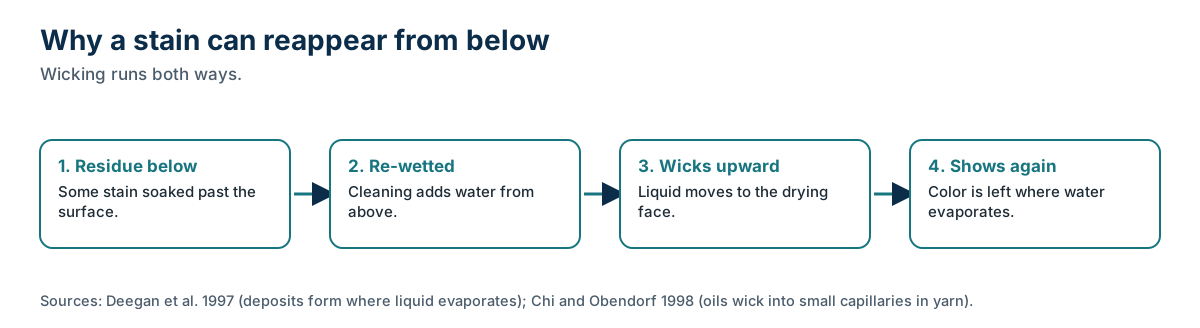
- Moisture moving through a material as it dries, carrying dissolved soil or stain with it. When the moisture evaporates at the surface, the stain can reappear on a fabric that looked clean.
- Lipid autoxidation:
- The slow reaction of unsaturated fats and oils with oxygen in air. On fabric, Chi and Obendorf's review links it to the yellowing of aged oily soils.
- Colorfastness:
- How well a dyed fabric keeps its color when it meets water, cleaners or bleach. Extension guides tell you to pretest any cleaning agent on a hidden area first to check it.
- Spot test:
- Trying a cleaning agent on a hidden area first and checking for color change or damage before treating the stain. Georgia Extension tells readers to always pretest each cleaning agent this way.
Mattress stains usually come back after drying because some of the stain was still there, just below the surface. As a mattress dries, water moves toward the face and the edge of the wet patch, where it evaporates, and it carries dissolved residue along. The edge part is what physicists call the coffee-ring effect. Too much water makes both worse, and some rings come from the fabric's own finish. Less water, center-out strokes and full drying help.
General information about stain chemistry, not medical advice.
What's actually happening when a stain reappears?
A mattress is thick. A spill soaks past the ticking into quilting fiber and sometimes foam, and surface cleaning reaches the top of that column, not the bottom. When you wet the area again to clean it, some of the leftover residue dissolves. As the area dries, water leaves from the top surface, so liquid keeps moving upward to replace it, carrying that residue to the face, where it's left behind.
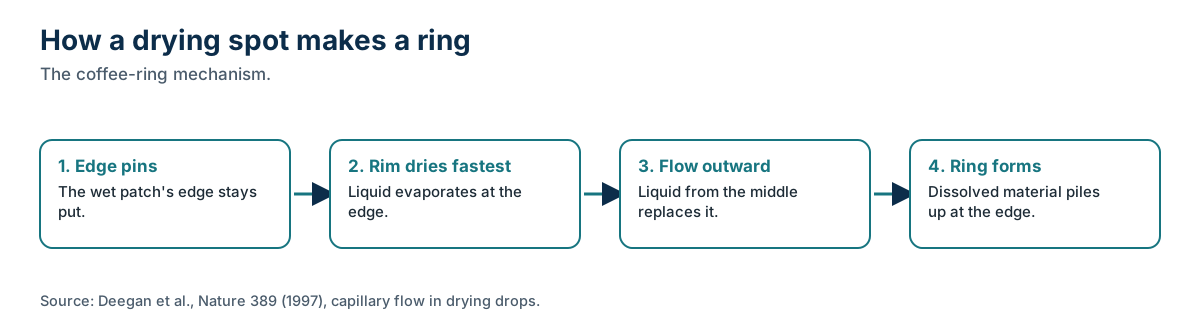
Researchers have studied the same pattern in drops. Deegan and colleagues found that rings form whenever "(1) the solvent meets the surface at a non-zero contact angle, (2) the contact line is pinned to its initial position as is commonly the case, and (3) the solvent evaporates." In their words, the outward flow "can carry virtually all the dispersed material to the edge." A cleaned spot on a mattress meets all three conditions.
Why do rings form at the edge?
The mechanism is capillary flow. Deegan's team explained that pinning the edge of a drying drop "ensures that liquid evaporating from the edge is replenished by liquid from the interior." The edge dries fastest, liquid from the middle flows out to replace it, and whatever is dissolved in that liquid piles up at the boundary. Their example was coffee, which "becomes concentrated into a tiny fraction" of the area it started in.
On fabric, the wet patch has an edge too. If you clean a spot and stop, the boundary of your wet area becomes a pinned edge, and residue collects there. That's why a cleaned spot can look worse than the original stain: a crisp outline where there used to be a soft blot.
Why can plain water leave a mark?
Because water dissolves whatever is already in the fabric. Deegan's team noted that ring deposits "are common wherever drops containing dispersed solids evaporate on a surface, and they influence processes such as printing, washing and coating." The material doesn't have to come from the spill. Everyday soil in a ticking, body oil, old residue from an earlier cleaning product or a fabric finish can all be picked up by water and carried to the edge of the damp patch.
That's why a clear spill, or a careful wipe with plain water, can still dry with a faint outline. It's also why a ring tends to appear on a mattress that hasn't been cleaned in a while, where there's more soil for water to move. The fix follows the same logic. Rather than adding more water to the ring, which can push it further out, the extension guides favor a damp cloth used from the center outward and feathered at the edge, so there's no single boundary for material to collect along.
Can the fabric itself make a ring?
Yes. Georgia Extension's upholstery advice warns that "Overwetting with water may cause the finish on the upholstery fabric to migrate and thus leave a circle in the treated area." Upholstery and ticking fabrics can carry finishes, and when water moves them, they can redeposit at the edge just as stain residue does. So a ring isn't always the stain coming back; sometimes it's water marking the fabric.
What reduces rings?
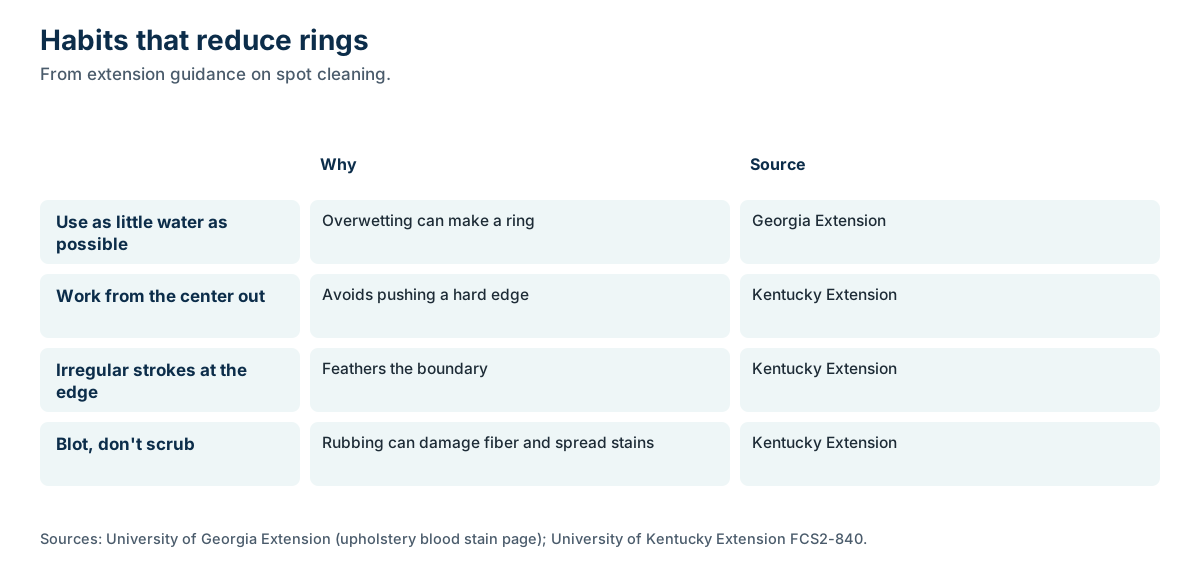
The extension guides agree on three habits. First, less water. Georgia's overwetting warning is the main reason. Second, technique: Kentucky Extension advises, "To avoid rings, work from the center out using irregular strokes around the edges." Feathering the edge avoids a single sharp boundary. Third, don't scrub. Kentucky cautions that excessive rubbing "may break the fiber, damage the finish, remove the color, or spread the stain."
| Habit | What it changes | Source |
|---|---|---|
| Use as little water as possible | Less residue dissolved, smaller wet area | UGA |
| Center-out strokes, irregular edges | No single pinned boundary | UKY |
| Blot instead of rubbing | Less fiber and finish damage | UKY |
| Avoid hot water on unknown stains | Protein stains can set | K-State, Iowa State |
| Dry fully, bed unmade | Moisture isn't trapped | EPA |
Kentucky adds one more rule that fits rings especially well: "Avoid using hot water on unidentifiable stains." A ring on a mattress is often a mix of old residues, some of which may be protein, so cool water is the safer default. It pairs with the drying advice below, because a cool, lightly dampened spot also dries sooner than a soaked one.
Is yellowing the same as a stain coming back?
Not quite. Oily stains can show up as yellow weeks or months later, without any re-wetting. Chi and Obendorf's review links that to oxidation of oils that have wicked into the yarn, and their squalene study found the yellow could return even after a bleach lightened it. That's chemistry happening in place rather than water moving residue, and it's covered in the sweat and yellowing article and the lotion and makeup article.
Urine has its own version of the comeback, including odor that returns when the area is damp again. Hub 3 covers that in why urine odor comes back after drying and how urine wicks into a mattress, so we link rather than repeat.
Why does drying matter so much?
Because a damp mattress gives residue more time to move, and moisture matters for more than stains. The EPA's brief guide starts from one principle: "The key to mold control is moisture control." It also notes that porous materials can be hard to clean once mold grows in them. So the safest habit is to leave the bed unmade until dry to the touch and then check with a moisture meter if you have one. Hub 5 explains how a mattress can feel dry on the surface but stay damp inside, and the compatibility guide covers moisture limits by material.
Sleep Sanitation's view
This section is our view. Rings and returning stains are one reason we're careful with moisture. Our Italian-made Vapor Clean machines give us control over how much moisture goes in, organic methods are the default, and every visit includes a moisture check, along with the built-in bed mite sensor. We still can't promise a stain won't show again, and we make no disinfection claim; the CDC's cleaning and sanitizing terms explain the difference. This is our own reasoning, not a manufacturer exemption. Your care label and warranty terms govern, so check your warranty terms before you book. See the pricing page for prices, or browse the stain chemistry hub.
What we don't know
- How deep a typical spill travels in each kind of mattress before it's cleaned. We found no measurements.
- How often a returning ring is stain residue versus a migrated fabric finish. Both are possible, and they can look the same.
- Whether the drop-scale physics Deegan measured on flat surfaces applies cleanly to thick, layered fabric.
Changelog
- 5 October 2026: First published. Sources accessed on this date.
Sources
- Capillary flow as the cause of ring stains from dried liquid drops (Deegan et al., Nature, 1997) · Nature
- Stain Removal for Washable Fabrics (FCS2-840) · University of Kentucky Cooperative Extension
- Remove Stains from Blood (accessed 2026-10-05) · University of Georgia Extension, Textiles
- Aging of oily soils on textile materials: a literature review (Chi and Obendorf, J Surfactants Deterg, 1998) · Journal of Surfactants and Detergents (DOI)
- Preventing discoloration of squalene-soiled cotton fabrics with antioxidants (Chi and Obendorf, J Surfactants Deterg, 1998) · Journal of Surfactants and Detergents (DOI)
- A brief guide to mold, moisture and your home · US EPA
- Holiday Stains (AnswerLine, 13 Dec 2022) · Iowa State University Extension and Outreach
- Stain Removal (accessed 2026-10-05) · K-State Research and Extension, Greenwood County
- Cleaning and disinfecting your school (definitions) · CDC
Last reviewed October 5, 2026. Manufacturer specifications and care instructions change; check the current version for your exact model. This page is general information, not medical advice. How we source and check pages: editorial standards.