
Short answer
Strip the bed, take off the cover if it zips, and press dry towels into the spot until no more moisture comes up. Tempur-Pedic says its material should never become wet and that it can't promise a stain or odor will fully come out. A fresh dog accident caught at the surface is often treatable; one that soaked the foam is harder.
Key terms used on this page
- Wicking (urine migration):
- Liquid moving through and along fabric and foam by capillary action, so the affected area below the surface is often wider than the visible stain. Quilting, fiber batting and open-cell foam all wick. It is why a spot can look small and still smell from a wider area.
- Enzyme cleaner:
- A cleaning product that uses enzymes to break down organic soils such as urine, sweat, vomit or blood. Several mattress makers mention them for urine stains, including Purple and Avocado. They are liquids, so how much is applied matters as much as what is applied. Sleep Sanitation uses enzyme treatment on urine and organic odor, sparingly.
- Memory foam (viscoelastic foam):
- An open-cell, slow-recovery polyurethane foam that softens with body heat and conforms to pressure. Because its cells are open, liquid can travel into it, and because it is dense and insulating, it is slow to dry.
- Drying window (EPA):
- The EPA's mold and moisture guide advises drying wet materials within 24 to 48 hours, and says that in most cases mold won't grow if you do. That is the public-health reason behind the drying instructions manufacturers give.
- Reading your label and warranty:
- A brand's web page is general; the sewn-in label and care tag speak for your model. Before any cleaning: find the care tag and law label, usually at the foot or along a side seam; keep your receipt and warranty together and read any clause on liquids, stains or cleaning; note which of the six variables the label names (water, soaking, heat, steam, chemicals, cover); and if the label or warranty says more than the web page, follow it, tell your cleaner before a visit, and ask the manufacturer if you're unsure.
- Saturated core:
- A mattress whose interior layers, not just the cover and quilting, were soaked by a large accident or several in one place. Surface treatment can't reach all of it. Some saturated cores improve with treatment and drying; some don't, and we say so before charging for work that won't help.
Dogs have accidents on beds for ordinary reasons: a puppy still learning, an older dog with weaker control, a nervous dog during a storm. When the bed is a Tempur-Pedic, the stakes feel higher, partly because of the price and partly because Tempur's care page is unusually direct about liquid.
Not affiliated with or endorsed by any manufacturer listed. Brand names are used only to identify products and their published care instructions.
The next ten minutes
Speed matters more than product choice. Do these in order:
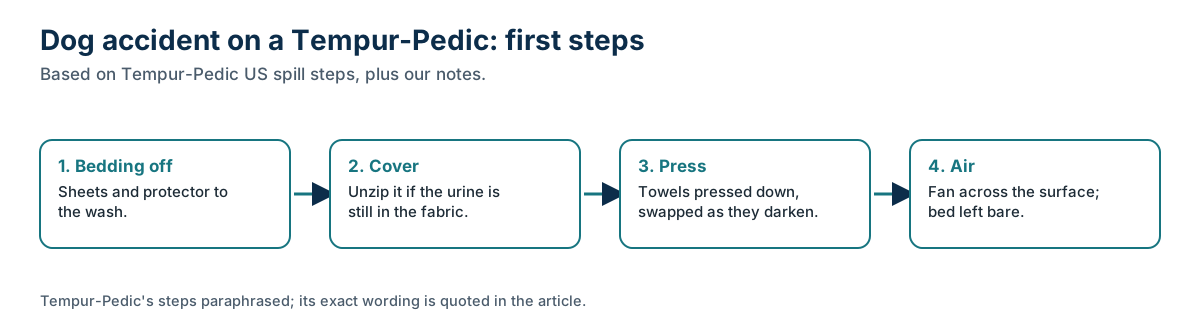
- Pull the bedding. Sheets, protector and any topper go to the wash.
- Check the cover. Many Tempur-Pedic covers unzip. If yours does and the urine is still in the fabric, removing the cover can stop it moving into the foam.
- Press, don't rub. Lay a dry towel over the spot and press with your palms or knees. Swap towels as they darken.
- Leave it open. Point a fan across the surface and leave the bed bare.
Tempur-Pedic's US care page describes the same approach for spills. Its blotting step says: "This may require pressing down on the material with the towel(s) to release the moisture." It then tells owners to let the material air dry and suggests a fan.
What Tempur-Pedic says about liquid
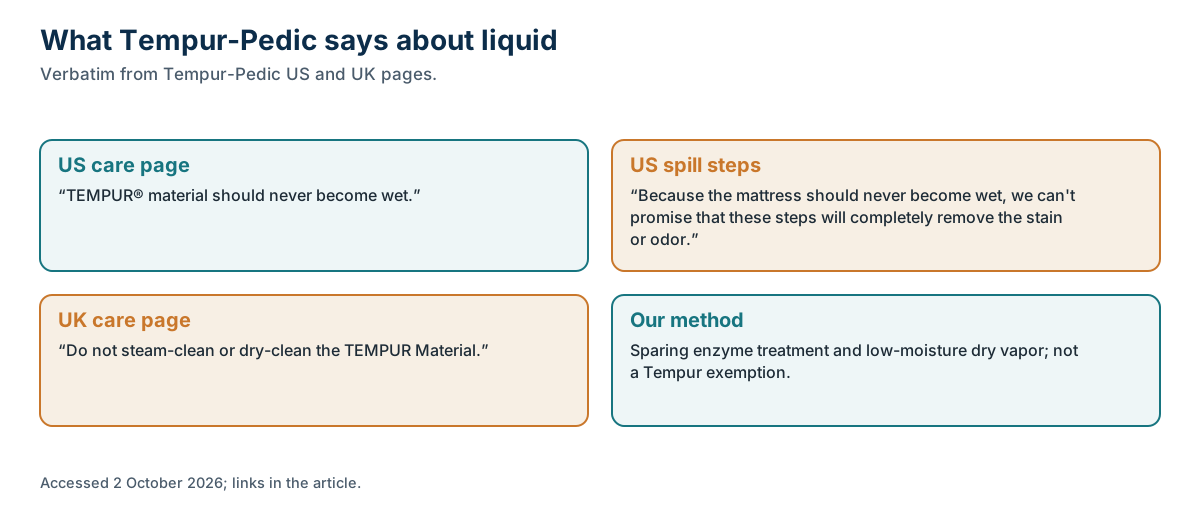
Two lines from Tempur's own pages set the frame for everything else. The US page says: "TEMPUR® material should never become wet." And at the end of its spill steps it adds: "Because the mattress should never become wet, we can't promise that these steps will completely remove the stain or odor."
Tempur's UK site is stricter about cleaning methods, and its warning covers damage and the guarantee in one passage. The UK care page says: "There is a high risk that soaking with water or other cleaning fluids will cause irreversible damage, destroying the benefits of comfort and support which the TEMPUR ® Material provides. It will also invalidate your guarantee. Do not steam-clean or dry-clean the TEMPUR ® Material." Read that with a dog accident in mind. Pouring water or cleaner onto the spot to rinse it is exactly the soaking the page describes, so in the first hour, pressing towels in and keeping liquid out is the part you control.
We read those as the manufacturer's rules, not suggestions. The full set of Tempur quotes, with dates and links, is in our Tempur-Pedic cleaning guide.
Why dog urine is harder on this kind of foam
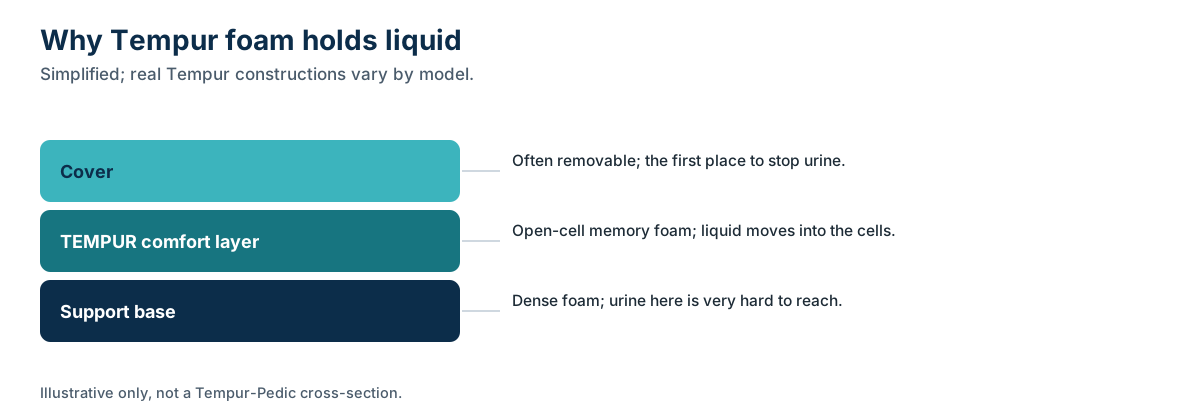
Tempur material is a memory foam, and memory foam has an open-cell structure. Liquid that gets past the cover moves into the cells instead of beading on top. Once it's there it dries slowly, because air has to work its way through the same cells. Our article on water in memory foam explains the mechanics, and the memory foam compatibility page covers what other foam makers say.
Urine also changes as it sits. Bacteria with the enzyme urease break down urea, the main compound in urine, into ammonia. A review in Microbiological Reviews summarizes it in one line: "Microbial ureases hydrolyze urea to ammonia and carbon dioxide." That's why an accident that smelled mild on day one can smell sharp on day three.
Dog urine isn't one fixed thing either. The Carpet and Rug Institute's bulletin notes that urine content changes with a pet's diet, medications, age, health, sex and reproductive cycles. An older dog on medication may leave a different stain from a puppy.
Bacteria in old dog urine are why we talk about cleaning rather than sanitizing; Hub 2 defines the CDC's three terms.
What not to do
- Don't soak it. The instinct is to flood the spot with cleaner and scrub. On Tempur foam that pushes urine deeper and leaves the bed wet for days.
- Don't spray fragrance. It covers the smell for a while, and the CRI notes masked odor can come back when the air turns humid.
- Don't reach for a household steam cleaner. Tempur UK says not to steam-clean its material.
- Don't flip the bed onto the wet side. It traps the moisture against the base.
How we treat a Tempur-Pedic after a dog accident
This is our method and our reasoning, not Tempur-Pedic's guidance, and it isn't a manufacturer exemption. Sleep Sanitation does clean Tempur-Pedic beds, using quick, repeated low-moisture dry-vapor passes. Your care label and warranty terms govern your own decision; check your warranty, or contact Tempur-Pedic, before any steam or vapor cleaning.
We start by finding how far the urine went. We check the cover, the edges of the stain and the foam surface, and we smell the area in a wider circle than the visible mark. On a Tempur bed we work with the cover off where it unzips.
On a Tempur bed, we lay down a light enzyme treatment over the urine only, wait out its dwell time, and then follow with dry vapor at low output from a Magnum XP, ProV 350 or Pro6 Duo. Nothing is poured to chase the urine into the TEMPUR layer. Vapor Clean says the Magnum XP's vapor carries "just 5-6% moisture," its claim rather than our measurement; what matters to us is that the cover dries quickly. How much moisture dry vapor uses covers the numbers, and heat and moisture are separate variables explains why low moisture doesn't mean low heat.
A dog accident like this is part of our standard price; severe, biohazard or extensive contamination is quoted separately first. See the accident cleanup service page.
What results to expect
A fresh accident, blotted early, on a bed with a removable cover often clears well. The smell drops away and the foam surface stays dry.
An accident that sat overnight and reached the foam usually improves a lot, but a faint odor can return on humid days. A big dog, a full bladder and no towels for hours can saturate the comfort layer. A saturated core in memory foam may not be fully recoverable, and we'll tell you that before we start rather than after.
If the accident went deeper than the cover, what happens when urine soaks into a mattress traces it layer by layer, and why odor comes back after drying explains a smell that returns on a humid night.
Drying afterwards
The EPA's mold guidance advises drying wet materials within 24 to 48 hours. That's the reason to keep cleaning liquid to a minimum on foam. As field guidance, not a measurement: a bed that was only damp at the top dries to the touch much sooner than one that was soaked. If you did a lot of blotting with water before we arrived, it will take longer. How long a mattress should take to dry has more on this.
Preventing the next one
- A waterproof protector is the single best defense. Wash it on the schedule the maker gives.
- Keep the cover zipped and in place; it's the first barrier.
- If your dog is suddenly having accidents, talk to your vet. New incontinence can be a health sign, not just a training lapse.
- If the dog sleeps on the bed, a washable blanket on top makes blotting much easier.
Other brands and materials
If your bed isn't a Tempur-Pedic, the same principles hold, but the rules differ by brand. Which materials are most moisture-sensitive ranks them, and the urine and odor guide covers what can and can't be removed.
If you can't remove the cover
Some Tempur-Pedic models have covers that don't come off, or that you'd rather not wrestle off a heavy bed alone. In that case, blot through the cover with extra pressure and more towels, and keep the fan running longer. Don't spray anything through the fabric to "flush" it.
What we don't know
- How your specific Tempur model and warranty treat liquid damage. Check your warranty.
- Whether any named enzyme product has been tested on Tempur material. We haven't found published results.
- How deep an accident went until we've looked at it.
Changelog
- 2 October 2026: First published. Sources accessed on this date.
Sources
- Product care (US, accessed 2026-10-02) · Tempur-Pedic
- Caring for your TEMPUR (UK, updated 11 July 2023, accessed 2026-10-02) · Tempur UK
- Pet Urine and Carpet (technical bulletin, revised 27 July 2017, accessed 2026-10-02) · Carpet and Rug Institute
- Composition and Concentrative Properties of Human Urine (NASA contractor report, July 1971) · NASA
- Microbial ureases: significance, regulation, and molecular characterization (Mobley and Hausinger, Microbiol Rev, 1989) · PubMed Central
- A brief guide to mold, moisture and your home · US EPA
- Cleaning and disinfecting your school (definitions) · CDC
- Magnum XP-Vac product page (maker's claims, accessed 2026-10-02) · Vapor Clean
- ProV 350 product page ('Italian Made'; maker's claims, accessed 2026-10-02) · Vapor Clean
- Pro6 Duo product page ('Made in Italy'; maker's claims, accessed 2026-10-02) · Vapor Clean
Last reviewed October 2, 2026. Manufacturer specifications and care instructions change; check the current version for your exact model. This page is general information, not medical advice. How we source and check pages: editorial standards.