
Short answer
We use them in sequence: a sparing enzyme application first, given its dwell time, then low-moisture dry-vapor passes. Enzyme cleaners are made to break down organic soils such as urine; Purple and Avocado both name them for urine. Dry vapor handles the surface and helps it dry. Neither one reaches a soaked core, and neither replaces checking your mattress label first.
Key terms used on this page
- Enzyme cleaner:
- A cleaning product that uses enzymes to break down organic soils such as urine, sweat, vomit or blood. Several mattress makers mention them for urine stains, including Purple and Avocado. They are liquids, so how much is applied matters as much as what is applied. Sleep Sanitation uses enzyme treatment on urine and organic odor, sparingly.
- Dwell time (enzyme products):
- How long a cleaning product stays on a surface before it is removed or dried. Enzyme products need dwell time to work, and the label sets it. Longer dwell does not mean more liquid: on a mattress we keep the amount small so the foam underneath doesn't soak.
- Dry-vapor steam:
- Steam made in a sealed, pressurized boiler and released through a hose and nozzle as hot vapor with a low liquid-water content. In the vendor specifications we reviewed, professional units are rated from 80 psi (Ladybug 2350) to 150 psi (Daimer), with stated boiler temperatures from about 345°F (Optima) to 360°F (Daimer); these are maker claims. Daimer describes its steam as about 5% water or less and Vapor Clean claims 'just 5-6% moisture'; that is a vendor claim, not an independent standard.
- Adjustable steam output:
- A control on some commercial steam machines that sets how much steam reaches the tool. For example, Vapor Clean describes its Magnum XP (with vac) as having a 'Fully Adjustable Steam Regulator' and a 'Pressure Regulator 0 - Full Range' (maker's claims). We don't publish settings; the technician chooses them for the material.
- Pass speed:
- How fast the steam tool moves across the fabric. A faster pass gives the fabric less time under the tool, so less heat and less condensed water reach any one spot. Purple's general guide makes the same point for home steamers: move 'without leaving it in one spot for too long.'
- Organic cleaning methods:
- Sleep Sanitation's default approach: heat from low-moisture dry vapor, physical removal with vacuuming, and enzyme treatment where urine or organic odor is present. 'Organic' here describes the method, not a certification.
This is the method behind most of our urine and odor work. It's not complicated, but the order matters, and so does how little liquid goes in. Here's what each step does, why it comes where it does, and where the method runs out.
Not affiliated with or endorsed by any manufacturer listed. Brand names are used only to identify products and their published care instructions.
Two tools, two jobs
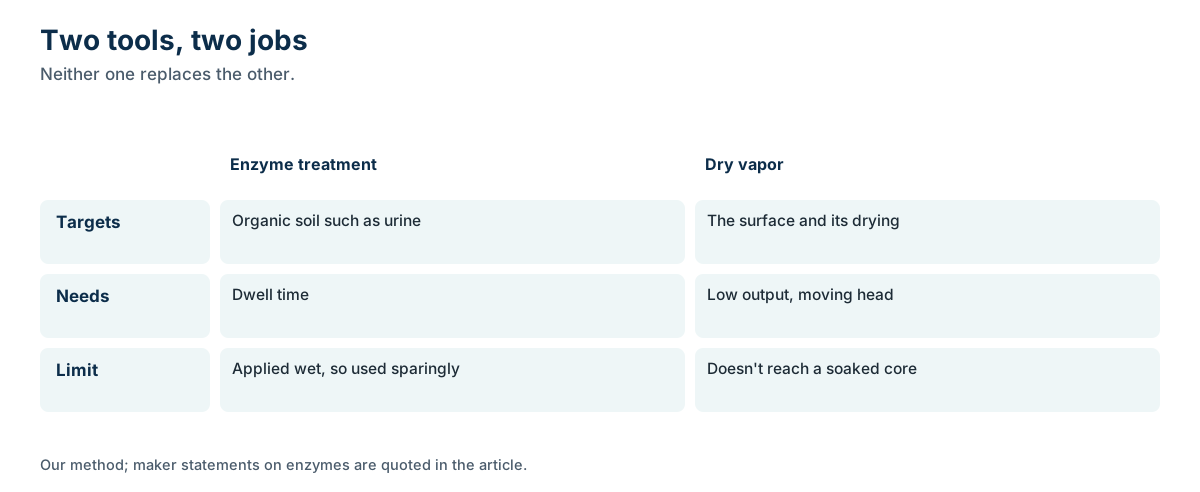
Enzyme treatment is for the urine itself (our Purple page quotes that maker's full stain advice). An enzyme cleaner contains enzymes chosen to break down organic soils. Manufacturers point owners toward them: Purple's care guide says "Urine, vomit, or sweat stains may require an enzyme cleaner or hydrogen peroxide," and Avocado's help center says "To remove urine from a mattress, you'll need a good enzymatic cleaner."
Dry vapor is for the surface. It's low-moisture steam from a boiler, applied with a moving tool head. Vapor Clean says its Magnum XP produces vapor with "just 5-6% moisture" (maker's claim, not our measurement). The heat works on the cover and upper layers, and the low moisture means the surface dries fast.
Neither tool does the other's job. Heat alone doesn't break urine down; an enzyme alone leaves a damp surface to dry on its own.
Neither tool is a sanitizing claim; the CDC's cleaning-versus-sanitizing distinction is set out in Hub 2.
The order, step by step
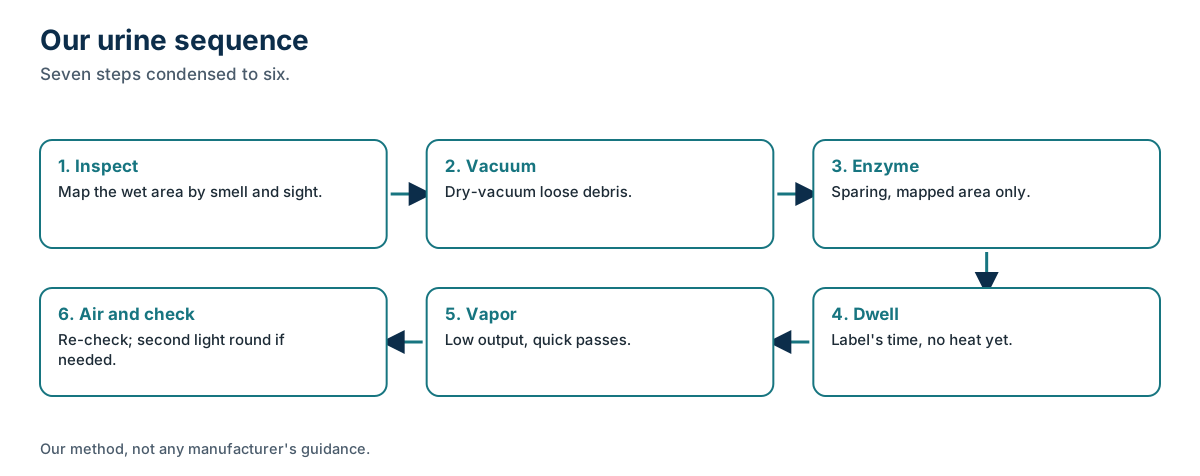
- Inspect and map. We find the edges of the affected area by smell and sight, including the sides of the bed. The visible stain is usually smaller than what got wet.
- Dry-vacuum the surface. Loose debris and hair come off first, so the enzyme reaches the stain.
- Apply enzyme, sparingly. Only on the mapped area, only enough to dampen it. We don't pour to chase urine into the core.
- Wait out the dwell time. Enzymes need time in contact with the soil. The product label sets it, and we follow it.
- Blot. We lift what we can from the surface.
- Dry-vapor passes. Low steam output, quick pass speed, several light passes with drying time between, not one long one.
- Air and check. We move air across the area and re-check the smell. If a second round would help, we do it then.
Why the enzyme goes first
Two reasons.
First, dwell time. An enzyme product needs time in contact with the soil, and the label sets how long. Running vapor over the area straight away would dry it early and cut that working time short. So the enzyme gets its full time before any heat, and we don't treat the label's time as optional.
Second, heat on an untreated stain is a known worry. PetMD's cat urine guide warns: "Don't use a steam cleaner, as the heat can set the stain." That's written about household steam cleaners on carpet, but it's a good reason to treat urine before applying heat, not after.
Why sparingly matters
An enzyme product is a liquid. Foam makers warn about liquid in their beds, and they mean all liquid. Purple's guide, for example, separates innerspring and hybrid beds, which it says can be steam cleaned, from memory foam, latex and adjustable beds, which it says should not be. Tempur's UK care page goes further, tying soaking to damage and to its guarantee before it mentions steam: "There is a high risk that soaking with water or other cleaning fluids will cause irreversible damage, destroying the benefits of comfort and support which the TEMPUR ® Material provides. It will also invalidate your guarantee. Do not steam-clean or dry-clean the TEMPUR ® Material."
Even so, foam beds still get dry vapor from us, as quick, repeated low-moisture passes once the enzyme has finished its dwell. We chose that on our own reasoning; it is Sleep Sanitation's method, not a manufacturer exemption and not a reading of these labels. The care label and warranty terms on your bed govern your decision, so check your warranty, or ask the maker, before booking.
So the enzyme goes on in the smallest amount that covers the stain. If the urine went deep, we'd rather do a second light round than soak the foam once. Moisture load adds up across every step, and our Hub 1 article on moisture explains how little dry vapor itself contributes.
Why dry vapor comes after
Once the enzyme has worked, dry vapor does three useful things. It works the surface fabric with heat. It warms the area so leftover moisture leaves faster. And it does both without rinsing, so no new water goes into the layers.
Heat and moisture are separate variables. We want the first at the surface and as little of the second as possible. On memory foam and latex, that means turning output down and keeping the head moving; our latex page explains why latex makers are cautious about heat. Avocado's help center, for example, says: "Steam cleaners are not recommended because their excessive heat can over-bake the organic latex."
Organic methods by default
Organic cleaning methods are our default. In practice that means relying on heat, vacuuming and enzyme treatment instead of reaching for harsher chemistry. We name no products here, because the right one depends on the soil and the label rules of your mattress, and we don't make claims about formulas we haven't seen tested on your bed.
Where the method stops working
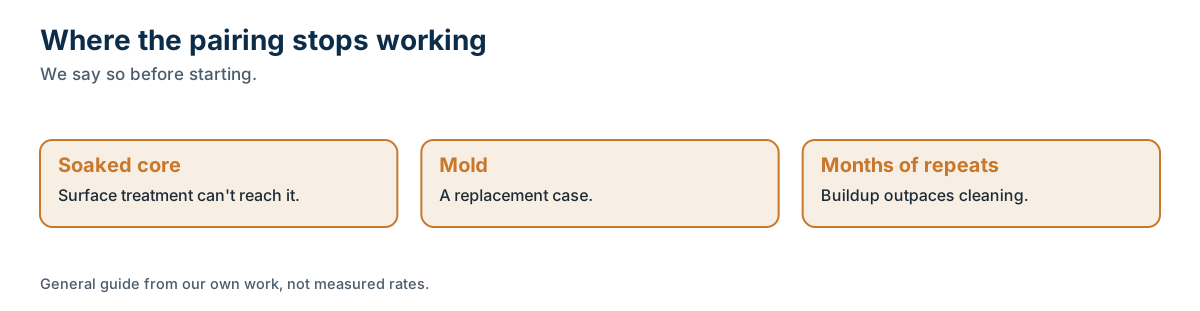
The pairing works on what it can reach. It can't fix:
- A soaked core. A saturated core holds more urine than surface treatment can address, and may not be fully recoverable.
- Mold. That's a replacement case.
- Months of repeated accidents in one spot.
We'll tell you if we think yours falls into one of those groups. The CRI's pet urine bulletin is candid about the same limit on carpet: "Because of these variations, some urine stains may not be removable."
Equipment and price
We use three Italian-made Vapor Clean machines: the Magnum XP, ProV 350 and Pro6 Duo. Which one we bring depends on the job, but on urine work the settings matter more than the model.
The pairing described here costs nothing beyond the standard price when the accident is an ordinary one. For severe, biohazard or extensive contamination, we give you a surcharge quote before starting; see the accident cleanup service.
After we leave
Drying time depends on the bed and the room; as field guidance, check that the surface is dry to the touch before making the bed. Leave it uncovered until then, keep air moving, and avoid putting a protector on while it's still cool or damp. The EPA's mold guide advises drying wet materials within 24 to 48 hours, and sparing application is how we stay well inside that.
How this compares with the usual home method
The common home method for urine on a mattress is to soak the stain with a cleaner, cover it, and leave it overnight. It gives the product plenty of dwell time, which is its strength. Its weakness is that it also gives the foam plenty of liquid, for many hours, with no airflow. Our version keeps the dwell time and drops the soak: a smaller amount, a mapped area, a set contact time, then heat and air to dry it. On a bed whose maker warns about liquid, that trade matters.
If you're treating at home before we arrive, the same principle applies on a small scale: mist, wait, blot, air. Don't cover the area with plastic, and don't pour a second dose on top of the first.
Our mattress urine pillar guide places this pairing in the wider method. Can enzyme cleaner damage memory foam? addresses the foam question, and can dry vapor remove urine odor? covers what heat adds.
A note on the word "organic"
We use "organic" here in its cleaning sense, meaning methods built on heat, vacuuming and biological products rather than harsh chemistry, not as a certification claim.
What we don't know
- How a specific enzyme product performs on your specific foam. Makers rarely publish this.
- Whether your mattress maker would treat this method differently from steam cleaning. Most don't address dry vapor; check your warranty.
- How deep the urine went until we've looked.
Changelog
- 2 October 2026: First published. Sources accessed on this date.
Sources
- How To Clean a Mattress in 9 Steps (last updated 16 Oct 2025, accessed 2026-10-02) · Purple
- How to Clean Your Natural Mattress Without Using Harsh Chemicals (25 June 2026, accessed 2026-10-02) · Avocado
- Pet Urine and Carpet (technical bulletin, revised 27 July 2017, accessed 2026-10-02) · Carpet and Rug Institute
- How To Get Rid of Cat Pee Smell (accessed 2026-10-02) · PetMD
- Microbial ureases: significance, regulation, and molecular characterization (Mobley and Hausinger, Microbiol Rev, 1989) · PubMed Central
- Caring for your TEMPUR (UK, updated 11 July 2023, accessed 2026-10-02) · Tempur UK
- Magnum XP-Vac product page (maker's claims, accessed 2026-10-02) · Vapor Clean
- ProV 350 product page ('Italian Made'; maker's claims, accessed 2026-10-02) · Vapor Clean
- Pro6 Duo product page ('Made in Italy'; maker's claims, accessed 2026-10-02) · Vapor Clean
- A brief guide to mold, moisture and your home · US EPA
Last reviewed October 2, 2026. Manufacturer specifications and care instructions change; check the current version for your exact model. This page is general information, not medical advice. How we source and check pages: editorial standards.