
Short answer
Because they do different things and come from different parts of a cleaning method. Heat is what affects mites, microbes and heat-sensitive materials; moisture is what drives mold risk, foam damage, wicking and drying time. A method can be hot and wet (hot-water extraction), hot and low-moisture (dry-vapor steam), cool and wet (shampoo or spot cleaning), or neither (vacuuming). Judging a method on one variable alone gives the wrong answer.
Key terms used on this page
- Boiler temperature vs surface temperature:
- Boiler temperature is the temperature of steam inside the machine. Surface temperature is what the mattress fabric actually reaches. Surface temperature is always lower and depends on nozzle distance, pass speed, fabric and the tool, and manufacturers rarely publish it.
- Dwell time:
- How long heat or a cleaning product stays in contact with a given spot. Heat-related lab results are reported as a temperature held for a time, so a temperature figure without a dwell time is incomplete.
- Latent heat (condensation):
- The energy steam releases when it condenses back into water, about 2,257 kJ per kilogram at atmospheric pressure and somewhat less at higher boiler pressures (about 2,048 kJ/kg at 7 bar gauge). It is why steam heats a surface quickly, and why steam that heats a surface always leaves some condensed water behind.
- Moisture load:
- The total amount of water a cleaning process puts into a mattress, whether from spray, steam condensate, shampoo or rinse. It is the main thing that decides how long a mattress takes to dry.
- Der p 1:
- One of the main dust mite allergens, a protein carried mostly on mite fecal particles. It is the allergen most often measured in mattress and carpet studies. It is stable enough that removing it matters as much as killing live mites.
- Memory foam (viscoelastic foam):
- An open-cell, slow-recovery polyurethane foam that softens with body heat and conforms to pressure. Because its cells are open, liquid can travel into it, and because it is dense and insulating, it is slow to dry.
Heat and moisture have to be considered separately because they do different things to a mattress and come from different parts of a cleaning method. Heat is what affects dust mites, microbes and heat-sensitive materials. Moisture is what drives mold risk, foam damage, wicking stains and drying time. A method can be hot and wet (hot-water extraction), hot and low-moisture (dry-vapor steam), cool and wet (shampoo or spot cleaning), or neither (vacuuming). If you judge a method on one variable alone, you'll get the wrong answer.
Marketing tends to fold the two into one word, "steam," and that hides the trade-off that matters most for a mattress. The flagship guide uses this split to compare all four common methods, and the Cleaning Methods hub defines heat terms such as dwell time and latent heat.
The four combinations
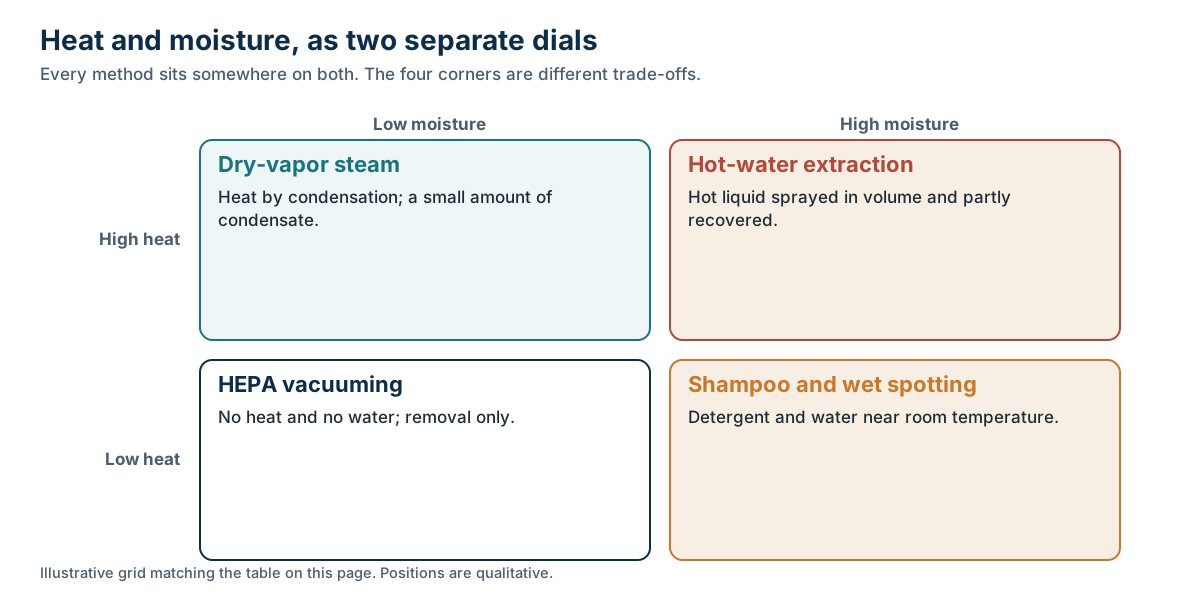
| Low moisture | High moisture | |
|---|---|---|
| High heat | Dry-vapor steam: heat delivered by condensation, small amount of condensate | Hot-water extraction: heat delivered by hot liquid, large volume sprayed and partly recovered |
| Low heat | HEPA vacuuming: no heat, no water | Shampooing and wet spot cleaning: detergent and water at or near room temperature |
Each corner has a different set of strengths and risks. Hot and wet is good at flushing soluble soil but adds the most water. Hot and low-moisture delivers heat with less water but doesn't flush. Cool and wet adds water without much heat benefit. Cool and dry removes loose particles but doesn't treat anything in place.
Why "hot" doesn't mean "wet"
People often assume a hotter method must be a wetter one, because both involve water. The physics says otherwise.
Hot water delivers heat by carrying it: to deliver more heat, you need more water, or hotter water, or both. Steam delivers most of its heat as latent heat, released when vapor condenses. According to standard steam tables, that's about 2,257 kJ per kilogram at atmospheric pressure, compared with about 335 kJ to heat a kilogram of water from room temperature to boiling. So a gram of condensing steam delivers several times more heat than a gram of hot water cooling down.
The practical result is that dry-vapor steam can put a lot of heat into a surface with a small moisture load, while extraction needs a large volume of water to deliver its heat. A Sapphire 370ss truckmount, for example, is rated at up to 250°F and up to 3.4 gallons per minute.
The temperature that matters is at the fabric, for a time
There are three different temperatures in any heat-based cleaning, and only the last one matters biologically:
- The machine temperature. For steam, this is the boiler: makers state from about 345°F (Optima) to 360°F (Daimer), as their own claims.
- The tool temperature. Steam cools as it leaves the nozzle. Optima, one of the few makers to publish both, lists about 175°C in the boiler and 120°C to 135°C at the gun tip, per the Steamericas model chart.
- The material temperature. How hot the ticking or a mite in the fabric actually gets, which depends on distance, pass speed, the tool and the fabric.
That's the difference between boiler temperature and surface temperature. We haven't found published measurements of the third number for mattresses.
Then there's time. Every biological heat threshold is a temperature held for a dwell time:
| Target | Temperature and time reported | Source |
|---|---|---|
| Dust mites in water | All killed at 55°C (131°F) or hotter during washing | McDonald & Tovey, 1992 |
| Dust mite eggs, dry heat | About 80% survived 40°C; at 60°C to 70°C death was almost instantaneous | Mahakittikun et al., 2011 |
| Der p 1 allergen | About 30 minutes at 120°C of dry heat to denature | AAAAI/ACAAI practice parameter |
| Der p 2 allergen | 140°C for 30 to 60 minutes | AAAAI/ACAAI practice parameter |
Two conclusions follow. Mites and eggs are vulnerable to temperatures a steam tool can plausibly produce at the surface, if the heat reaches them. But mite allergen such as Der p 1 needs far more heat for far longer than any cleaning pass provides, so allergen has to be removed, not cooked. That's why vacuuming matters after steam. See HEPA vacuuming vs steam vs extraction.
Heat doesn't travel deep into foam quickly
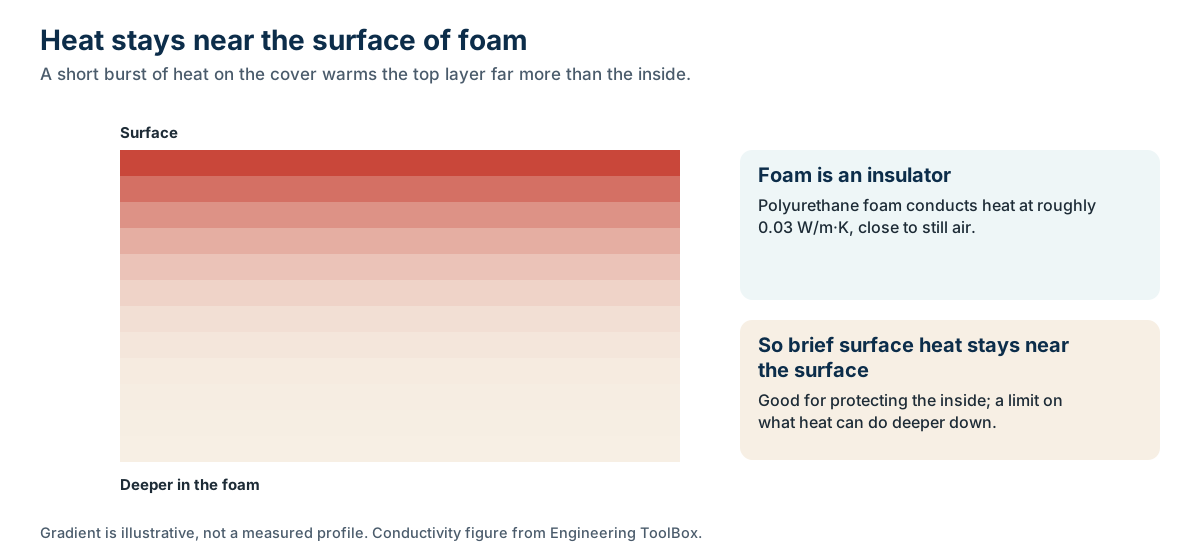
Foam is an insulator. Polyurethane foam conducts heat at roughly 0.03 W/m·K, according to Engineering ToolBox, which is close to still air. Heat applied briefly at the surface stays mostly near the surface. That's good for protecting the inside of a mattress from heat, and a limit on what surface heat can achieve deeper down.
The one study we've found that heat-treated whole mattresses, Htut et al. (2001), used a specialized process of hot air at 110°C, steam, then heat, which is very different from an in-home cleaning pass.
Moisture has its own consequences
Moisture's effects don't depend on whether the water is hot or cold. Water left in a mattress has to dry, and the EPA says wet materials should be dried within 24 to 48 hours to prevent mold in most cases. Hot water doesn't dry noticeably faster once it has cooled inside the foam, and it cools quickly. The full picture is in why moisture matters when cleaning a mattress.
Heat has its own risks too
Heat can damage materials that moisture wouldn't. Purple says not to steam clean memory foam, latex or adjustable mattresses "since the heat and water could damage its materials," and not to steam clean a Purple mattress at all. Note that Purple names both variables. Some natural fibers, gels and electronic components are also heat-sensitive. A low-moisture method isn't automatically a safe method if it concentrates heat in one place. Tempur UK says "Do not steam-clean or dry-clean the TEMPUR Material." and warns "There is a high risk that soaking with water or other cleaning fluids will cause irreversible damage"; "It will also invalidate your guarantee." Tempur-Pedic US names heat directly: "Due to the temperature-sensitivity of the TEMPUR-material, adding high heat can hinder its ability to react to your body temperature and conform to your body shape." So both brands advise against steam, and the label is the safe default. Sleep Sanitation does clean those brands, as our own choice, and when we do we manage each variable separately: low moisture from the steam (Vapor Clean's product page claims "just 5-6% moisture," a maker claim, not a measurement of our equipment), and quick, repeated passes so heat doesn't dwell on one spot. That is our approach and reasoning, not a manufacturer exemption; see what happens when water penetrates memory foam? for more, and check your warranty terms.
How to use this idea when comparing services
When a company describes its method, ask two separate questions:
- How much heat reaches the fabric, and for how long? A boiler temperature alone doesn't answer that.
- How much water stays in the mattress, and how is it controlled? "Dry" or "low-moisture" alone doesn't answer that.
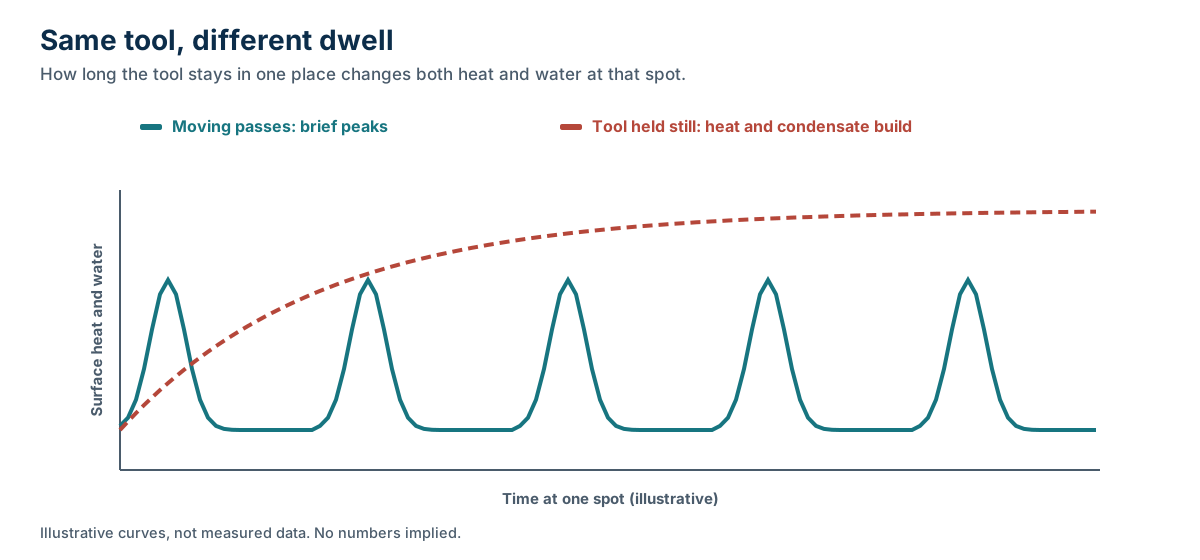
Sleep Sanitation designs its process around both variables: our Vapor Clean equipment for heat with a low moisture load, kept moving to avoid hot spots, and a heated UV-C vacuum to remove what's loosened. The order of steps is on our process page, and when you're ready you can choose a time.
What we don't know
- Fabric temperatures during cleaning. We haven't found published measurements of mattress surface temperature under any steam or extraction tool.
- Heat depth. We haven't found data on how far a brief steam pass warms the layers below the ticking.
- Mattress outcome trials. The mite heat thresholds above come from washing and lab studies, not in-home mattress cleaning.
Sources
- Saturated steam properties · Engineering ToolBox
- Optima Steamer model comparison chart · Steamericas
- McDonald & Tovey (1992), washing temperature and dust mites · Journal of Allergy and Clinical Immunology
- Mahakittikun et al. (2011), heat and dust mite eggs · Experimental and Applied Acarology
- Dust mite practice parameter (Portnoy et al., 2013) · AAAAI-ACAAI
- Thermal conductivity of common materials · Engineering ToolBox
- Sapphire 370ss truckmount specifications · Hi-Pressure Cleaning Systems
- How to clean a mattress · Purple
- A brief guide to mold, moisture and your home · US EPA
- Htut et al. (2001), heat treatment of mattresses and asthma · Journal of Allergy and Clinical Immunology
Last reviewed October 2, 2026. Manufacturer specifications and care instructions change; check the current version for your exact model. This page is general information, not medical advice. How we source and check pages: editorial standards.