
Short answer
Not by the manufacturers' rules: the brands we checked advise against steaming memory foam. Purple says not to steam it because 'the heat and water could damage its materials'; Tempur UK says not to steam-clean TEMPUR Material; Tempur-Pedic US says it 'should never become wet'; Saatva warns bleach can damage it. None mentions dry-vapor steam. The label is the safe default; our low-output, fast-pass method is our own, not a manufacturer exemption, so check your warranty terms.
Key terms used on this page
- Memory foam (viscoelastic foam):
- An open-cell, slow-recovery polyurethane foam that softens with body heat and conforms to pressure. Because its cells are open, liquid can travel into it, and because it is dense and insulating, it is slow to dry.
- Gel-infused (cooling gel) foam:
- Memory foam or polyurethane foam with gel beads, swirls or a gel layer added, marketed for cooling. It is still foam, so the cautions makers give for foam generally apply. We found no manufacturer care page that gives gel foam its own cleaning rule.
- Moisture load:
- The total amount of water a cleaning process puts into a mattress, whether from spray, steam condensate, shampoo or rinse. It is the main thing that decides how long a mattress takes to dry.
- Dry-vapor steam:
- Steam made in a sealed, pressurized boiler and released through a hose and nozzle as hot vapor with a low liquid-water content. In the vendor specifications we reviewed, professional units are rated from 80 psi (Ladybug 2350) to 150 psi (Daimer), with stated boiler temperatures from about 345°F (Optima) to 360°F (Daimer); these are maker claims. Daimer describes its steam as about 5% water or less and Vapor Clean claims 'just 5-6% moisture'; that is a vendor claim, not an independent standard.
- Adjustable steam output:
- A control on some commercial steam machines that sets how much steam reaches the tool. For example, Vapor Clean describes its Magnum XP (with vac) as having a 'Fully Adjustable Steam Regulator' and a 'Pressure Regulator 0 - Full Range' (maker's claims). We don't publish settings; the technician chooses them for the material.
- Pass speed:
- How fast the steam tool moves across the fabric. A faster pass gives the fabric less time under the tool, so less heat and less condensed water reach any one spot. Purple's general guide makes the same point for home steamers: move 'without leaving it in one spot for too long.'
Memory foam is the material manufacturers are most cautious about, and the cautions come from several brands, not just one. This page collects what they say about memory foam specifically, links to Hub 1 for the physics, and explains how Sleep Sanitation approaches foam mattresses and toppers. The deeper explanation of how water moves through foam is in Hub 1's what happens when water penetrates memory foam, and we don't repeat it here.
Not affiliated with or endorsed by any manufacturer listed. Brand names are used only to identify products and their published care instructions.
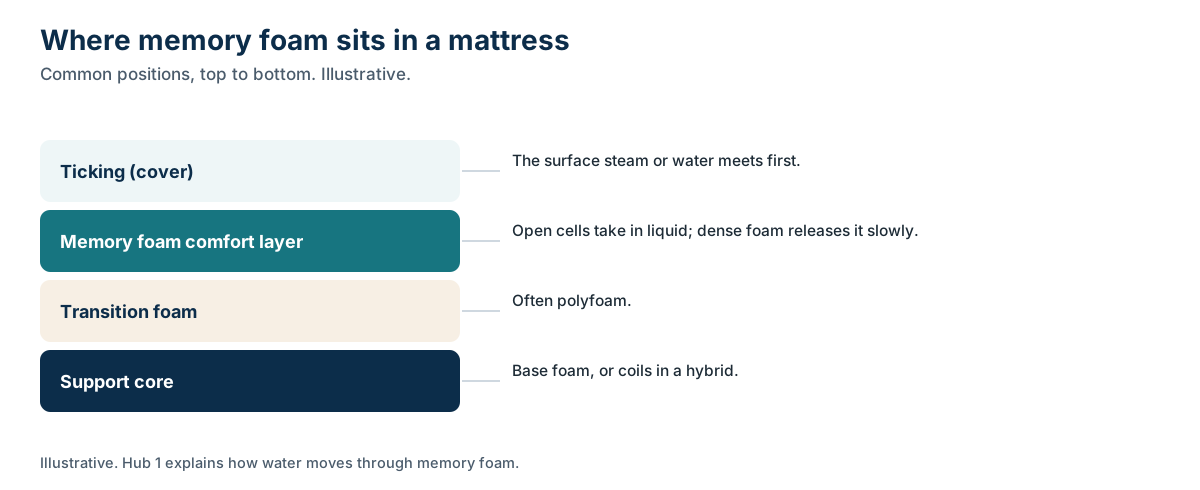
What memory foam is, briefly
Memory foam is a slow-recovery, open-cell polyurethane foam that softens with body heat. Two properties matter for cleaning. Its cells connect, so liquid can travel into it. And it is dense and insulating, so whatever gets in leaves slowly. Manufacturers describe both. Tempur-Pedic's phrase for the second is "the temperature-sensitivity of the TEMPUR-material."
Many mattresses use memory foam somewhere: all-foam beds, the comfort layers of hybrids, and the top of some innerspring beds. The Saatva Classic, for example, is described on Saatva's own page as having "a layer of memory foam." So the cautions below reach well beyond all-foam mattresses.
What manufacturers say about memory foam
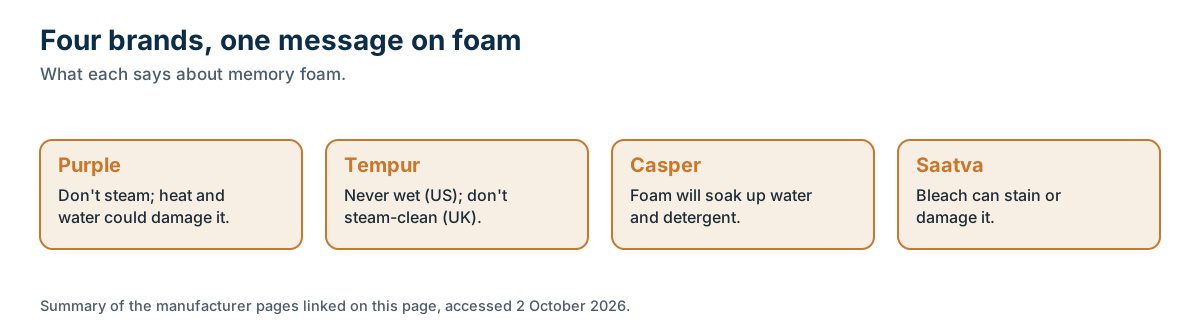
| Brand | Statement | Variable | Source |
|---|---|---|---|
| Purple | "you should not steam clean a memory foam, latex, or adjustable mattress since the heat and water could damage its materials" | Steam, heat, water | Purple |
| Purple | "Avoid steam cleaning a memory foam mattress, as this can leave it waterlogged." | Steam, water | Purple |
| Tempur (UK) | "Do not steam-clean or dry-clean the TEMPUR Material." | Steam | Tempur UK |
| Tempur (UK) | "There is a high risk that soaking with water or other cleaning fluids will cause irreversible damage, destroying the benefits of comfort and support which the TEMPUR Material provides." | Water, soaking | Tempur UK |
| Tempur (UK) | "It will also invalidate your guarantee." | Warranty | Tempur UK |
| Tempur-Pedic (US) | "TEMPUR® material should never become wet." | Water | Tempur-Pedic |
| Tempur-Pedic (US) | "adding high heat can hinder its ability to react to your body temperature" | Heat | Tempur-Pedic |
| Casper | "the foam in the mattress core will soak up water and detergent" | Water, detergent | Casper |
| Saatva | "the bleach can cause staining or damage the material" | Chemicals | Saatva |
All accessed 2 October 2026. None of these pages mentions dry-vapor steam.
Why both water and heat come up
Water and heat cause different problems in foam, and the brands name both. Water held in dense foam can take a long time to leave; Purple says memory foam "can absorb liquid and be harder to dry," and Hub 1's article on drying time explains why drying from the top is slow. Heat is a separate concern: Tempur-Pedic describes high heat affecting how the material responds to body temperature.
That is why Hub 1 treats heat and moisture as separate variables. A method can be low in one and high in the other. Wet extraction puts in a lot of water at moderate heat. A dry-vapor system delivers high heat with little liquid; Vapor Clean claims "just 5-6% moisture" for its Magnum XP, one of the machines we run (maker's claim). Neither method is zero-risk for foam, and the manufacturers haven't drawn the distinction.
Toppers
Memory foam toppers carry the same material cautions, often more strictly. Tempur-Pedic's care page says "Do NOT wash or Dry Clean the TEMPUR-Topper Supreme" and "We do not recommend using an electric blanket or heating pad with your mattress topper." A topper is also thinner, so less material sits between the surface and its core.
Sleep Sanitation's approach to memory foam
This section is our view, not any manufacturer's.
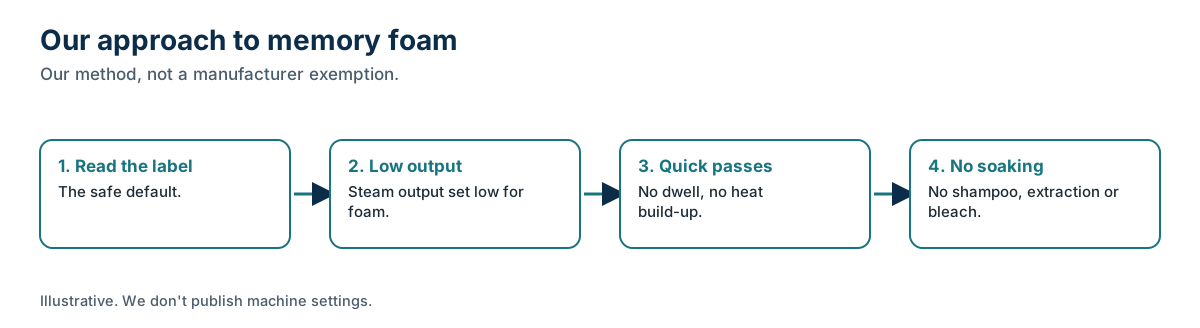
Following the label is the safe default for foam: vacuum, spot-clean with very little water, blot, and air the mattress. Our position is that we can sanitize any mattress or topper, foam included. The two risks manufacturers name are the two our method controls. We run three Vapor Clean machines, the Magnum XP, ProV 350 and Pro6 Duo, and match the machine to the job; Vapor Clean describes the Magnum XP (with vac) as having a "Fully Adjustable Steam Regulator" and "Vacuum Capability" (maker's claims). On foam, our technician keeps the steam output low and the pass speed quick, so heat doesn't build and little water condenses in any one spot. We never soak, shampoo or extract, and we don't use bleach.
That is our method and reasoning, not an exemption from any foam manufacturer. Check your warranty terms before booking; Tempur UK, for example, ties soaking to its guarantee. Contact the manufacturer if unsure. This is not legal advice.
Spot cleaning foam the way manufacturers describe
Every brand that warns about foam also tells owners how to deal with a spill, and the instructions share a pattern: as little liquid as possible, pressed out rather than rubbed in, then moving air.
- Tempur-Pedic: "soak up as much of the liquid using towels as possible. This may require pressing down on the material with the towel(s) to release the moisture." Then "place a fan so that it blows on the mattress."
- Casper: "we suggest spot-cleaning affected areas with water and mild detergent," and "Allow the treated area to air dry completely before putting your sheets and bedding back on."
- Sleep Number: "Use only a little water—just enough to lightly dampen the spot."
- Purple: "Spot-clean spills and stains with a mild detergent or enzyme cleaner," and let the mattress "fully dry."
None of these is a deep clean. They are damage control, and they tell you what the manufacturers fear most: liquid that reaches the foam and stays there.
Questions to ask a provider about foam
If you decide to have a foam mattress professionally cleaned, these questions separate careful providers from careless ones:
- What machine do you use, and is it an extractor or a steam boiler? An extractor sprays water in; Purple says a carpet cleaner "could overly saturate a memory foam mattress."
- How do you control heat on foam? Listen for pass speed and output, not a single fixed setting.
- Will you remove the cover? Several brands say not to.
- What chemicals do you use? Compare the answer with the list Purple names.
- Have you read my manufacturer's care page? A provider who hasn't should.
Common misreadings
"Foam brands only worry about soaking." Purple and Tempur-Pedic both name heat as a separate risk.
"Dry vapor is dry, so foam warnings don't apply." Lower moisture isn't zero, and heat is still present. No foam brand has ruled on dry vapor.
"A foam topper on a coil bed doesn't count." The foam is what the steam reaches first. The cautions travel with the material.
Why foam warnings are worded so strongly
Foam brands use the strongest language of any on the pages we checked: "never," "irreversible," "invalidate." One plausible reason is that foam damage is hard to undo. A soaked coil unit can dry out; a foam layer that has held water and detergent may not recover its feel. Whatever the reason, the wording tells you how much weight the manufacturers put on it.
Where this fits
Brand detail: Tempur-Pedic and Purple. Related materials: cooling gel foam and hybrid. The full table is in the compatibility guide; the hub overview lists every page. Our Tempur-Pedic service page explains a visit. To see what a visit involves, read our process.
Related guidance and background
How other manufacturers word the same issue, for comparison:
- Sleep Number. "Use only a little water—just enough to lightly dampen the spot" (Sleep Number).
Public guidance and reference sources behind this page:
- Clean, sanitize, disinfect. The CDC defines the three words differently: cleaning removes dirt and germs, sanitizing lowers germs to a safer level, and disinfecting kills germs, usually with a registered chemical used as labeled. We use "sanitize" in that sense and make no disinfection claim.
- Drying. The EPA's mold and moisture guide advises drying wet materials within 24 to 48 hours, and says that in most cases mold won't grow if you do. That is the public-health reason behind every manufacturer's drying instruction.
- Where memory foam came from. NASA's spinoff history describes the original as an open cell polymeric foam, which is why liquid can travel into it.
What we don't know
- Measured effects. Manufacturers warn of damage from water and heat but don't publish the tests behind those warnings.
- Differences between foams. Plant-based, high-density and gel-infused foams may behave differently; we found no comparative manufacturer guidance.
- Water left by any steam method. We haven't found an independent measurement inside a foam mattress.
- Warranty outcomes. Only the manufacturer can decide a claim.
Changelog
- 2 October 2026: First published. All manufacturer pages quoted here accessed on this date.
Sources
- Product care (US, accessed 2026-10-02) · Tempur-Pedic
- Caring for your TEMPUR (UK, updated 11 July 2023, accessed 2026-10-02) · Tempur UK
- How To Clean a Mattress in 9 Steps (last updated 16 Oct 2025, accessed 2026-10-02) · Purple
- How to Clean Your Mattress in 5 Simple Steps (blog, accessed 2026-10-02) · Saatva
- How to clean your mattress: a mattress care guide (accessed 2026-10-02) · Casper
- Magnum XP-Vac product page (maker's claims, accessed 2026-10-02) · Vapor Clean
- Cleaning and disinfecting your school (definitions) · CDC
- A brief guide to mold, moisture and your home · US EPA
- Foam cushioning (NASA spinoff) · NASA
Last reviewed October 2, 2026. Manufacturer specifications and care instructions change; check the current version for your exact model. This page is general information, not medical advice. How we source and check pages: editorial standards.