
Short answer
Tempur-Pedic's US care page doesn't mention steam; it says the mattress 'should never become wet' and warns against high heat. Tempur's UK page says 'Do not steam-clean or dry-clean the TEMPUR Material.' Neither mentions dry-vapor steam. Following the label is the safe default. Sleep Sanitation does clean TEMPUR beds with adjustable steam output and fast passes, as our own method, not a manufacturer exemption; check your warranty terms first.
Key terms used on this page
- Memory foam (viscoelastic foam):
- An open-cell, slow-recovery polyurethane foam that softens with body heat and conforms to pressure. Because its cells are open, liquid can travel into it, and because it is dense and insulating, it is slow to dry.
- Care instructions (manufacturer care guidance):
- What a manufacturer publishes about cleaning its product: a sewn-in label, a care web page, a help-center article or a brand blog post. They carry different weight. A sewn-in label or a product-care page speaks for a specific product; a blog post often gives general advice about many mattress types. On this hub we name the document type for every quote.
- Moisture load:
- The total amount of water a cleaning process puts into a mattress, whether from spray, steam condensate, shampoo or rinse. It is the main thing that decides how long a mattress takes to dry.
- Dry-vapor steam:
- Steam made in a sealed, pressurized boiler and released through a hose and nozzle as hot vapor with a low liquid-water content. In the vendor specifications we reviewed, professional units are rated from 80 psi (Ladybug 2350) to 150 psi (Daimer), with stated boiler temperatures from about 345°F (Optima) to 360°F (Daimer); these are maker claims. Daimer describes its steam as about 5% water or less and Vapor Clean claims 'just 5-6% moisture'; that is a vendor claim, not an independent standard.
- Adjustable steam output:
- A control on some commercial steam machines that sets how much steam reaches the tool. For example, Vapor Clean describes its Magnum XP (with vac) as having a 'Fully Adjustable Steam Regulator' and a 'Pressure Regulator 0 - Full Range' (maker's claims). We don't publish settings; the technician chooses them for the material.
- Pass speed:
- How fast the steam tool moves across the fabric. A faster pass gives the fabric less time under the tool, so less heat and less condensed water reach any one spot. Purple's general guide makes the same point for home steamers: move 'without leaving it in one spot for too long.'
Tempur-Pedic mattresses are built around TEMPUR material, a temperature-sensitive memory foam. The brand publishes care guidance in two places we checked: the US product care page and the UK Caring for your TEMPUR page. They are not identical, and the difference matters for anyone asking about steam. This page quotes both, answers the steam questions plainly, and then explains how Sleep Sanitation approaches TEMPUR beds.
Not affiliated with or endorsed by any manufacturer listed. Brand names are used only to identify products and their published care instructions.
1. What the manufacturer actually says
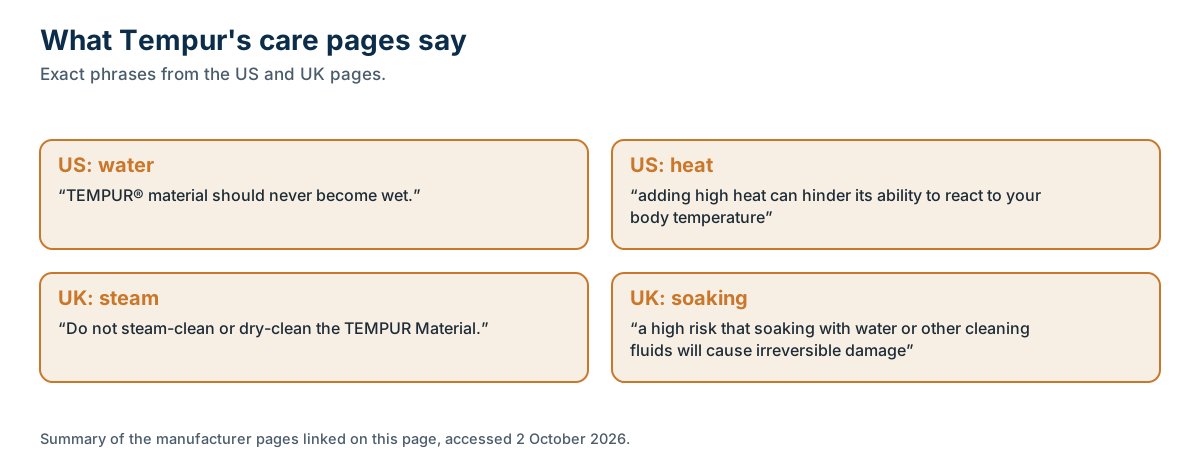
United States. The Tempur-Pedic product care page (no date shown, accessed 2 October 2026) says:
- "TEMPUR® material should never become wet."
- For spills: "After the cover has been removed, soak up as much of the liquid using towels as possible." Then: "Once excess moisture is removed, let the mattress air dry."
- "Because the mattress should never become wet, we can't promise that these steps will completely remove the stain or odor."
- "Due to the temperature-sensitivity of the TEMPUR-material®, adding high heat can hinder its ability to react to your body temperature and conform to your body shape."
- On covers: "The covers on most of our mattresses can be removed and washed," "Never use bleach or bleaching products with the cover," and "do not use chlorine products or harsh stain removers of any kind."
- On accessories: "We do not recommend using an electric blanket or heating pad with your mattress."
United Kingdom. The Tempur UK care page ("updated on 11th July 2023," accessed 2 October 2026) says:
- "Do not steam-clean or dry-clean the TEMPUR Material."
- "TEMPUR Material itself cannot be washed, sponged or dry cleaned."
- "There is a high risk that soaking with water or other cleaning fluids will cause irreversible damage, destroying the benefits of comfort and support which the TEMPUR Material provides."
- "It will also invalidate your guarantee."
- "TEMPUR products should be stored in a dry environment (maximum 65% relative humidity)."
2. Does it mention steam?
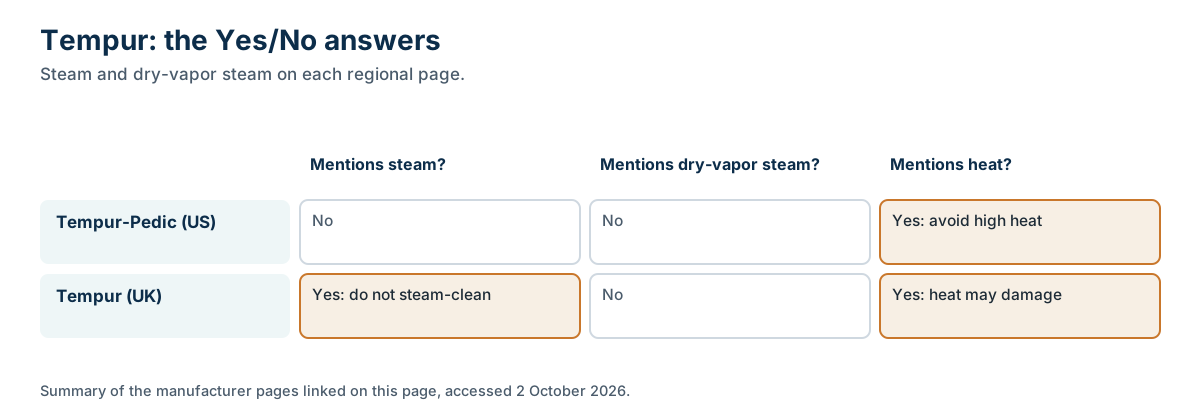
US: No. The word steam does not appear on the US product care page. The page warns against wetting and high heat, which are the two things steam delivers, but it doesn't name steam itself. Not stated in Product care.
UK: Yes. "Do not steam-clean or dry-clean the TEMPUR Material." That is an explicit prohibition.
If your mattress was bought in the US, the US page is the one written for it. We still treat the UK statement as relevant, because it is the clearest thing Tempur has published about steam on the same material.
3. Does it mention dry-vapor steam?
US: No. UK: No. Neither page uses the term dry-vapor steam or distinguishes low-moisture steam from any other kind. The UK prohibition is written without qualification, so we don't read it as leaving room for any particular type of steam.
4. The restrictions it states
| Variable | Tempur-Pedic (US) | Tempur (UK) |
|---|---|---|
| Water | "should never become wet" | "cannot be washed, sponged or dry cleaned" |
| Soaking | Not stated separately; covered by "never become wet" | "high risk that soaking... will cause irreversible damage" |
| Heat | "adding high heat can hinder its ability to react to your body temperature" | Electric blanket and hot water bottle warnings |
| Steam | Not stated in Product care | "Do not steam-clean" |
| Chemicals | No chlorine, bleach or "harsh stain removers" on covers | "other cleaning fluids" in the soaking warning |
| Covers | Most are removable and washable; cold water, hang dry | Covers with quilted-in material are "not washable" |
| Humidity | Not stated in Product care | "maximum 65% relative humidity" for storage |
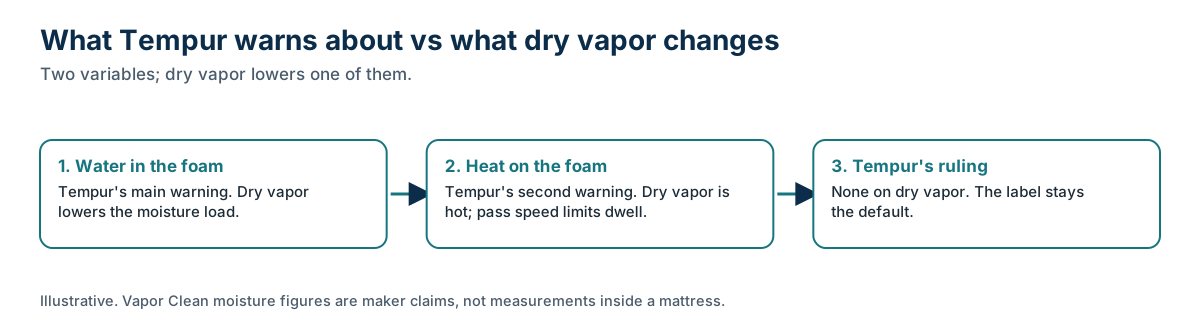
The pattern is consistent across both regions. Water inside the foam is the main risk, heat is the second, and the cover is the only part meant to be washed.
5. How dry vapor differs from wet cleaning
Tempur's warnings describe soaking, sponging and washing: methods that put liquid into the foam. Hub 1 explains what happens when water penetrates memory foam: it spreads through open cells, is held there and dries slowly from the top. That is the scenario both pages warn about.
Dry-vapor steam is made in a pressurized boiler and leaves the tool with far less liquid than a wet method. For the Magnum XP, one of the three Vapor Clean machines we run, Vapor Clean claims "just 5-6% moisture" on its product page; that is the maker's claim, not our measurement. Lower moisture is not zero moisture, and Hub 1 covers whether dry vapor is actually dry. Heat is a separate question, covered in heat and moisture are separate variables. Tempur hasn't ruled on any of this.
6. Sleep Sanitation's professional interpretation
This section is our view, not Tempur-Pedic's.
The label is clear and is the safe default: don't wet the foam, don't apply high heat, and, in the UK, don't steam-clean. If you want to follow it exactly, vacuum the cover and spot-clean with very little water.
Sleep Sanitation does clean Tempur-Pedic mattresses. Our position is that we can sanitize any mattress or topper, because the two risks Tempur names, water and heat, are the two things we can control. We run three Vapor Clean dry-vapor machines, the Magnum XP, ProV 350 and Pro6 Duo, and match the machine to the job. Vapor Clean describes the Magnum XP (with vac) as having a "Fully Adjustable Steam Regulator" (maker's claim). Our technician sets the steam output low for TEMPUR material and keeps the pass speed quick, so heat doesn't build in one spot. Nothing is soaked, sponged or washed, and we don't remove the cover.
That is our method and our reasoning. It is not an exemption from Tempur-Pedic or Tempur UK, and neither has reviewed it. Check your warranty terms before booking. Tempur UK ties soaking to the guarantee; we can't tell you how either company would treat a cleaned mattress. Contact the manufacturer if you're unsure. This is not legal advice.
Our Tempur-Pedic mattress sanitation service page explains what a visit includes. This page doesn't repeat it.
What Tempur-Pedic recommends instead
The US page gives owners a full routine that involves no steam and no washing of the foam:
- Spills. "After the cover has been removed, soak up as much of the liquid using towels as possible. This may require pressing down on the material with the towel(s) to release the moisture." Then "To speed up the drying process, place a fan so that it blows on the mattress."
- Covers. "If your mattress has a cover, remove it, wash it in cold water with mild detergent, and hang dry for best results." The page adds: "If you're not sure if your mattress cover is removable, please refer to the tags sewn into the cover or contact our Customer Service department."
- Protection. "We do not recommend using a conventional mattress pad or mattress cover with your mattress." It names its own protector as the alternative.
- Heat sources. "If you ever do use an electric blanket or heating pad, we recommend limiting its use to 30 minutes, and only on low or medium heat," though it doesn't recommend using one at all.
- Rotation. "Each of our mattresses use our patented, one-sided design that means you'll never have to flip, rotate, or turn it."
The UK page adds airing. For new-product smell, it says "Allowing the product to air or 'breathe', preferably uncovered in a well ventilated area before and after use, may speed this up."
Common misreadings
"The US page doesn't ban steam, so steam is fine." Silence isn't permission. The US page warns against both things steam delivers, water and high heat, and the UK page on the same material bans steam outright.
"Washable cover means washable mattress." The cover is the only part Tempur-Pedic describes as washable. "You should never wash TEMPUR-material®," the US page says about pillows, and the mattress guidance is the same.
"Dry vapor is a kind of dry cleaning." It isn't. Tempur UK's "Do not steam-clean or dry-clean" names two different processes. Dry cleaning uses solvents; dry-vapor steam uses water vapor. Both are named or covered by the prohibition.
Where this fits
The full brand table is in the compatibility guide. For the material itself, see our memory foam compatibility page and the hub overview. If you're comparing brands, the Purple page covers the other best-known foam-based brand. For what a visit involves, see our process.
Related guidance and background
How other manufacturers word the same issue, for comparison:
- Purple. "you should not steam clean a memory foam, latex, or adjustable mattress since the heat and water could damage its materials" (Purple).
Public guidance and reference sources behind this page:
- Clean, sanitize, disinfect. The CDC defines the three words differently: cleaning removes dirt and germs, sanitizing lowers germs to a safer level, and disinfecting kills germs, usually with a registered chemical used as labeled. We use "sanitize" in that sense and make no disinfection claim.
- Drying. The EPA's mold and moisture guide advises drying wet materials within 24 to 48 hours, and says that in most cases mold won't grow if you do. That is the public-health reason behind every manufacturer's drying instruction.
- Where memory foam came from. NASA's spinoff history describes the original as an open cell polymeric foam, which is why liquid can travel into it.
What we don't know
- Your sewn-in label. Tempur's UK page says "A label stitched inside the cover will give you specific care instructions." Your model's label may be more specific than either web page.
- Why the US page omits steam. We don't know whether the US omission is deliberate or simply a different writing choice.
- Test data. Tempur says soaking carries "a high risk" of irreversible damage, but we haven't found published tests on TEMPUR material and steam of any kind.
- Warranty outcomes. Only Tempur-Pedic can decide a claim.
Changelog
- 2 October 2026: First published. Tempur-Pedic US product care page and Tempur UK care page accessed on this date.
Sources
- Product care (US, accessed 2026-10-02) · Tempur-Pedic
- Caring for your TEMPUR (UK, updated 11 July 2023, accessed 2026-10-02) · Tempur UK
- Magnum XP-Vac product page (maker's claims, accessed 2026-10-02) · Vapor Clean
- How To Clean a Mattress in 9 Steps (last updated 16 Oct 2025, accessed 2026-10-02) · Purple
- Cleaning and disinfecting your school (definitions) · CDC
- A brief guide to mold, moisture and your home · US EPA
- Foam cushioning (NASA spinoff) · NASA
Last reviewed October 2, 2026. Manufacturer specifications and care instructions change; check the current version for your exact model. This page is general information, not medical advice. How we source and check pages: editorial standards.