
Short answer
Usually not. A single accident that's blotted quickly and treated without soaking is often fully or mostly recoverable. Replacement is the honest answer in a narrower set of cases: a core soaked through, repeated accidents in one spot, mold, or odor that survives proper treatment. Even Tempur-Pedic, strict about liquid, publishes spill steps rather than telling owners to replace the bed.
Key terms used on this page
- Saturated core:
- A mattress whose interior layers, not just the cover and quilting, were soaked by a large accident or several in one place. Surface treatment can't reach all of it. Some saturated cores improve with treatment and drying; some don't, and we say so before charging for work that won't help.
- Odor rebound:
- A urine smell that fades after cleaning and comes back later, often on humid days or when the bed is slept on again. The Carpet and Rug Institute notes that urine odor 'may reappear' in high humidity. It usually means residue remains deeper than the treatment reached.
- Mattress protector:
- A removable cover that goes between the mattress and the sheets. Purple says protectors 'go between the mattress and sheets to keep dirt and other stains off your mattress.' Tempur-Pedic recommends its own protector over conventional pads.
- Warranty exclusion:
- A condition a manufacturer says its warranty does not cover. Purple, for example, says 'damage from the sun is excluded from warranty coverage,' and Tempur UK says soaking 'will also invalidate your guarantee.' Only the manufacturer can decide a claim.
- Enzyme cleaner:
- A cleaning product that uses enzymes to break down organic soils such as urine, sweat, vomit or blood. Several mattress makers mention them for urine stains, including Purple and Avocado. They are liquids, so how much is applied matters as much as what is applied. Sleep Sanitation uses enzyme treatment on urine and organic odor, sparingly.
- Drying window (EPA):
- The EPA's mold and moisture guide advises drying wet materials within 24 to 48 hours, and says that in most cases mold won't grow if you do. That is the public-health reason behind the drying instructions manufacturers give.
A urine accident can feel like the end of a mattress, especially an expensive one. In most cases it isn't. This page goes through the common scenarios, what each usually means for the bed, and the smaller set of cases where replacing it really is the better choice.
Not affiliated with or endorsed by any manufacturer listed. Brand names are used only to identify products and their published care instructions.
Why people assume the bed is ruined
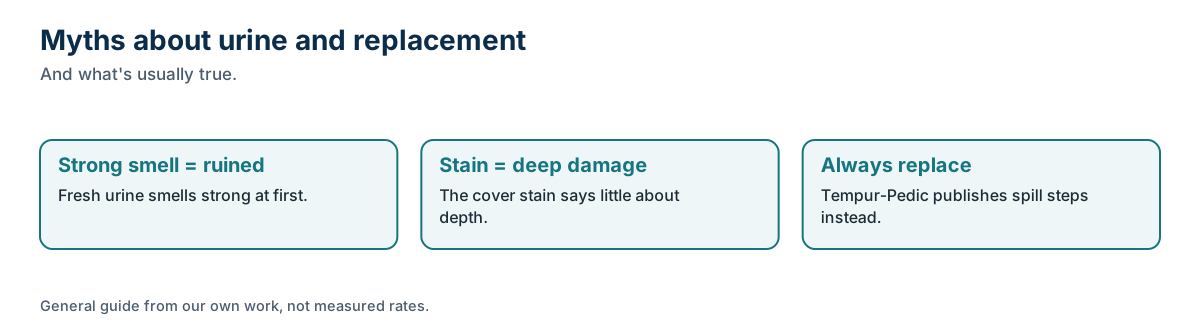
Three things push people toward replacement. The smell is strong. The stain looks permanent. And online advice often jumps straight to "throw it out." But a strong smell in the first day mostly reflects fresh urine near the surface, and a stain in the cover says little about the layers below.
Manufacturers don't treat a spill as automatic replacement either. Tempur-Pedic, one of the strictest about liquid, publishes spill steps: remove the cover, soak up liquid with towels, let it air dry. Its US care page is honest about limits too: "Because the mattress should never become wet, we can't promise that these steps will completely remove the stain or odor."
Common scenarios
| Scenario | What it usually means | Typical outcome |
|---|---|---|
| One child's accident, found in the morning | Urine in cover and comfort layer | Usually treatable, often fully |
| Puppy accident, blotted within minutes | Mostly in the cover | Usually removable |
| Large dog, not found for hours | Into the foam, wide spread | Big improvement; faint smell may return |
| Cat accident on the bed | Strong sulfur odor | Treatable if early; harder if repeated |
| Old dog, small leaks over weeks | Buildup in one area | Often improved; may not clear |
| Ongoing adult incontinence, no protector | Repeated soaking | Often a replacement case |
These are our general experience, not measured rates. Nobody publishes reliable recovery numbers, and we don't invent them.
What changes the answer
Depth. The CRI's pet urine bulletin puts it in one line about cats that applies broadly: "Unless the cat urine can be completely removed, complete odor removal is unlikely." The deeper urine goes, the harder that is.
Time. Avocado's help center says: "The longer the urine remains on a mattress, the harder the stain and odor will be to remove."
Repetition. A pattern of accidents builds up urine faster than cleaning removes it.
Mold. A musty smell after days of dampness changes the question entirely. Federal mold guidance gives a one-to-two-day drying window, and a bed that missed it badly is usually past saving.
Material. Our materials ranking shows which beds hold liquid longest, and the innerspring page explains why coil beds often recover more easily.
When replacing is right
We'd recommend replacing the mattress when:
- the core was soaked from top to bottom;
- accidents happened repeatedly in the same area;
- the odor comes from a wide area and returns after proper treatment;
- there's visible mold, or a musty smell alongside the urine smell;
- the bed was already sagging or near the end of its life.
Saatva's cleaning guide gives its own rule: "Replace your mattress if it sags, has an odor, or is over 10 years old." That's broader than we'd apply to a single treatable accident, but it's the right instinct for a bed where odor won't go.

What replacing doesn't fix
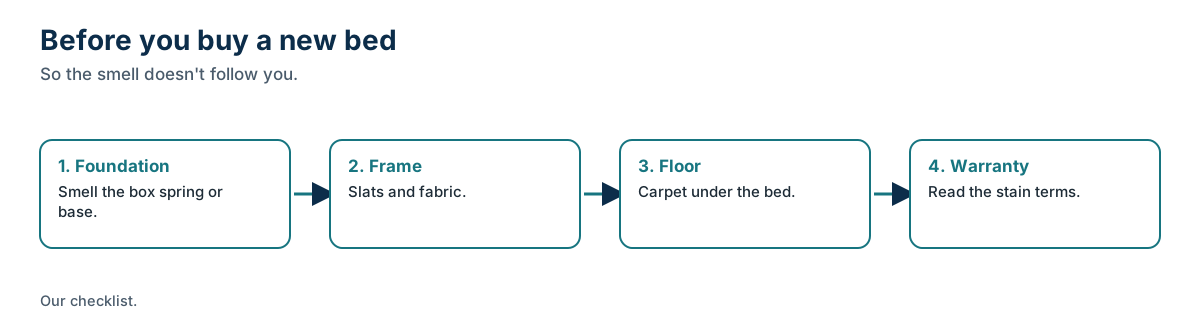
A new mattress won't fix urine that's in the foundation, the bed frame, the slats or the carpet. If the accident went through the bottom of the old mattress, check what was under it. Otherwise the new bed can pick up the old smell in the first humid week.
What treatment looks like if you don't replace
If you keep the bed, here's what treatment involves, as our method rather than a maker's. Enzyme product goes only where the urine is, lightly, and works through its dwell time before low-moisture heat from a Magnum XP, ProV 350 or Pro6 Duo. Organic cleaning methods are our default.
Hub 1 explains why we avoid soaking: why moisture matters and HEPA vacuuming vs steam vs extraction.
A single accident is covered by the standard price. Severe, biohazard or extensive contamination is quoted first, and if your bed belongs in the "replace" group, we'll say so before charging for work we don't expect to help.
That treatment is cleaning. The CDC's terms, summarized in Hub 2, explain why we don't call it sanitizing.
Warranty and stains
Many warranties have conditions about stains or liquid damage, and they vary by maker and model. Naturepedic's care page is one example: "Please note that any exposure to liquid may damage your mattress or topper and may void your warranty." Read yours before any cleaning, and before assuming a stained bed is still covered. Our Naturepedic page quotes its accident advice in full.
Our method doesn't override those terms. Your care label and warranty govern; check your warranty before booking any treatment.
Next time
A waterproof protector is the cheapest way to avoid this decision. Wash it regularly and keep a spare. For pets, a washable blanket on top. For children still night-training, a pad on top of the protector.
Replacement costs more than the mattress
When you add up delivery, removal of the old bed, the time it takes a new mattress to break in, and the risk that urine in the foundation follows you to the new one, replacement is a bigger step than the price tag. For a single accident, treating first and judging the result after the bed has dried is usually the better order. If the treatment doesn't work, you've lost little, and you'll replace the bed knowing why.
A note on guest beds and spare rooms
Accidents on spare-room beds are often found late, sometimes weeks later when a guest arrives. Those beds also tend to be older. Both push toward replacement, but neither decides it alone. An old accident on a bed that's otherwise in good shape can still be treated. An old accident on a sagging bed probably isn't worth it.
When a professional says replace
We'd rather lose a cleaning job than sell one that won't work. If we look at a bed and think it's beyond treatment, we'll explain why: the depth of the urine, the spread of the odor, the repetition, or the condition of the bed itself. You can still choose to try. If you do, we'll be clear about what to expect.
The middle ground: treat now, decide later
If you're on the fence, treat the bed, let it dry fully, and live with it for a couple of weeks, including at least one humid day. If the smell stays gone, you've saved a mattress. If it comes back strongly, you have your answer, and why urine odor comes back explains what that usually means.
One more factor: how you feel about the bed
Some people can't sleep comfortably on a bed after an accident, even once the smell is gone. That's a legitimate reason to replace a mattress, and it isn't one we'd argue with.
The mattress urine and odor guide has the full treatment picture. Clean or replace after urine and restoring an expensive mattress help with the decision.
A protector on the new bed, too
If you do replace, protect the new mattress from the first night. It's the easiest way to keep from facing the same decision again.
What we don't know
- How often single accidents fully recover. We don't have reliable numbers, and nobody publishes them.
- What your warranty says about stains.
- How deep your accident went until it's checked.
Changelog
- 2 October 2026: First published. Sources accessed on this date.
Sources
- Product care (US, accessed 2026-10-02) · Tempur-Pedic
- How to Clean Your Mattress in 5 Simple Steps (blog, accessed 2026-10-02) · Saatva
- How to Clean Your Natural Mattress Without Using Harsh Chemicals (25 June 2026, accessed 2026-10-02) · Avocado
- Pet Urine and Carpet (technical bulletin, revised 27 July 2017, accessed 2026-10-02) · Carpet and Rug Institute
- A brief guide to mold, moisture and your home · US EPA
- Product Care (accessed 2026-10-02) · Naturepedic
- Magnum XP-Vac product page (maker's claims, accessed 2026-10-02) · Vapor Clean
- ProV 350 product page ('Italian Made'; maker's claims, accessed 2026-10-02) · Vapor Clean
- Pro6 Duo product page ('Made in Italy'; maker's claims, accessed 2026-10-02) · Vapor Clean
Last reviewed October 2, 2026. Manufacturer specifications and care instructions change; check the current version for your exact model. This page is general information, not medical advice. How we source and check pages: editorial standards.