
Short answer
Dry vapor helps with urine odor but rarely solves it alone. Heat at the surface works on what it reaches, and low moisture keeps the bed from getting soaked. Urine deeper in the bed needs breaking down, which is why we pair dry vapor with sparing enzyme treatment. Some makers advise against steam, and PetMD warns heat can set a stain, so check your label first.
Key terms used on this page
- Dry-vapor steam:
- Steam made in a sealed, pressurized boiler and released through a hose and nozzle as hot vapor with a low liquid-water content. In the vendor specifications we reviewed, professional units are rated from 80 psi (Ladybug 2350) to 150 psi (Daimer), with stated boiler temperatures from about 345°F (Optima) to 360°F (Daimer); these are maker claims. Daimer describes its steam as about 5% water or less and Vapor Clean claims 'just 5-6% moisture'; that is a vendor claim, not an independent standard.
- Adjustable steam output:
- A control on some commercial steam machines that sets how much steam reaches the tool. For example, Vapor Clean describes its Magnum XP (with vac) as having a 'Fully Adjustable Steam Regulator' and a 'Pressure Regulator 0 - Full Range' (maker's claims). We don't publish settings; the technician chooses them for the material.
- Pass speed:
- How fast the steam tool moves across the fabric. A faster pass gives the fabric less time under the tool, so less heat and less condensed water reach any one spot. Purple's general guide makes the same point for home steamers: move 'without leaving it in one spot for too long.'
- Enzyme cleaner:
- A cleaning product that uses enzymes to break down organic soils such as urine, sweat, vomit or blood. Several mattress makers mention them for urine stains, including Purple and Avocado. They are liquids, so how much is applied matters as much as what is applied. Sleep Sanitation uses enzyme treatment on urine and organic odor, sparingly.
- Odor rebound:
- A urine smell that fades after cleaning and comes back later, often on humid days or when the bed is slept on again. The Carpet and Rug Institute notes that urine odor 'may reappear' in high humidity. It usually means residue remains deeper than the treatment reached.
- Dry to the touch vs dry through:
- Dry to the touch means the surface fabric feels dry. Dry through means the moisture inside the comfort layers has also left. A mattress can feel dry on top while still holding water underneath.
People often ask us this as a yes-or-no question. The honest answer is in between. Dry-vapor heat is one useful tool against urine odor. It isn't the whole job, and on some beds the manufacturer's rules limit how it can be used at all.
Not affiliated with or endorsed by any manufacturer listed. Brand names are used only to identify products and their published care instructions.
What dry vapor actually is
Dry vapor is steam from a pressurized boiler with very little liquid water in it. Vapor Clean, the Italian maker of our machines, says its Magnum XP produces vapor with "just 5-6% moisture" (manufacturer's claim, not our measurement). It's applied through a tool head that moves across the surface. Nothing is sprayed on and sucked back out.
That makes it very different from a carpet "steam cleaner," which is usually a hot-water extractor. Hub 1's comparison of dry vapor and carpet extraction and the article on whether dry vapor is actually dry cover the details.
What heat can do for urine odor
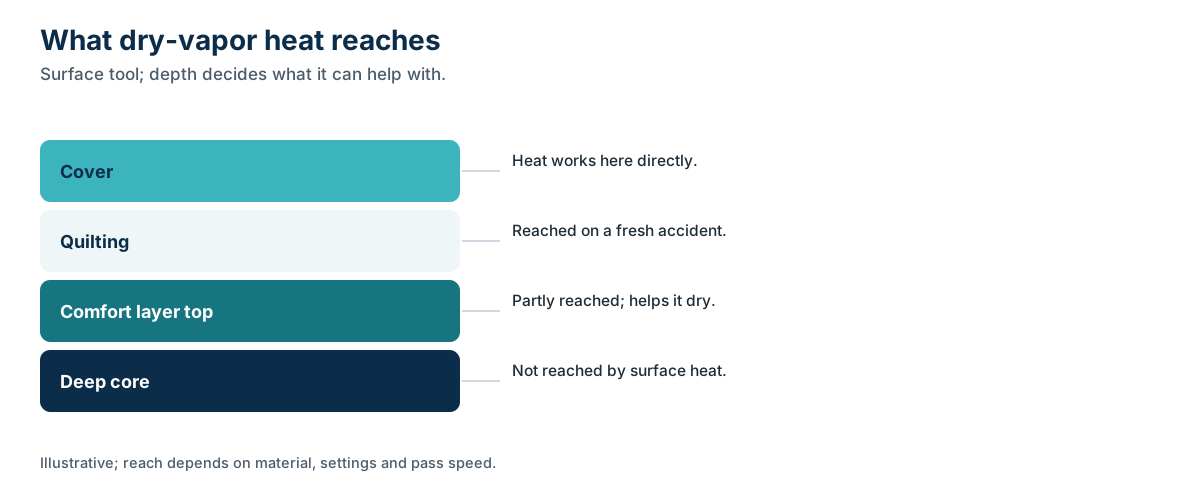
Heat works on what it reaches. On a mattress, that's the cover, the quilting and the top of the comfort layer. Fresh urine that stayed in those layers is where dry vapor helps most.
What it does there is practical: it loosens surface soil, warms the fabric so it releases moisture, and leaves the surface dry to the touch quickly. A surface that dries fast gives bacteria less time to keep breaking urea down into ammonia, the process a 1989 microbiology review describes as "Microbial ureases hydrolyze urea to ammonia and carbon dioxide."
Heat at the surface is part of cleaning, not a sanitizing claim; Hub 2 explains the CDC's line between cleaning and sanitizing.
What heat can't do
Heat doesn't remove urine that's deep in the bed. It doesn't dissolve compounds that barely dissolve in water. And it doesn't break urine down the way an enzyme product is designed to. If urine soaked the core, a surface tool is working on the top of the problem.
There's also a real risk with heat on a stain. PetMD's cat urine guide says: "Don't use a steam cleaner, as the heat can set the stain." That advice is written for carpet and household steamers, but we take the point: heat on an untreated urine stain may make it harder to remove. It's a reason to treat the urine before or alongside the heat, not to skip heat entirely.
Why we pair it with enzymes
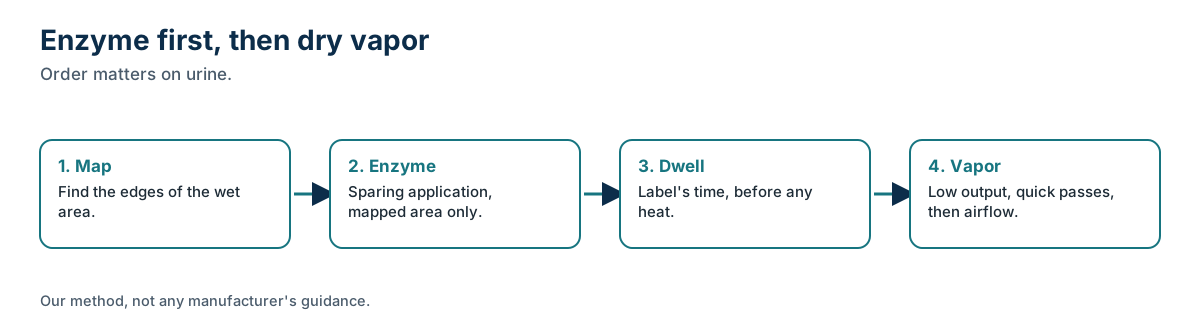
That's why heat is only half of our urine method. The other half is an enzyme cleaner, designed to break down organic soils such as urine. Dry vapor covers the surface and speeds drying; the enzyme product goes after the urine itself. Neither does the other's job.
Enzymes need dwell time, so the order matters. We apply the enzyme product sparingly to the affected area, give it the time the label calls for, and only then use dry-vapor passes. We don't flood the stain to give the enzyme more to work with; the foam would pay for that. Organic cleaning methods are our default. Enzyme treatment and dry vapor together explains the sequence step by step.
What manufacturers say about steam
This part matters more than our method. Several mattress makers address steam directly, and most of them say not to.
- Tempur UK puts liquid, damage, the guarantee and steam together in a single passage on its care page: "There is a high risk that soaking with water or other cleaning fluids will cause irreversible damage, destroying the benefits of comfort and support which the TEMPUR ® Material provides. It will also invalidate your guarantee. Do not steam-clean or dry-clean the TEMPUR ® Material." For anyone weighing dry vapor, the last sentence matters most. It names steam cleaning directly, and nothing in the passage carves out a low-moisture machine, so we don't claim one.
- Purple: "After vacuuming, you can steam clean your innerspring or hybrid mattress, but you should not steam clean a memory foam, latex, or adjustable mattress since the heat and water could damage its materials."
- Avocado: "Steam cleaners are not recommended because their excessive heat can over-bake the organic latex."
- Bear lists, under things to avoid, "Using steam cleaners, as excess moisture may damage foam materials."
None of these mention dry vapor specifically, and we don't read their silence as permission. Sleep Sanitation's use of quick, repeated low-moisture dry-vapor passes is our own method and reasoning, not a manufacturer exemption. Your care label and warranty terms govern your own decision. Check your warranty terms, or ask the manufacturer, before booking. The compatibility guide lays out every brand we checked, and the Purple and Avocado pages quote those makers in full.
How we set the machine
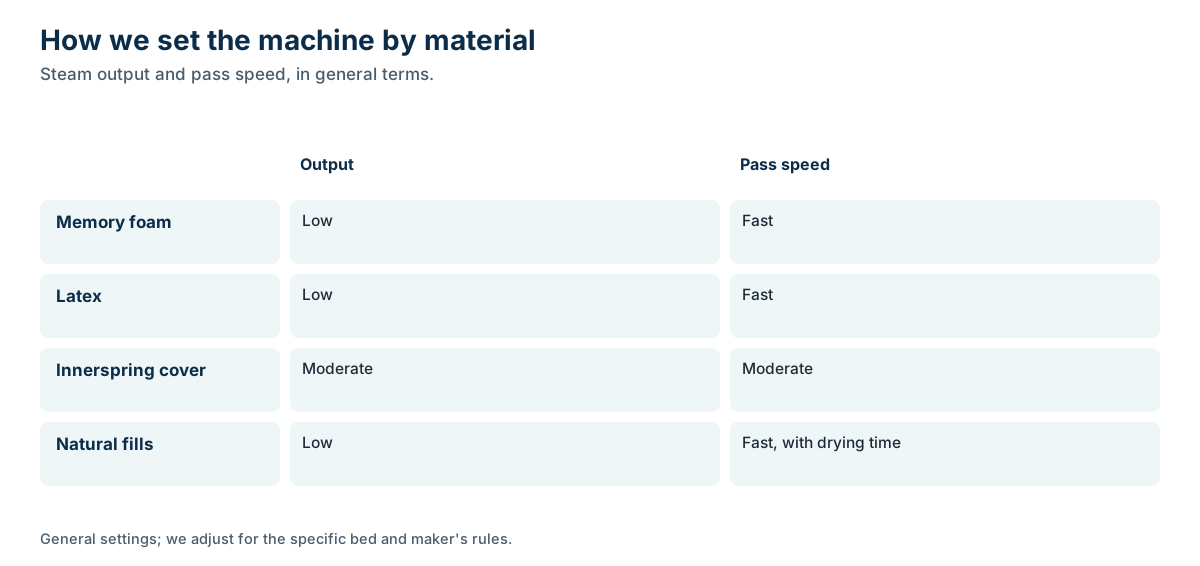
Heat and moisture are separate variables, and we set both for the material.
- Steam output goes down on foam and latex; the memory foam page explains why.
- Pass speed goes up, so the head never sits in one spot.
- Passes are repeated over a urine area with drying time between them, instead of one long pass.
We use the Magnum XP, ProV 350 and Pro6 Duo. Different jobs suit different machines, but on urine work the settings matter more than the model.
What results to expect
On a fresh accident in the top layers, the combination usually removes the smell. On an older one, it usually reduces it a lot. On a saturated core, surface work can't reach the source, and the odor may return. The CRI's pet urine bulletin warns: "A number of products are available to combat odor, but some may simply mask the odor, and, in times of high humidity, the odor may reappear." We'd rather tell you that up front than have you discover it in July.
Odor work like this sits inside our standard price, and severe, biohazard or extensive contamination is quoted as a surcharge. Low moisture also keeps drying well inside the EPA's 24-to-48-hour mold guidance.
The short version
- Dry vapor helps with urine odor at the surface.
- It doesn't replace breaking urine down, so we pair it with enzymes.
- It can't reach a soaked core.
- Many manufacturers warn against steam; check yours first.
Where dry vapor is the wrong tool
There are jobs where we'd tell you dry vapor won't help much, and we'd rather say so than sell a visit.
- A core soaked from top to bottom. Surface heat can't reach it.
- Mold. A moldy mattress is a replacement case.
- A bed whose maker forbids steam, if you want to keep warranty coverage. That's your call to make after reading your warranty, not ours.
- Repeated accidents over months. Treating the surface again and again won't keep up with urine building up underneath.
In those cases the most useful thing we can do is give you a straight assessment.
Questions to ask any cleaner
Whoever you hire, a few questions tell you a lot. How much liquid will go into the bed? Will you rinse or extract? What do you do differently on memory foam or latex? How long until I can sleep on it? What happens if the smell comes back? A cleaner who can't answer those clearly is guessing.
For the full sequence on a visit, how professionals treat mattress urine without flooding it walks through each step, and the mattress urine and odor guide puts dry vapor alongside every other option.
A note on household steamers
Handheld and upright steamers sold for home use vary widely in how wet their output is, and most don't let you set output and pass speed the way a commercial boiler does. Many of the manufacturer warnings above were likely written with those in mind. If you own one, it's not a substitute for treating the urine first, and on memory foam or latex it's exactly what several makers tell you not to use.
What we don't know
- How much odor dry vapor removes on its own. We haven't seen a controlled study on mattresses.
- Whether a given manufacturer would treat dry vapor differently from steam cleaning. None we read addresses it.
- What's inside your bed until we've checked.
Changelog
- 2 October 2026: First published. Sources accessed on this date.
Sources
- How To Get Rid of Cat Pee Smell (accessed 2026-10-02) · PetMD
- Pet Urine and Carpet (technical bulletin, revised 27 July 2017, accessed 2026-10-02) · Carpet and Rug Institute
- Microbial ureases: significance, regulation, and molecular characterization (Mobley and Hausinger, Microbiol Rev, 1989) · PubMed Central
- Caring for your TEMPUR (UK, updated 11 July 2023, accessed 2026-10-02) · Tempur UK
- How To Clean a Mattress in 9 Steps (last updated 16 Oct 2025, accessed 2026-10-02) · Purple
- How to Clean Your Natural Mattress Without Using Harsh Chemicals (25 June 2026, accessed 2026-10-02) · Avocado
- How do I clean a Bear mattress? (updated 6 May 2026, accessed 2026-10-02) · Bear
- Magnum XP-Vac product page (maker's claims, accessed 2026-10-02) · Vapor Clean
- ProV 350 product page ('Italian Made'; maker's claims, accessed 2026-10-02) · Vapor Clean
- Pro6 Duo product page ('Made in Italy'; maker's claims, accessed 2026-10-02) · Vapor Clean
- A brief guide to mold, moisture and your home · US EPA
Last reviewed October 2, 2026. Manufacturer specifications and care instructions change; check the current version for your exact model. This page is general information, not medical advice. How we source and check pages: editorial standards.