
Short answer
Pet and human urine share the same basics: mostly water, with urea that bacteria turn into ammonia as it sits. The differences are in the details. Cat urine carries felinine, the source of the catty smell, and pet urine varies with diet, age and health. In practice, volume, how fast it's caught and how often it repeats matter more than species. We treat both the same way.
Key terms used on this page
- Urea and ammonia:
- Urea is the main nitrogen-carrying compound in urine. Bacteria that make the enzyme urease break it down into ammonia and carbon dioxide, which is why stale urine smells sharper than fresh urine. NASA's study of stored human urine found that bacterial action decomposed the urea and released large amounts of ammonia.
- Uric acid:
- A normal, minor component of urine. NASA's table of urine constituents lists its solubility in water as very low, far below that of urea. Many cleaning guides blame uric acid for odor that returns after cleaning; we haven't found a study measuring that inside a mattress, so we treat it as a plausible explanation, not a proven one.
- Wicking (urine migration):
- Liquid moving through and along fabric and foam by capillary action, so the affected area below the surface is often wider than the visible stain. Quilting, fiber batting and open-cell foam all wick. It is why a spot can look small and still smell from a wider area.
- Enzyme cleaner:
- A cleaning product that uses enzymes to break down organic soils such as urine, sweat, vomit or blood. Several mattress makers mention them for urine stains, including Purple and Avocado. They are liquids, so how much is applied matters as much as what is applied. Sleep Sanitation uses enzyme treatment on urine and organic odor, sparingly.
- Mattress protector:
- A removable cover that goes between the mattress and the sheets. Purple says protectors 'go between the mattress and sheets to keep dirt and other stains off your mattress.' Tempur-Pedic recommends its own protector over conventional pads.
- Saturated core:
- A mattress whose interior layers, not just the cover and quilting, were soaked by a large accident or several in one place. Surface treatment can't reach all of it. Some saturated cores improve with treatment and drying; some don't, and we say so before charging for work that won't help.
People sometimes ask whether pet urine or human urine is worse on a mattress. The honest answer is that the basic chemistry is shared, a few details differ, and the things that matter most for cleaning have little to do with species.
Not affiliated with or endorsed by any manufacturer listed. Brand names are used only to identify products and their published care instructions.
What they have in common
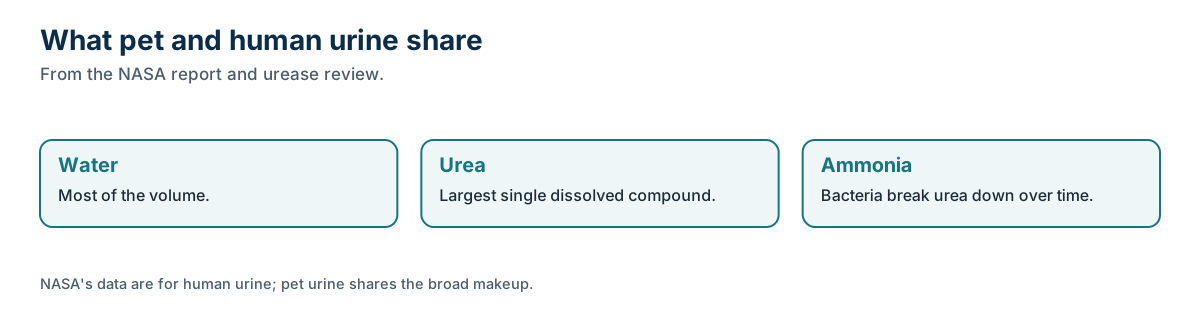
Most of the published detail on urine composition comes from human studies. NASA's 1971 report lists dozens of dissolved compounds in human urine, with urea the largest single one, followed by salts, creatinine and many others in small amounts. Pet urine has the same broad makeup: mostly water, with urea, salts and organic compounds.
Species makes no difference to the next step either. Urea from a dog, a cat or a person meets the same urease-producing bacteria, and a microbiology review describes the result in one sentence: "Microbial ureases hydrolyze urea to ammonia and carbon dioxide." That is why any old accident smells of ammonia.
Both also leave residue as they dry. NASA's table shows how unevenly urine's compounds dissolve. Uric acid's solubility is 0.00645 grams per 100 grams of water, compared with 119 for urea.
Either way, our treatment is cleaning. Hub 2 sets out the CDC's terms for cleaning, sanitizing and disinfecting.
Where pet urine differs
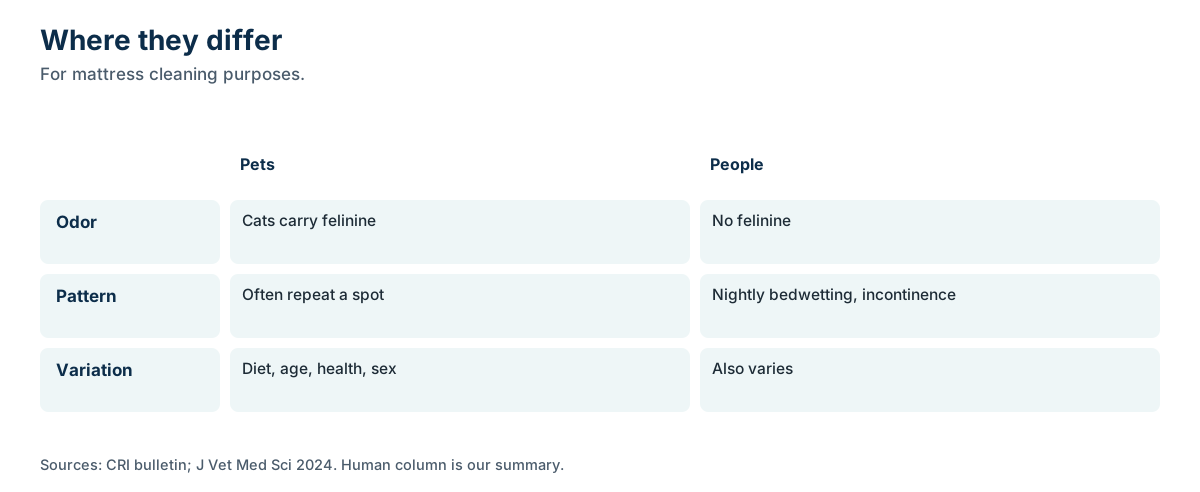
Cats have felinine. A 2024 study in the Journal of Veterinary Medical Science describes felinine as the precursor of sulfur-containing odorants, including 3-mercapto-3-methyl-1-butanol, behind the "catty" smell. It reports that "levels of the sulfur-containing VOCs are higher in intact males than other sexes." Our cat urine article covers this in detail.
Pet urine varies a lot. The Carpet and Rug Institute's pet urine bulletin says: "Urine content will change over the pet’s life because of the pet’s diet, medications, age, health, sex, and reproductive cycles." It adds: "Because of these variations, some urine stains may not be removable."
Pets often repeat. A dog or cat may return to the same place. Repeated accidents build up in the layers.
Where human urine differs
Bedwetting is often found late. A child's accident during the night may not be noticed until morning, after hours of soaking time.
Adults may have ongoing incontinence. The pattern varies from person to person, and accidents may land in the same area of the bed.
Sweat is part of the picture. Human beds also collect sweat every night. Purple's care guidance groups them together: "Urine, vomit, or sweat stains may require an enzyme cleaner or hydrogen peroxide." Sweat stains build slowly across the sleeping area, rather than as one spot.
What actually decides the outcome
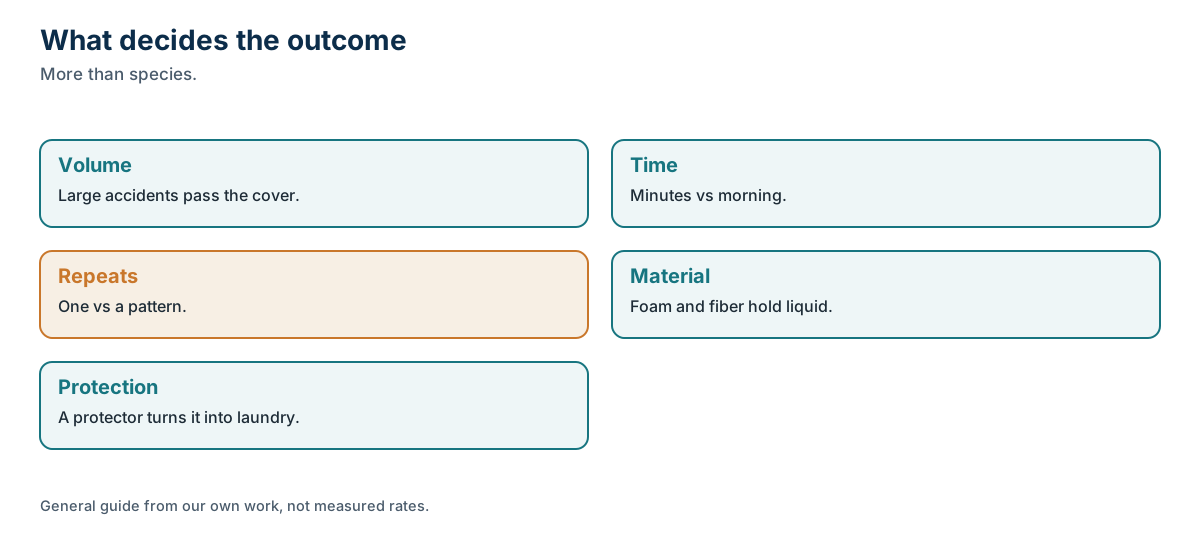
In our experience, a few factors predict results far better than the species:
- Volume. A large dog or a full bladder overnight moves past the cover and into the foam.
- Time before blotting. Caught in minutes is very different from found in the morning.
- Repetition. One accident is a cleaning job. A pattern is a buildup.
- Material. Memory foam and thick fiber tops hold liquid longest. Our materials ranking and wool page explain why.
- Protection. A waterproof protector turns most accidents into laundry.
Children's mattresses
Many families buy natural or organic mattresses for children, and some of those makers are strict about liquid. Naturepedic's care page warns: "Please note that any exposure to liquid may damage your mattress or topper and may void your warranty." Its accident advice is framed around an accident without a waterproof pad, which shows the protection it expects owners to use. Our Naturepedic page quotes its full accident advice.
For a child still night-training, a waterproof protector plus a washable pad on top is the most effective thing you can buy. It's cheaper than any cleaning.
How we treat either kind
Species doesn't change what we do. Enzyme treatment is applied lightly to the mapped stain and given its dwell time, then low-moisture dry vapor from a Magnum XP, ProV 350 or Pro6 Duo finishes the surface. Organic cleaning methods remain our default for both.
On repeated accidents, whether a pet's or a person's, we plan for more than one light round. How little water dry vapor adds is covered in Hub 1's moisture article, and why we don't rinse is explained in dry vapor vs carpet extraction.
Pet or human, an ordinary accident is part of the standard price. Severe, biohazard or extensive contamination, such as blood or other bodily fluids, is quoted as a custom surcharge; see our accident cleanup service.
Our method doesn't change the maker's rules. Your care label and warranty terms govern; check your warranty first, whoever had the accident.
When either one means a lost bed
A saturated core, from one huge accident or months of repeated ones, may not be fully recoverable no matter what made it. The EPA's mold guide advises drying wet materials within 24 to 48 hours; a bed wet night after night never gets that chance. Saatva's cleaning guide says: "Replace your mattress if it sags, has an odor, or is over 10 years old."
Sweat: the everyday version
Most mattresses meet human sweat far more often than urine. Sweat is spread thinly across the whole sleeping area night after night. That builds up as general yellowing and a stale smell, not as a single spot. It's easier to treat than a urine accident because it's spread thin, and harder to see coming because it builds slowly.
We treat sweat staining as part of a normal cleaning. Where there's organic odor, the same pairing applies: sparing enzyme treatment, dwell time, then low-moisture dry vapor.
Accidents in shared beds
When two people and a pet share a bed, an odor can come from any of them. If you're not sure what caused a smell, tell us what you know. We map by smell either way, and the treatment is the same, but the history helps us find the source faster. We don't need to know whose accident it was, just where and when.
Older pets and older people
Age changes urine and accident patterns in both pets and people. The CRI notes pet urine varies with age and health, and accident patterns can change as pets and people get older. In both cases, plan for prevention as much as cleaning: a protector, a washable top layer, and treatment of the mattress itself only when something gets through.
Laundry first
Whatever caused the accident, wash the bedding, protector and any pad before judging the mattress. Urine left in washable layers can make a clean mattress smell. Wash warm as the labels allow and dry fully.
Our mattress urine guide covers both kinds in one place. How many times a mattress can be treated helps with ongoing accidents, and old dog urine smell covers an ageing pet.
Telling us what happened
When you book, a single line helps: who or what had the accident, roughly when, and whether it has happened before. That's all we need to plan the visit.
What we don't know
- How dog urine composition compares with human urine in detail. The NASA report is human-only; we haven't cited a comparable dog study, so we don't make claims about it.
- Whether species changes cleaning outcomes when volume and timing are the same. No one has published that comparison for mattresses.
- How your mattress was built until we've seen it.
Changelog
- 2 October 2026: First published. Sources accessed on this date.
Sources
- Composition and Concentrative Properties of Human Urine (NASA contractor report, July 1971) · NASA
- Microbial ureases: significance, regulation, and molecular characterization (Mobley and Hausinger, Microbiol Rev, 1989) · PubMed Central
- Reduction of urinary felinine in domestic cats with renal diseases leads to decreased catty odor (J Vet Med Sci, 3 Dec 2024) · PubMed Central
- Pet Urine and Carpet (technical bulletin, revised 27 July 2017, accessed 2026-10-02) · Carpet and Rug Institute
- Product Care (accessed 2026-10-02) · Naturepedic
- How To Clean a Mattress in 9 Steps (last updated 16 Oct 2025, accessed 2026-10-02) · Purple
- How to Clean Your Mattress in 5 Simple Steps (blog, accessed 2026-10-02) · Saatva
- A brief guide to mold, moisture and your home · US EPA
- Magnum XP-Vac product page (maker's claims, accessed 2026-10-02) · Vapor Clean
- ProV 350 product page ('Italian Made'; maker's claims, accessed 2026-10-02) · Vapor Clean
- Pro6 Duo product page ('Made in Italy'; maker's claims, accessed 2026-10-02) · Vapor Clean
Last reviewed October 2, 2026. Manufacturer specifications and care instructions change; check the current version for your exact model. This page is general information, not medical advice. How we source and check pages: editorial standards.