
Short answer
Cat urine is harder than most accidents because it carries compounds that break down into strong sulfur odorants. A 2024 veterinary study links that 'catty' smell to felinine, especially in intact males. The Carpet and Rug Institute says complete odor removal is unlikely unless the urine itself is removed. Fast blotting, sparing enzyme treatment and low-moisture heat give the best chance.
Key terms used on this page
- Enzyme cleaner:
- A cleaning product that uses enzymes to break down organic soils such as urine, sweat, vomit or blood. Several mattress makers mention them for urine stains, including Purple and Avocado. They are liquids, so how much is applied matters as much as what is applied. Sleep Sanitation uses enzyme treatment on urine and organic odor, sparingly.
- Dwell time (enzyme products):
- How long a cleaning product stays on a surface before it is removed or dried. Enzyme products need dwell time to work, and the label sets it. Longer dwell does not mean more liquid: on a mattress we keep the amount small so the foam underneath doesn't soak.
- Wicking (urine migration):
- Liquid moving through and along fabric and foam by capillary action, so the affected area below the surface is often wider than the visible stain. Quilting, fiber batting and open-cell foam all wick. It is why a spot can look small and still smell from a wider area.
- Odor rebound:
- A urine smell that fades after cleaning and comes back later, often on humid days or when the bed is slept on again. The Carpet and Rug Institute notes that urine odor 'may reappear' in high humidity. It usually means residue remains deeper than the treatment reached.
- Saturated core:
- A mattress whose interior layers, not just the cover and quilting, were soaked by a large accident or several in one place. Surface treatment can't reach all of it. Some saturated cores improve with treatment and drying; some don't, and we say so before charging for work that won't help.
- Care instructions (manufacturer care guidance):
- What a manufacturer publishes about cleaning its product: a sewn-in label, a care web page, a help-center article or a brand blog post. They carry different weight. A sewn-in label or a product-care page speaks for a specific product; a blog post often gives general advice about many mattress types. On this hub we name the document type for every quote.
If you've lived with cats, you know the smell. Cat urine on a mattress is one of the hardest accidents we deal with. That isn't a reputation problem: the chemistry is genuinely different from other urine, and researchers have studied why.
Not affiliated with or endorsed by any manufacturer listed. Brand names are used only to identify products and their published care instructions.
What makes cat urine different
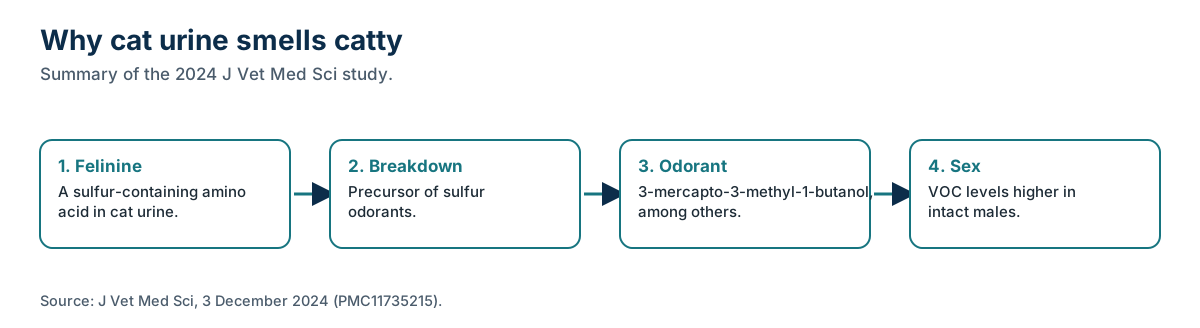
Cat urine contains the same basic ingredients as other urine: water, urea, salts and organic compounds. It also contains felinine, which the study below describes as "a sulfur-containing amino acid."
A 2024 study in the Journal of Veterinary Medical Science looked at felinine and the "catty" smell. It describes felinine as the precursor of sulfur-containing odorants, including 3-mercapto-3-methyl-1-butanol, which it treats as a major contributor to the characteristic odor.
The same study also found differences by sex. It reports that "levels of the sulfur-containing VOCs are higher in intact males than other sexes," and that "Cauxin is a major urinary protein excreted at higher levels in male cats." The paper says cauxin plays a key role in felinine metabolism, and that felinine excretion is regulated by testosterone. That fits the common experience that an unneutered male's spraying smells the worst.
What carpet experts say about cat urine
The Carpet and Rug Institute's pet urine bulletin addresses cats directly: "Unless the cat urine can be completely removed, complete odor removal is unlikely." It's written about carpet, but the logic carries over. Odor follows the urine, and mattresses hold more of it than carpet.
The bulletin also says "Urine content will change over the pet’s life because of the pet’s diet, medications, age, health, sex, and reproductive cycles." An older cat with kidney disease, a young male, and a spayed female can leave different stains on the same mattress. The 2024 study itself found a significant decrease in urinary felinine in cats with advanced kidney disease, a reminder that urine varies cat to cat.
The ordinary chemistry still applies
Cat urine also goes through the same changes as other urine. Bacteria break urea down into ammonia: "Microbial ureases hydrolyze urea to ammonia and carbon dioxide," as a microbiology review puts it. NASA's 1971 urine study saw the same: "This bacterial action resulted in the decomposition of urea and the evolution of large amounts of ammonia." So an old cat accident smells of ammonia and sulfur at once.
Because bacteria drive that chemistry, people ask whether we sanitize. We clean; the CDC's sanitizing definition is in Hub 2.
Why cats often go back to the same spot
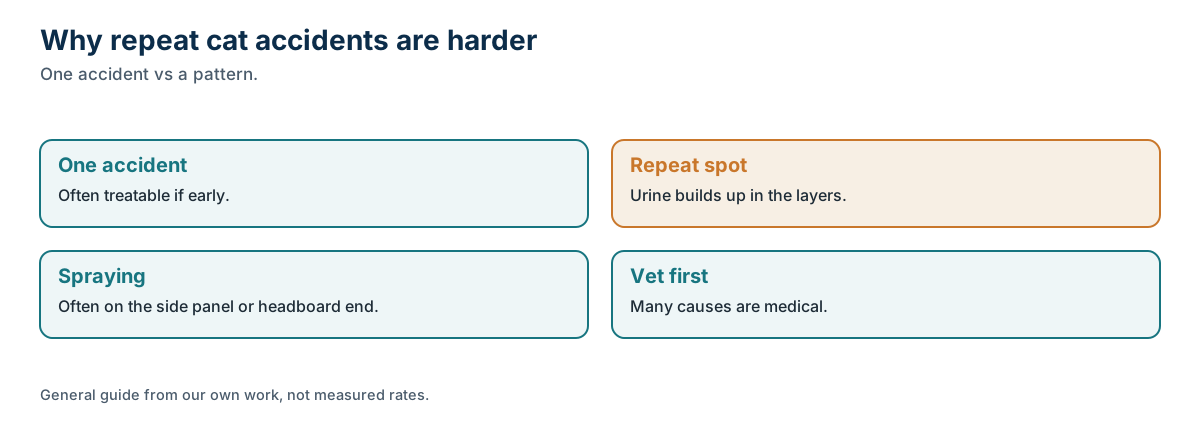
People often notice that a cat returns to a spot it has used before. A common explanation is that cats can still smell traces we can't. Whatever the reason, it's a practical problem: a mattress with repeated cat accidents builds up urine in the layers faster than one cleaning can remove it.
If your cat has started urinating on the bed, talk to a vet. Many causes are medical, and cleaning won't fix those.
What to do right away
- Strip the bed. Wash sheets and protector separately from other laundry.
- Press, don't rub. Dry towels, firm pressure, swapped often.
- Don't add water. It spreads cat urine into a wider area.
- Skip the steam cleaner. PetMD's guide says: "Don't use a steam cleaner, as the heat can set the stain."
- Skip fragrance. It covers sulfur odor for a short time, then the smell comes back.
- Keep the cat out of the room until the bed is treated and dry.
Do enzyme cleaners work on cat urine?
Enzyme treatment is widely recommended for pet urine. The CRI bulletin notes that "Enzyme-based treatments are available at pet stores, veterinarian offices or other retail stores." Mattress makers mention them too: Avocado's help center says "To remove urine from a mattress, you'll need a good enzymatic cleaner," and Purple's guide says: "Urine, vomit, or sweat stains may require an enzyme cleaner or hydrogen peroxide." Our Avocado and Purple pages have the full quotes.
What we haven't found is a study showing how well enzyme products remove felinine-derived odorants from mattresses. We don't claim they do. We use them because they're designed to break down organic soils and makers point to them for urine.
How we treat cat urine
This is our method, not any manufacturer's guidance.
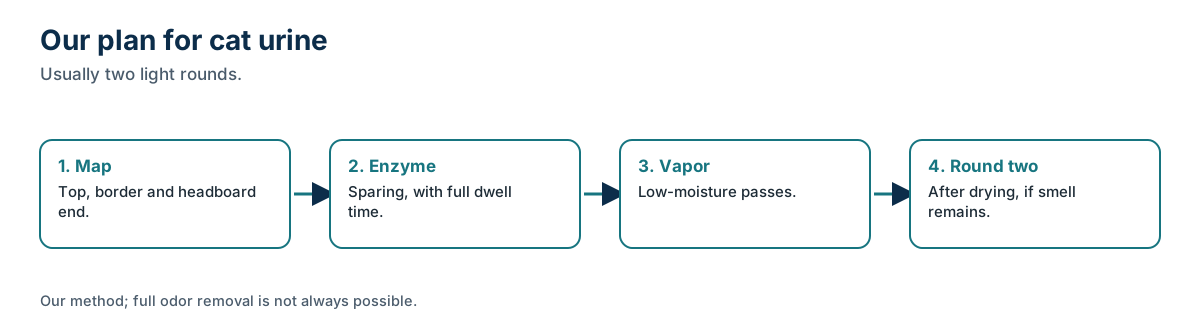
Cat jobs get a more careful map, because cats often use more than one spot and spraying can hit the border. Enzyme product goes on each spot lightly and is left for its full dwell time before dry vapor from a Magnum XP, ProV 350 or Pro6 Duo. Organic methods are our default, and we often plan a second light round.
On foam, the moisture limit matters more than ever, because cat urine that's pushed deeper is cat urine that stays. Our memory foam page and Hub 1's moisture article explain why. Heat and moisture are separate variables, so we can use heat at the surface without soaking the bed.
A single cat accident is within our standard price. Severe, biohazard or extensive contamination carries a quoted surcharge.
This is our method and reasoning, not a maker's. Your care label and warranty terms govern, so check your warranty before booking a cat-urine treatment.
Setting expectations
On a single, fresh accident in the top layers, we'd expect the smell to clear or nearly clear. On an older or larger one, we'd expect a strong improvement, with some chance of a faint smell on humid days. On a bed a cat has used repeatedly, we'll be honest: full odor removal is unlikely, and the CRI's sentence about cats applies.
Drying matters too. The EPA's mold guide advises drying wet materials within 24 to 48 hours. Low-moisture work stays well inside that.
Cats and new mattresses
People who replace a mattress after cat accidents are sometimes surprised when the cat uses the new one. If the reason for the behavior hasn't changed, the new bed is just a new surface. Ask your vet first, keep the bedroom door closed while you work on it, and put a waterproof protector on the new bed before it's ever slept on.
The full mattress urine guide compares cat urine with every other accident. Pet urine vs human urine and why odor returns after drying both matter for cat owners.
Spraying versus squatting
Not all cat urine on a bed is the same behavior. A cat that squats and urinates on a bed leaves a pool that soaks down. A cat that sprays leaves a smaller amount on a vertical surface, which on a mattress often means the side panel or headboard edge. When we map a cat job, we check the border and the headboard end for exactly that reason.
Keeping the cat off while it dries
A damp, treated spot can draw a cat back. Keep the bedroom door closed until the bed is fully dry, then put a protector on before the cat has access again. A washable throw on the cat's favorite spot gives it somewhere else to settle.
What we don't know
- How well any enzyme product removes the sulfur odorants studied in the 2024 paper, on mattresses specifically.
- How much a cat's sex, age or health changes the result on your bed. The research shows urine varies; it doesn't predict cleaning outcomes.
- Why your cat chose the bed. Your vet can help with that.
Changelog
- 2 October 2026: First published. Sources accessed on this date.
Sources
- Reduction of urinary felinine in domestic cats with renal diseases leads to decreased catty odor (J Vet Med Sci, 3 Dec 2024) · PubMed Central
- Pet Urine and Carpet (technical bulletin, revised 27 July 2017, accessed 2026-10-02) · Carpet and Rug Institute
- How To Get Rid of Cat Pee Smell (accessed 2026-10-02) · PetMD
- Composition and Concentrative Properties of Human Urine (NASA contractor report, July 1971) · NASA
- Microbial ureases: significance, regulation, and molecular characterization (Mobley and Hausinger, Microbiol Rev, 1989) · PubMed Central
- How to Clean Your Natural Mattress Without Using Harsh Chemicals (25 June 2026, accessed 2026-10-02) · Avocado
- How To Clean a Mattress in 9 Steps (last updated 16 Oct 2025, accessed 2026-10-02) · Purple
- A brief guide to mold, moisture and your home · US EPA
- Magnum XP-Vac product page (maker's claims, accessed 2026-10-02) · Vapor Clean
- ProV 350 product page ('Italian Made'; maker's claims, accessed 2026-10-02) · Vapor Clean
- Pro6 Duo product page ('Made in Italy'; maker's claims, accessed 2026-10-02) · Vapor Clean
Last reviewed October 2, 2026. Manufacturer specifications and care instructions change; check the current version for your exact model. This page is general information, not medical advice. How we source and check pages: editorial standards.