
Short answer
We haven't found evidence that enzyme cleaners themselves damage memory foam, and Purple's care guidance names enzyme cleaners for urine stains. The documented risk is the liquid. Tempur-Pedic says its material should never become wet, and Casper warns its foam core will soak up water and detergent. Used sparingly, with dwell time and good drying, enzymes are a common part of treating urine on foam.
Key terms used on this page
- Enzyme cleaner:
- A cleaning product that uses enzymes to break down organic soils such as urine, sweat, vomit or blood. Several mattress makers mention them for urine stains, including Purple and Avocado. They are liquids, so how much is applied matters as much as what is applied. Sleep Sanitation uses enzyme treatment on urine and organic odor, sparingly.
- Dwell time (enzyme products):
- How long a cleaning product stays on a surface before it is removed or dried. Enzyme products need dwell time to work, and the label sets it. Longer dwell does not mean more liquid: on a mattress we keep the amount small so the foam underneath doesn't soak.
- Memory foam (viscoelastic foam):
- An open-cell, slow-recovery polyurethane foam that softens with body heat and conforms to pressure. Because its cells are open, liquid can travel into it, and because it is dense and insulating, it is slow to dry.
- Moisture load:
- The total amount of water a cleaning process puts into a mattress, whether from spray, steam condensate, shampoo or rinse. It is the main thing that decides how long a mattress takes to dry.
- Reading your label and warranty:
- A brand's web page is general; the sewn-in label and care tag speak for your model. Before any cleaning: find the care tag and law label, usually at the foot or along a side seam; keep your receipt and warranty together and read any clause on liquids, stains or cleaning; note which of the six variables the label names (water, soaking, heat, steam, chemicals, cover); and if the label or warranty says more than the web page, follow it, tell your cleaner before a visit, and ask the manufacturer if you're unsure.
- Residual moisture:
- Water left in a material right after cleaning, before drying. For carpet, the Carpet and Rug Institute's test for its deep-cleaning extractor seal allows up to 8 ounces per square yard. We have not found an equivalent published test for mattresses.
People worry about enzyme cleaners for a reasonable-sounding reason. If enzymes break down organic material, might they break down a mattress? The short answer: we haven't found evidence they harm memory foam, and some foam makers recommend them. The thing that does cause trouble on foam is how much liquid ends up in it.
Not affiliated with or endorsed by any manufacturer listed. Brand names are used only to identify products and their published care instructions.
What an enzyme cleaner is
An enzyme cleaner is a cleaning product that contains enzymes chosen to break down specific kinds of organic soil, such as the compounds in urine, sweat or vomit. Each type of enzyme speeds up a particular reaction, so each works on particular materials.
Nature already provides an example from urine itself. Bacteria produce an enzyme, urease, that breaks down urea. A microbiology review describes it this way: "Microbial ureases hydrolyze urea to ammonia and carbon dioxide." Cleaning products use other enzymes, picked for the soils they target. Product labels say which ones, and we don't make claims about any specific formula.
The hub glossary has a short definition.
An enzyme cleaner cleans; it isn't a sanitizer. Hub 2's glossary gives the CDC's meaning of sanitize.
What manufacturers say
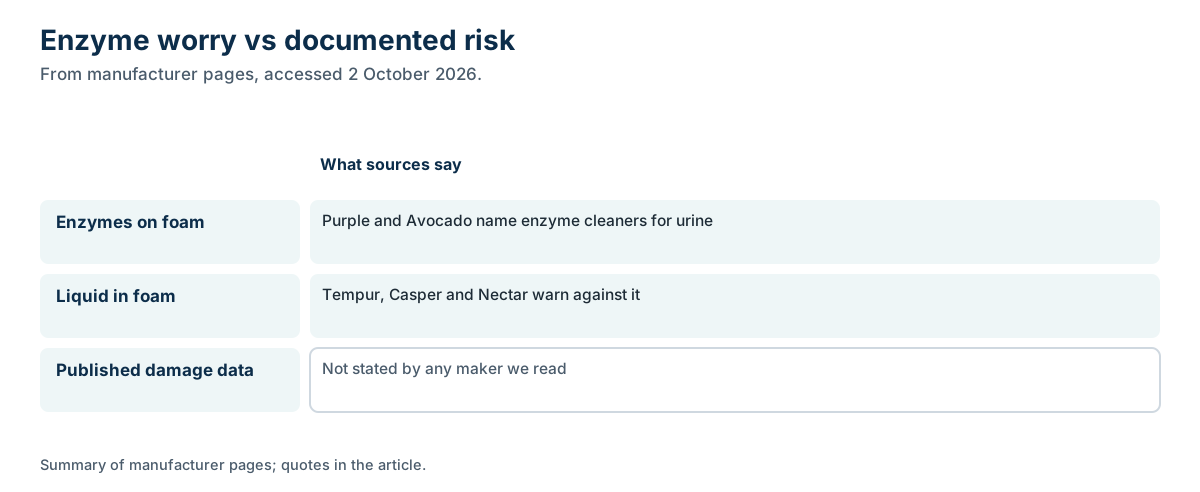
Foam-mattress makers mention enzyme cleaners directly:
- Purple: "Urine, vomit, or sweat stains may require an enzyme cleaner or hydrogen peroxide." Its guide also says: "Spot-clean spills and stains with a mild detergent or enzyme cleaner."
- Avocado: "To remove urine from a mattress, you'll need a good enzymatic cleaner."
The Carpet and Rug Institute's pet urine bulletin, written for carpet, notes: "Enzyme-based treatments are available at pet stores, veterinarian offices or other retail stores."
None of these sources warns that enzymes damage foam. Our Purple page and Avocado page quote both makers in full.
The real risk: liquid
Every foam maker we checked worries about liquid, whatever product it's in.
- Tempur-Pedic: "TEMPUR® material should never become wet."
- Casper cautions against saturating its beds, because the core foam absorbs water and detergent.
- Nectar wants spills handled on the cover, quickly, without letting liquid get through to the foam. Its full sentence is on our Nectar page.
Memory foam's open cells take liquid in and give it back slowly. Our Hub 1 article on water in memory foam explains why. A heavy dose of any cleaner, enzyme or not, can leave the foam damp for days. Damp foam can hold odor and, if it stays wet long enough, support mold; the EPA's mold guide advises drying wet materials within 24 to 48 hours.
So the useful question isn't "is the enzyme bad for foam?" It's "how do I give the enzyme time to work without soaking the foam?"
Dwell time without a soak
Enzymes need dwell time: they have to stay in contact with the soil long enough to work. Consumer advice often handles that by saturating the stain and covering it. On carpet that may be fine. On a mattress, it trades the urine problem for a moisture problem.
What works better on foam:
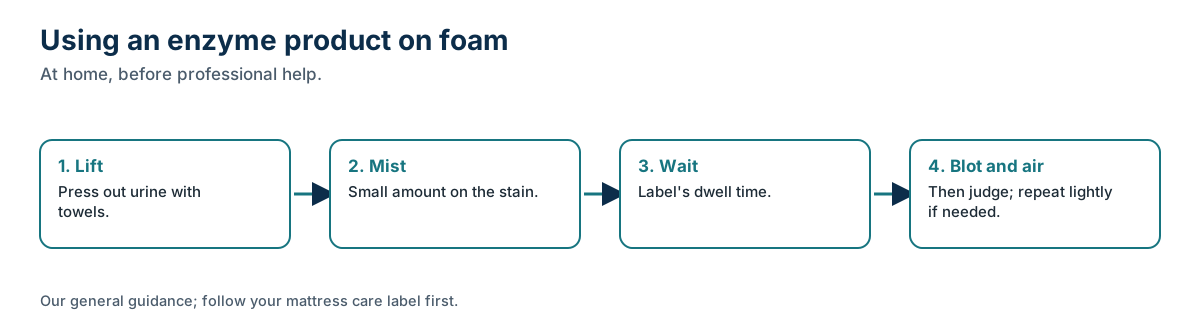
- Lift first. Press out as much urine as you can with dry towels before any product goes on.
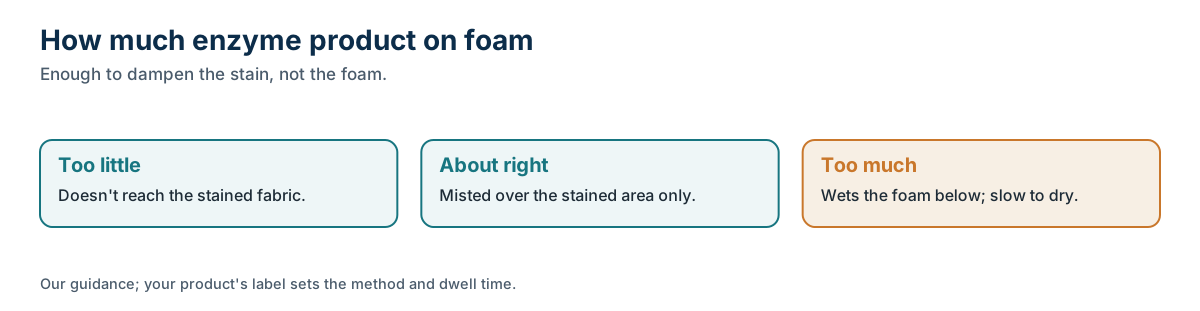
- Mist, don't pour. Apply a small amount, enough to dampen the stained area, not to wet the foam below.
- Follow the label's time. Let it sit as directed.
- Blot and dry. Press out what you can, then move air across the surface.
- Repeat if needed. A second light round beats one heavy one.
Other things to watch
- Read your mattress label. Your care label and warranty may restrict cleaners. Our label check explains what to look for.
- Spot-test the cover. Some fabrics react to cleaners. Try a small hidden area first.
- Don't mix products. Use one product at a time, and let it dry before switching.
- Don't add heat right away. Enzymes need their dwell time first.
How we use enzymes on foam
This is our professional method, not any manufacturer's guidance.
Our practice on foam reflects all of this. Enzyme product goes on the mapped urine only, in a light mist, and sits for its dwell time before any dry-vapor pass from a Magnum XP, ProV 350 or Pro6 Duo. Output stays low on memory foam, and organic methods are our default. Hub 1 explains why professional cleaning doesn't need detergent for routine work, and the memory foam page covers each foam maker's rules.
Foam beds with ordinary accidents fall under the standard price.
Why the worry persists
The idea that enzymes might eat foam sounds logical, which is probably why it spreads. Enzymes break down organic soils; foam is a manufactured material. Product labels tell you what a cleaner is for and how to use it. Read them, follow them, and you're in the territory foam makers like Purple describe.
There's also a real experience behind the worry. People soak a foam bed with cleaner, the area stays damp for days, and then it smells or feels different. That's a moisture problem. It would have happened with water alone.
Enzymes compared with other options
Manufacturers mention a few other options for urine. Purple names hydrogen peroxide alongside enzyme cleaners. Naturepedic's care page says: "In the unfortunate event of an accident without a waterproof pad, our best advice is to pour some hydrogen peroxide (3%) or rubbing alcohol on the soiled area and allow to soak in." The same page then warns that liquid exposure may damage the mattress. Nectar recommends mild detergent or hand soap on the cover.
Each of these is the maker's advice for its own beds. If your manufacturer names a product type, use that one, and spot-test it on a hidden area of the cover first. Don't combine them.
A quick decision list
- Your mattress maker names an enzyme cleaner for urine: use one, sparingly, as the label directs.
- Your maker names a different product: use that instead.
- Your maker says the material should never get wet: keep any product to the cover, and consider professional low-moisture treatment.
- You aren't sure: read the care label first, then the maker's website, then the warranty.
Following that order keeps you inside what the manufacturer has actually said, which is the most useful protection a mattress owner has.
The mattress urine guide covers enzymes alongside heat and drying. For how we combine the two, see enzyme treatment and dry vapor together; for home rounds on foam, urine in memory foam without soaking.
Spot-testing, briefly
Pick a hidden area of the cover, such as near the foot on the side panel. Apply a small amount of the product, wait the label's time, blot, and let it dry. If the fabric changes color or texture, don't use that product on the visible stain.
Gel and specialty foams
Cooling gel foams and other specialty foams follow the same logic: the product matters less than the amount of liquid. Our cooling gel foam page collects what those makers say about cleaning.
What we don't know
- Whether any specific enzyme product has been tested on any specific memory foam. We haven't found published results from foam makers or product makers.
- How long a given product should dwell on foam. That's the product label's job, not ours.
- What your warranty says about cleaning products. Check it.
Changelog
- 2 October 2026: First published. Sources accessed on this date.
Sources
- How To Clean a Mattress in 9 Steps (last updated 16 Oct 2025, accessed 2026-10-02) · Purple
- How to Clean Your Natural Mattress Without Using Harsh Chemicals (25 June 2026, accessed 2026-10-02) · Avocado
- Pet Urine and Carpet (technical bulletin, revised 27 July 2017, accessed 2026-10-02) · Carpet and Rug Institute
- Product care (US, accessed 2026-10-02) · Tempur-Pedic
- How to clean your mattress: a mattress care guide (accessed 2026-10-02) · Casper
- Nectar Sleep FAQ (accessed 2026-10-02) · Nectar
- Product Care (accessed 2026-10-02) · Naturepedic
- Microbial ureases: significance, regulation, and molecular characterization (Mobley and Hausinger, Microbiol Rev, 1989) · PubMed Central
- Magnum XP-Vac product page (maker's claims, accessed 2026-10-02) · Vapor Clean
- ProV 350 product page ('Italian Made'; maker's claims, accessed 2026-10-02) · Vapor Clean
- Pro6 Duo product page ('Made in Italy'; maker's claims, accessed 2026-10-02) · Vapor Clean
- A brief guide to mold, moisture and your home · US EPA
Last reviewed October 2, 2026. Manufacturer specifications and care instructions change; check the current version for your exact model. This page is general information, not medical advice. How we source and check pages: editorial standards.