
Short answer
Bedroom CO2 is mostly your own breath. In a closed room it climbs overnight until outdoor air dilutes it, often from about 430 ppm to well over 1,000 ppm. It's best read as a sign of how much fresh air reaches the room. Small studies link better bedroom ventilation to better sleep, but ASHRAE calls the evidence for direct CO2 effects inconsistent. Opening a door or window, or adding mechanical ventilation, lowers it.
By Matthew Brunken · Updated October 7, 2026 · Last reviewed October 7, 2026 · Sources · Editorial standards
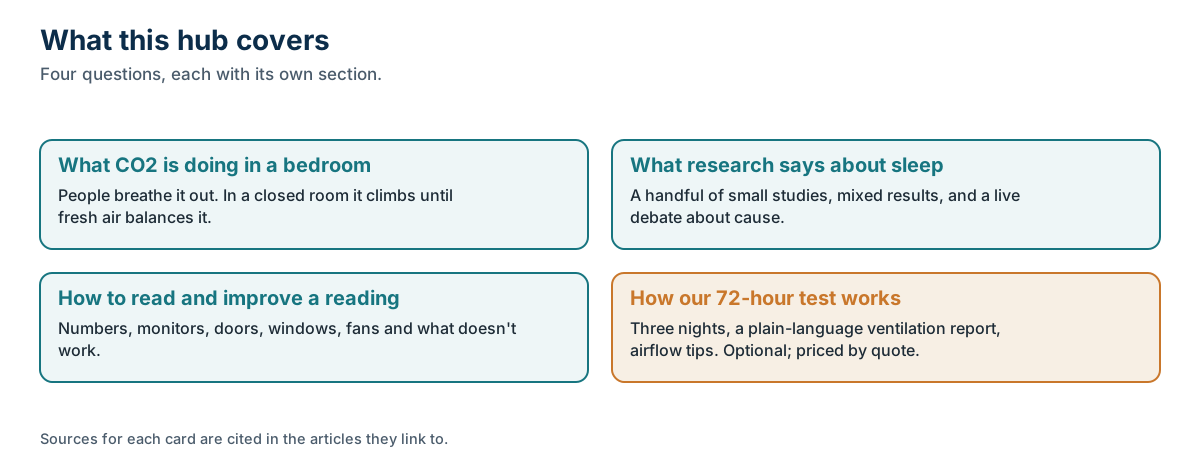
Carbon dioxide in a bedroom is mostly the breath of the people asleep in it. With the door and windows shut, the level climbs through the night until outdoor air leaking or blowing in balances it. That makes bedroom CO2 a useful window into one question: how much fresh air reaches the room while you sleep? This hub explains the physics, the research, the numbers people quote and the fixes that actually move the reading.
This hub is general information about bedroom air and ventilation, not medical advice. For sleep or health concerns, talk with a doctor.
Why a whole hub on bedroom CO2
You spend the night in one room, often with the door shut, and it's the room ventilation standards say least about. An ASHRAE committee brief notes that standards and guidelines "rarely have specific requirements for bedrooms." Meanwhile, cheap monitors have put a number on the nightstand, and the number often looks alarming. People share screenshots of 2,000 ppm mornings; others reply that submarines run higher and nobody is harmed. Both sides have a point, and neither tells the whole story. This hub sorts it out with sources, so you can decide what, if anything, to change.
What CO2 is doing in your bedroom
Start with what a normal bedroom CO2 level is. Outdoor air is about 428 ppm, and Health Canada's survey of Canadian homes found median readings of 418 to 729 ppm, with 95th percentiles as high as 1,483 ppm. A closed bedroom can go far higher, because a resting adult breathes out roughly 15 liters of CO2 an hour into a fixed volume of air.
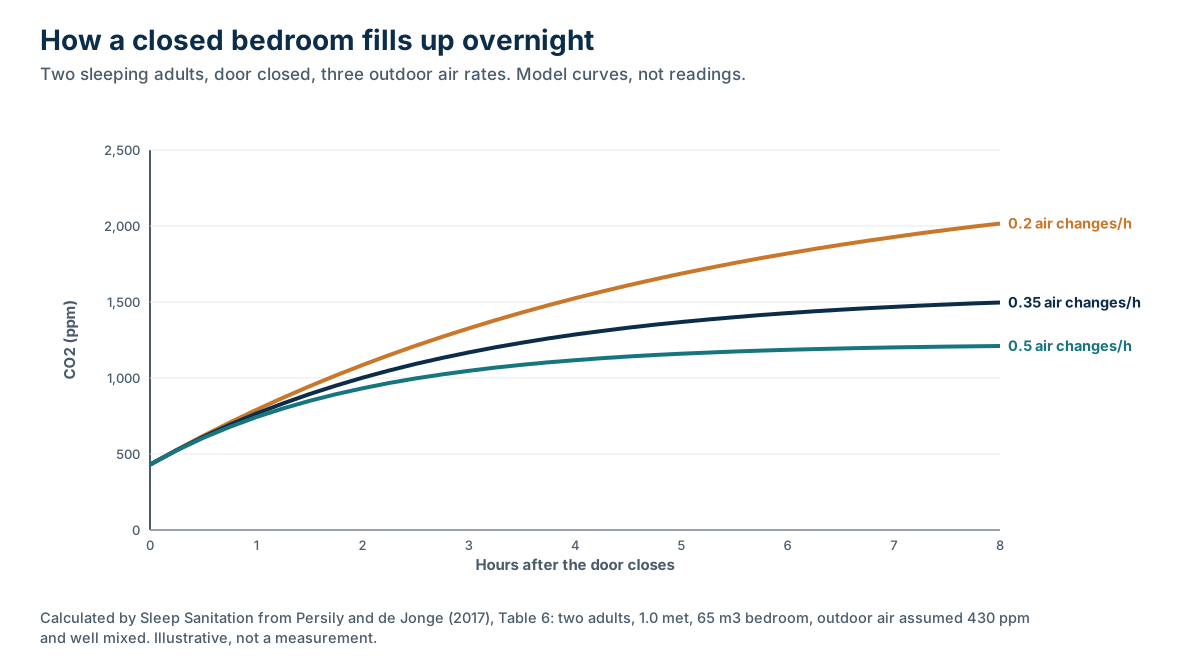
Why CO2 builds up in a closed bedroom overnight works through the mass balance using published model values. The short version: the less outdoor air the room gets, the higher the level climbs and the longer it takes to level off. In a tight room it can still be rising when the alarm goes off. Shared bedrooms, kids' rooms and pets explains why two adults in a small room read so differently from one child.
What the research says about sleep
The evidence is genuinely mixed, and we present it that way. What research says about bedroom CO2 and sleep walks through the field studies: students sleeping better with a window open or a quiet intake fan, Danish bedrooms where opening windows meant longer sleep, and a single-blind study in which participants had less deep sleep when their exhaust fan was covertly turned down. It also covers a double-blind study in children that found no effect.
Is CO2 the problem, or a marker of stale air? takes on the debate directly. One chamber study found that pure CO2 at 3,000 ppm did nothing measurable, while the same level of CO2 from people's own bioeffluents made subjects feel worse. Another found sleep quality fell as pure CO2 rose. Where the 1,000 ppm number comes from traces a figure that began as a marker for body odor, and why 5,000 ppm isn't a bedroom target explains why workplace limits answer a different question.
Getting more fresh air in
What lowers bedroom CO2 is outdoor air, delivered one way or another. Open door vs window vs fan compares the options, including a Danish finding that opening doors cut CO2 nearly as much as opening windows but wasn't tied to the same sleep gains. Tight homes and Nebraska winters explains why newer homes are built airtight and ventilated by code, and why a closed bedroom door can still cut a room's share of that air.
Two shortcuts don't work. Air purifiers and houseplants don't measurably lower CO2: the EPA's air cleaner ratings cover particles only, and a plant takes up a tiny fraction of what one sleeper breathes out. And because ventilation moves moisture as well as CO2, bedroom CO2, humidity and bed mites connects this hub with our allergens hub and the moisture and heat hub.
Measuring and reading CO2
Not every monitor measures CO2. How home CO2 monitors work explains the difference between NDIR sensors, which measure the gas, and eCO2 sensors, which estimate it from other signals. How to read a night of bedroom CO2 readings uses a clearly labeled illustrative chart to show what the starting level, the slope, the peak and the response to a change each tell you.
How our 72-hour test fits
We offer a 72-hour bedroom CO2 test. A monitor stays in your bedroom for three nights, and you get a plain-language ventilation report with airflow tips. It's an optional add-on priced by quote, booked on its own or added to a mattress visit, and never included in one. It isn't a medical test: it doesn't diagnose anything and makes no promise about sleep or health. How the 72-hour bedroom CO2 test works sets out exactly what it does and doesn't do.
How we handle evidence here
We lean on primary sources: ASHRAE's 2025 position document on indoor CO2, Health Canada's residential guideline, OSHA and NIOSH, federal building research and peer-reviewed studies. Where a study had industry involvement, we say so: in Fan et al. (2023), the ventilation systems came from a manufacturer whose R&D staff were co-authors. Thresholds from reviews are presented as tentative, not as limits. Charts built from published model values say so in their captions, and our illustrative night chart is not customer data.
Sleep Sanitation's position
This section is our view. We think bedroom CO2 is worth knowing about because it's a cheap, honest signal of airflow in the room where you spend every night, and because the fixes are often simple. We don't think a number on a monitor is a reason for alarm, and we don't claim that lowering it will change how you sleep. Every mattress visit includes two checks, a moisture check after service and the built-in bed mite sensor on our UV-C vacuum; the CO2 test is separate and optional. To ask about it, call or text (402) 512-5658 or see our process.
What we don't know
- Whether CO2 itself, or the other things that build up with it, explains the sleep differences seen in field studies. The studies to date can't fully separate them.
- How the findings, mostly from young, healthy adults in Denmark and the Netherlands, apply to older sleepers, children at home or Nebraska houses.
- What bedroom CO2 levels typically look like in Lincoln and Omaha homes. We found no published local survey.
Changelog
- 7 October 2026: First published. Sources accessed on this date.