
Short answer
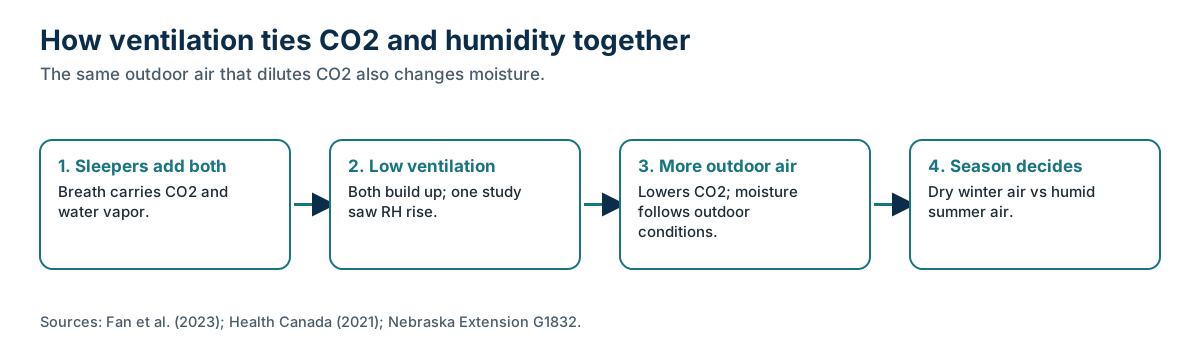
They share a cause: how much outdoor air reaches the bedroom. Sleepers add both CO2 and moisture, so a poorly ventilated room tends to get stuffier and more humid; one field study saw relative humidity rise at low ventilation. Mites need humidity above about 65% to thrive, and allergy guidance suggests keeping indoor humidity around 35% to 50%. CO2 doesn't affect mites directly; humidity does.
Key terms used on this page
- Relative humidity:
- How much moisture the air holds compared with its maximum at that temperature. Dust mites depend on humid air. NIEHS advises keeping indoor humidity at or below 50 percent, and the practice parameter gives a range of 35 to 50 percent.
- "Bed mites":
- A common search term, not a species. When people say bed mites they usually mean house dust mites living in bedding. It is sometimes confused with bed bugs, which are insects visible to the eye.
- Outdoor air ventilation:
- Outdoor air brought into a space on purpose or by leakage, which dilutes what people and the building give off. ASHRAE says indoor-outdoor CO2 differences can be used to evaluate outdoor ventilation rates, given valid assumptions.
- ERV / HRV:
- Energy or heat recovery ventilators: balanced systems that bring in outdoor air and exhaust stale air through a core that transfers heat, and with an ERV some moisture, between the two streams.
- Bioeffluents:
- Compounds people give off from skin and breath, the source of stuffy-room odor. In a chamber study, bioeffluents with CO2 at 3,000 ppm worsened perceived air quality and symptoms, while pure CO2 at the same level did not.
Bedroom CO2, humidity and mites are linked by ventilation. Sleepers breathe out moisture along with CO2, so a bedroom that gets little outdoor air tends to get both stuffier and more humid. Mites, a major source of mattress allergen, depend on humidity. CO2 itself doesn't affect them, but the airflow it signals can. This article connects our bedroom CO2 pages with our allergens hub and our moisture and heat hub.
General information about bedroom air, humidity and mites, not medical advice. For allergy symptoms, talk with an allergist or doctor.
Why do CO2 and humidity rise together?
Because they have the same source and the same exit. People add both by breathing, and outdoor air carries both away. In a single-blind field study of 29 bedrooms, Fan et al. (2023) covertly turned exhaust ventilation down and up. "At lower ventilation rate conditions, the concentrations of CO2 increased, as did the relative humidity, while bedroom temperatures remained unchanged."
So a high overnight CO2 reading is a hint that moisture from sleepers is also lingering. It's only a hint: humidity also depends on the weather, the season, bathrooms and cooking, and whether air conditioning or a humidifier is running. To know your humidity, measure it with a hygrometer.
Why do mites care about humidity?
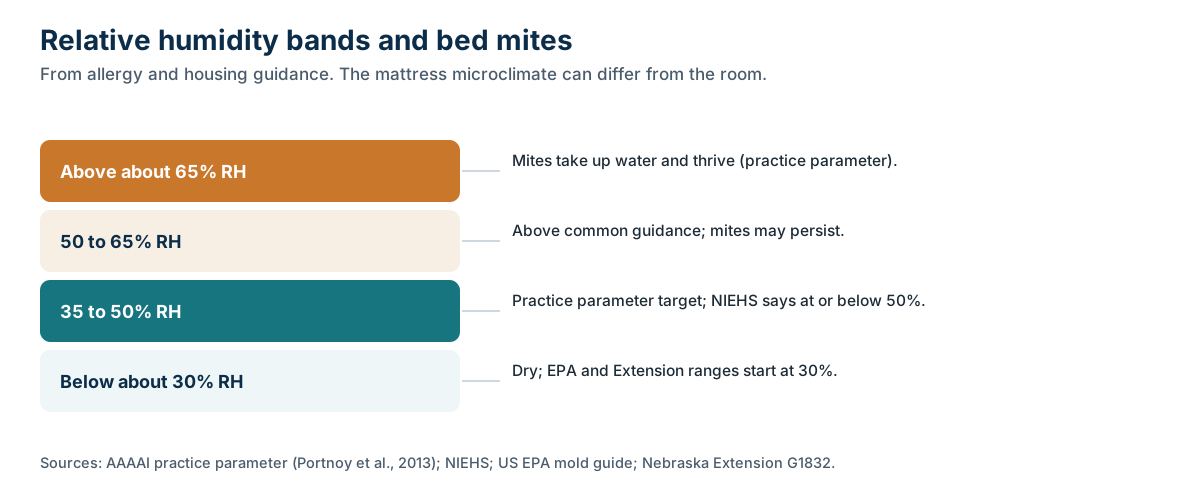
Because they drink from the air. The AAAAI's practice parameter on mite control explains that mites get their water by absorbing vapor, and "the most important facilitative factor for mite growth is RH." It says "mites require RH higher than 65% to prevent water loss and to thrive," and "once humidity decreases below 50%, mite proliferation decreases and survival is decreased."
Short spikes matter. The same document notes that "if the humidity increases for as little as 1.5 hours per day, as could occur during cooking or bathing, the mites can survive," and that "an elevated RH for as briefly as 3 hours per day permits mites to produce eggs."
What humidity do allergists and agencies suggest?
Similar ranges from several sources:
- The AAAAI practice parameter: homes where RH "can be kept at 35% to 50% continuously will have lower concentrations of mite allergen than in homes in which RH is permitted to fluctuate."
- NIEHS: "Use a dehumidifier or air conditioner to maintain humidity levels at, or below, 50 percent."
- The EPA's mold guide: "keep indoor humidity below 60 percent (ideally between 30 and 50 percent) relative humidity."
- Nebraska Extension's moisture checklist: an optimum range "between about 30 percent and 50 percent."
Our allergens hub defines relative humidity and explains how it fits into mite control. It's one measure among several; the hub's article on why mite control needs more than one step explains why.
Is the bed more humid than the room?
It can be. The AAAAI notes mites "live deep within soft substrates, such as pillows, mattresses, and carpets, where moisture is retained and humidity fluctuations are minimized." A body lying on a mattress for hours adds warmth and moisture right where mites live. So room humidity is a useful guide, but it isn't a measurement of the inside of your mattress. Our moisture hub covers how mattress moisture can lead to mildew or mold.
Does ventilation always lower humidity?
No. It depends on what the outdoor air holds:
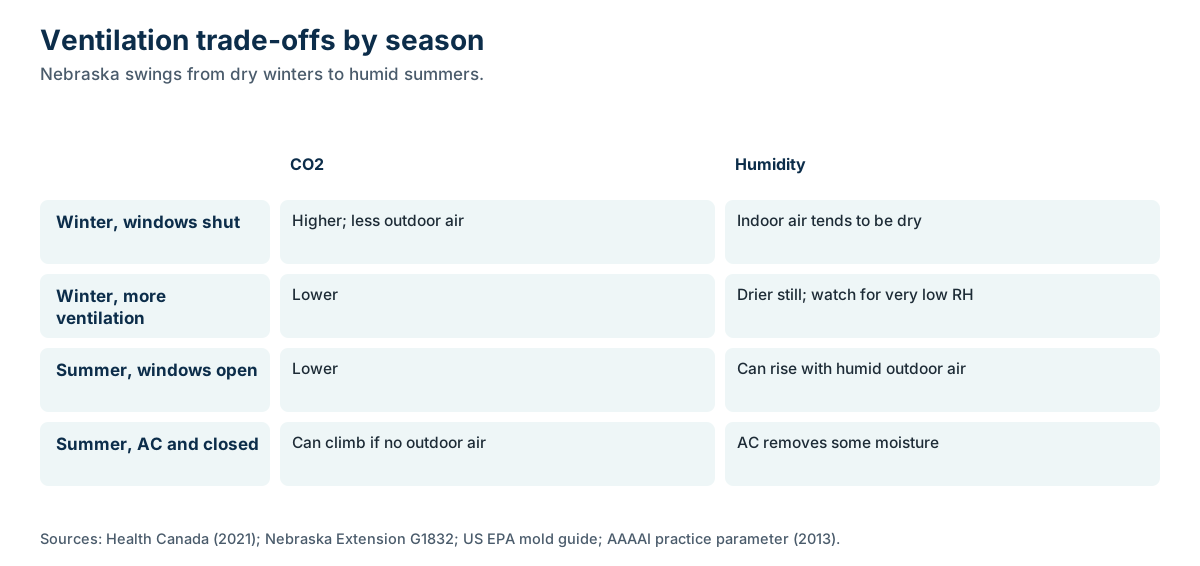
- Winter. Cold outdoor air carries little moisture, so more ventilation usually dries a heated home. That can push humidity below the comfortable range. An ERV, the DOE notes in its HRV/ERV checklist, "also transfers moisture," which can help keep some humidity in.
- Summer. Humid outdoor air can raise indoor humidity when windows are open. Air conditioning removes some moisture, which is why NIEHS mentions it alongside dehumidifiers.
- Shoulder seasons. It varies night to night.
That means the best ventilation choice for CO2 isn't always the best for humidity. In a Nebraska summer, for example, a closed, air-conditioned bedroom may keep humidity down while CO2 climbs, and an open window may do the reverse. Tight homes and Nebraska winters covers the winter side.
What about window condensation and mold?
Condensation is another sign that moisture and ventilation are out of balance. The EPA's mold guide says "the key to mold control is moisture control," and that "condensation can be a sign of high humidity." Its suggested actions to prevent condensation include reducing humidity and to "increase ventilation or air movement by opening doors and/or windows, when practical." Those are the same moves that lower bedroom CO2.
If you wake to fogged or wet bedroom windows on cold mornings, the room is holding a lot of moisture from the night, possibly alongside a high CO2 reading. Opening the door, running a ventilation fan or briefly airing the room can address both. If condensation keeps returning, or you see mold, the EPA guide and our moisture hub are better starting points than a CO2 monitor.
What about humidifiers and plants?
Both add moisture. In winter that can be welcome; for mites, more isn't better. In an office study by Jiang et al. (2024), 18 Boston ferns raised median relative humidity from 29.1% to 49.2%. Do air purifiers or houseplants lower bedroom CO2? covers why plants don't help with CO2. If you run a humidifier in a bedroom, a hygrometer helps you keep it in range rather than guessing.
Should I worry about CO2 and mites together?
Not as one problem. CO2 tells you about airflow; humidity tells you about moisture; mites respond to humidity and to what's in the mattress. Treating a high CO2 reading as a mite warning would overstate the link, and treating a low reading as proof the bed is dry would too. Measure humidity directly if mites are your concern, and use CO2 for what it's good at: showing whether outdoor air reaches the room.
A practical approach
- Measure both. A CO2 log shows airflow; a hygrometer shows humidity.
- Ventilate to keep CO2 reasonable, using the options in open door vs window vs fan.
- Watch humidity as you change ventilation, aiming for the 35% to 50% range allergy guidance suggests, and using air conditioning or a dehumidifier in humid weather.
- Address the mattress itself if mites are your concern; humidity is one factor, and our allergens hub explains the others.
Health Canada's CO2 guideline notes that in most homes, finding sources and reduction measures is more useful than testing alone. The same is true here: the measurements are there to guide simple changes. The hub links the rest of the CO2 topic.
Sleep Sanitation's view
This section is our view. CO2, humidity and mites are often talked about separately, but in a bedroom they share the same airflow. Our optional 72-hour bedroom CO2 test is a ventilation check: three nights of logging and a plain-language report with airflow tips, priced by quote, and not a medical test or a mite test. Mattress visits are separate and include two checks: a moisture check after service and the built-in bed mite sensor on our UV-C vacuum. See our process.
What we don't know
- How closely mattress-level humidity tracks room humidity overnight in real bedrooms. We found no study measuring both.
- Whether bedroom ventilation changes alone measurably affect mite numbers in a mattress. Studies of dehumidification used whole-house measures.
- How Nebraska's seasonal swings affect bedroom humidity in tight, mechanically ventilated homes.
Changelog
- 7 October 2026: First published. Sources accessed on this date.
Sources
- A single-blind field intervention study of whether increased bedroom ventilation improves sleep quality (Fan et al., 2023) · Science of the Total Environment (DOI)
- Environmental Assessment and Exposure Control of Dust Mites: A Practice Parameter (Portnoy et al., 2013) · American Academy of Allergy, Asthma & Immunology
- Dust Mites and Cockroaches · National Institute of Environmental Health Sciences (NIH)
- A Brief Guide to Mold, Moisture and Your Home · US EPA
- Identifying Moisture and Mold Sources in Houses (G1832) · Nebraska Extension, University of Nebraska-Lincoln
- Residential Indoor Air Quality Guidelines: Carbon Dioxide (2021) · Health Canada
- Balanced HRV/ERV · Building America Solution Center (US DOE / PNNL)
- Effects of indoor plants on CO2 concentration, indoor air temperature and relative humidity in office buildings (Jiang et al., 2024) · PLOS One
Last reviewed October 7, 2026. Manufacturer specifications and care instructions change; check the current version for your exact model. This page is general information, not medical advice. How we source and check pages: editorial standards.