
Short answer
Because each layer meets water and heat differently. Covers dry quickly, open-cell foam holds water and insulates, latex has its own maker warning about heat, coil units let air through, and adhesives vary. Some care rules follow construction: Purple's general guide allows steam on innerspring and hybrid beds, not memory foam or latex, and says not to steam clean a Purple mattress.
Key terms used on this page
- Foam lamination:
- Bonding foam layers to each other or to fiber and fabric to build a mattress. Adhesive data sheets from Jowat, ADiNO, Worthen and 3M each describe bonding foam, which tells us mattresses are glued in different ways with different chemistries.
- Open-cell foam:
- Foam whose cells connect, so air can move through it. The PFA primer says foam performance is optimized when air flow is maximized, which indicates the cells are open. The same open structure that lets air through also lets liquid water in.
- Viscoelastic foam:
- The foam sold as memory foam. The Polyurethane Foam Association describes it as a type of open cell, flexible polyurethane foam with slow recovery after compression, and says its firmness, support and recovery rate are affected by temperature and humidity.
- Hot-melt adhesive:
- A solvent-free adhesive applied molten and set by cooling. ADiNO's FG 8240.0, sold for bonding PU foam in the mattress and upholstery industry, is applied at 150 to 180°C and lists a softening point of about 87°C.
- Waterborne adhesive:
- An adhesive carried in water that bonds as the water leaves. Worthen's FOAMLAM 1573, based on natural latex, is roll-applied for laminating foam layers in mattresses and lists solids of 50 ± 2 percent.
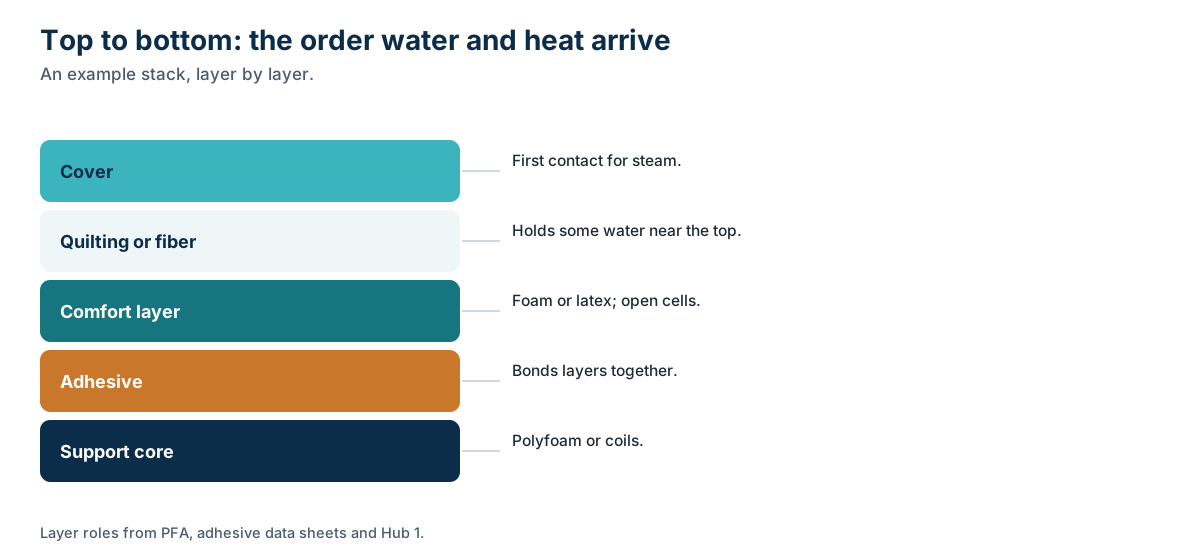
It's tempting to think of a mattress as a single object that is either "steam-friendly" or not. It isn't one object. It's a stack: a cover, sometimes quilted with fiber, one or more foam or latex comfort layers, a support core of foam or coils, and adhesive holding several of those together. Each layer meets water and heat differently, which is why a cleaning method that suits one mattress may not suit the next.
This article is general information about cleaning and materials, not medical or engineering advice. For mold or health questions, talk to a qualified professional.
A mattress is a stack
Hub 1's entry on mattress layers sets out the basic build, and Hub 2's moisture-sensitivity page ranks the materials. For cleaning, the useful way to think about the stack is from the top down, because that's the order in which water and heat arrive.
Covers and quilting
The cover is the first thing steam meets. A thin knit cover passes water quickly to whatever is underneath. A quilted cover with fiber batting holds more water near the surface, which can buy time but also means more to dry. Hub 3 covers this under cover and quilting, and Hub 2's pillow-top page covers the thickest version.
Foam comfort layers
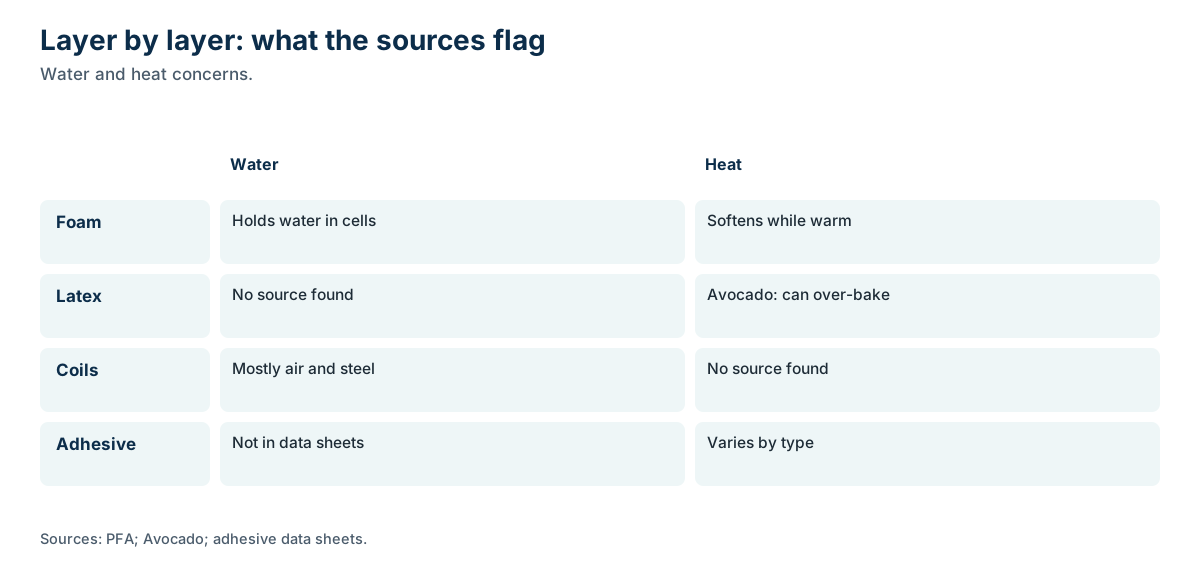
Foam is where water causes the most trouble. The Polyurethane Foam Association's viscoelastic bulletin describes memory foam as "a type of open cell, flexible polyurethane foam," and says its "firmness, support and height recovery rate are often affected by temperature and humidity." Its primer links good foam performance to open cells and high air flow.
Open cells hold liquid and foam insulates. Engineering ToolBox lists polyurethane foam's thermal conductivity at 0.03 W/(m K). So foam is the layer where water stays longest and where heat travels least. What happens when memory foam gets wet covers the detail.
Latex
Latex foam has its own maker guidance. Avocado's cleaning guide says, for its natural latex beds: "Allow any residual dampness to air-dry completely. You can place the mattress outside, since the natural latex is fully covered and not exposed to direct sunlight. However, a cool blow dryer will also work. Steam cleaners are not recommended because their excessive heat can over-bake the organic latex." Avocado gives heat, not water, as its reason. Hub 2's latex page covers latex in full.
Coils and the support core
A coil unit is mostly air and steel. Air moves through it far more freely than through a foam core, and steel doesn't absorb water. Purple's general guide, quoted below, also draws its line by construction, but it doesn't say why coil beds differ, so we don't attribute this reasoning to it. A foam core, by contrast, is another thick open-cell layer that holds water and insulates. How hybrid mattresses react differently from solid foam goes through the comparison.
The glue between layers
Layers are bonded, and the adhesives differ. Technical data sheets from adhesive makers show the range. Jowat's 639.10 is a reactive PUR hotmelt for foam mattress assembly, with "100 % solids content, no water used during bonding." ADiNO's FG 8240.0 is a polyolefin hotmelt for PU foam in the mattress and upholstery industry. Worthen's FOAMLAM 1573 is a waterborne adhesive based on natural latex, "Designed as a stable one-part, roll applied adhesive for laminating foam layers." 3M's 1000NF is a water-based adhesive that "Adheres to many types of flexible foam, latex foams, fabric, polyester" and other materials.
You can't tell from outside which of these, if any, your mattress uses. Can dry-vapor steam affect mattress adhesives? explains why that leaves an honest gap.
How makers draw the line
Purple's cleaning guide draws its steam rule by construction: "After vacuuming, you can steam clean your innerspring or hybrid mattress, but you should not steam clean a memory foam, latex, or adjustable mattress since the heat and water could damage its materials. Note that you should not steam clean a Purple mattress. If you have any doubts, refer to the manufacturer’s care instructions and your warranty." That's one maker's general advice, plus a rule for its own beds. It's not a measurement. But it shows a maker treating construction, not a brand or a price, as the deciding factor. Why some makers allow steam and others prohibit it sets it beside the other makers' passages.
Adjustable and specialty beds
Adjustable bases add motors and wiring beneath the mattress, and air-chamber beds add pumps and chambers. Purple lists adjustable mattresses among those not to steam clean. Hub 2's Sleep Number page covers an air-chamber bed. For these, the base maker's instructions matter as much as the mattress maker's.
Toppers and removable layers
A topper is a separate layer of foam, latex or fiber that sits on the mattress. For cleaning, it's a small mattress in its own right, with its own materials and possibly its own care label. Taking it off before a visit lets both pieces be inspected and treated separately, and lets each dry with both faces exposed. The same applies to removable covers: if the maker says a cover can be removed and washed, its care label governs that, not the mattress's.
Same method, different settings
Putting this together, two beds can get the same method and still be handled differently. Picture an innerspring bed with a thin quilted cover and a memory foam bed with a thick foam comfort layer. Both get dry vapor. The coil bed has air under its comfort layer and less foam to hold water, so heat at the surface is the main thing to manage. The foam bed has a thick insulating layer that would hold any water that got past the cover, so keeping water out of it matters most. That's the reasoning behind setting temperature and pass speed bed by bed rather than using one setting for all.
How construction shapes a visit
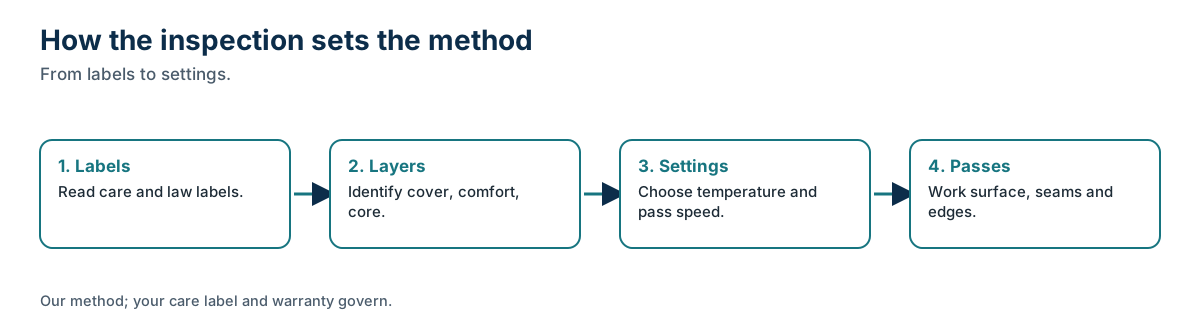
This is where our process starts. The first thing we do on a visit is a materials inspection: we read the labels, identify the layers we can, and decide steam temperature and pass speed from that. A coil bed with a thin cover gets different passes from a memory foam bed under a thick quilted top. Then dry vapor goes across the surface and into the seams, tufts, ridges and edges where dust and shed skin flakes collect.
Our machines are Italian-made Vapor Clean units, the Magnum XP with its built-in vac, the ProV 350 and the Pro6 Duo. Output and pass speed are adjustable, and in our experience that lets us treat any mattress or topper, adjusting or stopping if a material reacts. Organic cleaning methods are our default. The method is our own choice and reasoning, not a manufacturer exemption; your care label and warranty terms govern your decision, so check your warranty before booking. It's all in the standard price, and severe or biohazard contamination is quoted as a custom surcharge before we start. For what "sanitize" means here, Hub 2 explains the CDC's cleaning and sanitizing terms.
Where to read next
The moisture and heat guide works through every layer in more depth, and this hub lists every article. For the material-by-material view, Hub 2's compatibility guide covers each brand we checked.
What we don't know
- How each layer in a finished mattress responds to dry vapor. We found no study that tested a full mattress layer by layer.
- Which adhesive a given mattress uses. Makers don't publish it.
- Whether coil units and foam cores differ in how they dry after cleaning. Purple's split is a maker's view, not a measured result.
- How wool, cotton and other natural fiber layers respond to dry vapor. Hub 2's wool page covers what makers say, but we found no study.
Changelog
- 3 October 2026: First published. Sources accessed on this date.
Sources
- How To Clean a Mattress in 9 Steps (last updated 16 Oct 2025, accessed 2026-10-02) · Purple
- How to Clean Your Natural Mattress Without Using Harsh Chemicals (25 June 2026, accessed 2026-10-02) · Avocado
- IN-TOUCH Vol. 11 No. 1: Viscoelastic (Memory) Foam (revised 2016) · Polyurethane Foam Association
- IN-TOUCH Vol. 1 No. 1: Flexible Polyurethane Foam, a Primer (revised 2016) · Polyurethane Foam Association
- Thermal conductivity of common materials · Engineering ToolBox
- Jowat 639.10 PUR foam mattress assembly hotmelt, technical data (accessed 2026-10-03) · ECT Adhesives (Jowat distributor)
- ADiNO FG 8240.0 foam-bonding PO hotmelt, technical product information (January 2025) · Adino GmbH
- FOAMLAM 1573 Biobased waterborne mattress adhesive, technical data sheet · Worthen Industries
- Fast Tack Water Based Adhesive 1000NF, technical data sheet · 3M
- Magnum XP-Vac product page (maker's claims, accessed 2026-10-02) · Vapor Clean
- ProV 350 product page ('Italian Made'; maker's claims, accessed 2026-10-02) · Vapor Clean
- Pro6 Duo product page ('Made in Italy'; maker's claims, accessed 2026-10-02) · Vapor Clean
- Cleaning and disinfecting your school (definitions) · CDC
Last reviewed October 3, 2026. Manufacturer specifications and care instructions change; check the current version for your exact model. This page is general information, not medical advice. How we source and check pages: editorial standards.