
Short answer
It could, and nobody has published enough to rule it out for every mattress. Adhesive data sheets show wide differences: one mattress PUR hotmelt lists a 60 ± 4°C softening point before curing, a polyolefin hotmelt about 87°C, and a waterborne latex adhesive no heat figure. No source measures glue-line temperatures during cleaning, so we make no all-adhesive claim.
Key terms used on this page
- Hot-melt adhesive:
- A solvent-free adhesive applied molten and set by cooling. ADiNO's FG 8240.0, sold for bonding PU foam in the mattress and upholstery industry, is applied at 150 to 180°C and lists a softening point of about 87°C.
- PUR hotmelt:
- A reactive polyurethane hot-melt adhesive that cures by chemical cross-linking after it is applied. Jowat's 639.10, sold for foam mattress assembly, is described as having very high heat resistance due to cross-linking, with a softening point of 60 ± 4°C.
- Softening point:
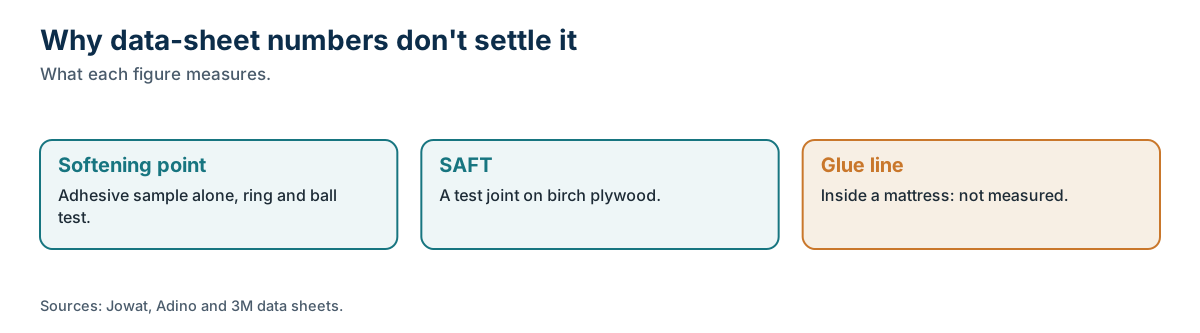
- The temperature at which an adhesive sample softens under a standard ring-and-ball test. It is measured on the adhesive alone, not inside a finished mattress, so it does not tell you what temperature a glue line reaches during cleaning.
- Waterborne adhesive:
- An adhesive carried in water that bonds as the water leaves. Worthen's FOAMLAM 1573, based on natural latex, is roll-applied for laminating foam layers in mattresses and lists solids of 50 ± 2 percent.
- Shear adhesion failure temperature (SAFT):
- A heat test in which a bonded joint under a small load is warmed step by step until it fails. 3M reports a SAFT above 149°C for its 1000NF foam adhesive, tested on birch plywood rather than foam.
- Foam lamination:
- Bonding foam layers to each other or to fiber and fabric to build a mattress. Adhesive data sheets from Jowat, ADiNO, Worthen and 3M each describe bonding foam, which tells us mattresses are glued in different ways with different chemistries.
This is the question in this hub with the least published evidence behind it, so the answer has to be careful. Mattress layers are glued, the glues differ, and their makers publish data about the adhesive itself, not about what it experiences inside a finished bed during cleaning. So the honest answer is that dry-vapor steam could affect some mattress adhesives under some conditions, and we can't rule that out for every bed. Here's what the data sheets say and how we handle the uncertainty.
This article is general information about cleaning and materials, not medical or engineering advice. For mold or health questions, talk to a qualified professional.
Where adhesives are in a mattress
Glue holds the stack together. It bonds foam to foam, foam to fiber and fabric, and foam to other components. Hub 1's entry on mattress layers and the spoke on why construction matters describe the stack. The adhesive layer between two sheets of foam is the glue line, and much of it sits well below the cover.
Hot melts
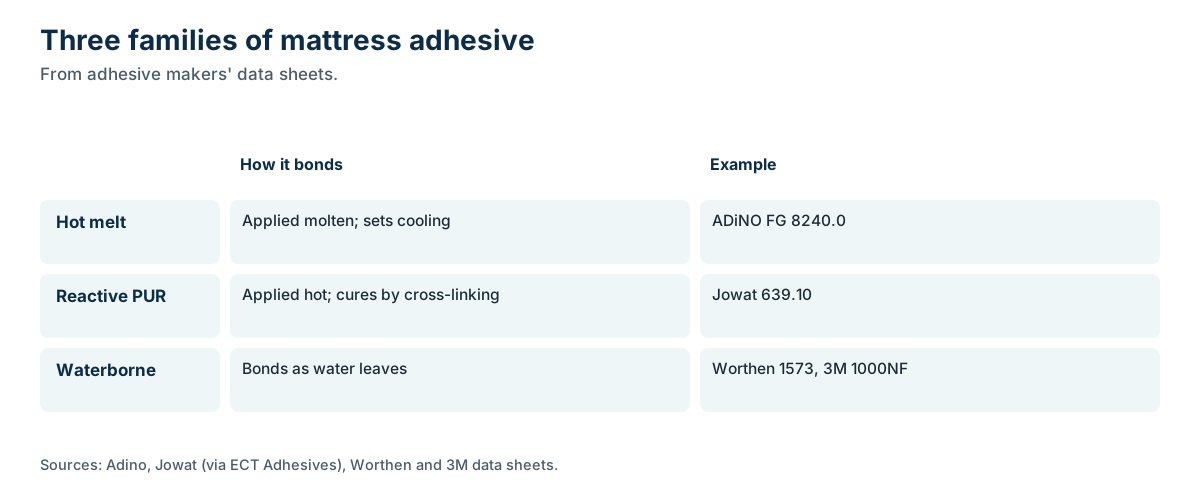
A hot melt is applied molten and sets as it cools. ADiNO's FG 8240.0 is a polyolefin hot melt for "Bonding of PU foam to itself, to non-woven materials, to textile materials and all other commonly used materials in the mattress and upholstery industry." Its data sheet lists a "Softening Point : approx. 87 ⁰C (R&B)", an application temperature of 150 to 180°C, and "Highest thermal stability" among its characteristics.
The sheet ends with a caution that applies to everything in this article: "The variety of materials used and different work conditions, which lie beyond our control, preclude any claims based on this data."
Reactive PUR hotmelts
A PUR hotmelt is applied hot and then cures by chemical reaction. Jowat's 639.10 is sold for foam mattress assembly and, per its distributor's page, bonds "especially on materials which are difficult to bond, such as latex, viscose or gel foam." The page lists "Softening point [°C]: 60 ± 4 (Ring and Ball)" and a processing temperature of 110 to 130°C, and says: "Very high heat resistance and compound strength due to chemical cross-linking."
Those two figures need reading together. The softening point describes the hotmelt before it cures. The heat-resistance line describes the bond after cross-linking. A cured PUR bond is meant to be more heat-resistant than the raw adhesive's softening point suggests, but the page doesn't give a cured figure.
Waterborne adhesives
Waterborne adhesives are carried in water and bond as it leaves. Worthen's FOAMLAM 1573 is a "One-part, zero VOC, waterborne roll applied adhesive based on natural latex," designed "for laminating foam layers" in the furniture and mattress industries. Its data sheet lists solids of 50 percent and gives no heat-resistance figure. 3M's 1000NF is a water-based adhesive that "Adheres to many types of flexible foam, latex foams, fabric, polyester" and other materials, with "Long term stable bonds. Good heat resistance." Its shear adhesion failure temperature is above 149°C, but that test used birch plywood, not foam.
Neither sheet says how a cured bond responds to being re-wetted.
Why these numbers don't answer the question
Each of these figures is measured on the adhesive or on a test joint, under the maker's conditions. None is a measurement inside a mattress. To know whether a cleaning affects a glue line you'd need three things nobody publishes: which adhesive a given mattress uses, where its glue lines sit, and what temperature and moisture those glue lines reach during cleaning.
The one surface temperature measurement we found on steamed mattress material, by Puckett, McDonald and Gold, recorded 67.38 to 73.91°C at the surface immediately after treatment with a Jiffy steamer. That's the cover surface, with a different machine, and not a glue line. It sits between two of the softening points above. We mention it only to show why a blanket claim in either direction would be guesswork.
How deep the heat goes
Glue lines below the cover are shielded by everything above them. Cornell IPM's draft steam guidance for bed bugs says lethal steam "can penetrate 2 ⅜ inches (6 centimeters) into a crack/crevice, and less than one inch beneath fabric surface." That figure is bed bug guidance; it cites no study and wasn't measured in mattresses. Polyurethane foam has a thermal conductivity of 0.03 W/(m K), per Engineering ToolBox, so heat moves slowly through it. A glue line under a comfort layer is less exposed than the cover. A glue line close to the surface, or one at an edge, is more exposed. Does steam penetrate a mattress or treat the surface? covers depth in more detail.
Cornell's guidance also lists items to test before steaming, including "Wallpaper and other glued surfaces." That's a reminder from outside the mattress world that heat and moisture can affect glued materials.
Signs a bond has been affected
Adhesive problems show up as changes in shape or feel, not as anything you'd see on the cover's color. Look for a layer that has separated from the one below, a bubble or ridge under the cover that wasn't there before, or a section that slides or shifts when you press and release it. Edges and corners are worth a look, since that's where layers end. None of these is specific to cleaning; a bond can also fail with age or heavy use. But if you notice one after any cleaning, steam or otherwise, stop further treatment and contact the mattress maker. A maker can tell you what adhesive it used and whether its warranty covers a bond failure, which is information no cleaner has.
How we handle the uncertainty
We don't claim dry vapor suits every mattress adhesive. Here's what we do instead. Before steaming, we inspect the mattress's materials, and that inspection sets steam temperature and pass speed for that construction. Passes keep moving, which limits heat at any one spot, and low moisture limits water reaching any waterborne bond. Dry vapor covers the sleep surface and the seams, tufts, ridges and edges where dust and shed skin flakes collect. The machines are Italian-made: the Magnum XP with its built-in vac, the ProV 350 and the Pro6 Duo. Organic cleaning methods are our default.
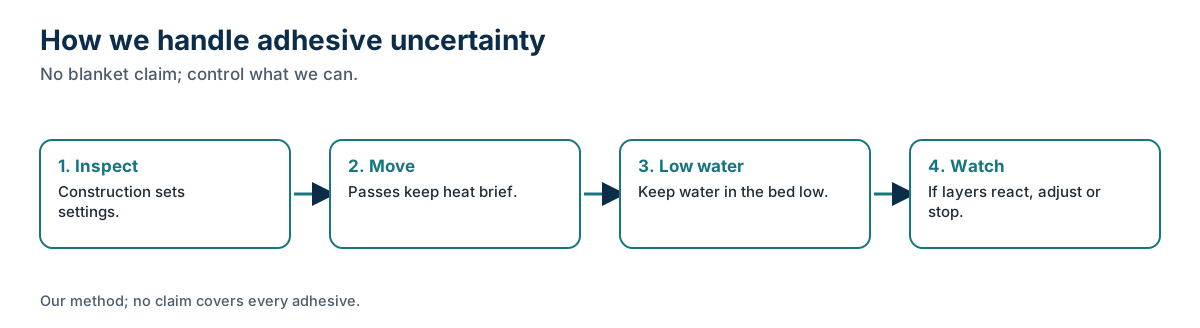
That approach is our own method and reasoning, not a manufacturer exemption. The care label and warranty terms on your mattress govern your decision; check your warranty before booking. During a visit, if a layer looks like it's reacting, we lower output, speed up or stop. If you see layers separating or a ridge under the cover at any time, stop and contact the maker. The visit is part of the standard price, with severe or biohazard contamination quoted as a custom surcharge before we start. Hub 2 explains the CDC's cleaning and sanitizing terms, which is how we use "sanitize."
Where to read next
The moisture and heat guide sets adhesives beside foam and latex, and this hub lists every article. For temperature limits on the foam itself, read what temperature can mattress foam tolerate?
What we don't know
- Which adhesive any given mattress uses. Makers don't publish it, and it can't be seen from outside.
- What temperature a glue line inside a mattress reaches during a dry-vapor pass. We found no measurement.
- How cured PUR, hot-melt or waterborne bonds respond to brief steam heat or to re-wetting. The data sheets don't say.
- Whether edge and border glue lines, closer to the surface, behave differently from those deep in the stack.
- Whether repeated cleanings over the life of a mattress add up to an effect on any bond. Every data sheet we read describes a single bond under set conditions, not years of use.
Changelog
- 3 October 2026: First published. Sources accessed on this date. The title asks what the evidence can actually answer: whether dry vapor can affect adhesives, not whether it never will.
Sources
- Jowat 639.10 PUR foam mattress assembly hotmelt, technical data (accessed 2026-10-03) · ECT Adhesives (Jowat distributor)
- ADiNO FG 8240.0 foam-bonding PO hotmelt, technical product information (January 2025) · Adino GmbH
- FOAMLAM 1573 Biobased waterborne mattress adhesive, technical data sheet · Worthen Industries
- Fast Tack Water Based Adhesive 1000NF, technical data sheet · 3M
- 6. Using Steam to Eliminate Bed Bugs (draft help article, accessed 2026-10-03) · Cornell IPM Help Center
- Thermal conductivity of common materials · Engineering ToolBox
- Comparison of multiple steam treatment durations for control of bed bugs (Puckett, McDonald and Gold, Pest Manag Sci, 2013) · Texas A&M Urban Entomology (author copy)
- Magnum XP-Vac product page (maker's claims, accessed 2026-10-02) · Vapor Clean
- ProV 350 product page ('Italian Made'; maker's claims, accessed 2026-10-02) · Vapor Clean
- Pro6 Duo product page ('Made in Italy'; maker's claims, accessed 2026-10-02) · Vapor Clean
- Cleaning and disinfecting your school (definitions) · CDC
Last reviewed October 3, 2026. Manufacturer specifications and care instructions change; check the current version for your exact model. This page is general information, not medical advice. How we source and check pages: editorial standards.