
Short answer
At the surface, very little: both have foam comfort layers under the cover. The difference is below. A coil unit is mostly air and steel, which holds no water, while a foam core is another thick open-cell layer that does. Purple's general guide allows steam on hybrids but says not to steam clean a Purple mattress. No study compares drying.
Key terms used on this page
- Open-cell foam:
- Foam whose cells connect, so air can move through it. The PFA primer says foam performance is optimized when air flow is maximized, which indicates the cells are open. The same open structure that lets air through also lets liquid water in.
- Thermal conductivity:
- How readily a material passes heat. Engineering ToolBox lists polyurethane foam at 0.03 W/(m K) and liquid water at 0.606 W/(m K). Foam is an insulator, which is one reason surface heat does not travel far into a thick foam layer.
- Foam lamination:
- Bonding foam layers to each other or to fiber and fabric to build a mattress. Adhesive data sheets from Jowat, ADiNO, Worthen and 3M each describe bonding foam, which tells us mattresses are glued in different ways with different chemistries.
- Mattress saturation:
- Water filling the open cells of a foam or fiber layer below the cover, rather than sitting at the surface. Casper's care page warns that the foam in the mattress core will soak up water and detergent; saturation is that outcome.
- Surface moisture:
- Water held in the cover fabric and the top of the comfort layer, close enough to the air to evaporate quickly. It is the moisture a low-moisture method aims to leave, as opposed to water that has travelled down into the core.
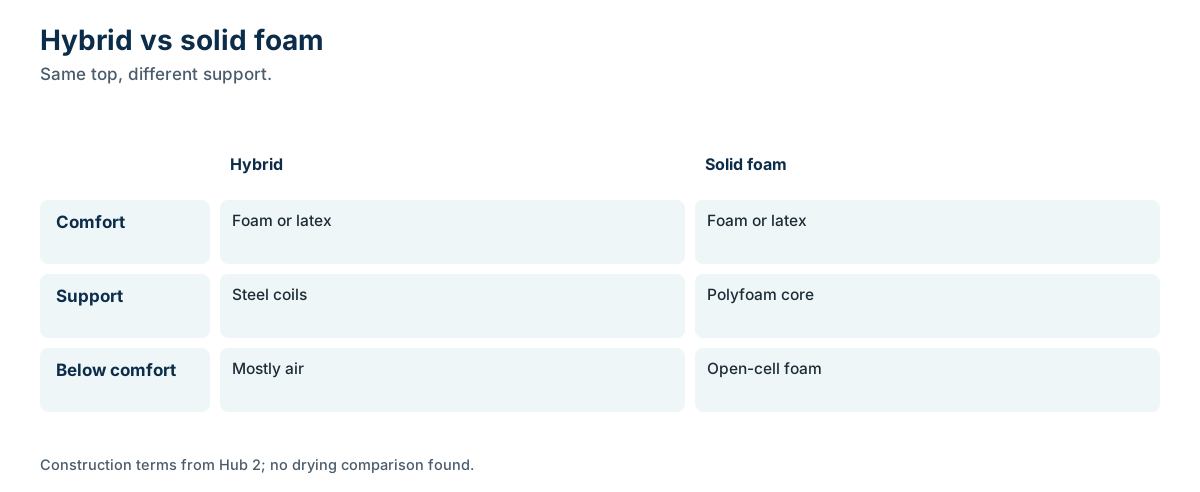
A hybrid and a solid foam mattress can look identical from the outside. Underneath, they're built differently. A hybrid puts one or more foam comfort layers over a coil unit. A solid foam bed has foam all the way down, from the comfort layers to the support core. For cleaning, the top of each bed behaves much the same. The difference is in what happens if water gets past the top.
This article is general information about cleaning and materials, not medical or engineering advice. For mold or health questions, talk to a qualified professional.
The two builds
Hub 2 defines a hybrid mattress and covers hybrid compatibility in detail. In short, the hybrid's support comes from steel coils, sometimes with a foam border around the edge, and its comfort comes from foam or latex layers above. The solid foam bed's support comes from a thick polyfoam core, with comfort layers above. Hub 2's polyfoam entry covers the core material.
The top behaves alike
Steam meets the cover first and then the comfort layer. In both builds, that comfort layer is foam or latex. The Polyurethane Foam Association describes memory foam as "a type of open cell, flexible polyurethane foam" in its viscoelastic bulletin, and polyfoam is open-celled too, as its primer explains when it links performance to air flow.
So heat at the surface, and any water held in the cover and the first inch of foam, behave the same way in a hybrid as in a solid foam bed. A memory foam comfort layer in a hybrid needs the same care as memory foam in an all-foam bed. What happens when memory foam gets wet applies to both.

The difference is below the comfort layer
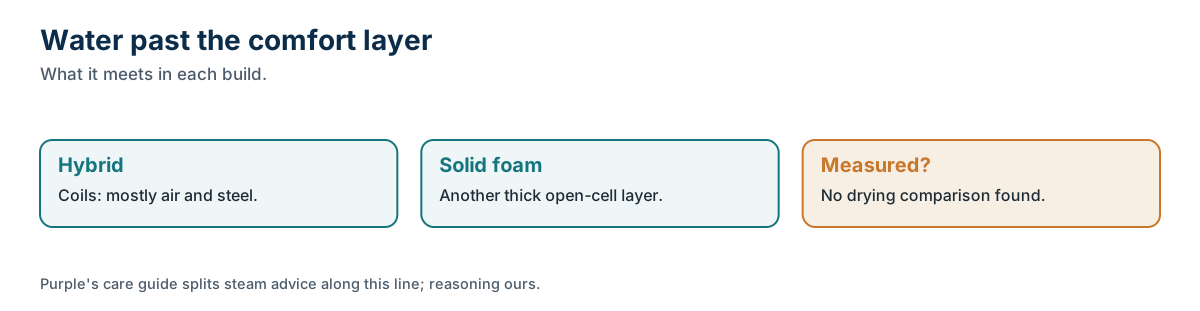
If water gets through the comfort layer, the two builds part ways. In a solid foam bed, it meets another thick layer of open-cell foam: the core. That core takes water in and, being an insulator, is slow to give it back. Engineering ToolBox lists polyurethane foam's thermal conductivity at 0.03 W/(m K).
In a hybrid, water that gets past the comfort layer meets a coil unit. Steel doesn't absorb water, and the spaces between coils are open to air. So water that reaches the coil layer has room to drain and evaporate. That doesn't mean it disappears. Pocketed coils are wrapped in fabric, and the layers above and below are bonded to fabric and foam. ADiNO's hotmelt data sheet, for example, lists "Bonding of PU foam to itself, to non-woven materials, to textile materials" among its uses in the mattress and upholstery industry.
What Purple's guide says
Purple's cleaning guide draws its steam advice along exactly this line: "After vacuuming, you can steam clean your innerspring or hybrid mattress, but you should not steam clean a memory foam, latex, or adjustable mattress since the heat and water could damage its materials. Note that you should not steam clean a Purple mattress. If you have any doubts, refer to the manufacturer’s care instructions and your warranty." The passage treats coil-based beds as more tolerant of steam than all-foam beds. It gives "the heat and water" as the reason, without explaining why construction changes that. It also sets a separate rule for Purple's own beds, some of which are hybrids. That's Purple's view, not a measured comparison. Hub 2's Purple page quotes it in more detail.
Drying: what we'd expect and what's measured
We'd expect water that reached a hybrid's coil layer to leave faster than water that reached a foam core, because of the air. But we found no study that measured it, so that's a reasoned expectation, not a result. EPA's water-damage table for upholstered furniture, written for soaked furniture in general, says such items "May be difficult to completely dry within 48 hours." It doesn't separate sprung from foam furniture.
The one weighed steam test we found, by Puckett, McDonald and Gold, used mattress material on a wooden base, five replicates per treatment, and recorded 0.92 to 1.44 grams of average gain at five minutes. It didn't include a coil unit or a foam core.
In practice, if a hybrid does get soaked, the same drying steps apply as for any mattress, with one addition. Lifting it off a solid platform, or standing it on edge if the maker allows, lets air reach the coil layer from below as well as above. A solid foam bed benefits from the same thing, but has no open layer inside for that air to move through.
Latex hybrids
Some hybrids use latex rather than polyurethane foam in the comfort layer, and latex comes with its own maker guidance. Avocado's cleaning guide, for its natural latex beds, says: "Allow any residual dampness to air-dry completely. You can place the mattress outside, since the natural latex is fully covered and not exposed to direct sunlight. However, a cool blow dryer will also work. Steam cleaners are not recommended because their excessive heat can over-bake the organic latex."
That's a heat concern, not a water one, and it applies to the latex layer whatever is underneath it. Engineering ToolBox's closest entry to latex foam is cellular rubber, which it lists at a thermal conductivity of 0.045 W/(m K). Like polyurethane foam, it's an insulator, so surface heat stays near the surface. Avocado doesn't give a temperature for over-baking. Hub 2's latex page and Avocado page cover latex beds in more depth.
Edges and borders
A hybrid may have a foam border around the coil unit to firm up the edge; check yours. That border is open-cell foam like any other, and the edges are where we spend extra time with steam because dust and shed skin flakes collect in the seams there. So the edge of a hybrid gets the same care as a foam bed's.
What it means for a visit
For us, a hybrid and a solid foam bed get the same method with settings chosen for each. The materials inspection identifies the comfort layer, the core and the cover, and from that we decide steam temperature and pass speed. The comfort layer governs the surface settings in both. Dry vapor covers the sleep surface and works the seams, tufts, ridges and edges where dust and shed skin flakes collect. We use Italian-made Vapor Clean machines: the Magnum XP with its built-in vac, the ProV 350 and the Pro6 Duo. Organic cleaning methods are our default.
That's our own choice and reasoning, not a manufacturer exemption, and it applies whether or not a maker allows steam on hybrids. Your care label and warranty terms govern your decision, so check your warranty before booking. The standard price applies; severe or biohazard contamination is quoted as a custom surcharge before we start. On terminology, Hub 2 explains the CDC's cleaning and sanitizing terms.
Where to read next
The moisture and heat guide covers every layer type, and this hub lists every article. For the broader point, read why mattress construction matters for cleaning. For why makers draw lines like Purple's, see why some makers allow steam and others prohibit it. For drying, why foam mattresses are slow to dry.
What we don't know
- How a hybrid dries compared with a solid foam bed after the same wetting. We found no study.
- Whether water reaching a coil unit causes corrosion or other problems over time.
- How pocketed-coil fabric and its bonds respond to moisture.
- Why Purple treats hybrids as more tolerant of steam. Its guide doesn't explain the reasoning.
Changelog
- 3 October 2026: First published. Sources accessed on this date.
Sources
- How To Clean a Mattress in 9 Steps (last updated 16 Oct 2025, accessed 2026-10-02) · Purple
- How to Clean Your Natural Mattress Without Using Harsh Chemicals (25 June 2026, accessed 2026-10-02) · Avocado
- IN-TOUCH Vol. 1 No. 1: Flexible Polyurethane Foam, a Primer (revised 2016) · Polyurethane Foam Association
- IN-TOUCH Vol. 11 No. 1: Viscoelastic (Memory) Foam (revised 2016) · Polyurethane Foam Association
- Thermal conductivity of common materials · Engineering ToolBox
- Mold Remediation in Schools and Commercial Buildings, Table 1: Water Damage, Cleanup and Mold Prevention · US EPA
- Comparison of multiple steam treatment durations for control of bed bugs (Puckett, McDonald and Gold, Pest Manag Sci, 2013) · Texas A&M Urban Entomology (author copy)
- ADiNO FG 8240.0 foam-bonding PO hotmelt, technical product information (January 2025) · Adino GmbH
- Magnum XP-Vac product page (maker's claims, accessed 2026-10-02) · Vapor Clean
- ProV 350 product page ('Italian Made'; maker's claims, accessed 2026-10-02) · Vapor Clean
- Pro6 Duo product page ('Made in Italy'; maker's claims, accessed 2026-10-02) · Vapor Clean
- Cleaning and disinfecting your school (definitions) · CDC
Last reviewed October 3, 2026. Manufacturer specifications and care instructions change; check the current version for your exact model. This page is general information, not medical advice. How we source and check pages: editorial standards.