
Short answer
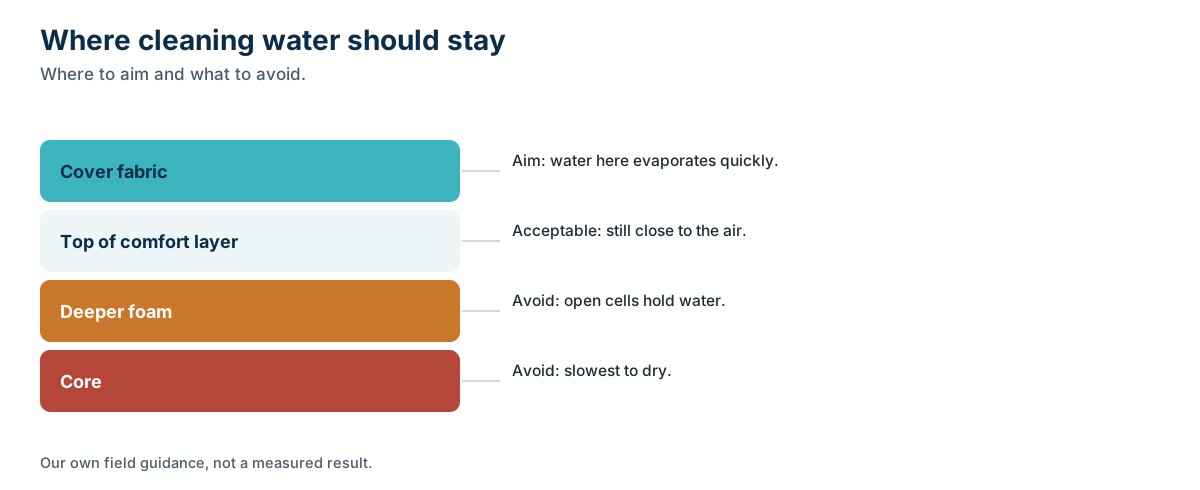
As little as the job allows, with water kept in the cover and the top of the comfort layer. No published standard gives a number for mattresses. The closest data come from one lab test in which steamed arenas of mattress material gained 0.92 to 1.44 grams at five minutes, a change the authors called negligible.
Key terms used on this page
- Surface moisture:
- Water held in the cover fabric and the top of the comfort layer, close enough to the air to evaporate quickly. It is the moisture a low-moisture method aims to leave, as opposed to water that has travelled down into the core.
- Mattress saturation:
- Water filling the open cells of a foam or fiber layer below the cover, rather than sitting at the surface. Casper's care page warns that the foam in the mattress core will soak up water and detergent; saturation is that outcome.
- Weight-gain test:
- Weighing an item before and after treatment to measure how much water it took on. Puckett and colleagues weighed steam-treated mattress-material arenas at intervals from 5 minutes to 7 days and recorded average gains of 0.92 to 1.44 grams at 5 minutes.
- Steam tip distance:
- The gap between the steam nozzle and the surface. A bed bug manual reprinting an Armed Forces Pest Management Board guide puts it at about 2.5 to 3.8 cm and warns that a tip held too close may inject excess moisture.
- Vapor moisture claim:
- An equipment maker's stated water content for its steam. Vapor Clean lists 5-6% moisture for the Magnum XP, ProV 350 and Pro6 Duo. These are the maker's own claims; the pages do not describe how the figure was measured.
The honest answer to "how wet?" is as little as possible, and no deeper than the cover. That sounds like a dodge, but it's what the evidence supports. Nobody has published a moisture limit for mattresses. What exists is one careful measurement on mattress material, a few mattress makers' warnings about liquid, and the physics of open-cell foam. Together they point in one direction.
This article is general information about cleaning and materials, not medical or engineering advice. For mold or health questions, talk to a qualified professional.
Why there's no single number
A target moisture figure would need a test method, a material and a time point. Carpet cleaning has residual-moisture methods; Hub 1 discusses them under residual moisture. Mattresses don't. A mattress is several materials stacked together, and the same amount of water means something different in a quilted cover than in a memory foam layer three inches down.
So instead of a number, the useful question is where the water goes. Water in the cover fabric and the top of the comfort layer can leave quickly. Water that reaches the core is harder to get back out. That difference is the subject of surface moisture vs saturation.
The one weighed test
Puckett, McDonald and Gold ran the only test we found that weighed mattress material before and after steaming. Their 2013 paper in Pest Management Science was about bed bugs; moisture was a secondary measurement. They built arenas from plastic boxes 31 × 19 × 9 cm, with Sealy mattress material folded over and stapled to a wooden base. There were five replicates per treatment and untreated controls.
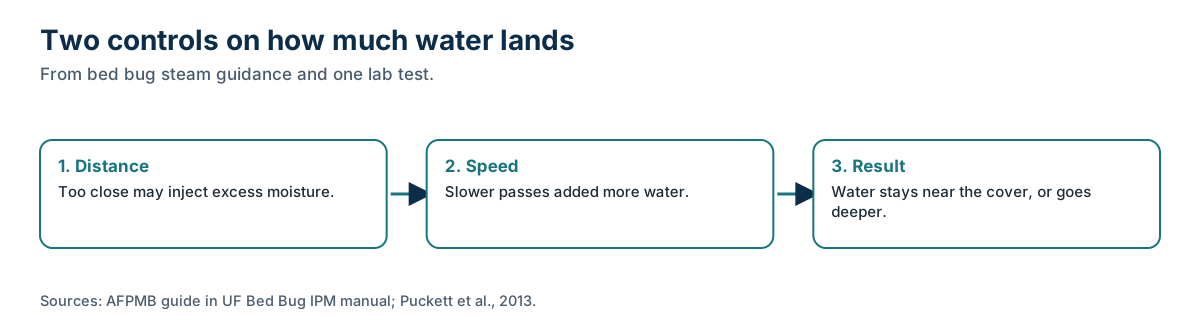
The steamer, a J-4000DM Jiffy with a 15.25 cm head, sat about 1 cm above the material and travelled at 10, 20 or 30 seconds per 30.50 cm. At five minutes, the arenas had gained 0.92, 1.32 and 1.44 grams on average for the three speeds; the controls gained nothing. By seven hours the difference was no longer significant. The authors' words: "The weight change of trial arenas was negligible".

Two details matter for reading this. Slower passes added more water, which fits the idea that time on a spot controls moisture as well as heat. And the material was a thin layer on a wooden base, not a mattress with deep foam. The authors also say they made no attempt to find out how deep steam went. The result is good evidence that a moving steam head adds little water to a mattress surface. It doesn't show what happens three inches down.
Distance and speed
Two field variables decide how much water lands. One is pass speed, as the Puckett data show. The other is how close the nozzle is. A bed bug manual from the University of Florida, which reprints an Armed Forces Pest Management Board guide, puts the usual gap at "about 2.5-3.8 cm from the surface" and explains both ways it can go wrong: "If the tip is too far away, the steam may not be hot enough to kill all the bed bugs and eggs that it contacts. If the tip is too close, excess moisture may be injected into the treated material, which may lead to other problems (e.g., facilitating dust mite population survival and increase; growth of surface molds)."
That passage is about bed bug work, not mattress cleaning, but it describes the trade-off well. Heat reaching the surface and water entering the material are linked through the same two controls.
What the steam itself carries
Vapor Clean lists 5-6% moisture for all three of our machines. The Magnum XP page says it "Generates steam up to 357°F with just 5-6% moisture"; the ProV 350 and Pro6 Duo pages describe "Dry" Vapor "yielding 5-6% moisture content." These are the maker's claims, and the pages don't explain the measurement. Steam engineers describe wetness as a dryness fraction; Spirax Sarco's example is steam with 5 percent water by mass, which "is said to be 95% dry".
Even if the vapor is dry, a mattress can still get wet if the head lingers or presses in. The figure describes what comes out of the nozzle. It doesn't describe how wet the bed ends up. Hub 1's how much moisture does dry-vapor steam use? looks at that distinction.
What mattress makers say about liquid
Several mattress makers address liquid directly. These passages are each maker's guidance for its own products.
Casper's care page says: "If you need to clean your Casper mattress or cover, we suggest spot-cleaning affected areas with water and mild detergent. Be careful not to saturate the mattress with too much water and/or detergent, as the foam in the mattress core will soak up water and detergent. Allow the treated area to air dry completely before putting your sheets and bedding back on." Beautyrest's help page says: "We do not recommend applying liquids to the mattress. Applying liquids may stain the fabric and make the soiled area worse. Moisture or chemicals applied directly to the mattress can cause premature breakdown of the foam and damage the product." Both put the risk in water reaching the foam. Neither sets a number. Hub 2's Casper and Beautyrest pages quote each maker in more detail.
Signs a mattress got too wet
You can't see how far water went, but you can feel for it. A surface that is cool and slightly damp right after dry vapor is expected; that's the cover giving up its moisture. A surface that stays cold, or that feels wet when you press a palm in firmly, suggests water below the cover. A sour or musty smell over the following days is another sign. How to tell if moisture reached the core covers these checks in more detail.
How we keep the water low
Here's our side of it. Before any steam touches the bed, we inspect what it's made of, because that inspection decides steam temperature and pass speed for that particular mattress. Then dry vapor goes over the surface in moving passes, with extra attention on the seams, tufts, ridges and edges where dust and shed skin flakes collect. Our machines are Italian-made: the Magnum XP with a built-in vac, the ProV 350 and the Pro6 Duo. Organic cleaning methods are our default.
This is our own method and our own reasoning, not a manufacturer exemption, and the care label and warranty terms on your bed govern your decision. Check your warranty before booking. The visit is part of the standard price; severe or biohazard contamination is quoted as a custom surcharge before we start. We use "sanitize" in its cleaning sense; Hub 2 sets out the CDC's cleaning and sanitizing terms, and we make no disinfection claim.
Where to read next
The moisture and heat guide puts this question beside the heat and construction evidence, and this hub lists every article. For what dry vapor leaves behind, read does dry-vapor steam leave a mattress wet?. For the drying side, see how quickly a treated mattress should dry.
What we don't know
- How much water a full-thickness mattress takes on during dry-vapor cleaning. The only weighed test used thin mattress material on a wooden base.
- Whether our machines behave like the Jiffy steamer in that test. We haven't weighed mattresses before and after our own visits.
- How Vapor Clean measures its 5-6% moisture figure.
- Where the line sits between harmless surface moisture and a problem. No source we found defines it for mattresses.
Changelog
- 3 October 2026: First published. Sources accessed on this date.
Sources
- Comparison of multiple steam treatment durations for control of bed bugs (Puckett, McDonald and Gold, Pest Manag Sci, 2013) · Texas A&M Urban Entomology (author copy)
- Bed Bug IPM manual, including Armed Forces Pest Management Board Technical Guide 44 (University of Florida, 2008) · University of Tennessee (hosted copy)
- How to clean your mattress: a mattress care guide (accessed 2026-10-02) · Casper
- How do I clean my mattress? (updated 16 Sep 2026, accessed 2026-10-02) · Beautyrest
- Magnum XP-Vac product page (maker's claims, accessed 2026-10-02) · Vapor Clean
- ProV 350 product page ('Italian Made'; maker's claims, accessed 2026-10-02) · Vapor Clean
- Pro6 Duo product page ('Made in Italy'; maker's claims, accessed 2026-10-02) · Vapor Clean
- What is steam? (steam engineering tutorial, dryness fraction) · Spirax Sarco
- A brief guide to mold, moisture and your home · US EPA
- Cleaning and disinfecting your school (definitions) · CDC
Last reviewed October 3, 2026. Manufacturer specifications and care instructions change; check the current version for your exact model. This page is general information, not medical advice. How we source and check pages: editorial standards.