
Short answer
For foam, the evidence points to water held over time. Foam industry data describe heat as softening memory foam temporarily, while a lab study tied rising humidity to lasting stiffness loss in soft foam held for days. The makers we checked cite moisture for foam and Avocado cites heat for latex. No study compares a brief steam pass with a wetting directly.
Key terms used on this page
- Heat softening:
- The temporary softening of viscoelastic foam as it warms. The PFA says heat, even body heat, can soften viscoelastic materials and, in extreme situations, affect the foam's ability to provide support. It gives an optimum range for memory action of 55°F to 85°F.
- Humid heat aging:
- Lasting change in foam after long exposure to heat and moisture together. Lapčík and colleagues held soft polyurethane foam bought at a hobby market at 45 or 80°C, at two humidity levels up to 80 percent, for up to 300 hours, and tied rising humidity to stiffness loss and more permanent deformation.
- Permanent deformation:
- The height a foam sample fails to recover after being held compressed, sometimes called compression set. In the Lapčík study, 50 mm foam cubes were compressed to half their height for 30 minutes after 300 hours of conditioning, and humid heat increased the lasting loss.
- Glass transition temperature:
- The temperature range where a polymer shifts between a stiff, glassy state and a soft, rubbery one. In one 2026 study of lab-made viscoelastic foams with up to 20 percent bio-based polyols, the glass transition stayed around 10°C. It explains why memory foam stiffens in the cold.
- Indentation force deflection (IFD):
- A standard firmness test that measures the force needed to compress a foam sample by a set amount. The PFA notes that warmer, more humid conditions in the test room may contribute to temporary softer readings, so samples are conditioned first.
Steam brings both, so it's natural to ask which one is the problem. The sources we found don't settle it with a head-to-head test, because nobody has run one on mattresses. But they point the same way. Heat, at least the kind that comes from a moving steam pass, acts briefly and the foam recovers. Water that gets into foam stays, and the lasting changes in the one relevant lab study came from humidity held for hours to days.
This article is general information about cleaning and materials, not medical or engineering advice. For mold or health questions, talk to a qualified professional.
Two exposures with different time scales
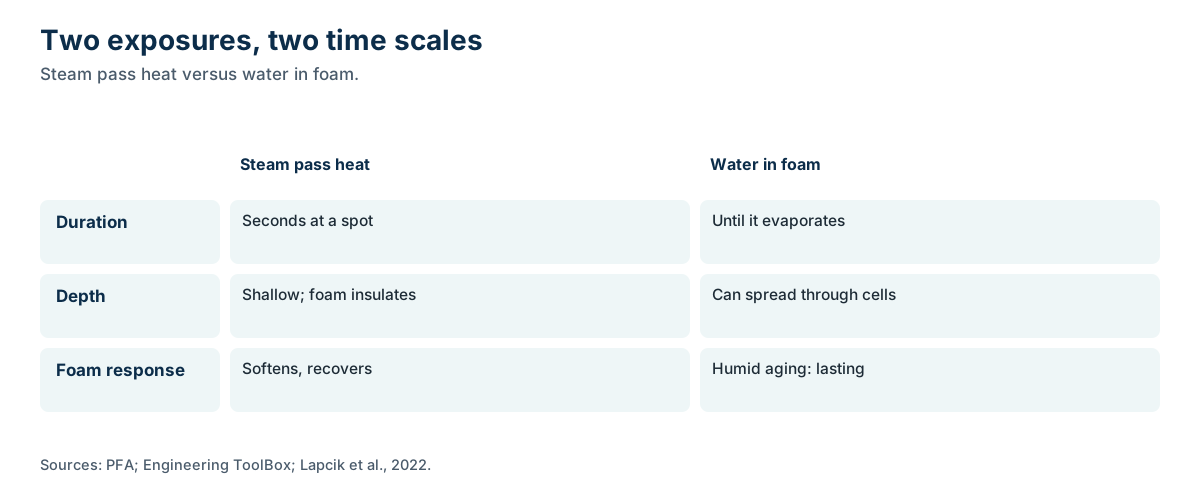
A steam pass delivers heat to the surface in seconds. When the head moves on, the surface starts cooling to the room. Water is different. If it gets past the cover into open-cell foam, it stays until it evaporates, which can take a long time inside an insulating layer. Hub 1 calls these separate variables; here the question is which one does more to the materials.
What heat does to foam
The Polyurethane Foam Association describes heat as a change in feel and support. Its viscoelastic bulletin says: "Heat (even body heat) can soften viscoelastic materials and, in extreme situations, affect the foam’s ability to provide support. This process is known as a phase change or relaxation." It also explains the direction: "Recovery rate has been positively correlated to heat, so that as the foam increases in temperature, pliability and compression and recovery rates increase. In colder conditions, viscoelastic products tend to become firmer or even stiff."
That's a description of a reversible response. Memory foam is designed to soften with body heat; that's what lets it conform. A 2026 lab study of bio-based viscoelastic foams found the glass transition "around 10 °C" and comfortable viscoelastic behavior at 20 and 40°C. Neither source describes damage at cleaning temperatures, and neither tested them. What temperature can mattress foam tolerate? covers the gap.
What water and humidity do
Water's effects show up in two places. The first is feel. The PFA says "Viscoelastic products tend to soften in more humid conditions," and its lab-testing bulletin says "Warmer, more humid conditions may contribute to temporary softer readings."
The second is lasting change. Lapčík and colleagues held open-cell soft polyurethane foam, bought at a hobby market, in a climate chamber at 45 or 80°C and two humidity levels, the higher of them 80 percent, for up to 300 hours, with each measurement repeated five times. Their abstract: "the increasing relative humidity of the surrounding atmosphere leads to the initiation of the degradation processes." They reported lower stiffness and more permanent deformation, and in the conclusions, "the significant loss of the PU foam’s thermal stability."
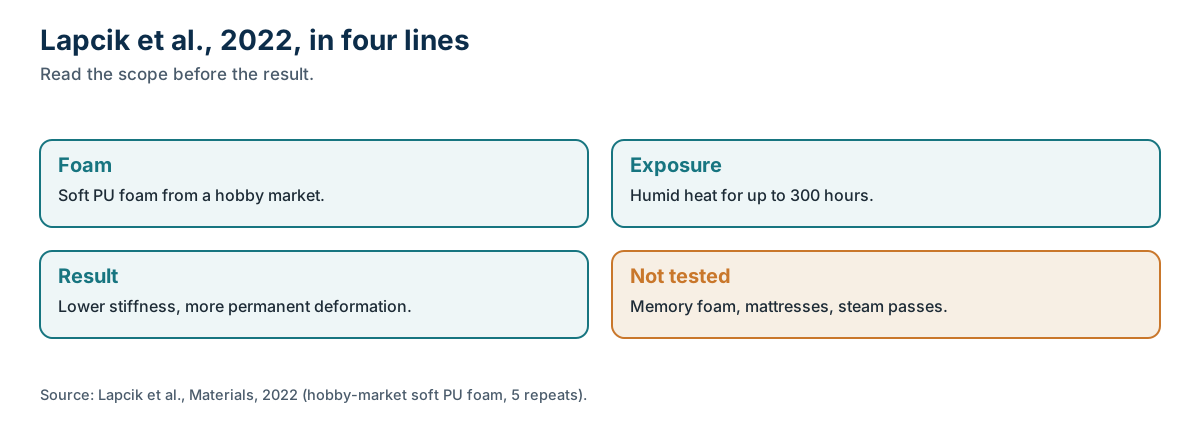
Read the scope carefully. This was not memory foam, not a mattress, and not a steam pass. It was soft foam held in warm, humid air for days. What it shows is that humidity was the factor the authors singled out for starting degradation, and that the changes were lasting.
What makers say
Of the makers we checked, those who explain a warning point to water or moisture, with one exception. These are each maker's words for its own beds. Beautyrest: "We do not recommend applying liquids to the mattress. Applying liquids may stain the fabric and make the soiled area worse. Moisture or chemicals applied directly to the mattress can cause premature breakdown of the foam and damage the product." Bear's help page lists, among things to avoid: "Using steam cleaners, as excess moisture may damage foam materials."
Avocado is the exception, and it's about latex. Its full passage: "Allow any residual dampness to air-dry completely. You can place the mattress outside, since the natural latex is fully covered and not exposed to direct sunlight. However, a cool blow dryer will also work. Steam cleaners are not recommended because their excessive heat can over-bake the organic latex." Avocado doesn't give a temperature for "over-bake," and we didn't find a latex heat study that would supply one.
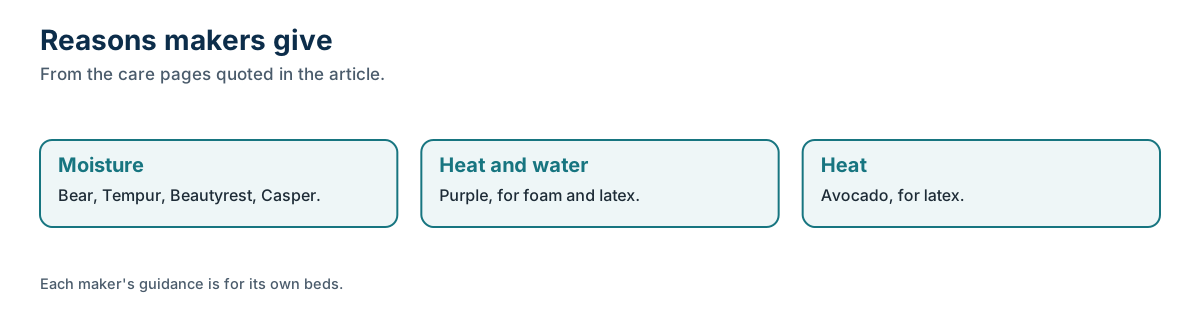
So the makers we checked give moisture as the reason for foam and heat as the reason for latex. That fits the material data: foam's lasting changes in the lab came with humidity, and latex is a different polymer with its own maker's view. Hub 2's latex page and Bear page quote more.
Heat and water together
The Lapčík result concerns the combination: warmth and humidity acted together, over hours and days. In a mattress, the worst case would be a layer that stays warm and wet for a long time: a soaked bed in a warm room with no airflow. A steam pass that adds little water and moves on is a different exposure. The one weighed steam test we found, by Puckett, McDonald and Gold, recorded 0.92 to 1.44 grams of average gain at five minutes on small arenas of mattress material, five replicates per treatment, with surface temperatures of 67.38 to 73.91°C right after treatment.
Why foam makes heat brief and water long
Foam's insulation cuts both ways. Engineering ToolBox lists polyurethane foam's thermal conductivity at 0.03 W/(m K), against 0.606 for water. Surface heat from a steam pass doesn't travel far into foam, which limits how much of the layer gets warm. But the same insulation slows evaporation of any water that does get in. Heat stays shallow and short; water, once deep, stays long.
How this shapes what we do
Our conclusion from all this is our own: keep water low, and control heat with time on the spot. A visit starts with an inspection of the mattress's materials, which decides steam temperature and pass speed. A latex bed and a polyfoam bed don't get the same settings. Dry vapor then goes over the sleep surface and the seams, tufts, ridges and edges where dust and shed skin flakes collect. The Italian-made Vapor Clean machines we use, the Magnum XP with a built-in vac, the ProV 350 and the Pro6 Duo, let us adjust output and pass speed for each bed. Organic cleaning methods are our default.
That's our method and reasoning, not a manufacturer exemption. Your care label and warranty terms govern your decision; check your warranty before booking, and if your bed is latex, read the maker's heat warning above. The standard price covers the visit, with severe or biohazard contamination quoted as a custom surcharge before we start. Hub 2's entry on the CDC's cleaning and sanitizing terms explains the sense in which we use "sanitize."
Where to read next
The moisture and heat guide sets out both stresses for every layer, and this hub lists every article. For what water does to memory foam specifically, read what happens when memory foam gets wet. For heat depth, see does steam penetrate a mattress or treat the surface?
What we don't know
- How a brief steam pass compares with a wetting, measured on the same mattress material. We found no study.
- Whether the Lapčík humidity results apply to memory foam or latex.
- At what temperature, and for how long, heat would cause lasting change in mattress foam. No source gives a threshold.
- How much heat latex can take before "over-bake" applies. Avocado doesn't give a figure.
- Whether repeated cleanings over a mattress's life add up to anything measurable. The Lapčík exposure was one continuous period, not many short ones.
- Whether heat and water together do more than either alone in a brief cleaning pass. Lapčík's chamber combined them over hours, which is not the same exposure as a moving steam head.
Changelog
- 3 October 2026: First published. Sources accessed on this date.
Sources
- Effect of Conditioning on PU Foam Matrix Materials Properties (Lapcik et al., Materials, 2022) · PubMed Central
- IN-TOUCH Vol. 11 No. 1: Viscoelastic (Memory) Foam (revised 2016) · Polyurethane Foam Association
- IN-TOUCH Vol. 4 No. 2: Laboratory Tests of Foam Performance · Polyurethane Foam Association
- Bio-Based Viscoelastic Polyurethane Foams: Functional Behavior Across Application Temperatures (Malewska et al., Polymers, 2026) · PubMed Central
- Comparison of multiple steam treatment durations for control of bed bugs (Puckett, McDonald and Gold, Pest Manag Sci, 2013) · Texas A&M Urban Entomology (author copy)
- How do I clean my mattress? (updated 16 Sep 2026, accessed 2026-10-02) · Beautyrest
- How do I clean a Bear mattress? (updated 6 May 2026, accessed 2026-10-02) · Bear
- How to Clean Your Natural Mattress Without Using Harsh Chemicals (25 June 2026, accessed 2026-10-02) · Avocado
- Thermal conductivity of common materials · Engineering ToolBox
- Magnum XP-Vac product page (maker's claims, accessed 2026-10-02) · Vapor Clean
- ProV 350 product page ('Italian Made'; maker's claims, accessed 2026-10-02) · Vapor Clean
- Pro6 Duo product page ('Made in Italy'; maker's claims, accessed 2026-10-02) · Vapor Clean
- Cleaning and disinfecting your school (definitions) · CDC
Last reviewed October 3, 2026. Manufacturer specifications and care instructions change; check the current version for your exact model. This page is general information, not medical advice. How we source and check pages: editorial standards.