
Short answer
Mainly the surface. No study has measured steam penetration inside a mattress. Cornell IPM's draft bed bug guidance says lethal steam penetrates less than one inch beneath fabric, a 2018 lab study found steam killed over 89 percent of bed bugs under a fabric cover but not behind leather, and foam insulates. Dry vapor treats the cover and seams.
Key terms used on this page
- Steam penetration:
- How far steam heat reaches below a surface. In its bed bug guidance on lethal temperatures, Cornell IPM's draft says steam can penetrate 2 3/8 inches into a crack or crevice and less than one inch beneath a fabric surface, citing no study. No source we found measured it inside a mattress.
- Thermal conductivity:
- How readily a material passes heat. Engineering ToolBox lists polyurethane foam at 0.03 W/(m K) and liquid water at 0.606 W/(m K). Foam is an insulator, which is one reason surface heat does not travel far into a thick foam layer.
- Steam tip distance:
- The gap between the steam nozzle and the surface. A bed bug manual reprinting an Armed Forces Pest Management Board guide puts it at about 2.5 to 3.8 cm and warns that a tip held too close may inject excess moisture.
- Dryness fraction:
- The share of steam, by mass, that is vapor rather than water droplets. Spirax Sarco's example: steam with 5 percent water by mass is 95 percent dry, a dryness fraction of 0.95. Wetter steam carries less usable heat and more liquid.
- Surface moisture:
- Water held in the cover fabric and the top of the comfort layer, close enough to the air to evaporate quickly. It is the moisture a low-moisture method aims to leave, as opposed to water that has travelled down into the core.
Steam penetration sounds like a selling point: the deeper the better. For a mattress, it's the opposite. Deep heat would need slow passes, slow passes add water, and water deep in foam is the problem every other article in this hub keeps coming back to. The evidence we found also says steam doesn't go deep under fabric in the first place. Dry vapor is a surface and near-surface method, and that's what it's for.
This article is general information about cleaning and materials, not medical or engineering advice. For mold or health questions, talk to a qualified professional.
No one has measured it in a mattress
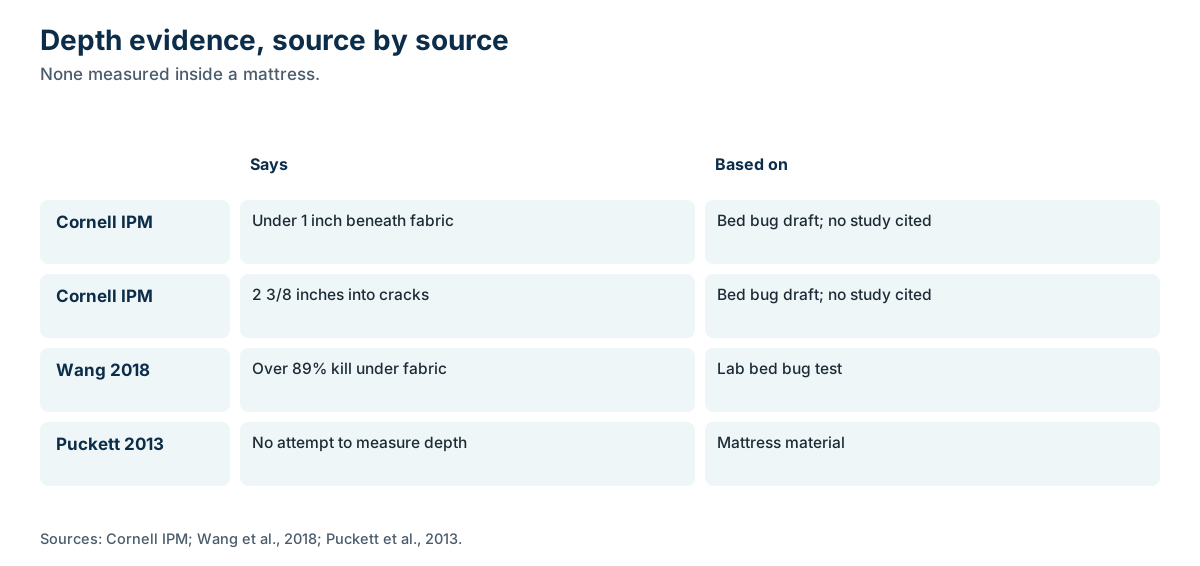
We looked for a study that measured how far steam heat or moisture travels into a mattress and didn't find one. The closest, by Puckett, McDonald and Gold in 2013, steamed small arenas of Sealy mattress material on a wooden base and measured surface temperature and weight. The authors are explicit about the gap: "There was no attempt to determine whether, or to what depth, steam penetrates into folds, creases or fissures associated with the substrate in these trials."
Everything else on this question comes from bed bug research on other materials, plus the physics of foam.
What bed bug research says
Cornell IPM's draft steam guidance gives the most specific figures: "steam at lethal temperatures is thought to have low penetration. Specifically, steam can penetrate 2 ⅜ inches (6 centimeters) into a crack/crevice, and less than one inch beneath fabric surface." It also notes that "steam dissipates and cools the further it gets from the applicator."
Those figures are about killing bed bugs, so "lethal temperatures" means temperatures high enough to do that. They don't come with a cited study in the guidance, they weren't measured in mattresses, and they describe cracks and fabric generally, not mattress foam.
A 2018 lab study by Wang and colleagues compared three steamers on bed bugs placed in different positions. It reported 100 percent mortality for bugs exposed on mattresses and in cracks, over 89 percent for bugs "located beneath a fabric cover," and no significant mortality for bugs "located behind a leather cover." The abstract doesn't give sample sizes or fabric thickness. What it shows is that steam heat gets through a fabric layer to something directly beneath it, and that a less permeable material stops it.
Cornell's guidance also gives a pace: "Slowly (10-30 seconds per foot) move the applicator over the area." It attributes the range to a study that found 10 to 30 seconds per foot "was sufficient to kill all stages of bed bugs and their eggs on upholstered furniture." That matches the pass speeds in the Puckett paper, which used 10, 20 and 30 seconds per 30.50 cm. Even at the slowest of those speeds, Puckett's authors didn't measure depth.
Nozzle distance and contact
The bed bug sources don't agree on distance. Cornell's draft says to "keep the nozzle within ¼ inch of the infested item, or in direct contact." The manual reprinting the Armed Forces Pest Management Board guide says the tip "must usually be about 2.5-3.8 cm from the surface being steamed." In the Puckett trials, the head rested on a tape edge about 1 cm above the material. These are three different setups for killing insects, and none was designed to measure how deep heat goes. What they share is the trade-off: closer and slower puts more heat into the surface, and also more water. For cleaning, where water in the foam is the outcome to avoid, we lean toward moving passes rather than dwelling.
Why foam limits depth
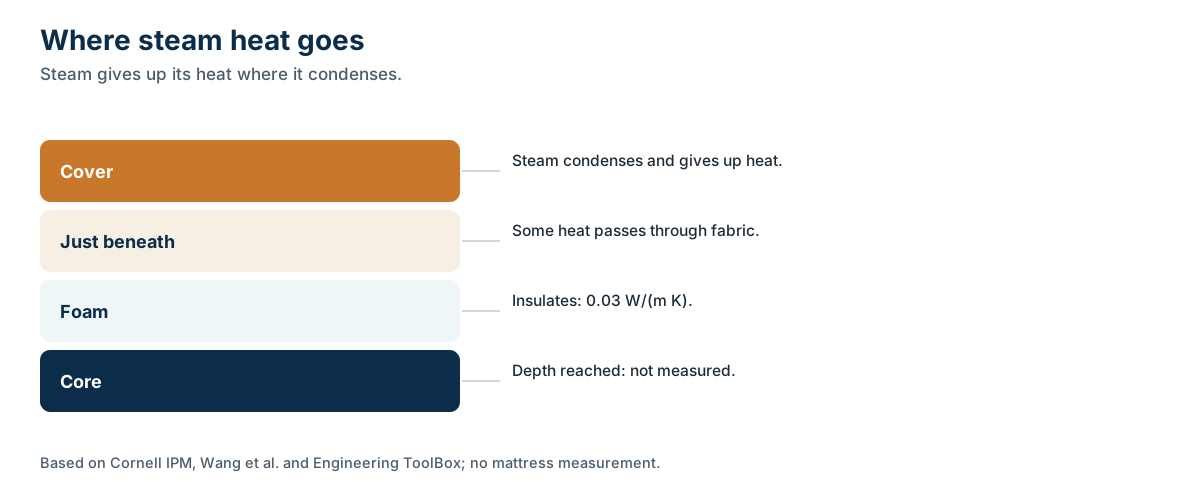
Foam is an insulator. Engineering ToolBox lists polyurethane foam's thermal conductivity at 0.03 W/(m K), close to still air, against 0.606 for water. Heat arriving at the surface of a foam layer moves into it slowly, and a moving steam head isn't there long enough for much of it to travel far.
Steam itself cools quickly too. Spirax Sarco, writing about steam in engineering systems, notes that "Wet steam will have lower usable heat energy than dry saturated steam." That is an engineering term for saturated steam; Vapor Clean's "dry vapor" is the maker's own product description, and we keep the two separate. Either way, steam gives up its heat as it condenses on the first cool surface it meets. In a mattress, that's the cover.
Why deeper would be worse
To push heat deeper into foam, you'd have to hold the head in place longer. The Puckett data show what that does to moisture: average weight gain at five minutes rose from 0.92 grams at 10 seconds per 30.50 cm to 1.44 grams at 30 seconds. A bed bug manual reprinting an Armed Forces Pest Management Board guide warns that if the tip is too close, "excess moisture may be injected into the treated material". So depth and water travel together. Hub 1's heat and moisture are separate variables explains why it's worth keeping them apart.
What the surface is, and why it matters
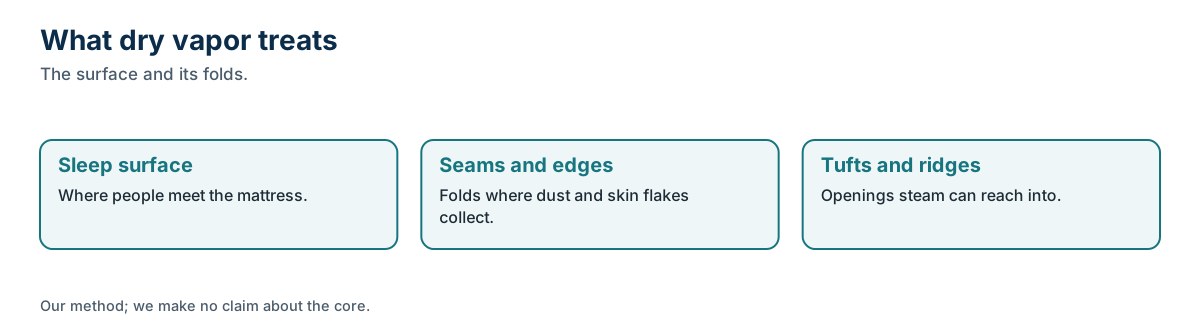
The surface is where people meet the mattress, and it's where dust and shed skin flakes collect. The cover and its quilting sit between the sleeper and the foam; the PFA's primer notes that foam's own performance depends on open cells and air flow, which a cleaning should leave alone. Seams, tufts, ridges and edges add folds and openings, and we give them focused passes because that's where dust and shed skin flakes collect. That's our own reason. Cornell's crack-and-crevice figure is bed bug guidance on lethal temperatures, cites no study and wasn't measured in mattress seams, so we don't use it to say how far our steam goes there.
What this means for claims
Because steam treats the surface, we don't claim dry vapor sanitizes the inside of a mattress. We don't claim it reaches the core, removes anything from the core, or treats an accident that has soaked down through the layers. Hub 3 covers what happens when urine reaches the saturated core. For dust mites, Hub 4's dust mite guide explains what heat at the surface does and doesn't do.
Our method, surface first
We work with what steam can do. Each visit starts with an inspection of the bed's materials to set steam temperature and pass speed. Then dry vapor goes over the sleep surface and sides, and we steam the seams, tufts, ridges and edges where dust and shed skin flakes collect, giving the folds focused passes. The machines are Italian-made Vapor Clean units: the Magnum XP, with its built-in vac, the ProV 350 and the Pro6 Duo. Organic cleaning methods are our default.
Dry vapor through the seams and tufts is our own method and reasoning, not a manufacturer exemption. Before you book, read the care label and the warranty terms on your mattress, since those govern your decision. Edge and seam work comes within the standard price. We add a custom surcharge only when contamination is severe or biohazard, and we quote it up front. Our use of "sanitize" follows the cleaning sense set out in Hub 2's entry on the CDC's cleaning and sanitizing terms; it is not a disinfection claim.
Where to read next
The moisture and heat guide sets penetration beside the moisture and foam evidence, and this hub lists every article. For the moisture side, read surface moisture vs saturation. For heat and glue lines, see can dry-vapor steam affect mattress adhesives?, and for heat limits, what temperature foam can tolerate.
What we don't know
- How far steam heat or moisture travels into any mattress layer. No study we found measured it.
- Where Cornell's penetration figures come from. The draft guidance doesn't cite a study.
- How Wang's fabric-cover result compares with a quilted mattress cover. The abstract doesn't describe the fabric.
- What temperatures our machines produce below the cover.
- Whether a mattress protector or a thick quilted top changes how far heat reaches. The Wang result covered a fabric cover, not a quilted mattress top.
Changelog
- 3 October 2026: First published. Sources accessed on this date.
Sources
- 6. Using Steam to Eliminate Bed Bugs (draft help article, accessed 2026-10-03) · Cornell IPM Help Center
- Efficacy of three different steamers for control of bed bugs (Wang et al., Pest Manag Sci, 2018) · PubMed
- Comparison of multiple steam treatment durations for control of bed bugs (Puckett, McDonald and Gold, Pest Manag Sci, 2013) · Texas A&M Urban Entomology (author copy)
- Thermal conductivity of common materials · Engineering ToolBox
- Bed Bug IPM manual, including Armed Forces Pest Management Board Technical Guide 44 (University of Florida, 2008) · University of Tennessee (hosted copy)
- What is steam? (steam engineering tutorial, dryness fraction) · Spirax Sarco
- IN-TOUCH Vol. 1 No. 1: Flexible Polyurethane Foam, a Primer (revised 2016) · Polyurethane Foam Association
- Magnum XP-Vac product page (maker's claims, accessed 2026-10-02) · Vapor Clean
- ProV 350 product page ('Italian Made'; maker's claims, accessed 2026-10-02) · Vapor Clean
- Pro6 Duo product page ('Made in Italy'; maker's claims, accessed 2026-10-02) · Vapor Clean
- Cleaning and disinfecting your school (definitions) · CDC
Last reviewed October 3, 2026. Manufacturer specifications and care instructions change; check the current version for your exact model. This page is general information, not medical advice. How we source and check pages: editorial standards.