
Short answer
It leaves some moisture at the surface, but it isn't designed to wet the mattress through. Vapor Clean says its machines produce steam with 5-6% moisture, a maker's claim. In one lab test with a different steamer, mattress-material arenas gained 0.92 to 1.44 grams at five minutes, a change the authors called negligible. Pass speed and nozzle distance still matter.
Key terms used on this page
- Vapor moisture claim:
- An equipment maker's stated water content for its steam. Vapor Clean lists 5-6% moisture for the Magnum XP, ProV 350 and Pro6 Duo. These are the maker's own claims; the pages do not describe how the figure was measured.
- Dryness fraction:
- The share of steam, by mass, that is vapor rather than water droplets. Spirax Sarco's example: steam with 5 percent water by mass is 95 percent dry, a dryness fraction of 0.95. Wetter steam carries less usable heat and more liquid.
- Weight-gain test:
- Weighing an item before and after treatment to measure how much water it took on. Puckett and colleagues weighed steam-treated mattress-material arenas at intervals from 5 minutes to 7 days and recorded average gains of 0.92 to 1.44 grams at 5 minutes.
- Steam tip distance:
- The gap between the steam nozzle and the surface. A bed bug manual reprinting an Armed Forces Pest Management Board guide puts it at about 2.5 to 3.8 cm and warns that a tip held too close may inject excess moisture.
- Surface moisture:
- Water held in the cover fabric and the top of the comfort layer, close enough to the air to evaporate quickly. It is the moisture a low-moisture method aims to leave, as opposed to water that has travelled down into the core.
"Dry vapor" sounds like a contradiction. Steam is water, and water is wet. The name refers to how little liquid the vapor carries, not to zero. So the fair answer to the question is: a dry-vapor pass leaves a little moisture at the surface, which then leaves, and it isn't designed to wet the mattress below the cover. How well that holds depends on the machine and, just as much, on how it's used.
This article is general information about cleaning and materials, not medical or engineering advice. For mold or health questions, talk to a qualified professional.
What the makers claim
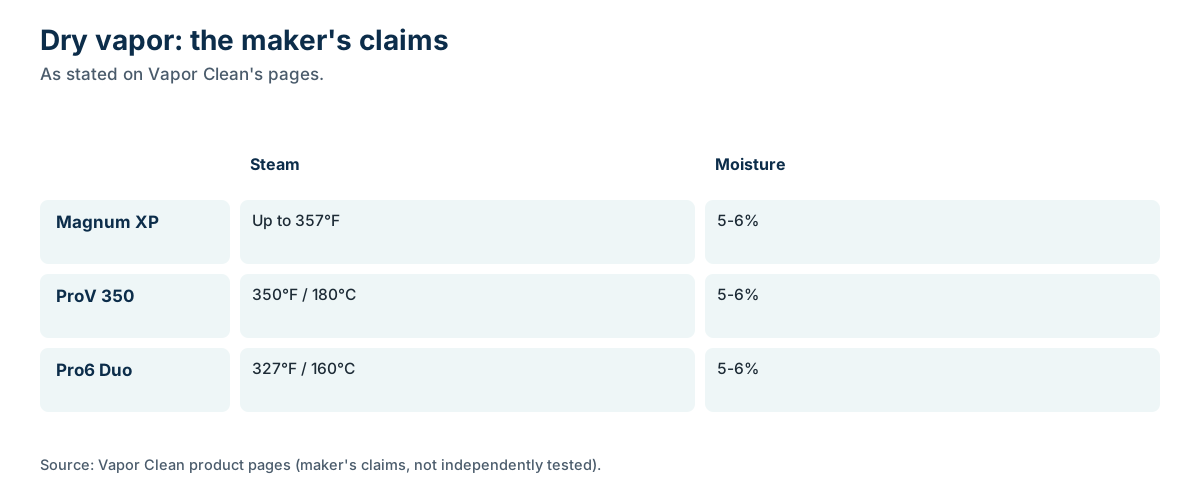
Our three machines are Italian-made Vapor Clean units, and the maker gives the same moisture figure for each. The Magnum XP page says it "Generates steam up to 357°F with just 5-6% moisture." The ProV 350 page lists "350ºF / 180ºC Superheated "Dry" Vapor yielding 5-6% moisture content." The Pro6 Duo page lists "327ºF / 160ºC Superheated "Dry" Vapor yielding 5-6% moisture content."
These are vendor claims. We haven't verified them, and the pages don't describe how they were measured.
What "dry" means to a steam engineer
Spirax Sarco, which writes engineering material on steam systems, describes wetness as a dryness fraction. Its example: if the water content of the steam "is 5% by mass, then the steam is said to be 95% dry and has a dryness fraction of 0.95." It also notes that "Wet steam will have lower usable heat energy than dry saturated steam."
That second point is why dryness matters for cleaning. Wetter steam brings more liquid and less heat. Drier steam brings more heat per unit of water. Vapor Clean's figure may correspond to a dryness fraction of about 0.95, but since the maker doesn't define it, we don't claim the conversion. Hub 1 explains steam quality and asks is dry-vapor steam actually dry?
What reaches the mattress
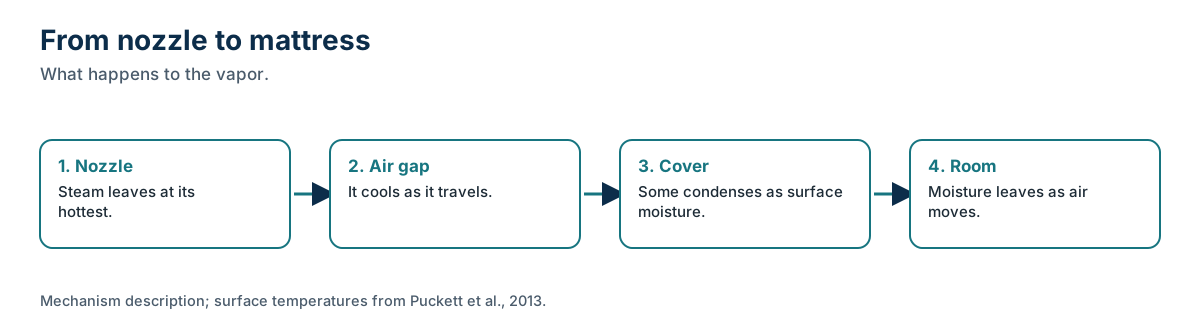
Steam leaves the nozzle hot and cools quickly in room air. Some of it condenses on the cooler fabric, which is where the surface moisture comes from. Hub 1 separates boiler temperature from surface temperature for that reason.
The one study that measured both temperature and weight on mattress material used a different machine, a J-4000DM Jiffy steamer. Puckett, McDonald and Gold recorded mean surface temperatures of 67.38 to 73.91°C immediately after treatment, and average weight gains of 0.92, 1.32 and 1.44 grams at five minutes for passes of 10, 20 and 30 seconds per 30.50 cm. Their arenas were small boxes with Sealy mattress material on a wooden base, five replicates per treatment. By seven hours, the weight difference from untreated controls was not significant.
That's the best evidence we have that a moving steam head adds little water to a mattress surface. It doesn't tell us what our machines add, and it didn't test thick foam.
The operator matters as much as the machine
Even dry steam can over-wet a surface. The Puckett data show it: slower passes added more water. A bed bug manual reprinting an Armed Forces Pest Management Board guide adds the distance variable. It says the steam emission tip "must usually be about 2.5-3.8 cm from the surface being steamed," and warns that if the tip is too close, "excess moisture may be injected into the treated material".
Cornell IPM's draft steam guidance for bed bugs makes the same point from the other direction: "Dry steam (low moisture) is preferable but such outputs are only available with commercial steam machines designed for deep cleaning." It also says to "Allow the treated area to dry," and, for mattresses, to consider an encasement "only after it has dried to avoid the development of mold."
What's left behind, and for how long
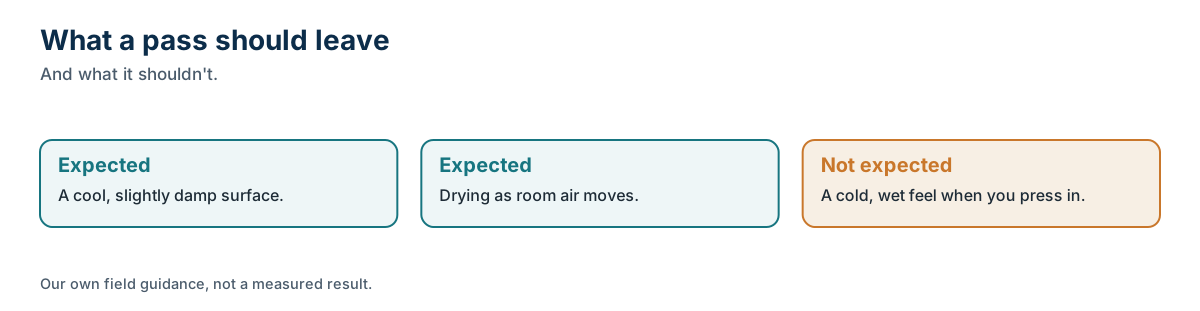
After a dry-vapor pass, the cover may feel cool and slightly damp. That's surface moisture, the kind described in surface moisture vs saturation. It should leave as the room's air moves over it. What shouldn't happen is a cold, wet feel when you press in, which would suggest water below the cover.
We don't publish a drying time in hours, because no source we found measured one after dry-vapor cleaning of a mattress. EPA's guide to mold advises drying water-damaged areas and items "within 24-48 hours to prevent mold growth"; that's EPA's guidance for leaks and floods, not a cleaning benchmark. How quickly should a treated mattress dry? gives our field guidance.
Why we use low moisture at all
Liquid water is the stress mattress makers warn about directly, and it's the one that lingers in foam. If cleaning can reach the surface with heat while adding little water, that trade-off favors the mattress. That's our reasoning. It isn't a measured result for your bed, and it isn't a substitute for the care instructions that came with it.
Vapor and liquid are different kinds of wet
Methods that put liquid water or detergent solution onto a mattress start with the water already in liquid form at the fabric. It can run straight into the open cells below, and anything not extracted stays there. Dry vapor arrives as a gas. Some of it condenses on the cooler cover as a thin film, and the rest dissipates into the room. Both leave water behind, but in different amounts and at different depths, which is why Hub 1 treats dry-vapor steam and carpet extraction as different methods rather than stronger and weaker versions of one. We haven't found a study that weighed mattresses after each method, so this is a description of the mechanism, not a measured comparison.
What a visit involves
On a visit, we start with the mattress's materials. The inspection decides steam temperature and pass speed, and on a memory foam bed that means quicker passes than on a coil bed with a thin comfort layer. Dry vapor covers the sleep surface, then the seams, tufts, ridges and edges where dust and shed skin flakes collect. We bring the Magnum XP, which has a built-in vac, along with the ProV 350 and the Pro6 Duo. Organic cleaning methods are our default.
Low-moisture dry vapor is Sleep Sanitation's own method and reasoning, not a manufacturer exemption. If your mattress has a care label or warranty that says otherwise, those terms govern your decision, so check the warranty before you book. A pass adjusted for your bed costs nothing beyond the standard price; only severe or biohazard contamination brings a custom surcharge, which we quote before starting. On terminology, Hub 2 explains the CDC's cleaning and sanitizing terms, and we make no disinfection claim.
Where to read next
The moisture and heat guide sets dry vapor beside the foam and adhesive evidence, and this hub lists every article. For the moisture question in general, read how wet should a mattress get?. Hub 1 covers how much moisture dry-vapor steam uses.
What we don't know
- How Vapor Clean measures the 5-6% moisture figure, and whether it holds at the nozzle tip.
- How much water our machines add to a mattress. We haven't weighed beds before and after our visits.
- Whether the Puckett result, from a Jiffy steamer on thin mattress material, carries over to thick foam or latex.
- How long surface moisture from dry vapor takes to leave a mattress in an ordinary bedroom.
- How much a quilted cover or pillow top changes the amount of water held after a pass. Thicker fiber holds more near the surface, but we found no measurement of how much.
Changelog
- 3 October 2026: First published. Sources accessed on this date.
Sources
- Magnum XP-Vac product page (maker's claims, accessed 2026-10-02) · Vapor Clean
- ProV 350 product page ('Italian Made'; maker's claims, accessed 2026-10-02) · Vapor Clean
- Pro6 Duo product page ('Made in Italy'; maker's claims, accessed 2026-10-02) · Vapor Clean
- What is steam? (steam engineering tutorial, dryness fraction) · Spirax Sarco
- Comparison of multiple steam treatment durations for control of bed bugs (Puckett, McDonald and Gold, Pest Manag Sci, 2013) · Texas A&M Urban Entomology (author copy)
- 6. Using Steam to Eliminate Bed Bugs (draft help article, accessed 2026-10-03) · Cornell IPM Help Center
- Bed Bug IPM manual, including Armed Forces Pest Management Board Technical Guide 44 (University of Florida, 2008) · University of Tennessee (hosted copy)
- A brief guide to mold, moisture and your home · US EPA
- Cleaning and disinfecting your school (definitions) · CDC
Last reviewed October 3, 2026. Manufacturer specifications and care instructions change; check the current version for your exact model. This page is general information, not medical advice. How we source and check pages: editorial standards.