
Short answer
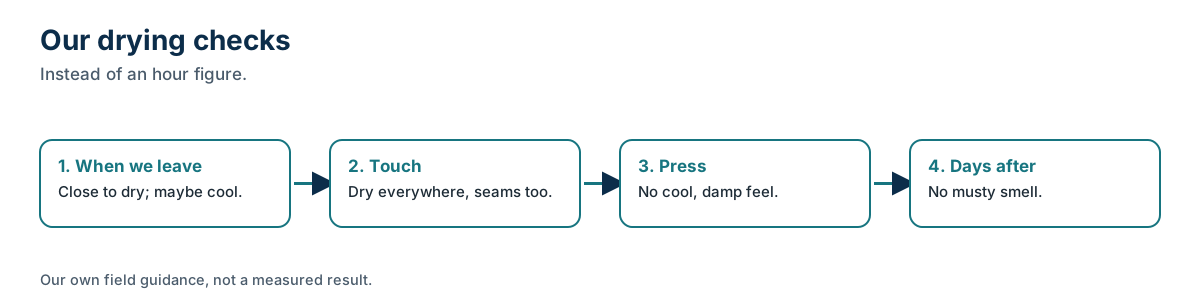
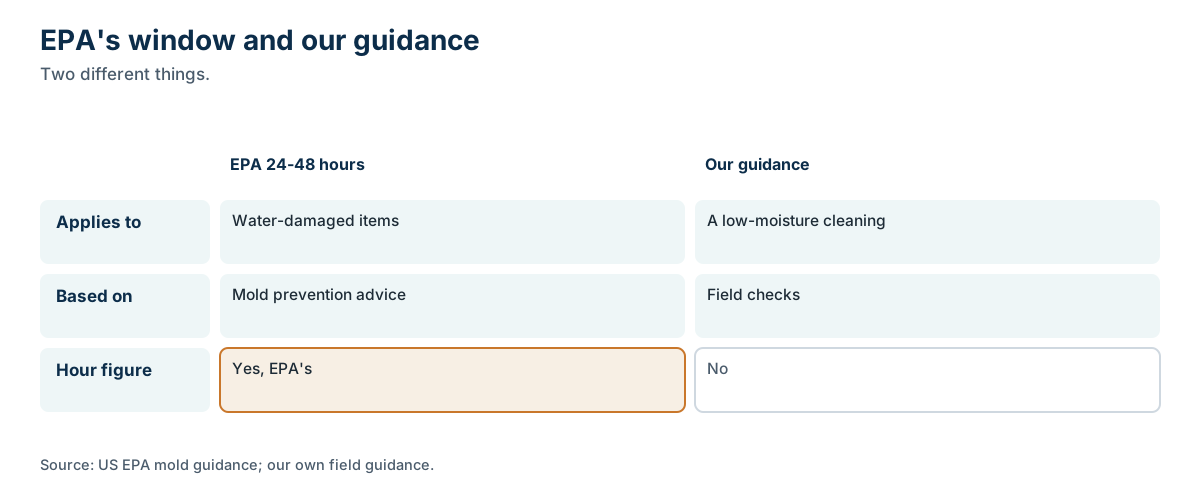
We don't give an hour figure, because no source we found measured drying time after dry-vapor cleaning of a mattress. Our field guidance: the surface should feel close to dry when we leave and be dry to the touch before you make the bed, with no cool, damp feel when you press in. EPA's 24-48 hour advice is for water-damaged materials.
Key terms used on this page
- Surface moisture:
- Water held in the cover fabric and the top of the comfort layer, close enough to the air to evaporate quickly. It is the moisture a low-moisture method aims to leave, as opposed to water that has travelled down into the core.
- Water-damage drying guidance:
- EPA's advice for materials soaked by leaks and floods. EPA says to dry water-damaged areas and items within 24-48 hours to prevent mold growth, and its Table 1 says upholstered furniture may be difficult to completely dry within 48 hours.
- Mattress saturation:
- Water filling the open cells of a foam or fiber layer below the cover, rather than sitting at the surface. Casper's care page warns that the foam in the mattress core will soak up water and detergent; saturation is that outcome.
- Weight-gain test:
- Weighing an item before and after treatment to measure how much water it took on. Puckett and colleagues weighed steam-treated mattress-material arenas at intervals from 5 minutes to 7 days and recorded average gains of 0.92 to 1.44 grams at 5 minutes.
- Thermal conductivity:
- How readily a material passes heat. Engineering ToolBox lists polyurethane foam at 0.03 W/(m K) and liquid water at 0.606 W/(m K). Foam is an insulator, which is one reason surface heat does not travel far into a thick foam layer.
A number would be convenient here, and we understand why people want one. The practical form of the question is simple: when can I put the sheets back on? But a number would have to come from somewhere, and we haven't found a source that measured how long a mattress takes to dry after dry-vapor cleaning. So, like Hub 3, we give field guidance and checks instead of hours. This article explains why, what EPA's well-known 24-48 hours covers, and how to tell when your bed is ready.
This article is general information about cleaning and materials, not medical or engineering advice. For mold or health questions, talk to a qualified professional.
Why there's no hour figure
Drying time depends on how much water went in, how deep it went, the cover and foam, the room's temperature and humidity, and how much air moves over the bed. Change any one and the time changes. No study we found held those constant on mattresses after dry vapor.
The closest data are from Puckett, McDonald and Gold, who weighed small arenas of Sealy mattress material on a wooden base after steaming with a J-4000DM Jiffy steamer, five replicates per treatment. Average gains were 0.92 to 1.44 grams at five minutes, and by seven hours the difference from untreated controls was not significant. That's a useful sign that little water went in. It isn't a drying time for a mattress, because the material was thin, the machine wasn't ours and the weighings were spaced out.
What EPA's 24-48 hours covers
EPA's guide to mold says: "It is important to dry water-damaged areas and items within 24-48 hours to prevent mold growth." In its prevention tips: "If wet or damp materials or areas are dried 24-48 hours after a leak or spill happens, in most cases mold will not grow." Its water-damage table "presents strategies to respond to water damage within 24-48 hours," and for upholstered furniture says it "May be difficult to completely dry within 48 hours."
That's EPA's guidance for water damage: leaks, floods and spills. It isn't a test on cleaned mattresses, and we don't present it as our drying time. It does tell you how seriously to take a mattress that was soaked by an accident. Hub 3 calls this the mold drying window.
Our field guidance
Here is what we tell people, and why.
When we leave, the surface should feel close to dry. It may be slightly cool, because a little moisture is leaving the cover, but it shouldn't feel wet.
Before you make the bed, the surface should be dry to the touch everywhere, including seams and edges. Hub 1 defines dry to the touch.
The press test: push a flat palm firmly into the mattress for several seconds. If a cool, damp feel comes up from below, give it longer.
Over the next few days, the mattress shouldn't develop a musty smell. If it does, water may have gone deeper than intended.
Casper's care page, for spot cleaning its own beds, gives the same order of operations: "If you need to clean your Casper mattress or cover, we suggest spot-cleaning affected areas with water and mild detergent. Be careful not to saturate the mattress with too much water and/or detergent, as the foam in the mattress core will soak up water and detergent. Allow the treated area to air dry completely before putting your sheets and bedding back on."
Helping it along
Drying needs air movement and a dry room. Some practical steps:
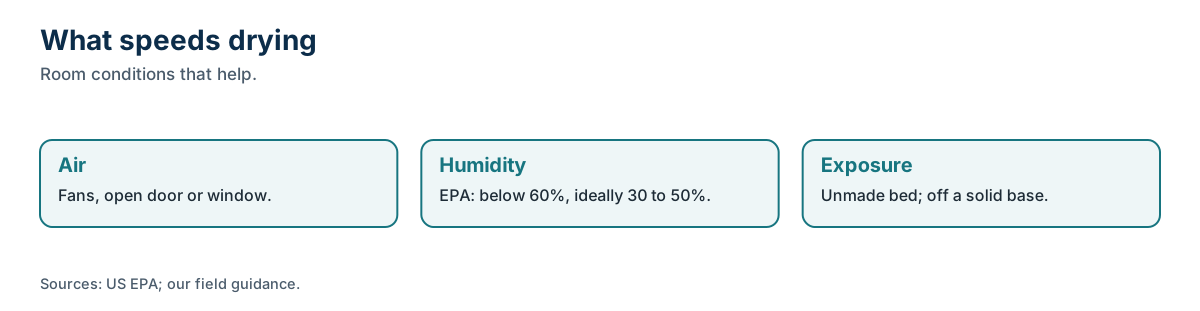
- Leave the bed unmade, with any protector off.
- Open a door or window, or run a fan across the surface. EPA's water-damage table, for soaked upholstered furniture, recommends that you "Accelerate drying process with dehumidifiers, fans, and/or heaters." A cleaned mattress isn't flood damage, but the same air movement helps.
- Keep the room's humidity down. EPA advises: "If possible, keep indoor humidity below 60 percent (ideally between 30 and 50 percent) relative humidity."
- Don't seal the mattress in an encasement until it's dry. Cornell IPM's draft steam guidance says, for steamed mattresses, to consider an encasement "only after it has dried to avoid the development of mold."
Why a soaked bed is different
If a mattress was soaked before we arrived, by an accident or a spill, our visit doesn't change how long that water takes to leave. Foam insulates; Engineering ToolBox lists polyurethane foam's thermal conductivity at 0.03 W/(m K), and water deep in it dries slowly. Why foam mattresses are slow to dry explains this, and Hub 3's urine and odor guide covers accidents.
Why the season and the room matter
The same visit can dry at different speeds in different homes. A warm, dry room with moving air takes moisture off a cover quickly. A cool, humid room with the door shut does it slowly, because the air is already close to holding all the water it can. Hub 4 defines relative humidity, the measure behind that. A bed against a wall, or on a solid platform, has less air reaching it than one in open space on a slatted base. None of these changes how much water went in. They change how fast it leaves, which is one more reason a single hour figure would mislead. Our guidance is built on checks rather than a clock for exactly this reason.
When to call
If the surface still feels damp well after we've left, if the press test keeps bringing up a cool, wet feel, or if a musty smell appears, keep the bed unmade, add airflow and call us. Those signs suggest water went deeper than a low-moisture visit should put it. How to tell if moisture reached the core has more checks, and can mattress moisture lead to mold? explains why it matters.
How we keep drying short
The main thing we do for drying happens before any steam goes on: a materials inspection that sets steam temperature and pass speed so water stays at the cover. Dry vapor then covers the surface and the seams, tufts, ridges and edges where dust and shed skin flakes collect. We use Italian-made Vapor Clean machines, the Magnum XP with its built-in vac, the ProV 350 and the Pro6 Duo. Organic cleaning methods are our default.
That's our own method and reasoning, not a manufacturer exemption, and your care label and warranty terms govern your decision; please check your warranty before booking. Drying guidance is part of the standard price, and severe or biohazard contamination is quoted as a custom surcharge before we start. Hub 2 explains the CDC's cleaning and sanitizing terms, the sense in which we say "sanitize."
Where to read next
The moisture and heat guide brings drying together with the water and heat evidence, and this hub lists every article. For what dry vapor leaves behind, read does dry-vapor steam leave a mattress wet?. Hub 1's how long should a mattress take to dry after cleaning? covers other methods.
What we don't know
- How long a mattress takes to dry after dry-vapor cleaning in an ordinary bedroom. We found no measurement, and we haven't published our own.
- How much fans, open windows or dehumidifiers shorten drying for a mattress. EPA recommends them for furniture without giving times.
- Whether drying differs meaningfully between foam, latex and hybrid beds after low-moisture cleaning.
- How much a mattress protector put back on too early slows drying. It blocks air at the surface, which is why we suggest leaving it off until the bed is dry.
Changelog
- 3 October 2026: First published. Sources accessed on this date.
Sources
- A brief guide to mold, moisture and your home · US EPA
- Mold Remediation in Schools and Commercial Buildings, Table 1: Water Damage, Cleanup and Mold Prevention · US EPA
- Comparison of multiple steam treatment durations for control of bed bugs (Puckett, McDonald and Gold, Pest Manag Sci, 2013) · Texas A&M Urban Entomology (author copy)
- 6. Using Steam to Eliminate Bed Bugs (draft help article, accessed 2026-10-03) · Cornell IPM Help Center
- How to clean your mattress: a mattress care guide (accessed 2026-10-02) · Casper
- Thermal conductivity of common materials · Engineering ToolBox
- Bed Bug IPM manual, including Armed Forces Pest Management Board Technical Guide 44 (University of Florida, 2008) · University of Tennessee (hosted copy)
- Magnum XP-Vac product page (maker's claims, accessed 2026-10-02) · Vapor Clean
- ProV 350 product page ('Italian Made'; maker's claims, accessed 2026-10-02) · Vapor Clean
- Pro6 Duo product page ('Made in Italy'; maker's claims, accessed 2026-10-02) · Vapor Clean
- Cleaning and disinfecting your school (definitions) · CDC
Last reviewed October 3, 2026. Manufacturer specifications and care instructions change; check the current version for your exact model. This page is general information, not medical advice. How we source and check pages: editorial standards.