
Short answer
None of the seven manufacturer care pages we checked gives pillow-top or Euro-top mattresses their own cleaning rule, and none mentions dry-vapor steam. A pillow-top is padding sewn on top, usually fiber, foam or both, so the cautions for those materials apply to it. Follow your label as the safe default; our method is our own, not a manufacturer exemption, so check your warranty terms.
Key terms used on this page
- Pillow-top and Euro-top:
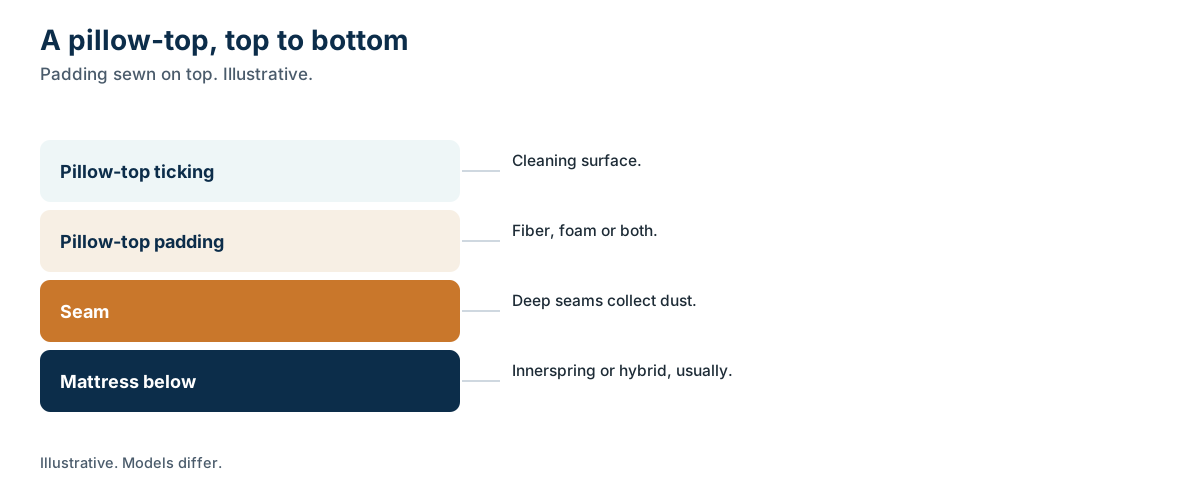
- An extra padded layer sewn onto the top of a mattress. On a pillow-top it is stitched on as a separate pillow-like layer; on a Euro-top it is sewn flush with the sides. The padding is usually fiber, foam or both, and it sits directly under the cleaning surface.
- Mattress layers (ticking, comfort layers, support core):
- Ticking is the outer fabric cover. Comfort layers are the foams, latex, fiber or wool directly under it. The support core is the coil unit or base foam underneath. Most mattresses also include a fire barrier between the ticking and the comfort layers.
- Memory foam (viscoelastic foam):
- An open-cell, slow-recovery polyurethane foam that softens with body heat and conforms to pressure. Because its cells are open, liquid can travel into it, and because it is dense and insulating, it is slow to dry.
- Moisture load:
- The total amount of water a cleaning process puts into a mattress, whether from spray, steam condensate, shampoo or rinse. It is the main thing that decides how long a mattress takes to dry.
- Pass speed:
- How fast the steam tool moves across the fabric. A faster pass gives the fabric less time under the tool, so less heat and less condensed water reach any one spot. Purple's general guide makes the same point for home steamers: move 'without leaving it in one spot for too long.'
- Care instructions (manufacturer care guidance):
- What a manufacturer publishes about cleaning its product: a sewn-in label, a care web page, a help-center article or a brand blog post. They carry different weight. A sewn-in label or a product-care page speaks for a specific product; a blog post often gives general advice about many mattress types. On this hub we name the document type for every quote.
A pillow-top is an extra padded layer sewn onto the top of a mattress. A Euro-top is the same idea, sewn flush with the sides. Pillow-tops are common on innerspring and hybrid mattresses. They are also where manufacturer guidance runs out: none of the seven care pages in this hub gives them a cleaning rule. This page says so plainly, explains what applies by inference, and labels the inference as ours.
Not affiliated with or endorsed by any manufacturer listed. Brand names are used only to identify products and their published care instructions.
What manufacturers say about pillow-tops
No OEM cleaning guidance found. We searched the text of all seven care pages (Tempur-Pedic US, Tempur UK, Saatva, Purple, Avocado, Casper and Sleep Number, accessed 2 October 2026) for pillow-top and Euro-top. Two mention them, but not for cleaning. Saatva's post says "If your mattress has a pillow top, for example, you won't be able to flip it," and describes the Saatva Classic's "cushiony Euro pillow top." Purple's guide promotes a "Quilted Euro Top" in one of its collections. Neither gives a cleaning rule for the top layer, and none of the seven mentions dry-vapor steam.
That doesn't mean there is no rule for your mattress. Your sewn-in label may have one. It means the web guidance we can quote doesn't single pillow-tops out.
What applies by inference
This section is our reasoning, not a manufacturer's statement.
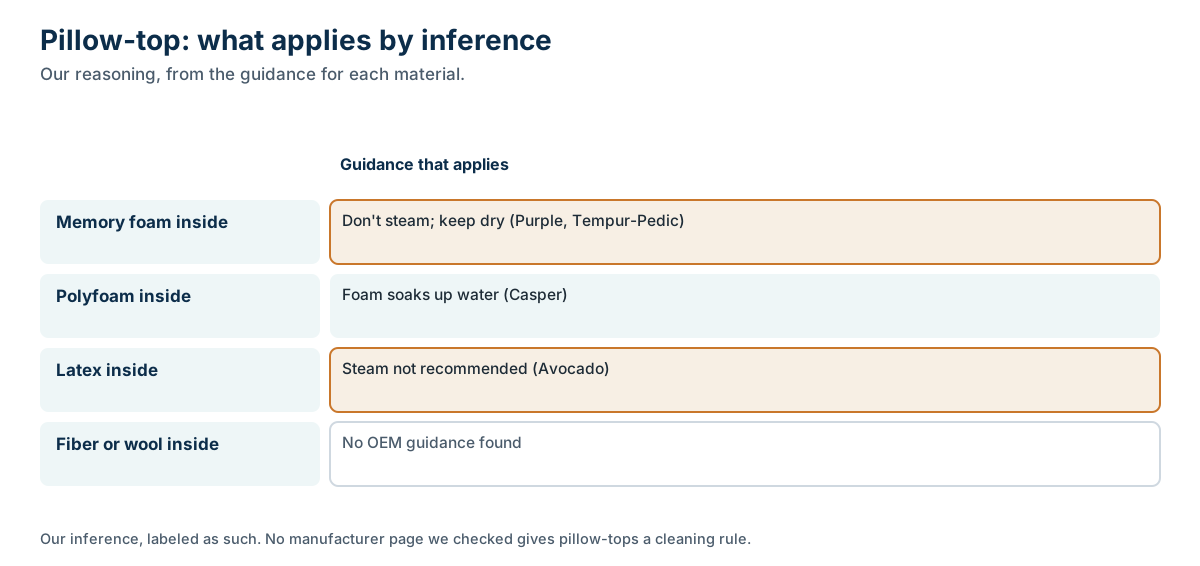
A pillow-top is made of materials the manufacturers do discuss. So the cautions for those materials carry over:
| If the pillow-top contains | Guidance that applies | Source |
|---|---|---|
| Memory foam | Don't steam; "should never become wet" (TEMPUR); avoid bleach | Purple, Tempur-Pedic, Saatva |
| Polyfoam | Foam "will soak up water and detergent" | Casper |
| Latex | "Steam cleaners are not recommended" | Avocado |
| Fiber or wool | No OEM guidance found | None found |
And the cautions about the whole mattress still apply: don't remove the cover (Casper, Sleep Number, Purple), and use "only a little water" (Sleep Number).
Why the top layer matters most
The pillow-top is the first padding under the ticking. Any water a cleaning method leaves behind reaches it before anything else, and padded fiber and foam both hold water. It is also thick, so it can take longer to dry than a thin quilted top. Hub 1 explains the moisture load idea in why moisture matters and how long a mattress should take to dry.
Pillow-tops also have deep seams where the top joins the mattress. Those seams collect dust and are hard to reach, which is why vacuuming them thoroughly matters. Purple's guide says to "Go over the seams and corners several times to vacuum everything up."
Sleep Sanitation's approach to pillow-tops
This section is our view, not any manufacturer's.
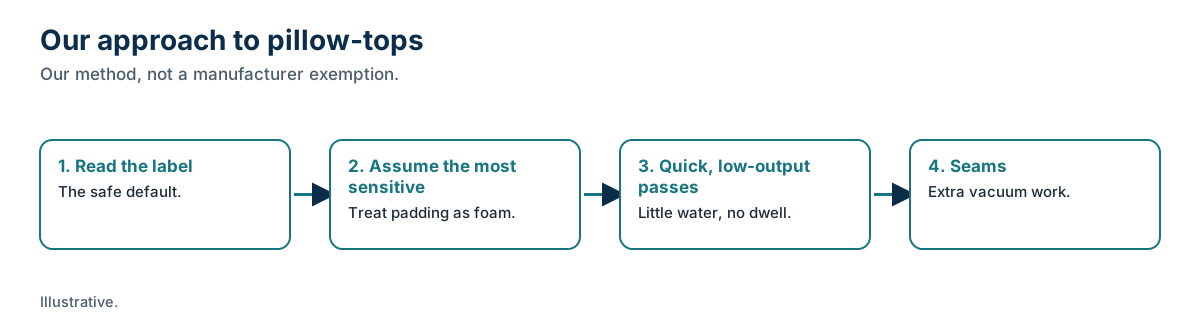
Your label is the safe default. Our position is that we can sanitize any mattress or topper, pillow-tops included. We use Vapor Clean dry-vapor equipment (we run the Magnum XP, ProV 350 and Pro6 Duo and match the machine to the job). Because the pillow-top is padding close to the surface, our technician treats it like the most sensitive material it might contain: low steam output, a quick pass speed, and extra vacuum work along the seams. We don't soak, extract or unpick anything.
That is our method and reasoning, not an exemption from any manufacturer. Check your warranty terms before booking and contact the manufacturer if you're unsure. This is not legal advice.
Caring for a pillow-top between cleanings
Without a pillow-top-specific rule, the general routines are the best guide, with extra attention to the parts that make a pillow-top different.
- Seams. The join between the pillow-top and the mattress is a deep crease. Purple's advice to "Go over the seams and corners several times" matters more here than on a flat top.
- Flipping. Saatva notes that "If your mattress has a pillow top, for example, you won't be able to flip it," so the top surface takes all the wear and all the cleaning.
- Protection. Purple and Saatva both recommend protectors, and a pillow-top's padding is where a spill would collect.
- Spills. Use as little liquid as possible. Sleep Number's "just enough to lightly dampen the spot" is a good rule for any padded layer.
Questions to ask a provider about pillow-tops
- What's in the pillow-top? Fiber, foam, latex and wool call for different care.
- How do you handle the seams? Look for a vacuum step that targets them.
- How much water will be left in the padding? A thick top dries slowly; an extractor leaves far more water than dry vapor.
- Do you treat the pillow-top as the most sensitive layer? It should be.
Common misreadings
"No rule means no risk." It means no published rule. The padding still holds water and heat.
"It's an innerspring, so steam is fine." Purple's general innerspring guidance doesn't mention pillow-tops, and the padding on top is what the steam reaches.
"The pillow-top can be removed and washed." It is usually sewn on, and several brands say not to remove covers at all.
Euro-top vs pillow-top for cleaning
A Euro-top is sewn flush with the sides; a pillow-top looks like a separate layer with a visible gusset. For cleaning, the difference is mostly the seam: a pillow-top's gusset creates a deeper crease that collects more dust. The padding inside is similar in both, and so is our approach.
A worked example: a pillow-top hotel-style mattress
Suppose you have a plush pillow-top innerspring, the kind sold as hotel-style, and the top has a visible sweat outline and dust in the seams. Here is how we'd reason through it.
First, the label. Look for the fill materials. Pillow-tops commonly combine fiber with polyfoam or memory foam.
Second, the published guidance. No page gives pillow-tops a rule, so we borrow the guidance for what is inside. If memory foam is listed, Purple's "you should not steam clean a memory foam, latex, or adjustable mattress since the heat and water could damage its materials" is the closest statement. If it is fiber only, there is no OEM guidance found.
Third, the seams. Dust collects in the gusset. A thorough vacuum pass along the seams, as Purple's guide suggests for seams and corners, does more there than anything else.
Fourth, drying. A thick pillow-top takes longer to dry than a flat quilted top, so less water is better.
Fifth, the warranty. Read it before booking.
If you book us, we'd treat the pillow-top as the most sensitive layer: low output, quick passes, extra seam work, nothing soaked. That's our method, not a manufacturer's ruling.
Why a gap in the guidance isn't a green light
When a manufacturer doesn't mention a material, it is tempting to read that as permission. It isn't. The pages we quote were written for whole mattresses, and most of them assume the owner will only vacuum and spot clean. A pillow-top is just one more layer that assumption covers. Silence about pillow-tops means the brands haven't addressed them, not that they've considered them and decided anything goes.
Where this fits
See innerspring and hybrid mattresses, which often carry pillow-tops, and wool layers. The compatibility guide and hub overview have the full picture. For costs, see pricing.
Related guidance and background
How other manufacturers word the same issue, for comparison:
- Saatva. "If you have a garment steam cleaner, go over your mattress with that before vacuuming" (Saatva).
- Tempur-Pedic (US). "TEMPUR® material should never become wet" (Tempur-Pedic).
- Avocado. "Steam cleaners are not recommended because their excessive heat can over-bake the organic latex" (Avocado).
Public guidance and reference sources behind this page:
- Clean, sanitize, disinfect. The CDC defines the three words differently: cleaning removes dirt and germs, sanitizing lowers germs to a safer level, and disinfecting kills germs, usually with a registered chemical used as labeled. We use "sanitize" in that sense and make no disinfection claim.
- Drying. The EPA's mold and moisture guide advises drying wet materials within 24 to 48 hours, and says that in most cases mold won't grow if you do. That is the public-health reason behind every manufacturer's drying instruction.
What we don't know
- Any OEM cleaning rule for pillow-tops. None found on the pages we checked.
- What is inside your pillow-top. Labels list materials; we can't see inside.
- Drying times for thick tops. Not published by any source we found.
- Warranty treatment. Only the manufacturer can decide.
Changelog
- 2 October 2026: First published. Seven manufacturer care pages searched on this date.
Sources
- How to clean your mattress: a mattress care guide (accessed 2026-10-02) · Casper
- Cleaning Your Mattress (support, accessed 2026-10-02) · Sleep Number
- How To Clean a Mattress in 9 Steps (last updated 16 Oct 2025, accessed 2026-10-02) · Purple
- Magnum XP-Vac product page (maker's claims, accessed 2026-10-02) · Vapor Clean
- How to Clean Your Mattress in 5 Simple Steps (blog, accessed 2026-10-02) · Saatva
- Product care (US, accessed 2026-10-02) · Tempur-Pedic
- How to Clean Your Natural Mattress Without Using Harsh Chemicals (25 June 2026, accessed 2026-10-02) · Avocado
- Cleaning and disinfecting your school (definitions) · CDC
- A brief guide to mold, moisture and your home · US EPA
Last reviewed October 2, 2026. Manufacturer specifications and care instructions change; check the current version for your exact model. This page is general information, not medical advice. How we source and check pages: editorial standards.